
ⓘ Educational Disclosure:
This article is for educational and informational purposes only. It does not constitute financial, legal, tax, or lending advice. SaveXpert and its authors are not licensed financial advisors. Tax laws, contribution limits, and financial data change frequently. Always consult a qualified financial or tax professional before making any financial decisions.
The four highest-value uses of a 2026 tax refund — ranked by the research evidence — are: (1) building or completing an emergency cash reserve, (2) paying down high-interest revolving debt (the Federal Reserve reports an average credit card APR of 22.15% on interest-assessed accounts as of Q2 2026), (3) contributing to a tax-advantaged retirement account such as a Roth IRA (2026 limit: $7,500, per the IRS), and (4) holding liquidity in a high-yield savings account for near-term goals. The right sequence depends on individual emergency reserves, debt APRs, and available contribution room.
What This Research Found
- A tax refund is not free money. It is a return of wages that were already withheld and overpaid to the IRS — the money was always yours.
- 2026 IRS standard deductions: $16,100 (Single), $32,200 (Married Filing Jointly), $24,150 (Head of Household). Knowing your deduction can help calibrate withholding so less money sits with the IRS next year.
- Federal Reserve Q2 2026 data: average credit card APR on interest-assessed accounts is 22.15%. At that rate, paying down a $1,000 balance avoids ~$221.50 in annualized interest — a predictable, guaranteed return no savings account matches.
- Emergency fund first — the CFPB framework establishes that consumers with no cash reserve should build one before applying extra funds to other goals, because an empty buffer forces new high-interest debt when unexpected expenses arise.
- 2026 IRA contribution limit: $7,500 ($8,600 with age-50 catch-up). 401(k) limit: $24,500 ($35,750 for ages 60–63 under SECURE 2.0).
- Tax-advantaged accounts come before taxable brokerage accounts once immediate obligations and emergency reserves are handled — the tax-deferred or tax-free compounding creates a structural advantage over time.
- Time To Read: 8 Minutes
Table of Contents
1. 2026 IRS Standard Deductions: Know Your Baseline
2. Pay Off Debt or Save? What the Data Shows
3. The Emergency Fund Decision Comes First
4. Where to Put a Refund After Immediate Needs Are Met
5. 2026 Retirement Account Contribution Limits (IRS)
A tax refund feels like a windfall. It hits the account, and suddenly there are options. But before doing anything with that money, there’s one thing worth anchoring: this was always your money. The government withheld it, held it for a year, and is handing it back.
That reframe matters practically. A refund isn’t a bonus — it’s a financial tool. And how it gets directed can make a meaningful difference in where someone stands 12 months from now.
I went through IRS guidance on 2026 deductions and contribution limits, Federal Reserve Q2 2026 consumer credit data, CFPB research on emergency savings, and IRS Publication 590-A on IRA eligibility. Here’s what the numbers actually say about the smartest ways to use a 2026 tax refund.
2026 IRS Standard Deductions: Know Your Baseline
One thing that trips people up every year: a refund received in 2026 typically reflects Tax Year 2025 income — not 2026. But the 2026 standard deductions are worth knowing now because they affect the return you’ll file in 2027, and they inform decisions about withholding adjustments for the current year.
The IRS has set the following standard deduction amounts for Tax Year 2026:
2026 IRS Standard Deduction Amounts by Filing Status
| Filing Status | Standard Deduction |
|---|---|
| Single | $16,100 |
| Married Filing Jointly | $32,200 |
| Head of Household | $24,150 |
| Married Filing Separately | $16,100 |
The 2026 Enhanced Senior Deduction
For Tax Years 2025 through 2028, eligible individuals age 65 or older may claim a separate enhanced senior deduction of up to $6,000 per person. For a married couple filing jointly where both spouses qualify, that represents a combined potential deduction of $12,000. This deduction phases out above a modified adjusted gross income of $75,000 for single filers and $150,000 for couples filing jointly.
📌 Why Standard Deductions Matter for Refund Decisions:
Understanding whether itemized deductions exceed the standard deduction can change withholding decisions for the current year. A large recurring refund may indicate that too much is being withheld — money that could be working in a high-yield savings account or debt paydown throughout the year rather than sitting with the IRS. The IRS Tax Withholding Estimator at irs.gov/individuals/tax-withholding-estimator provides a free tool for recalibrating.
💸 Quick Debt Payoff Check
Find out exactly how long it takes to become debt-free.
Time to Payoff
Total Interest
Total Paid
Pay Off Debt or Save? What the Data Shows
This is the question that matters most when a large refund arrives. And the math is more direct than most people expect.
📈 Federal Reserve Q2 2026 Consumer Credit Data
Average APR on credit card accounts assessed interest: 22.15%
Average APR across all credit card accounts: 20.94%
FDIC national average savings rate (July 2026): 0.38%
At a 22.15% APR, paying down a $1,000 credit card balance avoids approximately $221.50 in annualized interest. That’s a predictable, guaranteed reduction in future cost.
By contrast, $1,000 sitting in a standard savings account at the FDIC national average of 0.38% generates roughly $3.80 in interest over a year. The math clearly favors debt paydown from a pure interest perspective. But cash isn’t only about return — it’s about access. Savings provide liquidity when something unexpected happens, and that distinction makes this a real decision rather than an obvious one.
The right answer depends on three variables: the actual APR on existing debt, the current size of the emergency cash reserve, and what an unexpected $500 or $1,000 expense would force a person to do if they had no savings buffer. Those three variables, not a generic rule, determine the optimal split.
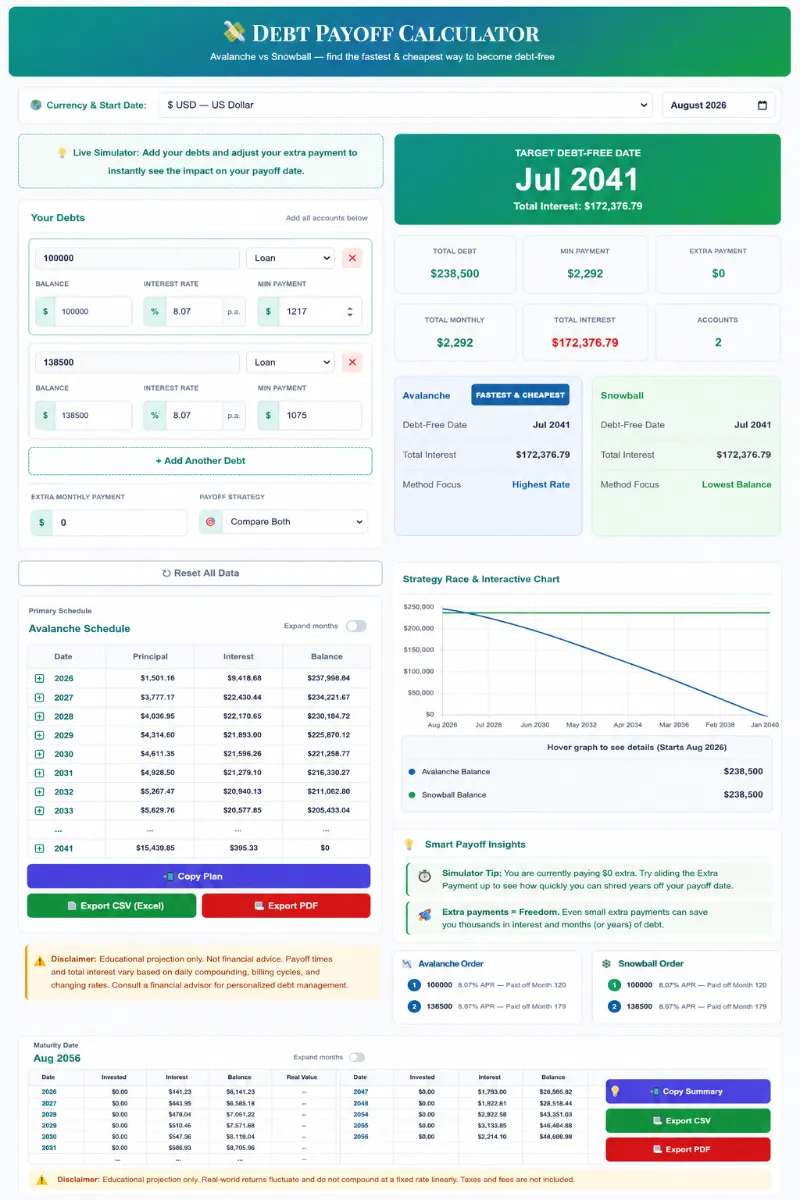
📈 Try the SaveXpert Debt Payoff Calculator
The SaveXpert Debt Payoff Calculator lets you enter your actual balance, current APR, minimum payment, and a one-time refund amount to see how applying a lump sum shifts the payoff date and total interest cost. The result reflects your specific numbers — not a national average
Educational note: Calculator results are estimates for educational purposes only.
💰 Quick Emergency Fund Check
Calculate your safety net target and see how close you are.
Target Goal
Saved So Far
Remaining Gap
The Emergency Fund Decision Comes First
The CFPB defines emergency savings as a cash reserve that covers unexpected expenses — car repairs, medical bills, a gap in income, an appliance failure. What the research consistently shows is that even a modest buffer significantly changes financial stability outcomes. An empty emergency fund doesn’t just leave someone exposed; it turns every unexpected expense into an invitation for new high-interest debt.
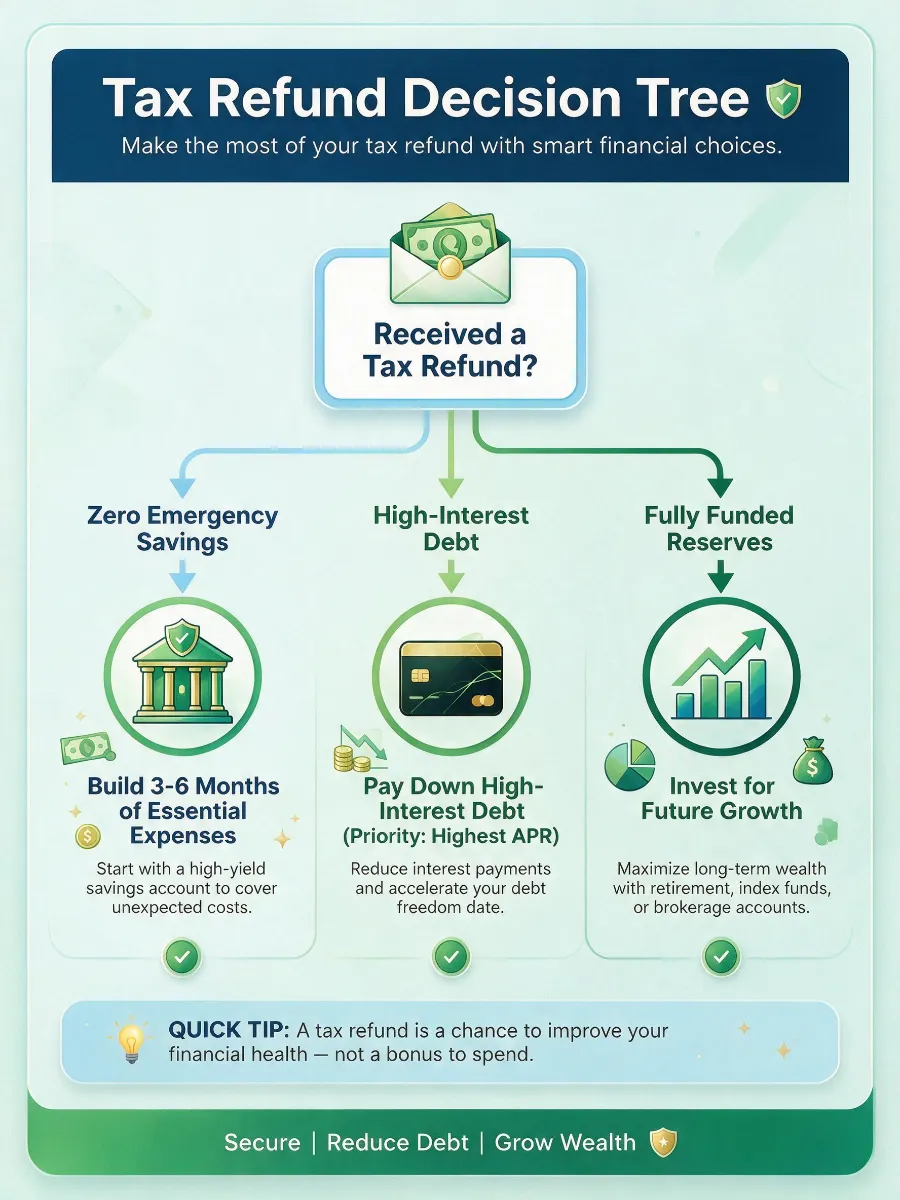
The staged framework the evidence supports:
1. No emergency savings at all.
The full refund going toward a starter cash reserve is a defensible starting point. The goal here isn’t yield — it’s preventing the next financial emergency from becoming expensive new revolving debt. A high-yield savings account accomplishes that with more interest than a standard account while keeping the money accessible.
2. Emergency fund partially funded.
A split allocation addresses two vulnerabilities at once without ignoring either. A $3,000 refund might reasonably be divided: $1,500 toward completing the cash buffer, $1,500 toward the highest-APR debt balance. Neither goal is abandoned; both move forward.
3. Emergency fund fully funded.
Once at least three to six months of essential expenses are covered in accessible savings, the research points toward directing remaining refund dollars toward debt paydown or tax-advantaged retirement contributions — whichever the individual’s debt load and contribution eligibility make most relevant.
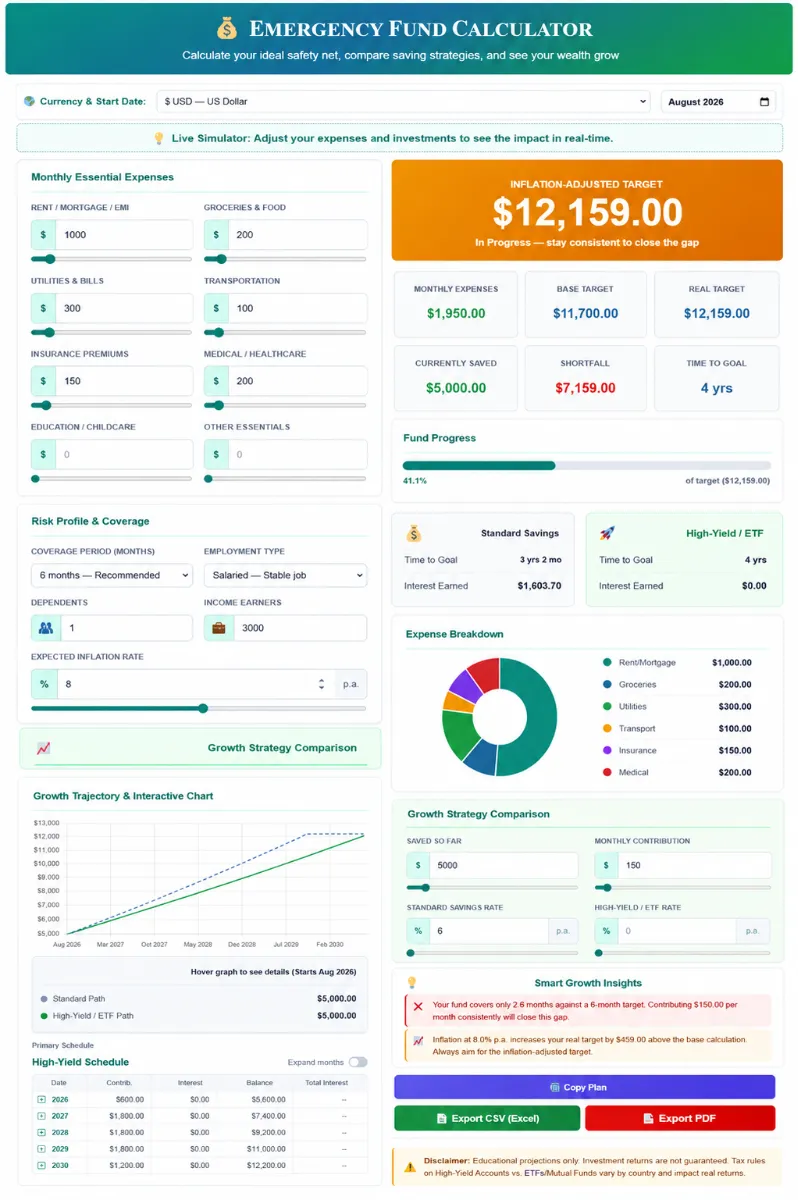
💰 Try the SaveXpert Emergency Fund Calculator
The SaveXpert Emergency Fund Calculator estimates the target cash reserve based on monthly expenses and household situation — useful for understanding exactly how much of a refund covers that gap before debt paydown or investing begins
Educational note: Calculator results are estimates for educational purposes only.
Where to Put a Refund After Immediate Needs Are Met
Once high-consequence bills are current, emergency reserves are in place, and high-interest debt has been addressed, the question shifts to where additional money could work harder over time. Each vehicle balances liquidity, risk, time horizon, and tax treatment differently — and no single option is universally “best.”
High-Yield Savings Accounts
A high-yield savings account is the appropriate vehicle when the primary goal is keeping money accessible while earning meaningfully more than the 0.38% FDIC national average. These accounts — typically offered by online banks and credit unions — have historically offered rates well above the national average while maintaining FDIC or NCUA insurance and full liquidity. The trade-off: they won’t outpace inflation over the long run the way diversified investing might, but they don’t expose principal to market risk either.
Certificates of Deposit (CDs)
A CD offers a fixed stated rate in exchange for committing funds for a defined term — commonly 3, 6, 12, or 24 months. They can make sense for money with a known future use that isn’t needed before the maturity date. The critical caveat: most CDs impose early-withdrawal penalties, so the actual time horizon matters before committing. For funds that might be needed unexpectedly, the liquidity constraint of a CD can be a meaningful drawback compared to a high-yield savings account.
Roth IRAs and Traditional IRAs
For Tax Year 2026, the IRS annual contribution limit for both traditional and Roth IRAs is $7,500. Eligible individuals age 50 or older can add a catch-up contribution of $1,100, bringing the potential total to $8,600.
Roth IRA contributions are made with after-tax dollars. Qualified withdrawals in retirement are generally tax-free — including growth — which represents a meaningful long-term structural advantage for accounts held over decades. Whether a Roth IRA contribution is eligible at all depends on modified adjusted gross income and filing status. IRS Publication 590-A is the authoritative source on eligibility thresholds.
Taxable Brokerage Accounts
A taxable brokerage account offers flexibility that retirement accounts don’t: no contribution limits, no restrictions on withdrawals, no age requirements. The trade-offs: no tax deferral on growth, and any realized capital gains or dividends create a tax obligation in the year they occur. For money that exceeds what can be contributed to tax-advantaged accounts, a taxable brokerage account is worth considering — but the IRS tax treatment of investment income should be factored into the analysis.
2026 Retirement Account Contribution Limits (IRS)
Before placing excess refund funds into a taxable brokerage account, the IRS 2026 contribution limits for tax-advantaged retirement accounts are worth checking. Tax-deferred or tax-free compounding over decades produces structural advantages that taxable accounts can’t replicate.
2026 IRS Retirement Account Contribution Limits
| Account Type | 2026 Employee Contribution Limit | Age-50+ Catch-Up | Ages 60–63 (SECURE 2.0) |
|---|---|---|---|
| 401(k), 403(b), most 457 plans, federal TSP | $24,500 | $8,000 | $11,250 |
| Traditional IRA / Roth IRA | $7,500 | $1,100 (total: $8,600) | Same as age-50+ for IRAs |
Note: 401(k) contribution limits shown are for employee elective deferrals only — employer match contributions are separate. IRA deductibility (for traditional IRAs) and Roth IRA eligibility depend on income level and filing status. See IRS Publication 590-A for income phase-out ranges.
One important distinction the IRS makes clear in its publications: contribution limits and deductibility are separate questions. Knowing how much can be contributed doesn’t automatically tell a taxpayer how much of it reduces taxable income in the current year. Whether a traditional IRA contribution is deductible — and whether a Roth IRA contribution is even eligible — both depend on income level, filing status, and workplace retirement plan coverage. A qualified tax professional or IRS Publication 590-A can clarify what applies to a specific situation.
A Three-Step Allocation Framework
Research consistently points toward addressing the highest-consequence financial vulnerabilities first and working outward from there. The highest theoretical return isn’t automatically the smartest move with a tax refund — sequence matters.
Tax Refund Allocation Priority Framework — What the Research Supports
| Step | Priority | Rationale from Research |
|---|---|---|
| 1 | High-consequence obligations (overdue rent, utilities, secured debts) | CFPB identifies these as highest-consequence for nonpayment — they must come before any discretionary allocation |
| 2 | Emergency savings (if empty) / High-APR debt paydown (if buffer exists) | At 22.15% avg APR, revolving debt is expensive to hold; but an empty buffer turns every emergency into new debt |
| 3 | Tax-advantaged retirement accounts (IRA, 401k), then taxable brokerage | IRS contribution limits create a “use it or lose it” annual window; tax-deferred compounding outperforms equivalent taxable investing over time |
There is no single right answer for every household. But there is a right sequence — and working through it with real numbers rather than instinct tends to produce better outcomes across the board.
“A tax refund isn’t a lottery win — it’s a targeted cash injection. The research consistently shows that deploying it where it neutralizes the highest financial risk first, then directing the remainder toward long-term growth, outperforms any other sequencing approach.”
— Kevin Brown, Lead Researcher at SaveXpert.com
Frequently Asked Questions
Ans: A tax refund is not free money. It is a return of wages that were withheld from paychecks during the tax year and overpaid to the IRS. The government held those funds and is returning them — they were always the taxpayer’s money. That reframe matters for how the refund gets directed: it should be treated as a financial tool, not a windfall.
Ans: For Tax Year 2026, the IRS annual contribution limit for both traditional and Roth IRAs is $7,500. Eligible individuals age 50 or older qualify for an additional $1,100 catch-up contribution, making the potential total $8,600. Roth IRA eligibility phases out at higher income levels — income thresholds by filing status are detailed in IRS Publication 590-A.
Ans: According to Federal Reserve Q2 2026 data, the average APR on credit card accounts assessed interest is 22.15%. Paying down a balance at that rate produces a guaranteed reduction in future interest that no standard savings or investment vehicle is certain to match. However, maintaining at least some cash reserve matters alongside this — an empty emergency fund can force new high-interest debt when unexpected expenses arise. The CFPB framework suggests building a basic buffer first if reserves are empty, then directing additional funds toward high-APR debt.
Ans: For Tax Year 2026, the IRS standard deduction amounts are: $16,100 for Single filers and Married Filing Separately; $32,200 for Married Filing Jointly; and $24,150 for Head of Household. Eligible individuals age 65 or older may also claim an enhanced senior deduction of up to $6,000 per person (phasing out above $75,000 modified AGI for single filers and $150,000 for couples filing jointly).
Ans: CFPB guidance recognizes that households typically have multiple financial goals running simultaneously. Dividing a tax refund across emergency savings, debt reduction, and retirement investing is a recognized approach — not a compromise. A staged split can address more than one financial vulnerability at once rather than forcing an all-or-nothing decision. The right allocation depends on current emergency fund status, existing debt APRs, and available contribution room.
Ans: For 2026, the IRS employee contribution limit for 401(k), 403(b), most governmental 457 plans, and the federal Thrift Savings Plan is $24,500. The standard age-50 catch-up contribution is $8,000. Under SECURE 2.0 Act rules, eligible participants ages 60 through 63 may make a higher catch-up contribution of $11,250 instead of the standard $8,000 — a meaningful planning opportunity for those in that age window.