ⓘ Educational Disclosure:
This article is for educational and informational purposes only. It does not constitute financial, legal, tax, or lending advice. SaveXpert and its authors are not licensed financial advisors. Federal student-loan rules under Public Law 119-21 are subject to final regulations and ongoing implementation guidance. Always verify current eligibility, loan type, and repayment rules at studentaid.gov or with a qualified financial-aid professional before making borrowing decisions.
To invest in index funds: (1) open a brokerage or IRA account; (2) choose a fund that tracks a broad market benchmark like the S&P 500; (3) compare expense ratios and select the lowest-cost option; (4) set up automated monthly contributions. According to Investment Company Institute (ICI) 2025 data, passive equity index funds average an expense ratio of just 0.05% — compared to 0.40% for actively managed equity funds. The SEC and CFPB both support building an emergency cash reserve before directing money into market investments.
What This Research Found
- Passive vs. active cost gap: Index equity funds average 0.05% expense ratio vs. 0.40% for actively managed funds (ICI 2025 data) — an 8x cost difference for a strategy that published SPIVA research shows consistently fails to beat its benchmark after fees over long periods.
- Fee drag is real and large: A 0.45% expense ratio difference on $200/month contributions over 30 years costs approximately $20,000 in lost compounding growth — even though no separate bill is ever received.
- S&P 500 historical context: Long-run datasets show roughly 10% nominal annually, or 6.5–7% after inflation over very long periods. This is a historical average, not a forecast — markets have bad years.
- Financial prerequisites come first: An emergency cash reserve and reduction of high-interest revolving debt (avg. 22%+ APR, Federal Reserve Q2 2026) should precede market investing.
- ETF vs. mutual fund: “Index fund” is a strategy; “ETF” and “mutual fund” are legal structures. Both can be index funds. ETFs tend to be more tax-efficient in taxable accounts due to their in-kind redemption mechanism.
- Automation beats timing: Setting up automatic recurring contributions removes emotion from the decision — consistent contributions over decades outperform sporadic attempts at market timing in long-run behavioral research.
- Time To Read: 9 Minutes
Table of Contents
1. What Is an Index Fund and Why Do Beginners Use Them?
2. Index Funds vs. ETFs vs. Mutual Funds: Understanding the Difference
3. How to Choose an Index Fund for Your Portfolio
4. Financial Prerequisites Before Investing
5. How Compounding Amplifies Long-Term Returns
6. Step-by-Step: How to Start Investing in Index Funds
Most people know they’re supposed to invest. They just don’t know what to buy — or why the financial world’s insistence on acronyms and jargon makes the whole thing feel more complicated than it needs to be.
I went through Investment Company Institute (ICI) fee data, published SPIVA performance research from S&P Global, CFPB guidance, SEC investor education resources, and Federal Reserve consumer credit data to put this together. The goal is to explain index fund investing the way a knowledgeable friend would — clearly, without selling anything, and with the math actually shown.
What Is an Index Fund and Why Do Beginners Use Them?
An index fund is a pooled investment vehicle — structured as either a mutual fund or an ETF — that tracks a specific market benchmark rather than attempting to beat it. Instead of a manager selecting individual stocks, the fund follows predefined rules and holds what the index holds.
Think of an index as a shopping list. An S&P 500 index fund, for example, tracks the performance of roughly 500 large U.S. companies using a market-capitalization weighting methodology. When those companies collectively perform well, the fund goes up. When they don’t, the fund goes down. The investor owns a fraction of all of them at once.
Passive vs. Active Investing — Where the Cost Difference Comes From
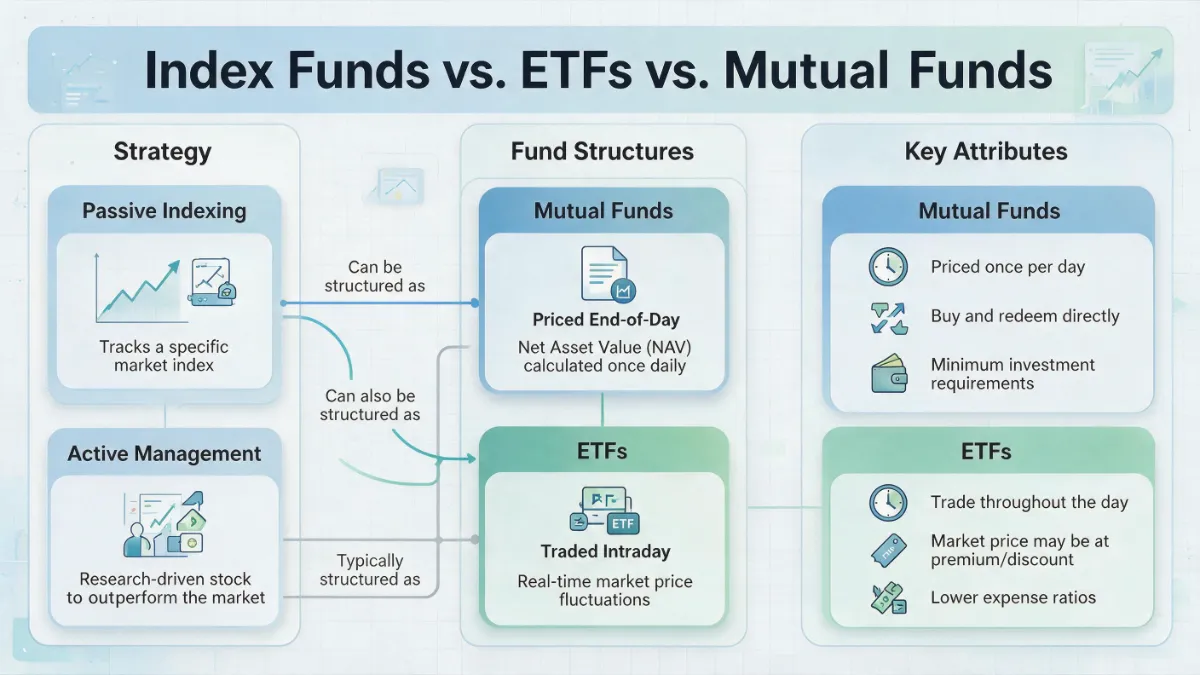
Traditional index investing is passive. The fund follows predefined rules — no manager is constantly predicting which stocks to buy or sell. Active investing is the opposite: a fund manager makes ongoing decisions attempting to outperform the market, and that research costs money passed through to investors via higher fees.
📊 ICI 2025 Fee Data — The Cost Gap
Average expense ratio, passive index equity mutual funds: 0.05%
Average expense ratio, actively managed equity mutual funds: 0.40%
Cost difference: 8x higher for active management
Published SPIVA research from S&P Global — running across multiple market cycles and time horizons — consistently shows that the majority of actively managed funds fail to outperform their benchmark index after fees are accounted for over long periods. Lower cost. Simpler rules. Historically competitive returns. That’s the core case for passive index investing.
Index Funds vs. ETFs vs. Mutual Funds: Understanding the Difference
This is one of the most common points of confusion for new investors. The key distinction: “index fund” describes a strategy, while “ETF” and “mutual fund” describe legal structures. A fund can be simultaneously an ETF and an index fund. Or a mutual fund and an index fund. The terms aren’t mutually exclusive.
Index Fund Structures — Key Differences
| Feature | Index Mutual Fund | Index ETF |
|---|---|---|
| Trading mechanics | Priced once daily at end-of-day NAV | Trades throughout the day on an exchange, like a stock |
| Minimum investment | May have dollar minimums (e.g. $1,000+) | Often one share or a fractional share — no dollar minimum on many platforms |
| Automated investing | Easy to set up recurring dollar contributions | Requires share-based or fractional-share ordering on most platforms |
| Passive strategy? | Yes (if tracking an index) | Yes (if tracking an index — not all ETFs are passive) |
ETF Tax Efficiency in Taxable Accounts
In a taxable brokerage account, the ETF structure often holds a meaningful tax advantage over mutual funds. The SEC’s investor education resources explain that traditional mutual funds can generate capital gains distributions when the fund sells appreciated securities internally — and those distributions flow through to all shareholders, even those who didn’t personally sell anything. ETFs use an “in-kind” creation-and-redemption mechanism that generally reduces the need for those taxable distributions.
Worth noting: selling ETF shares still triggers capital gains taxes, and dividends remain taxable in both structures. The advantage is structural, not a complete tax shield. For accounts inside a Roth IRA or traditional IRA, this distinction matters far less — growth is already sheltered from annual taxation inside those accounts.
How to Choose an Index Fund for Your Portfolio
Choosing an index fund doesn’t start with ticker symbols. It starts with asking four specific questions — in order. What the fund tracks, how well it tracks it, how established it is, and what it costs.
1. What Benchmark Does the Fund Actually Track?
A total U.S. stock market fund and a narrow single-sector technology fund can both technically be index funds — but they carry completely different risk profiles and levels of diversification. Broad market funds spread exposure across hundreds or thousands of companies. Sector funds concentrate on one industry. For beginners, broad market exposure is what the research on long-term wealth building consistently supports.
Common broad benchmarks include the S&P 500 (roughly 500 large U.S. companies), the Russell 3000 (approximately 3,000 U.S. stocks), and the MSCI World Index (large and mid-cap stocks across developed markets globally).
2. How Closely Does the Fund Follow Its Index?
This metric is called tracking error — the gap between the fund’s actual returns and the index it’s supposed to mirror. Some deviation is expected due to fund expenses and transaction costs. Significant and persistent divergence from the benchmark warrants investigation. Most major index funds from large fund families have very low tracking error, which is part of why fund age and asset size both matter.
3. Fund Size, Age, and Trading Volume
Larger, older funds with higher trading volume generally carry operational advantages. For ETFs specifically, higher trading volume produces tighter bid-ask spreads — the small hidden cost embedded in every buy and sell transaction. Smaller, newer funds can carry wider spreads that reduce effective returns in ways the stated expense ratio doesn’t capture. Checking the fund’s assets under management and average daily trading volume before buying is a reasonable due-diligence step.
4. The Expense Ratio: The Real Cost of Fee Drag
The expense ratio is the fund’s annual operating cost expressed as a percentage of invested assets. It’s deducted directly from the fund’s assets — investors never receive a bill, which is part of why it’s easy to underestimate its long-run impact.
Expense Ratio Fee Drag — $200/Month Over 30 Years at 7% Assumed Return
| Scenario | Expense Ratio | Monthly Contribution | Approximate Ending Value |
|---|---|---|---|
| Low-cost fund | 0.10% | $200 | ~$239,000 |
| Higher-cost fund | 0.55% | $200 | ~$219,000 |
| Difference | 0.45% | — | ~$20,000 in lost compounding |
Calculations treat the expense ratio as a simple reduction in annual return. For educational illustration only. Actual results will vary. All investments carry risk of loss.
A 0.45% fee difference sounds trivial. Over 30 years of compounding, it represents approximately $20,000 in foregone growth on modest monthly contributions. Low expense ratios are one of the few investing variables entirely within an investor’s direct control — and one of the most consequential over long holding periods.
Financial Prerequisites Before Investing
There’s no universally correct percentage of income every household should invest. The right starting point depends on the existing financial picture — specifically two things that come before market investment.
⚠️ Before Index Fund Contributions Begin — Research-Supported Order
- Build an emergency cash reserve. The CFPB recommends a dedicated accessible cash reserve covering unexpected expenses. Stock markets are volatile — and investments can decline in value at exactly the wrong moment. If a medical bill or car repair arrives during a market downturn, accessible cash means not being forced to sell investments at a loss to cover it. The emergency fund provides the breathing room that a brokerage account can’t.
- Address high-interest revolving debt. According to Federal Reserve Q2 2026 data, the average APR on credit card accounts assessed interest is 22.15%. Paying 22% guaranteed on revolving debt versus earning an uncertain long-run average through index funds is not a close comparison at typical holding periods. High-interest credit card balances generally warrant serious attention before investment contributions begin.
- Only then: determine what’s genuinely sustainable. Consistency matters more than amount. Research on long-term outcomes shows that investors contributing steadily — even modest amounts — over long periods tend to build more than those making sporadic large deposits. Setting a contribution amount that won’t create pressure to stop and restart has more practical value than starting with a number that’s hard to maintain.
📈 Quick Investment Check
Estimate your lump sum investment growth over time.
Total Invested
Total Returns
Final Value
How Compounding Amplifies Long-Term Returns
Compounding means returns generate their own additional returns. The longer the time horizon, the more powerful that effect becomes — and the more dramatically the ending balance separates from the total amount contributed.
S&P 500 Historical Performance Context
Long-run datasets show the S&P 500 has historically delivered a nominal annual return of roughly 10%, translating to approximately 6.5–7% annually after adjusting for inflation over very long periods. That history is useful for understanding the mathematics of long-term investing. It is not a forecast — markets have bad years, sometimes consecutive ones, and past performance does not guarantee future results.
Compounding Illustration — $200/Month at an Assumed 7% Annual Return
| Investment Period | Total Contributions Made | Illustrative Ending Value | Growth Beyond Contributions |
|---|---|---|---|
| 20 Years | $48,000 | ~$104,000 | ~$56,000 |
| 30 Years | $72,000 | ~$244,000 | ~$172,000 |
Illustrative only. Assumes 7% annual return compounded monthly. Does not reflect taxes, fees, or actual fund performance. All investments carry risk. Past market performance does not guarantee future results.
The investor contributes only $24,000 more by extending from 20 to 30 years. But the illustrative ending balance grows by roughly $140,000. The gap between money contributed and money accumulated represents compounding doing the work. The earlier consistent contributions start, the more years that effect has to build — which is why time horizon matters more than any single contribution amount.
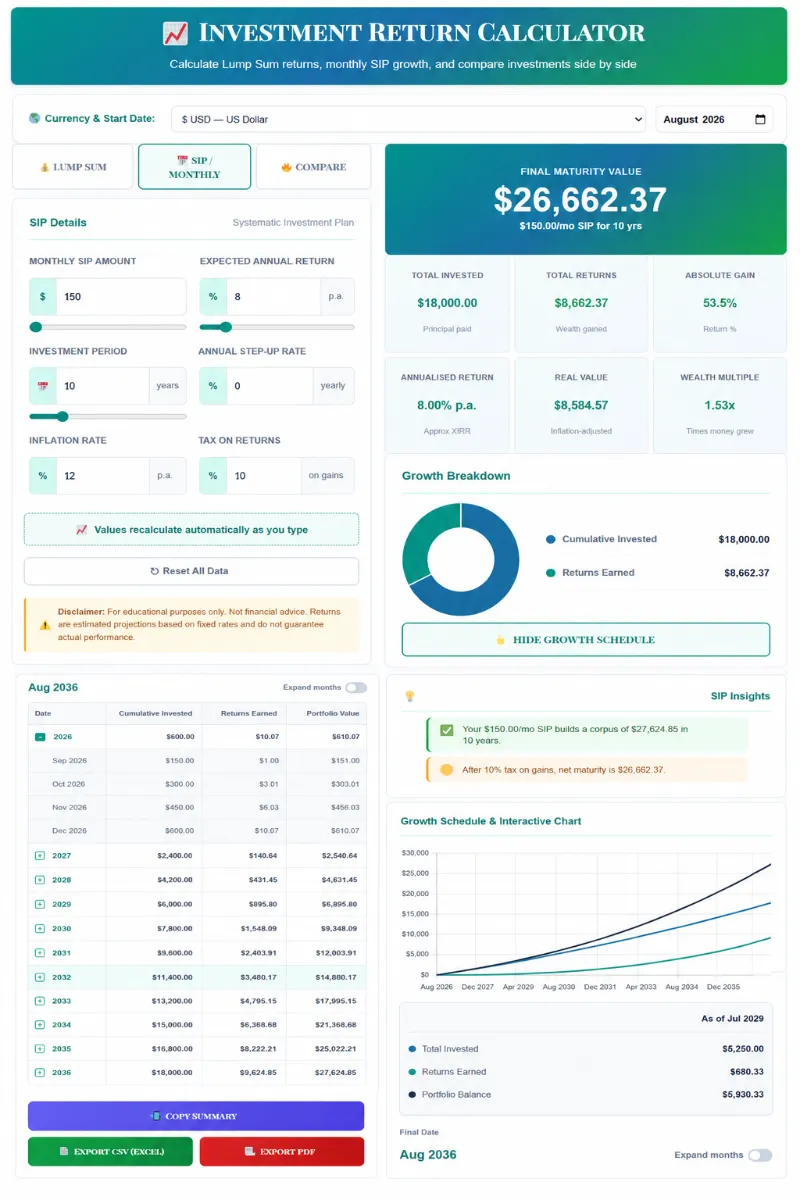
📈 Try the SaveXpert Investment Return Calculator
The SaveXpert Investment Return Calculator takes a starting balance, monthly contribution amount, and assumed annual return, and shows how the balance builds over 10, 20, or 30 years — with the contribution total and growth separated visually.
Educational note: Calculator results are illustrative estimates for educational purposes only. Actual investment returns vary and are not guaranteed.
Step-by-Step: How to Start Investing in Index Funds
1. Choose an account type.
The account determines tax treatment and withdrawal flexibility. A
taxable brokerage account
offers no contribution limits or restrictions on withdrawals, but capital gains and dividends create taxable events each year. A
traditional or Roth IRA
offers tax advantages: the 2026 IRS annual contribution limit is $7,500 (or $8,600 for those age 50 or older). Roth IRAs use after-tax contributions with tax-free qualified withdrawals in retirement. Traditional IRAs may offer upfront deductibility depending on income and workplace retirement plan coverage. See IRS Publication 590-A for eligibility details.
2. Select a low-cost brokerage platform.
The brokerage is the platform that provides access to markets. Key considerations: transparent pricing, no-load index fund access, fractional share availability, and the ability to set up automatic recurring contributions. A clean, beginner-focused interface tends to serve new investors better than a platform built for active traders — reducing the friction that leads to unnecessary trading.
3. Pick a broad market index fund with a low expense ratio.
Funds tracking the S&P 500 or Total U.S. Stock Market provide diversification across hundreds of companies without concentration in a single sector or company. Compare expense ratios and choose the lowest-cost option available on the platform. The SEC’s ETF and mutual fund investor education page explains the key terms used in fund documents.
4. Automate recurring contributions.
The CFPB identifies automatic recurring transfers as a practical approach for building consistent long-term wealth. When money moves from a bank account to an investment account automatically — monthly or per paycheck — it removes the temptation to wait for a “better” market moment. Markets have no perfect entry points. Consistency over time — a practice known as dollar-cost averaging — produces more reliable long-run outcomes than attempts to time purchases.
Common Beginner Mistakes to Avoid
1. Chasing past performance.
A fund’s recent surge may reflect temporary market conditions unlikely to repeat. The SEC requires all fund marketing materials to state that past performance does not guarantee future results — for good reason. The fund with the highest return last year is often not the top performer the year after. Expense ratios and index breadth are more durable selection criteria than recent performance rankings.
2. Assuming “ETF” automatically means broad diversification.
ETFs can be passive broad-market index funds. They can also be actively managed, concentrated in a single sector, leveraged two or three times the index, or inverse (designed to move opposite to the market). The ETF label describes the legal structure, not the risk level or strategy. Reading what the fund actually holds — available in its prospectus and on the fund’s website — matters more than the acronym on the label.
3. Attempting to time the market.
No published research supports the reliable ability to exit before downturns and re-enter before recoveries. Long-term historical data consistently shows that missing even a small number of the market’s best single trading days — which are often clustered near its worst days — significantly reduces long-run returns. Staying invested through volatility is what time in the market actually means.
4. Ignoring the financial prerequisites.
Investing while carrying high-interest revolving debt or without an emergency cash buffer creates a structural problem: the next unexpected expense forces a sale — potentially during a market decline, locking in a loss. Building the financial foundation first isn’t a delay; it’s what makes long-term investing sustainable.
“Investing shouldn’t feel like guessing. The research points to a clear approach: own the entire market through low-cost index funds, automate contributions so emotion stays out of the equation, and give compounding the time it needs to work. That’s the whole strategy.”
— Kevin Brown, Lead Researcher at SaveXpert.com
Frequently Asked Questions
Ans: Yes. An index fund tracking stocks can lose substantial value during a broad market decline. Index funds provide diversification across many companies, but they do not eliminate market risk. A broadly diversified index fund declines when the overall market declines. The SEC’s investor.gov resources explain clearly that all market investments carry risk of loss, and past performance of any index does not guarantee future results.
Ans: It depends on the fund and platform. Many index mutual funds set a minimum initial investment (often $1,000 or more). Many index ETFs can be purchased for the price of one share, or fractionally on platforms that support fractional shares — which several major brokerages now offer with no dollar minimum. Minimum requirements vary significantly and change as platforms compete for investors.
Ans: Generally, ETFs tend to be more tax-efficient in taxable accounts. As confirmed by SEC investor education materials, ETFs’ in-kind creation-and-redemption mechanism typically reduces taxable capital-gains distributions compared to mutual funds. Inside a tax-advantaged account like a Roth IRA or traditional IRA, this structural tax difference matters much less because growth is already sheltered from annual taxation.
Ans: A consistent, rules-based schedule produces better long-run outcomes than attempting to time purchases around market conditions, according to CFPB guidance and behavioral finance research. Setting up automated recurring contributions — monthly or per paycheck — removes emotion and daily market headlines from the decision. This approach, called dollar-cost averaging, results in purchasing more shares when prices are lower and fewer when prices are higher.
Ans: An expense ratio is the fund’s ongoing annual operating cost expressed as a percentage of invested assets — deducted automatically from fund returns with no separate bill. A load fee is a one-time sales commission charged when purchasing (front-end load) or selling (back-end load) certain mutual funds. Most index funds and ETFs are no-load funds with no sales commission. The expense ratio is the relevant ongoing cost to compare when evaluating index fund options, and is disclosed in every fund’s prospectus as required by the SEC.
Ans: Dollar-cost averaging (DCA) is the practice of investing a fixed dollar amount at regular intervals — such as $200 every month — regardless of market conditions. When prices are lower, the fixed contribution buys more shares. When prices are higher, it buys fewer. Over time, this averages out the cost per share and removes the need to predict market direction. Automating monthly contributions to an index fund is the most direct way to implement dollar-cost averaging, and is supported by CFPB guidance on building consistent long-term saving and investing habits.