ⓘ Educational Disclosure:
This guide explains federal income tax bracket mechanics, standard deductions, and related 2026 tax concepts strictly for educational purposes. It is not personalized tax, legal, or financial advice. Tax rules often have specific exceptions, phaseouts, and strict eligibility requirements. Always consult a qualified tax professional regarding your specific situation.
What are the 2026 federal income tax brackets? The 2026 federal income tax system uses seven marginal rates: 10%, 12%, 22%, 24%, 32%, 35%, and 37%. These progressive brackets apply only to taxable income, not gross pay. Baseline 2026 standard deductions — $16,100 (Single) and $32,200 (Married Filing Jointly) — reduce your income before these rates apply.
Key Takeaways
- Problem: Most people think reaching a higher tax bracket taxes their whole salary at that rate — so they fear raises.
- Solution: The 2026 system uses seven marginal rates (10%–37%) that apply only to slices of taxable income, after a $16,100 (Single) or $32,200 (MFJ) standard deduction.
- Result: A Single filer on $100,000 has a 22% marginal rate but only a 13.17% effective rate — and a raise always leaves more take-home pay.
- Source: IRS — 2026 inflation adjustments (Rev. Proc. 2025-32)
- Time To Read: 9 Minutes
Table of Contents
1. 2026 Federal Income Tax Brackets: Single & Married Filing Jointly
2. 2026 Standard Deductions & Additional Amounts
3. Marginal vs. Effective Tax Rate: Debunking the Bracket Myth
4. Standard vs. Itemized Deductions: When Does Itemizing Make Sense?
5. Worked Math Example: Federal Tax on a $100,000 Salary
6. How to Calculate Federal Income Tax in 2026
7. Do Tax Brackets Apply to All Income?
Here’s a $13,170 fact that trips up millions of people every year. A Single filer earning $100,000 in 2026 sits in the 22% tax bracket — yet actually pays about 13% of their income to the IRS. The gap between those two numbers is the most misunderstood idea in personal finance. And getting it wrong makes people turn down raises.
The most stubborn tax myth is that earning more can somehow leave you with less because you “moved into a higher bracket.” That’s not how the federal system works. Your bracket applies only to slices of your taxable income — never your whole paycheck.
2026 Federal Income Tax Brackets: Single & Married Filing Jointly
What are the 2026 tax brackets for single and married filers? For 2026, Single and Married Filing Jointly filers face seven marginal tax rates ranging from 10% to 37%. These progressive thresholds apply only to distinct slices of taxable income earned during 2026, which taxpayers report on their 2027 returns.
The 2026 system keeps seven statutory rates: 10%, 12%, 22%, 24%, 32%, 35%, and 37%. These are marginal rates. Each one applies only to the exact portion of taxable income that falls inside its band.
The IRS confirms the 2026 thresholds apply to income earned during 2026, reflected on returns filed in 2027.
Table 1 —2026 Tax Brackets: Single Filer
| Tax Rate | 2026 Taxable Income |
|---|---|
| 10% | $0 – $12,400 |
| 12% | Over $12,400 – $50,400 |
| 22% | Over $50,400 – $105,700 |
| 24% | Over $105,700 – $201,775 |
| 32% | Over $201,775 – $256,225 |
| 35% | Over $256,225 – $640,600 |
| 37% | Over $640,600 |
Source: IRS — Tax inflation adjustments for tax year 2026 (Rev. Proc. 2025-32)
Table 2 — 2026 Tax Brackets: Married Filing Jointly
| Tax Rate | 2026 Taxable Income |
|---|---|
| 10% | $0 – $24,800 |
| 12% | Over $24,800 – $100,800 |
| 22% | Over $100,800 – $211,400 |
| 24% | Over $211,400 – $403,550 |
| 32% | Over $403,550 – $512,450 |
| 35% | Over $512,450 – $768,700 |
| 37% | Over $768,700 |
Source: IRS — Tax inflation adjustments for tax year 2026 (Rev. Proc. 2025-32)
The Critical Distinction: Taxable Income vs. Gross Income
This is where most people get confused. Brackets apply strictly to taxable income, not gross salary. Your gross income is only the starting point.
Adjustments and deductions shrink your income long before the brackets touch it. Here’s a simplified example: $100,000 gross income − $16,100 standard deduction = $83,900 taxable income.
That $83,900 — not the original $100,000 — is what enters the bracket calculation. Miss this distinction and the rest of the math never adds up.
2026 Standard Deductions & Additional Amounts
What is the 2026 standard deduction? The baseline 2026 standard deduction is $16,100 for Single or Married Filing Separately, $32,200 for Married Filing Jointly, and $24,150 for Head of Household. Qualifying taxpayers aged 65 or older or blind receive an additional deduction amount, which directly reduces taxable income.
The standard deduction is the simplest way to lower your taxable income. Instead of documenting individual expenses, eligible taxpayers take a fixed amount based on filing status.
Table 3 — 2026 Standard Deductions & Bonus Amounts
| Filing Status | 2026 Standard Deduction | Age 65+ / Blind Bonus (Per Person) |
|---|---|---|
| Single | $16,100 | + $2,050 |
| Married Filing Jointly | $32,200 | + $1,650 |
| Head of Household | $24,150 | + $2,050 |
| Married Filing Separately | $16,100 | + $1,650 |
Source: IRS — Tax inflation adjustments for tax year 2026 · IRS Topic No. 501, Standard Deduction
There’s an extra standard deduction amount for qualifying taxpayers who are age 65 or older, blind, or both. A taxpayer who qualifies on both counts generally gets the bonus for each condition.
💡 Research note: There’s also a 2026-era update worth flagging. Eligible taxpayers age 65 and older may qualify for a separate, enhanced senior deduction of up to $6,000 per person for tax years 2025 through 2028. This bonus carries strict income-based phaseouts and rules.
Marginal vs. Effective Tax Rate: Debunking the Bracket Myth
What is the difference between marginal and effective tax rates? Your marginal tax rate is the highest percentage applied to your last slice of taxable income. Your effective tax rate is the actual average percentage of your total gross income paid in federal taxes — and it’s always lower than your marginal rate.
The biggest mistake people make is treating these two numbers as the same thing. They’re not even close.
What Is a Marginal Tax Rate in 2026?
Your marginal rate is the rate on your next dollar of taxable income. A Single filer with $83,900 of taxable income lands in the 22% bracket.
So the marginal rate is 22%. It does not mean the taxpayer pays 22% on the full $83,900.
What Is an Effective Tax Rate?
Your effective rate measures your average federal tax burden against your total gross income. The simplified formula is: Effective Tax Rate = Total Federal Income Tax ÷ Gross Income × 100.
This is the number that answers the real question: on average, what share of my gross income actually went to federal taxes? As the math below shows, a person can carry a 22% marginal rate while paying just a 13.17% effective rate.
The “Higher Bracket Means Less Take-Home Pay” Myth
Let’s kill this one for good. Say the top of a bracket is $50,400 and you earn enough to cross it. You don’t suddenly pay the higher rate on every dollar you earned.
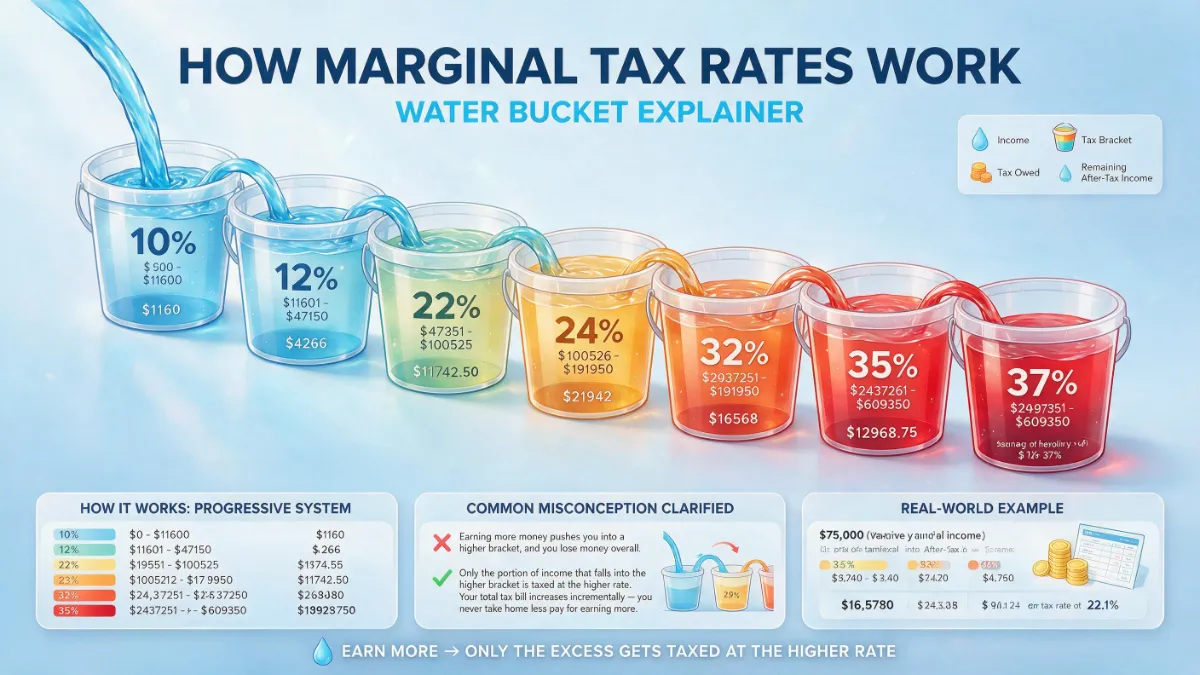
Picture the progressive system as a row of buckets. Crossing into a higher bracket doesn’t “reprice” the dollars already sitting in your lower buckets. So a raise can lift your total tax bill while still lifting your after-tax take-home pay.
📈 Quick Income Tax Check
Estimate your tax liability, effective rate, and take-home pay.
Estimated Tax
Effective Rate
Take-Home Pay
Standard vs. Itemized Deductions: When Does Itemizing Make Sense?
Should I take the standard deduction or itemize in 2026? Research suggests itemizing in 2026 only pays off when your allowable itemized deductions exceed your baseline standard deduction — such as $16,100 for Singles or $32,200 for joint filers. Keep in mind the 2026 overall State and Local Tax (SALT) deduction limit is $40,400.
Most taxpayers compare the standard deduction against their allowable itemized deductions and take whichever is bigger.
The standard deduction is a fixed amount tied to filing status. It’s simpler because you don’t document every qualifying expense on Schedule A.
Itemizing means adding up qualifying expenses and claiming them on Schedule A. Common categories include qualifying mortgage interest, charitable contributions, and state and local taxes (SALT).
💡 Research note: One major 2026 update — the old $10,000 SALT cap is gone. The 2026 overall SALT deduction limit is now $40,400, subject to income-based limitations.
Worked Math Example: Federal Tax on a $100,000 Salary
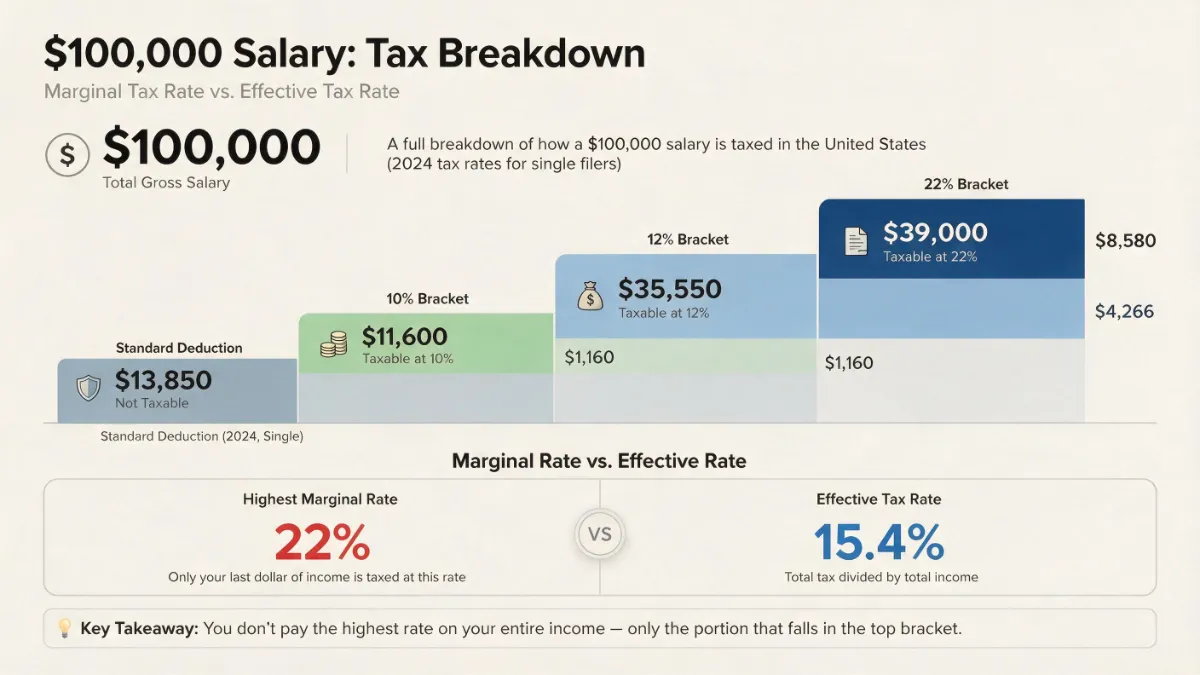
How do tax brackets affect a $100,000 salary? A Single filer earning $100,000 gross income in 2026 has $83,900 in taxable income after the $16,100 standard deduction. That taxable income crosses the 10%, 12%, and 22% brackets in sequence, landing at an estimated effective tax rate of just 13.17%.
Let’s make it concrete. Assume a Single filer with $100,000 gross income, the $16,100 standard deduction, and no other credits or adjustments.
First, subtract the deduction: $100,000 − $16,100 = $83,900. That $83,900 is the taxable income, and its top dollars reach the 22% bracket.
Applying the 2026 Brackets Slice by Slice
Because the U.S. uses a progressive system, that taxable income crosses three brackets:
- First slice (10%): The first $12,400 is taxed at 10% = $1,240.
- Second slice (12%): The next $38,000 is taxed at 12% = $4,560.
- Third slice (22%): The remaining $33,500 is taxed at 22% = $7,370.
Add the three pieces ($1,240 + $4,560 + $7,370), and you get a total federal income tax of $13,170.
Table 4 — Worked Math Example Summary ($100k Salary)
| Measure | Result |
|---|---|
| Gross Income | $100,000 |
| Standard Deduction | $16,100 |
| Taxable Income | $83,900 |
| Marginal Tax Rate | 22% |
| Simplified Federal Tax | $13,170 |
| Effective Tax Rate | 13.17% |
Source: Author calculation using 2026 Single brackets from IRS Rev. Proc. 2025-32. Simplified; excludes credits and adjustments.
This shows the gap between marginal and effective rates in plain numbers. The taxpayer is technically in the 22% bracket but pays far less than 22% on their total salary.
💰 Calculate Your 2026 Federal Income Tax in Seconds
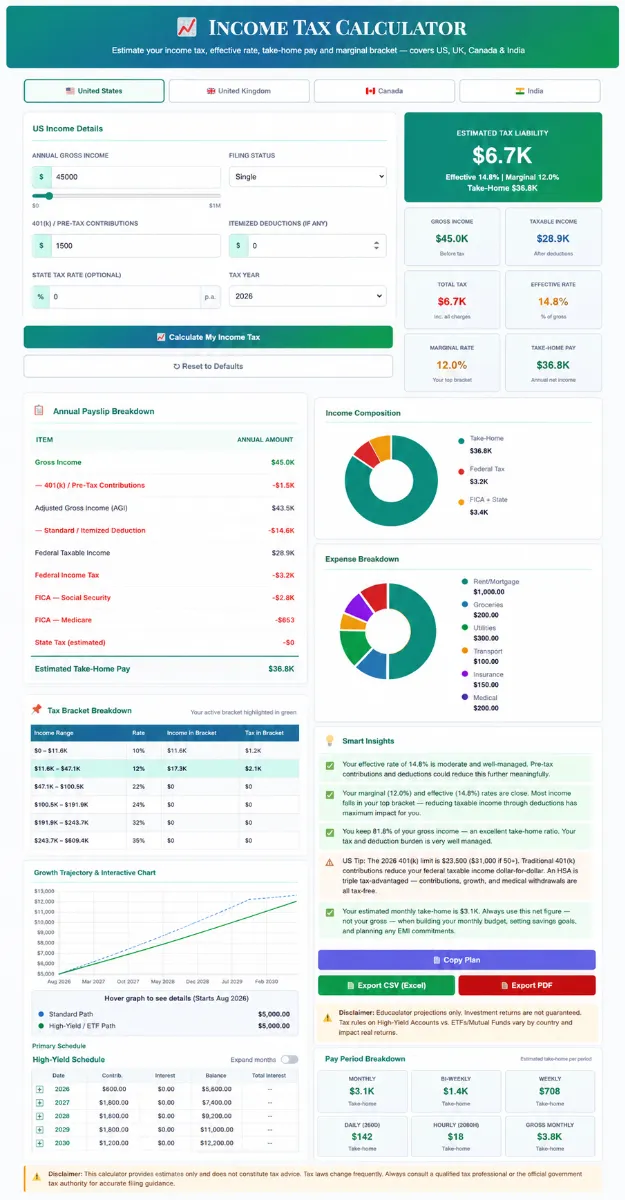
I ran this $100,000 scenario through SaveXpert’s Income Tax Calculator to check the slice-by-slice math — it returned the same $13,170 and a 13.17% effective rate. Enter your income, pick your filing status, apply deductions, and see your estimated marginal bracket and effective rate.
Use The Free Income Tax Calculator→Educational note: This calculator helps you model federal tax scenarios and does not provide personalized tax advice. Results may differ from actual liability due to specific IRS rules. Source: IRS 2026 inflation adjustments.
How to Calculate Federal Income Tax in 2026
How is federal income tax calculated? To calculate your federal income tax, subtract your standard or itemized deductions from your gross income to find your taxable income. Then apply the 2026 progressive brackets slice by slice to that taxable income, based on your filing status.
For a basic bracket-only estimate, start with your total gross income for the year. That includes wages, business income, dividends, and other taxable sources.
Next, find your taxable income by subtracting deductions like the standard deduction. Apply the brackets from the bottom up to that final figure. Never multiply your entire taxable income by the single highest rate you reach — that’s the exact mistake the bucket model exists to prevent.
Do Tax Brackets Apply to All Income?
Do tax brackets apply to gross income or taxable income? Federal tax brackets apply strictly to taxable income, never your entire gross income. Moving into a higher bracket only affects the new dollars above that threshold — which is why earning more never reduces your total take-home pay.
No, brackets don’t apply to all of your income the way many people assume. They apply only to taxable income, with each bracket touching a specific sliced portion.
Your gross income is not taxed at your highest marginal rate. If a bonus pushes you from the 22% bracket toward the 24% bracket, only the dollars spilling into the 24% range get taxed at 24%. You don’t retroactively pay 24% on everything you already earned.
The Bottom Line: Quick-Start 2026 Tax Planning Checklist
How can I plan for my 2026 taxes? Start by estimating your gross income and subtracting standard or itemized deductions to find your taxable income. Identify your marginal bracket, review your W-4 paycheck withholding, and consider pre-tax contributions to retirement or HSA accounts to lower your final tax liability.
The easiest way to understand the 2026 brackets is to stop seeing them as a flat percentage on your whole salary. It’s a layered system, and once that clicks, the rest is arithmetic.
Here’s a research-based 5-step starting point for 2026:
1. Estimate gross income:
Add up expected wages and all other taxable income sources for the year.
2. Estimate taxable income:
Subtract the 2026 standard deduction or your itemized deductions to find your true taxable base.
3. Find your marginal bracket:
Match your estimated taxable income against the 2026 IRS table for your filing status.
4. Review paycheck withholding:
Check your Form W-4 elections and year-to-date withholding so they line up with your expected liability.
5. Review pre-tax opportunities:
Eligible retirement or HSA contributions can legally lower your taxable income.
Know your taxable income, know your marginal rate, know your effective rate. And never assume that crossing into a higher bracket taxes all of your hard-earned income at that higher rate — it doesn’t.
“When I went through the IRS bracket tables, one pattern stood out: almost every ‘my raise cost me money’ story falls apart once you see the system as stacked buckets. What the data shows is that a higher bracket only ever touches the dollars above the line — never the whole salary.”
— Kevin Brown, Lead Researcher at SaveXpert.com
Frequently Asked Questions
Ans: No. Because the U.S. uses a progressive tax system, entering a higher bracket only applies the higher rate to the income above the new threshold. The rest of your income is still taxed at the lower rates, so a raise always increases your after-tax take-home pay.
Ans: For 2026, taxpayers age 65 or older receive an additional standard deduction of $2,050 if unmarried, or $1,650 if married. On top of that, eligible seniors may qualify for a separate enhanced deduction of up to $6,000 per person, subject to income phaseouts.
Ans: Divide your total federal income tax liability by your total gross income, then multiply by 100. That formula reveals the actual average percentage of your gross income paid to federal taxes.
Ans: Tax brackets apply only to your taxable income. You calculate taxable income by subtracting applicable standard or itemized deductions from your total gross income before any tax rates apply.
Ans: Married Filing Jointly filers use the same seven rates as everyone else, but with wider bands: 10% up to $24,800, 12% to $100,800, 22% to $211,400, 24% to $403,550, 32% to $512,450, 35% to $768,700, and 37% above $768,700. As with all filers, each rate applies only to the taxable income inside that band.
Ans: The 2026 overall State and Local Tax (SALT) deduction limit is $40,400, up from the previous $10,000 cap. It’s subject to income-based limitations, and it only matters if you itemize on Schedule A rather than taking the standard deduction.