ⓘ Educational Disclosure:
This article provides general educational information about investment structures, costs, and tax mechanics. It does not constitute personalized investment advice. Tax rules change frequently, and individual circumstances vary. Always consult a qualified professional regarding your specific situation.
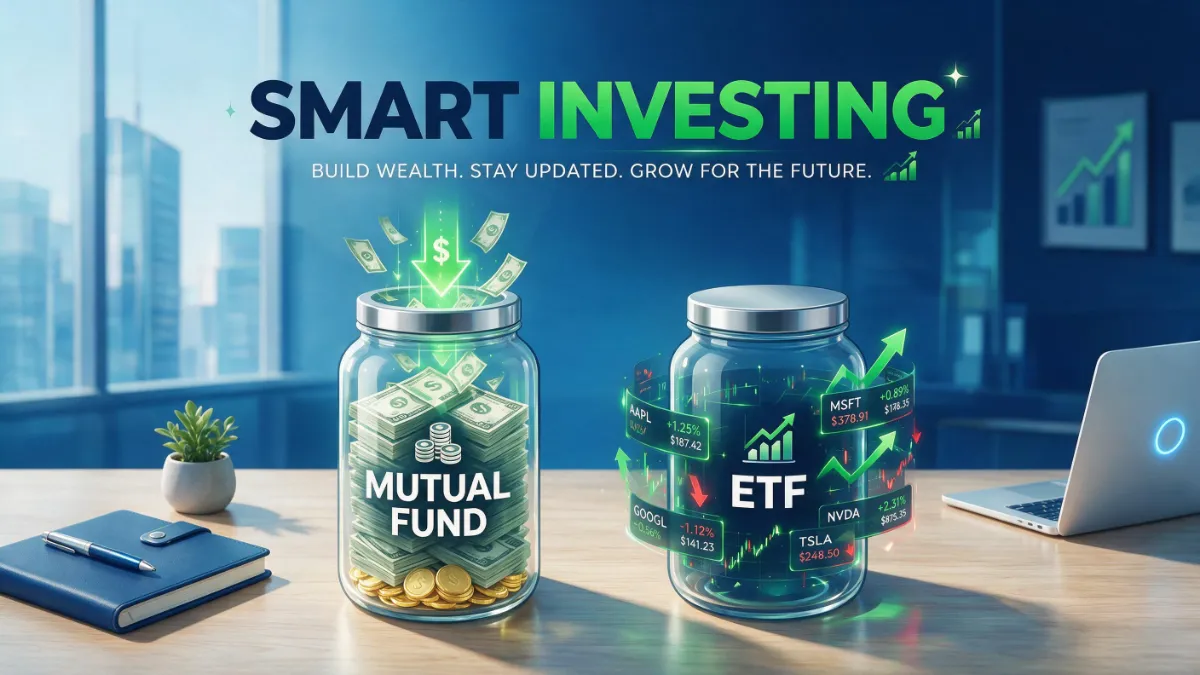
What is the exact difference between an index fund and an ETF? “Index fund” describes a passive investment strategy that tracks a market benchmark. “ETF vs. mutual fund” describes the legal vehicle holding your money. That structure determines whether you trade shares intraday on an exchange or buy them once a day at Net Asset Value (NAV). Both can track the same index — they just work differently under the hood.
Key Takeaways
- Problem: Most beginners think “index fund vs. ETF” is a strategy debate — when they actually describe two different things: what the fund does vs. how it’s packaged and traded.
- Solution: Match the vehicle to the account — ETFs in taxable brokerage accounts for tax efficiency; index mutual funds in retirement accounts for seamless dollar-based automation.
- Result: A low-cost, tax-aware portfolio that automates contributions and compounds for decades with minimal friction.
- Source: SEC Investor Bulletin — Exchange-Traded Funds (ETFs), FINRA — Mutual Fund Fees & Expenses
- Time To Read: 9 Minutes
Table of Contents
1. Core Definitions: Understanding Index Mutual Funds vs. ETFs
2. Trading Mechanics: Intraday Trading vs. End-of-Day NAV
3. Minimum Investments, Fractional Shares & Automatic Investing
4. Tax Efficiency: Why ETFs Have the Edge in Taxable Accounts
5. Expense Ratios & Hidden Costs Explained
6. Decision Framework: Which Fund Type Fits Your Strategy?
7. How Index Funds and ETFs Work: A Simple Side-by-Side
Broad-market investing offers real wealth-building power. But one question still trips up beginners every year: should you buy an index mutual fund or an ETF? I’ve gone through SEC filings, fund prospectuses, and FINRA’s fee guidance on this — and the answer is simpler than most people think, once you separate two ideas that constantly get tangled together.
Here’s where most people get stuck. They treat “index fund” and “ETF” as opposites, when they actually sit on two different axes. Lock in this mental model: indexing = what the fund tries to do; ETF vs. mutual fund = how the fund is packaged and traded. Once that clicks, the rest is mechanics.
Core Definitions: Understanding Index Mutual Funds vs. ETFs
What is an index mutual fund? An index mutual fund pools investor capital to track a specific market index — like the S&P 500 or the total U.S. stock market. Rather than picking stocks to beat the market, a passively managed mutual fund tries to replicate benchmark performance minus fund expenses.
What is an ETF? An exchange-traded fund (ETF) is a fund whose shares trade on a stock exchange during the normal trading day. While ETFs can use active management, passive index-tracking ETFs dominate the market by assets.
Both vehicles can own the same basket of stocks. The difference is everything that happens when you buy and sell — pricing, taxes, automation, and cost structure.
Trading Mechanics: Intraday Trading vs. End-of-Day NAV
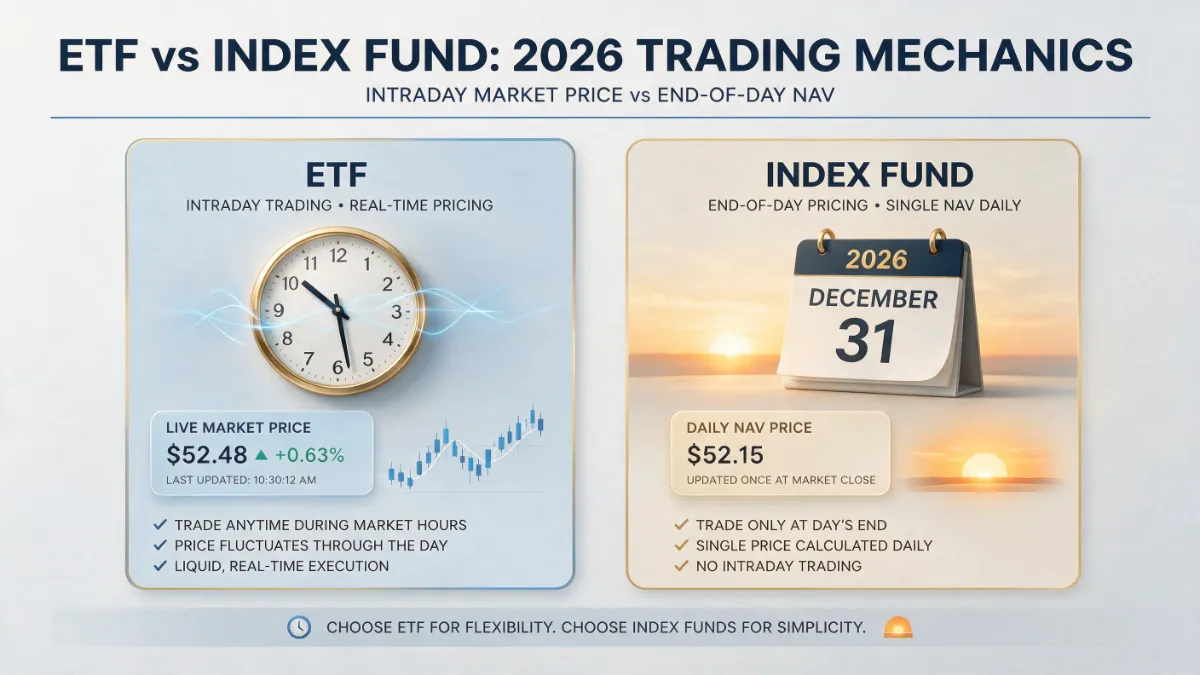
How does an ETF trade differently from an index mutual fund? ETFs trade on exchanges during regular market hours (9:30 a.m. to 4:00 p.m. Eastern Time), just like individual stocks. Index mutual funds bypass the intraday market entirely — they price once at the end of each business day at their Net Asset Value (NAV).
ETFs Trade Throughout the Day
When you buy an ETF, you’re purchasing shares from another market participant through the exchange. That exchange-based trading creates a bid-ask spread — you pay the “ask” price when buying and accept the “bid” price when selling. The spread is a real trading cost, even if it’s small.
The upside is control. You get market orders, limit orders, and stop orders — letting you set the exact price you’re willing to pay.
Index Mutual Funds Execute at NAV
Index mutual funds skip the intraday market. When you place an order, the fund prices your transaction at the next calculated NAV — the per-share value of the fund’s assets minus its liabilities, calculated once at market close. You transact directly with the fund at that price, which means no bid-ask spread at all.
Index Mutual Funds vs. ETFs at a Glance
| Feature | Index Mutual Fund | ETF |
|---|---|---|
| Pricing | Once daily at NAV | Continuously during market hours |
| Intraday Trading | No | Yes |
| Bid-Ask Spread | No | Yes |
| Order Types | Basic buy/sell | Market, limit, and stop orders |
| Automation | Extremely simple | Depends on brokerage capabilities |
Source: SEC — Investor Bulletin: Exchange-Traded Funds (ETFs). Compiled by SaveXpert for educational use.
Minimum Investments, Fractional Shares & Automatic Investing
How do minimum investments differ between index funds and ETFs? Index mutual fund minimums vary widely — generally $0 to $3,000 — but they naturally support dollar-based investing, so you can put in exactly $250 every payday and the fund handles the fractional shares automatically. ETF automation depends heavily on whether your brokerage supports fractional shares.
Index Mutual Fund Minimums
Mutual funds have traditionally required a minimum investment, though many providers have dropped that floor to $0. The real advantage is dollar-based investing. If you want to put in exactly $500 on the 1st of every month, the fund calculates the fractional shares for you — no manual math, no leftover cash sitting idle.
ETFs and Fractional Shares
Historically, ETFs required whole-share purchases. Today, many brokerages support fractional ETF shares, which lets you invest small dollar amounts. But this isn’t universal — ETF automation depends entirely on your brokerage platform’s specific features. For automatic paycheck-to-investing setups, index mutual funds still have the simpler path.
Tax Efficiency: Why ETFs Have the Edge in Taxable Accounts
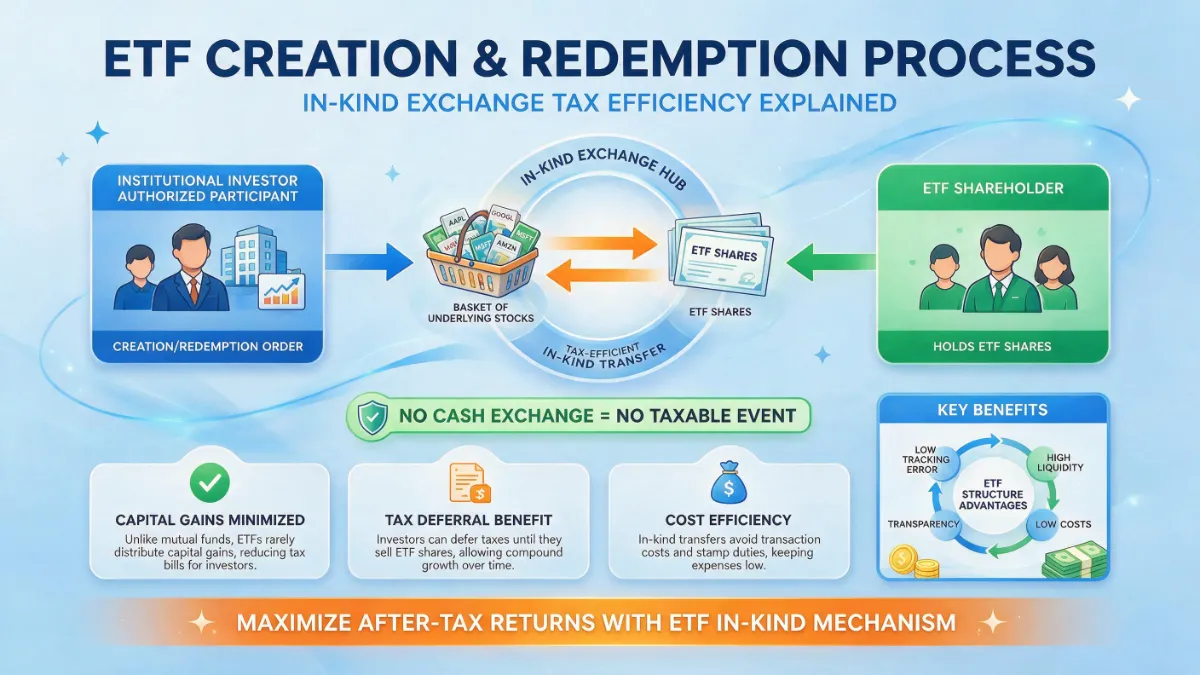
Are ETFs more tax efficient than mutual funds? Yes, in most cases. The SEC’s Investor Bulletin on ETFs confirms that ETFs can be tax efficient because they typically buy and sell portfolio securities through in-kind exchanges — not for cash — which means they generate fewer capital gain distributions than mutual funds.
Here’s what that means in practice. When investors sell traditional mutual fund shares, the fund may need to sell underlying stocks to raise cash. Selling stocks realizes capital gains, which the fund then distributes to all remaining shareholders as a taxable event — even shareholders who didn’t sell a single share.
How the ETF In-Kind Mechanism Works
ETFs solve this through authorized participants. These large institutional firms interact directly with the ETF in massive blocks called creation units. They swap underlying securities for ETF shares in kind — the ETF never needs to sell stocks for cash, so no taxable capital gain gets triggered for remaining investors.
💡 Research note: The SEC specifically identifies this in-kind creation and redemption mechanism as the core driver of ETF tax efficiency. As a result, ETF shareholders may pay less in capital gains taxes on a similar investment compared to mutual fund holders — a meaningful difference in a taxable brokerage account over decades.
Where Tax Efficiency Actually Matters
| Account Type | Why Tax Efficiency Matters |
|---|---|
| Taxable Brokerage | High priority. Capital gain distributions create immediate tax liabilities for investors. |
| Roth IRA | Low priority. The account shelters capital gains from current taxes, and qualified distributions remain tax-free. |
| 401(k) / Traditional IRA | Low priority. Investment growth avoids current taxation under retirement-plan rules. |
Source: SEC — Investor Bulletin: Exchange-Traded Funds (ETFs). Account tax treatment subject to IRS rules and individual circumstances.
⚠️ Important caveat: Inside a Roth IRA or 401(k), the tax efficiency difference between ETFs and index mutual funds mostly disappears. Both vehicles work well in tax-sheltered accounts — in that context, focus entirely on low expense ratios and whichever option your brokerage makes easiest to automate.
📈 Quick Compound Interest Check
See how your money grows over time with the power of compounding.
Total Invested
Total Interest
Final Value
Expense Ratios & Hidden Costs Explained
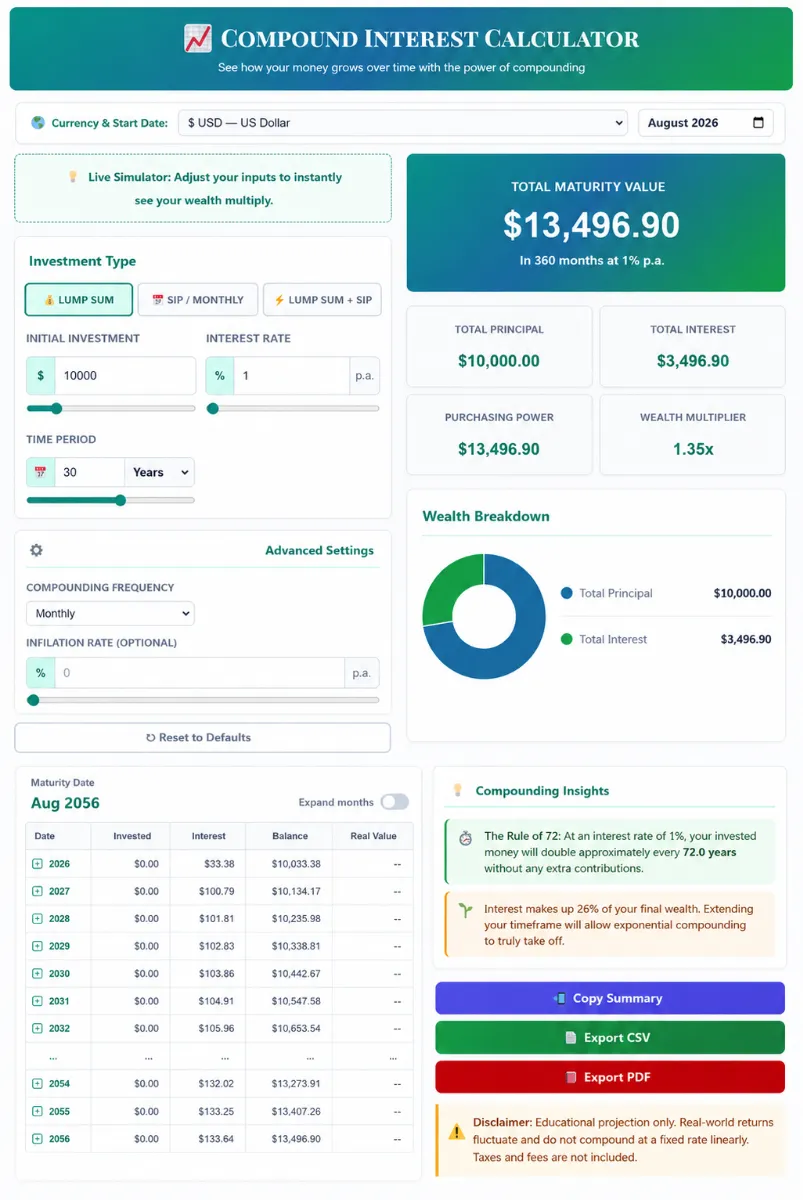
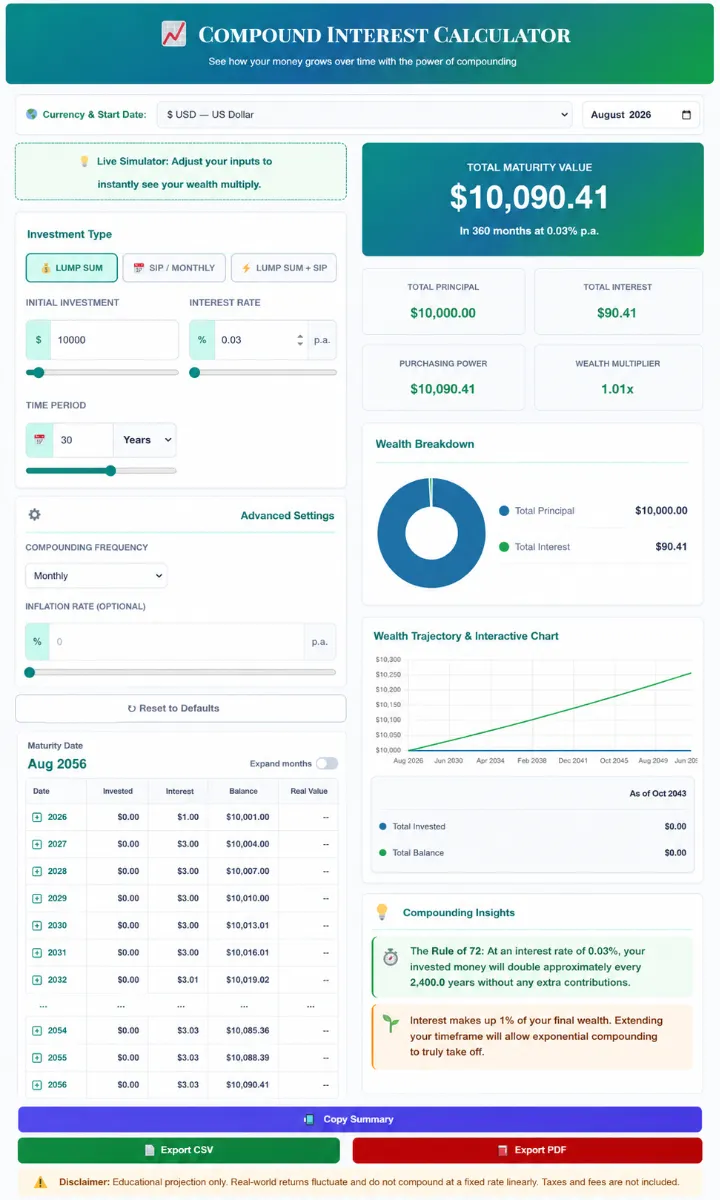
What is an expense ratio and why does it matter? The expense ratio is the percentage of a fund’s assets used annually to cover operating expenses. A 0.03% expense ratio costs you roughly $3 per year for every $10,000 invested. Many large, diversified U.S. index funds and ETFs charge between 0.03% and 0.10%. That’s a real number — and over 30 years, the difference between a 0.03% and a 1.00% fund on the same portfolio is substantial.
FINRA’s investor guidance on fund fees flags several hidden costs that go beyond the expense ratio headline number. Scrutinize any fund for front-end sales loads, back-end deferred loads, and 12b-1 marketing fees. These charges create a drag on returns that compounds over a 30-year investing timeline.
💡 Research note: Both low-cost ETFs and no-load index mutual funds from major providers typically carry expense ratios well under 0.10%. The bigger danger isn’t the ETF vs. mutual fund question — it’s buying any fund with a sales load or a 12b-1 fee on top of the base expense ratio.
💰 Try the SaveXpert Compound Interest Calculator
I ran the same $10,000 initial investment through SaveXpert’s Compound Interest Calculator using a 0.03% and a 1.00% expense ratio over 30 years. The gap at the end was striking. Enter your starting investment, monthly contributions, and swap the return assumptions to see exactly what a fee difference costs you in real dollars.
Educational note: This calculator helps you explore budgeting scenarios and does not provide personalized financial advice. General budgeting guidance: CFPB.
Decision Framework: Which Fund Type Fits Your Strategy?
Which should I choose — an ETF or an index mutual fund? Stop asking which is universally better. Ask which vehicle creates the least friction for your specific strategy and account type. The table below maps common situations to the right vehicle.
Decision Matrix — Which Vehicle Fits Your Account & Strategy?
| Your Priority | Optimal Vehicle | The Reason Why |
|---|---|---|
| Taxable Brokerage Account | ETF | Fewer capital gain distributions keep your tax bill lower. |
| Roth IRA | Either | Tax efficiency matters less; focus on low costs and easy automation. |
| Set-it-and-Forget-it Automation | Index Mutual Fund | Dollar-based automated purchases work seamlessly without brokerage restrictions. |
| Intraday Trading & Limit Orders | ETF | Shares trade on the exchange during market hours with full order-type control. |
Framework compiled by SaveXpert for educational use. Individual circumstances vary; see SEC ETF Investor Bulletin and FINRA fund fee guidance.
How Index Funds and ETFs Work: A Simple Side-by-Side
How do index funds and ETFs work in practice? Imagine investing $500 into two different funds that track the exact same index.
Fund A — Index Mutual Fund: Your broker executes the $500 purchase at the end-of-day NAV. You set up a recurring automated transfer for $500 on the 1st of every month. The fund handles all fractional share math automatically.
Fund B — Index ETF: You buy shares immediately on the exchange at the prevailing market price. You pay a small bid-ask spread. To automate your future $500 monthly contributions, your brokerage needs to explicitly support fractional ETF shares — not all of them do.
Both funds deliver identical market exposure. The choice only changes your trading mechanics, tax behavior, and how easily you can automate.
💡 Research note: Many long-term index investors hold both. ETFs in their taxable brokerage account for tax efficiency, and index mutual funds inside their 401(k) or IRA for hassle-free automated contributions. There’s no rule that says you must pick one forever.
The Bottom Line: 5-Quick-Start Portfolio Checklist
How do I start investing in index funds or ETFs? Before you buy any index product, run through this 5-step checklist to build a low-cost portfolio you’ll actually stick with.
1. Pick a broad index:
Verify exactly what benchmark the fund tracks. Broad diversification — like a total U.S. market or S&P 500 index — is the starting point.
2. Check the expense ratio:
Target options below 0.10% for broad-market products. Check for sales loads and 12b-1 fees using FINRA’s fee guidance.
3. Match the vehicle to the account:
ETFs for taxable brokerage accounts. Either vehicle in tax-sheltered retirement accounts — pick whichever your brokerage makes easier to automate.
4. Automate contributions:
Set up recurring investments on payday. Removing the decision from your monthly to-do list is one of the most reliable things you can do for long-term returns.
5. Ignore market timing:
Build a long-term strategy and don’t let short-term headlines change your contribution schedule. The research on this is consistent.
Low expense ratios and consistent contributions do more work than any vehicle debate. The best index fund or ETF is the low-cost, broadly diversified one you’ll keep buying every month for 20 years.
“What the SEC and FINRA data consistently shows is that the vehicle debate — ETF vs. index mutual fund — is almost never the most important decision. Low expense ratios and consistent contributions do far more work than which wrapper you pick.”
— Kevin Brown, Lead Researcher at SaveXpert.com
Frequently Asked Questions
Ans: No. Index mutual funds simplify exact-dollar automatic investing, making them the better fit for set-and-forget strategies. ETFs hold a clear advantage for investors using taxable brokerage accounts and anyone who wants intraday trading control.
Ans: Both work well. Because Roth IRAs shelter your money from current taxes, the ETF’s structural tax advantage becomes mostly irrelevant. Choose whichever vehicle offers the lowest expense ratio and the easiest automation on your brokerage platform.
Ans: Yes. Both index mutual funds and ETFs collect dividends from the underlying stocks they own and distribute them directly to shareholders. The timing and mechanics differ slightly by vehicle and brokerage, but both pass dividends through.
Ans: Yes. Index funds track market benchmarks, which means they carry full market risk. If the broader stock market falls, so does your index fund or ETF. Past performance never guarantees future returns.
Ans: A bid-ask spread is the difference between what buyers will pay (bid) and what sellers will accept (ask) for ETF shares at any given moment. When you buy, you pay the ask price; when you sell, you accept the bid. The SEC’s ETF Investor Bulletin identifies this as a real trading cost. For widely traded, liquid ETFs tracking major indexes, the spread is typically tiny — but it still exists, unlike index mutual fund NAV transactions.
Ans: For broad U.S. market index funds and ETFs from major providers, expense ratios are now very similar — often 0.03% to 0.10% for both. The more important thing to check, as FINRA’s guidance notes, is whether either vehicle carries hidden costs like sales loads or 12b-1 marketing fees on top of the base expense ratio. Those are the fees that create a real long-term drag.