

ⓘ Educational Disclosure:
This article is for educational and informational purposes only. It does not constitute financial, legal, tax, lending, or investment advice. SaveXpert and its authors are not licensed financial advisors, CPAs, attorneys, or tax advisors. All data comes from publicly available government and institutional sources. Always consult a qualified professional before making investment decisions.
How do you reduce taxable income before December 31, 2026? According to IRS data, the most effective strategies with hard December 31 deadlines include maximizing pre-tax 401(k) employee deferrals (up to $24,500 in 2026), completing tax-loss harvesting transactions, spending remaining FSA balances, and making eligible charitable contributions if you itemize. HSA contributions (up to $4,400 self-only or $8,750 family) and traditional IRA contributions ($7,500 limit) have an extended deadline of April 15, 2027 — giving taxpayers more time for those specific moves.
Key Takeaways
- Problem: Most Americans don’t realize that year-end tax strategies have different deadlines — some expire December 31, while others extend to April 2027. Missing the right one can cost a full year of savings.
- Solution: Maximize pre-tax 401(k) deferrals (up to $24,500 in 2026), spend FSA balances, execute tax-loss harvesting, and make charitable gifts by December 31. HSA and IRA contributions can wait until April 15, 2027.
- Result: IRS data shows completing these transactions before year-end directly lowers adjusted gross income for the 2026 tax year on a dollar-for-dollar basis, within applicable limits.
- Source: IRS 2026 Retirement Plan Contribution Limits, IRS Publication 969 (HSAs)
- Time To Read: 6 Minutes
Table of Contents
1. Why December 31 Is a Hard Deadline — and April 15 Isn’t
2. How a 401(k) Reduces Taxable Income Before December 31, 2026
3. HSA Contributions: Tax Reduction With a More Flexible Deadline
4. Traditional IRA Contributions: Not a December 31 Deadline
5. Tax-Loss Harvesting Before Year-End: The Wash-Sale Rule Matters
6. Charitable Deductions in 2026: The New 0.5% AGI Floor
7. The 2026 Standard Deduction and Tax Bracket Context
8. FSA Balances: A Different Kind of December 31 Deadline
9. What the Research Shows Works (and What Doesn’t)
The IRS set the 2026 401(k) employee deferral limit at $24,500 — up from $23,500 in 2025. That increase matters, but the deadline matters more. Miss December 31 for a workplace retirement deferral and no amount of spring tax preparation will put that contribution back into 2026. The same isn’t true for an IRA or HSA, which both have an April 2027 window. Knowing which deadline applies to which strategy is the most important year-end tax planning move most people skip entirely.
Why December 31 Is a Hard Deadline — and April 15 Isn’t
The biggest confusion in year-end tax planning isn’t knowing which strategies exist. It’s assuming they all share the same calendar. They don’t.
Here’s the deadline map the IRS data shows:
| Strategy | Reduces AGI? | 2026 Limit | Hard Deadline |
|---|---|---|---|
| 401(k) / 403(b) / 457 deferrals | Yes (pre-tax) | $24,500 + catch-up | December 31, 2026 |
| FSA spending (not new contributions) | Already excluded from income | Use existing balance | December 31, 2026 * |
| Tax-loss harvesting | Offsets gains + $3K ordinary income | $3,000 ordinary income cap/yr | December 31, 2026 |
| Charitable donations (itemizers) | Possibly — 0.5% AGI floor applies | 60% of AGI (cash gifts) | December 31, 2026 |
| HSA contributions | Yes (triple tax advantage) | $4,400 / $8,750 | April 15, 2027 |
| Traditional IRA (deductible) | Possibly — income limits apply | $7,500 | April 15, 2027 |
* Unless employer plan offers a grace period or rollover. Source: IRS.gov 2026 guidelines
The four strategies with December 31 deadlines are driven by the tax year itself — they involve transactions that must happen within the calendar year to count. The two with April deadlines have specific IRS provisions that allow contributions made in the first months of 2027 to apply to the 2026 tax year.
💡 Research note: For people with limited time before year-end, the IRS data supports prioritizing December 31 deadlines first. HSA and IRA contributions can be funded in January or February 2027 and still count for 2026 — 401(k) deferrals can’t.

How a 401(k) Reduces Taxable Income Before December 31, 2026
I spent time going through the IRS retirement plan guidance and the 2026 limit announcement. The core mechanism is straightforward: pre-tax 401(k) deferrals reduce adjusted gross income dollar-for-dollar, up to the applicable annual limit.
The IRS raised the 2026 employee deferral limit for 401(k), 403(b), and governmental 457 plans to $24,500, up from $23,500 in 2025. Workers age 50 and older can add a standard catch-up contribution. The age-50+ catch-up rose from $7,500 to $8,000 in 2026.
The 2026 retirement contribution limits at a glance
| Worker Category | 2026 Employee Limit | Combined Maximum |
|---|---|---|
| Under age 50 | $24,500 | $24,500 |
| Age 50–59 (standard catch-up) | $24,500 + $8,000 catch-up | $32,500 |
| Ages 60, 61, 62, 63 (enhanced catch-up) | $24,500 + $11,250 enhanced catch-up | $35,750 |
| Age 64+ (standard catch-up resumes) | $24,500 + $8,000 catch-up | $32,500 |
The enhanced catch-up for ages 60–63
This is the part that surprised me during the research. Workers ages 60, 61, 62, and 63 get a higher catch-up amount — $11,250 in 2026 — rather than the standard $8,000. That’s a provision from the SECURE 2.0 Act. It doesn’t apply to age 64 or older. The window is specifically those four birth-year cohorts.
Why does this matter for December 31 planning? Because payroll has to process the deferral within the 2026 tax year. Employees who want to increase their 401(k) deferral rate need to submit that change to their employer with enough lead time for payroll to capture it before December 31. Many HR systems have cutoff dates for changes several weeks before year-end.
⚠️ Watch the payroll cutoff: A 401(k) deferral isn’t something you can decide on December 31 and still capture for the tax year. Your employer’s payroll system needs time to process the change. Check with HR now — many plans stop accepting deferral rate changes two or three pay periods before the year ends.
HSA Contributions: Tax Reduction With a More Flexible Deadline
Health Savings Accounts offer what the research describes as a triple tax advantage: pre-tax contributions reduce AGI, growth in the account is tax-free, and qualified medical expense withdrawals are tax-free too. The IRS set the 2026 HSA limits under IRS Publication 969 and Revenue Procedure 2025-19.
| Coverage Type | 2026 HSA Contribution Limit | Age 55+ Catch-Up | Total (Age 55+) |
|---|---|---|---|
| Self-only (HDHP) | $4,400 | $1,000 | $5,400 |
| Family (HDHP) | $8,750 | $1,000 | $9,750 |
Source: IRS Publication 969 — Health Savings Accounts · Revenue Procedure 2025-19
The age-55 catch-up stays at $1,000 — it doesn’t get inflation-adjusted the way the base limits do. That’s been true for several years, and the 2026 data confirms it continues.
Here’s what makes HSA planning different from 401(k) planning: you don’t have to fund the 2026 HSA contribution by December 31. The IRS allows HSA contributions for a given tax year to be made up to the April 15, 2027 filing deadline (without extensions), as long as you had qualifying high-deductible health plan coverage in 2026.
That means the HSA doesn’t compete with the 401(k) for December attention. You can handle 401(k) deferrals before December 31 and fund the HSA anytime between January 1 and April 15, 2027 — still counting it toward 2026.

Traditional IRA Contributions: Not a December 31 Deadline
This is one of the most common deadline misunderstandings in tax planning. Traditional IRA contributions for 2026 don’t expire on December 31.
The IRS confirms that 2026 traditional IRA contributions can be made through the tax-return due date — generally April 15, 2027 for most taxpayers, without extensions. Contributions made between January 1 and April 15, 2027 can be designated for 2026.
The 2026 IRA contribution limit is $7,500 for taxpayers under 50. The age-50+ catch-up adds another $1,100, bringing the total to $8,600.
⚠️ The deductibility catch: Not every traditional IRA contribution is deductible. The IRS bases deductibility on filing status, income level, and whether the taxpayer or their spouse participates in an employer retirement plan. A Roth IRA contribution doesn’t reduce taxable income at all — it uses after-tax dollars. Check IRS deductibility thresholds before assuming a traditional IRA contribution will lower your AGI.
Tax-Loss Harvesting Before Year-End: The Wash-Sale Rule Matters
Tax-loss harvesting — selling investments that have declined in value to generate a deductible loss — is one of the few year-end strategies that requires a December 31 transaction, not just a contribution deadline.
What the IRS data shows on losses
Under IRC §1211(b), capital losses offset capital gains dollar-for-dollar. When losses exceed gains, taxpayers can deduct up to $3,000 against ordinary income per year. Any remaining losses carry forward to future tax years — they don’t disappear.
So a taxpayer with $15,000 in realized losses and $5,000 in realized gains can net to $10,000 of losses. That offsets $5,000 in gains (netting to zero), then deducts $3,000 against ordinary income, and carries forward $7,000 to future years. That’s real tax reduction — but the sale must happen by December 31.
The wash-sale rule can disallow the loss
Here’s where it gets complicated. Selling a stock at a loss and buying it back quickly to recapture the position doesn’t count as a harvestable loss. The IRS wash-sale rule under IRC §1091 disallows the loss if the taxpayer purchases “substantially identical” securities within 61 days of the sale — that’s 30 days before plus 30 days after the sale date.
| Scenario | Wash-Sale Result |
|---|---|
| Sell Stock A at a loss on December 15 → rebuy Stock A on December 20 | Loss DISALLOWED — within 30-day window after sale |
| Sell Stock A at a loss on December 15 → rebuy Stock A on January 16, 2027 | Loss ALLOWED — outside the 30-day window |
| Sell Stock A at a loss on December 15 → buy a similar-but-not-identical ETF immediately | Loss ALLOWED — not “substantially identical” |
| Sell cryptocurrency at a loss on December 15 → rebuy same crypto on December 20 | Loss ALLOWED — crypto currently not covered by wash-sale under existing classification |
Source: IRS — Topic No. 409 Capital Gains and Losses · IRC §1091
💡 Research note: The wash-sale rule currently applies to stocks and securities — the research brief notes that cryptocurrency doesn’t fall under the same classification as of 2026. This is an active area of tax policy discussion, and classification could change. Consult a tax professional for current guidance on crypto loss harvesting.
Charitable Deductions in 2026: The New 0.5% AGI Floor
December charitable giving matters for taxpayers who itemize deductions — but 2026 added a rule that changes the calculation.
The research identifies a new 0.5% AGI deduction floor beginning in 2026 for itemizers claiming charitable contribution deductions. Under this rule, only the portion of qualifying charitable gifts that exceeds 0.5% of adjusted gross income becomes deductible.
Here’s what that means in practice. A taxpayer with $100,000 AGI has a $500 floor (0.5% × $100,000). A $1,000 donation to a qualifying public charity produces a deductible amount of $500 — not $1,000. The first $500 falls below the floor. The $1,000 cash gift limit (60% of AGI) for cash contributions still applies as the upper cap.
⚠️ Two separate tests for charitable deductibility: First — do you itemize? Taxpayers who take the standard deduction generally can’t claim charitable contribution deductions. Second — does your total charitable giving exceed the 0.5% AGI floor? Only the amount above that floor is deductible. Both tests need a yes for the deduction to apply.
Cash gifts to qualifying public charities remain subject to the 60% of AGI upper cap. Non-cash contributions and gifts to certain private foundations follow different rules. This is one area where the research consistently recommends verifying the specific deduction rules with a tax professional before year-end giving decisions.
Estimate your tax, effective rate, and take-home pay.
The 2026 Standard Deduction and Tax Bracket Context
Before deciding whether to itemize or take the standard deduction, it helps to see the 2026 numbers together.
| Filing Status | 2025 Standard Deduction | 2026 Standard Deduction | Increase |
|---|---|---|---|
| Single | $15,750 | $16,100 | +$350 |
| Married Filing Jointly | $31,500 | $32,200 | +$700 |
| Head of Household | $23,625 | $24,150 | +$525 |
Source: IRS 2026 Inflation Adjustments
The higher standard deduction means a larger share of taxpayers will find the standard deduction exceeds their itemized deductions — which affects whether charitable contributions, mortgage interest, and state taxes produce any marginal benefit.
2026 tax bracket thresholds worth knowing
The IRS also set the 2026 bracket thresholds. The 10% bracket covers up to $12,400 for single filers and $24,800 for married couples filing jointly. At the other end, the 37% bracket begins above $640,600 for single filers and $768,700 for married couples filing jointly.
These thresholds matter for tax-loss harvesting and charitable giving decisions. A taxpayer in the 22% bracket saves $220 of federal tax for every $1,000 of AGI reduction — not $370. The bracket determines the value of each dollar of deduction or contribution.
💰 Model Your Year-End Tax Savings: SaveXpert Income Tax Calculator
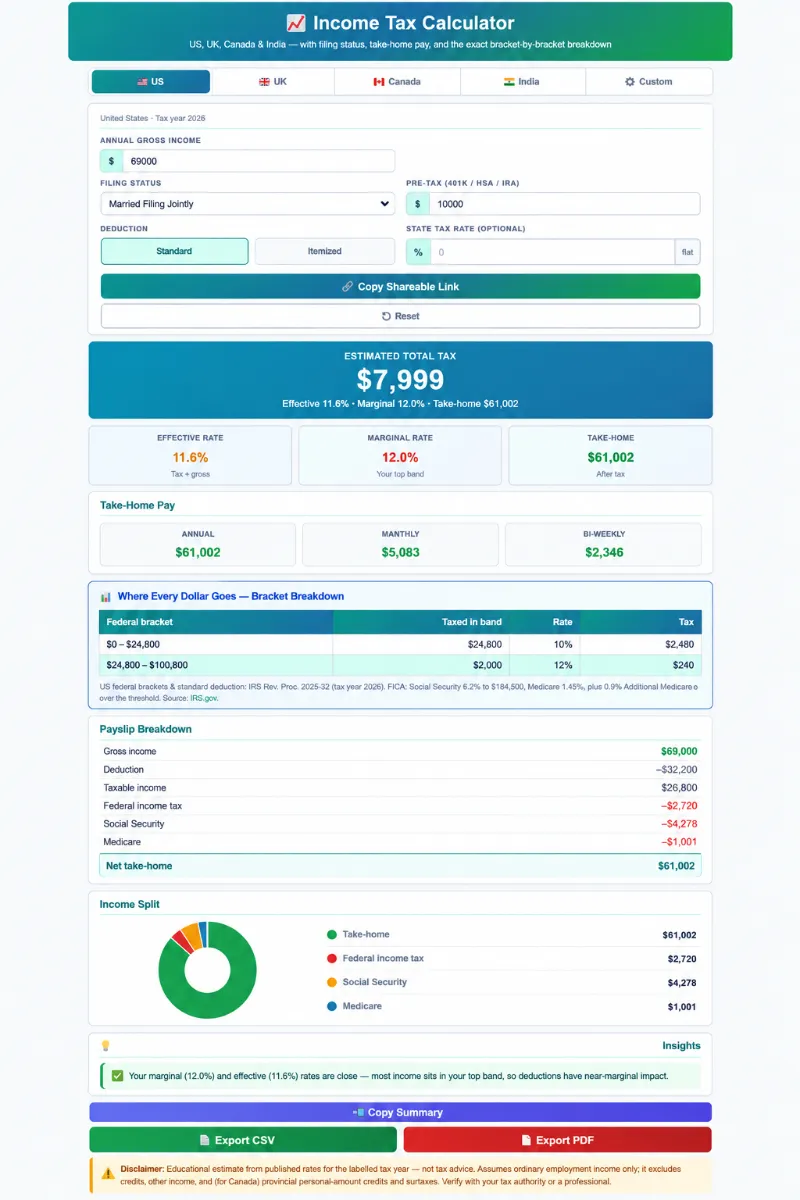
I ran a $10,000 pre-tax 401(k) contribution through the Income Tax Calculator to see how it shifts the income subject to federal tax. The contribution reduces the taxable income figure by $10,000 — not the tax bill by $10,000. What it actually saves depends on the taxpayer’s bracket, other deductions, and filing status. The calculator lets you put in your own numbers and compare your federal tax liability before and after a year-end contribution.
Educational note: This calculator models federal income tax scenarios for informational purposes only and does not provide personalized tax advice. Source: IRS.gov 2026 Tax Guidelines
FSA Balances: A Different Kind of December 31 Deadline
Flexible Spending Accounts create a December 31 issue that’s different from every other strategy on this list. The question isn’t “how much should I contribute?” — it’s “how much is already in the account that I need to spend?”
Under the standard FSA rules, unused funds are forfeited at year-end. That’s the “use it or lose it” provision. Two employer-optional exceptions exist: a grace period (up to 2.5 months into the new year to spend remaining funds) and a limited rollover (up to $640 in 2026 can carry over to the next plan year). But those exceptions depend entirely on what the employer plan offers.
If neither exception applies, a December 31 unused FSA balance doesn’t carry over — it’s forfeited to the plan. That makes the FSA year-end deadline different from a contribution deadline. The task is spending existing funds on qualified medical expenses before the calendar year closes.
💡 Research note: Check your specific employer plan for grace period or rollover provisions. FSA terms are set by the employer within IRS limits — not every plan works the same way. A call to HR or the FSA administrator before December 15 gives you time to plan qualified spending if your balance is significant.

What the Research Shows Works (and What Doesn’t)
What the data consistently supports
Pre-tax 401(k) deferrals with enough payroll lead time.
The IRS confirms these reduce AGI dollar-for-dollar up to the annual limit. The research makes clear this is the most direct income-reduction tool with a hard December 31 deadline. Workers ages 60–63 should specifically check whether the $11,250 enhanced catch-up applies to their plan.
Funding a qualifying HSA — whenever the budget allows.
The triple tax advantage (deductible contributions, tax-free growth, tax-free qualified withdrawals) makes HSA funding one of the most tax-efficient moves available. The April 2027 deadline for 2026 contributions removes the year-end pressure, but the tax benefit is the same whether the contribution happens in November or February.
Tax-loss harvesting executed with wash-sale awareness.
Offsetting capital gains with realized losses, plus the $3,000 ordinary income cap, can produce real tax savings. The execution matters as much as the decision — a December 31 sale that triggers a wash-sale concern before January 30 can disallow the loss entirely.
What the data says doesn’t work
Treating all year-end strategies as interchangeable.
The deadline table at the start of this article shows four different cutoffs. Prioritizing an IRA contribution before December 31 while assuming a 401(k) deadline can wait is backwards — the IRA has the flexible deadline, the 401(k) doesn’t.
Assuming every charitable dollar is fully deductible.
The new 0.5% AGI floor in 2026 means the first portion of charitable giving doesn’t produce a deduction. For a $60,000 AGI household, the first $300 of charitable giving falls below the floor. And none of it is deductible if the taxpayer takes the standard deduction.
Ignoring FSA balances until late December.
Eligible qualified medical expenses take time to process and submit. Waiting until December 28 to check an FSA balance and then scrambling to schedule appointments isn’t a reliable strategy. The research supports checking balances in October or November when time for qualified spending decisions still exists.
Bottom Line: 5 Tax Moves to Complete Before December 31
1. Maximize 401(k) deferrals — and check the payroll cutoff now:
The 2026 limit is $24,500, with $8,000 catch-up for age 50+ and $11,250 for ages 60–63. Contact HR to confirm the last pay period for which deferral rate changes can still be processed before December 31. This is the hardest deadline in year-end tax planning.
2. Check your FSA balance and spend it on qualified expenses:
Unlike an HSA, an FSA balance doesn’t roll over automatically. If your plan doesn’t offer a grace period or rollover, unused funds are forfeited. Check your balance now — not on December 28 — when you still have time to schedule qualifying medical appointments or purchases.
3. Execute tax-loss harvesting — but check the wash-sale window first:
Selling a losing position by December 31 can offset gains and up to $3,000 of ordinary income. Before you sell, check whether you purchased the same or substantially identical securities in the past 30 days — and plan a 30-day hold after the sale before rebuying, or switch to a similar-but-not-identical position immediately.
4. Make eligible charitable contributions if you itemize — and account for the 0.5% AGI floor:
December 31 is the hard cutoff for donations to count in 2026. But first confirm you’ll be itemizing (the 2026 standard deduction is $16,100 single / $32,200 MFJ), and subtract 0.5% of your AGI from the total — only the amount above that floor becomes deductible.
5. Leave HSA and IRA contributions for January–April 2027 if needed:
Both have extended deadlines for 2026 tax year contributions. If cash is tight before December 31, these two strategies don’t require action this month. Use the April 2027 window — and designate the contribution for 2026 when you make it.
“When I went through the IRS releases for 2026, the timing distinction stood out more than the dollar limits. Most people research these strategies but assume they all share the same deadline. They don’t. A 401(k) deferral missed by one day on January 1 is gone for tax year 2026. An IRA contribution missed on January 2 can still be made through April. That difference defines how to sequence year-end moves.”
— Kevin Brown, Lead Researcher at SaveXpert.com
Frequently Asked Questions
Ans: According to IRS data, the most effective legal strategies with December 31 deadlines include maximizing pre-tax 401(k) employee deferrals (up to $24,500 in 2026, plus catch-up contributions for eligible workers), completing tax-loss harvesting transactions, spending remaining FSA balances on qualified expenses, and making eligible charitable contributions if you itemize deductions. Each requires a transaction to occur within the 2026 calendar year — contributions or sales dated January 1 or later won’t count for 2026.
Ans: Yes — pre-tax 401(k) contributions reduce adjusted gross income dollar-for-dollar up to the applicable annual limit. The 2026 employee deferral limit is $24,500. Workers age 50 and older can add an $8,000 standard catch-up, and workers ages 60 through 63 qualify for a higher $11,250 enhanced catch-up under SECURE 2.0 provisions. The contribution must be processed through payroll by December 31 to count for the 2026 tax year.
Ans: Yes — HSA contributions are deductible when the taxpayer has qualifying high-deductible health plan coverage. The 2026 limits are $4,400 for self-only coverage and $8,750 for family coverage, with an additional $1,000 catch-up for taxpayers age 55 and older. Unlike 401(k) deferrals, HSA contributions for the 2026 tax year can be made until the April 15, 2027 filing deadline — so December 31 is not the cutoff for this strategy.
Ans: Unlike workplace 401(k) contributions, 2026 deductible traditional IRA contributions don’t expire on December 31. The IRS allows contributions for the 2026 tax year to be made through April 15, 2027 for most taxpayers. Contributions made between January 1 and April 15, 2027 can be designated as 2026 contributions when submitted. Note that not every taxpayer can claim the full traditional IRA deduction — eligibility depends on income, filing status, and participation in an employer retirement plan.
Ans: Tax-loss harvesting involves selling investments that have declined in value to realize a capital loss. Under IRC §1211(b), those losses offset capital gains dollar-for-dollar. When losses exceed gains, up to $3,000 can be deducted against ordinary income per year, with excess losses carrying forward to future years. The sale must occur by December 31 to count for 2026. The wash-sale rule under IRC §1091 disallows the loss if substantially identical securities are repurchased within 30 days before or after the sale date — the full 61-day window applies.
Ans: Starting in 2026, itemizers claiming charitable contribution deductions face a new 0.5% AGI deduction floor. Only the portion of qualifying charitable gifts that exceeds 0.5% of adjusted gross income is deductible. For example, a taxpayer with $80,000 AGI has a $400 floor — a $1,000 donation to a public charity produces a $600 deductible amount, not $1,000. The 60% of AGI limit on cash gifts to public charities still applies as the upper cap. Taxpayers who take the standard deduction cannot claim charitable contribution deductions at all under current rules.