ⓘ Educational Disclosure:
This guide explains common budgeting frameworks and their trade-offs for educational purposes. It does not provide personalized financial advice, guarantee specific results, or determine which budgeting method is appropriate for your individual circumstances. The “best” budget is the system you can follow consistently. Always consult a qualified professional regarding your specific situation.
What are the best budgeting methods in 2026? The best budgeting methods in 2026 match your income type and behavioral tendencies to a structured system. Top frameworks include the 50/30/20 rule for beginners, zero-based budgeting for aggressive debt payoff, pay yourself first for automated saving, and the envelope system for curbing discretionary overspending.
Key Takeaways
- Problem: Most budgets fail not because the math is wrong, but because the system is too strict to keep up for more than a few weeks.
- Solution: Match a framework to how you actually live — 50/30/20 for simplicity, zero-based for debt payoff, pay yourself first for automation, envelopes for overspending.
- Result: A repeatable, mostly automated plan that funds savings and debt payoff without demanding you track every penny forever.
- Source: CFPB — How to create a budget and stick with it, Federal Reserve SHED 2024
- Time To Read: 9 Minutes
Table of Contents
1. The 50/30/20 Rule: The Best Beginner Budgeting Framework
2. Zero-Based Budgeting: Best for Aggressive Debt Payoff
3. Pay Yourself First: The Automated “Reverse Budgeting” Method
4. The Envelope System & Digital Cash Stuffing
5. Zero-Based Budgeting vs. 50/30/20: What Is the Difference?
6. Pay Yourself First vs. Zero-Based Budgeting
7. Decision Framework: Which Budgeting Method Fits Your Life?
8. Which Budgeting Method Is Best for Debt Payoff?
9. How to Budget Variable Income
Here’s a number that reframes the whole conversation about budgeting. In the Federal Reserve’s 2024 Survey of Household Economics and Decisionmaking, 37% of U.S. adults said they couldn’t cover a surprise $400 expense with cash. A budget won’t fix that overnight. But the right system — one you’ll actually keep using — is how most people close that gap.
Budgeting fails when it feels like punishment. A spreadsheet can be mathematically perfect and still be useless if you abandon it after two weeks. The real goal isn’t controlling every dollar forever — it’s building a repeatable system that helps you spend intentionally and save consistently.
The 50/30/20 Rule: The Best Beginner Budgeting Framework
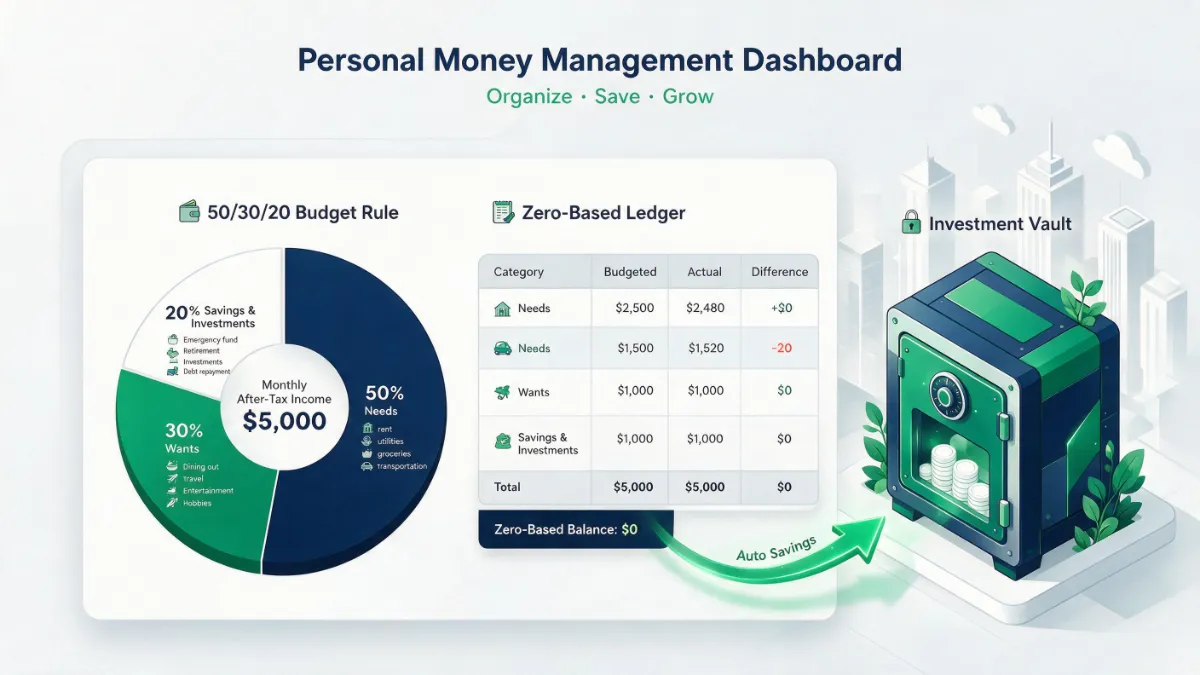
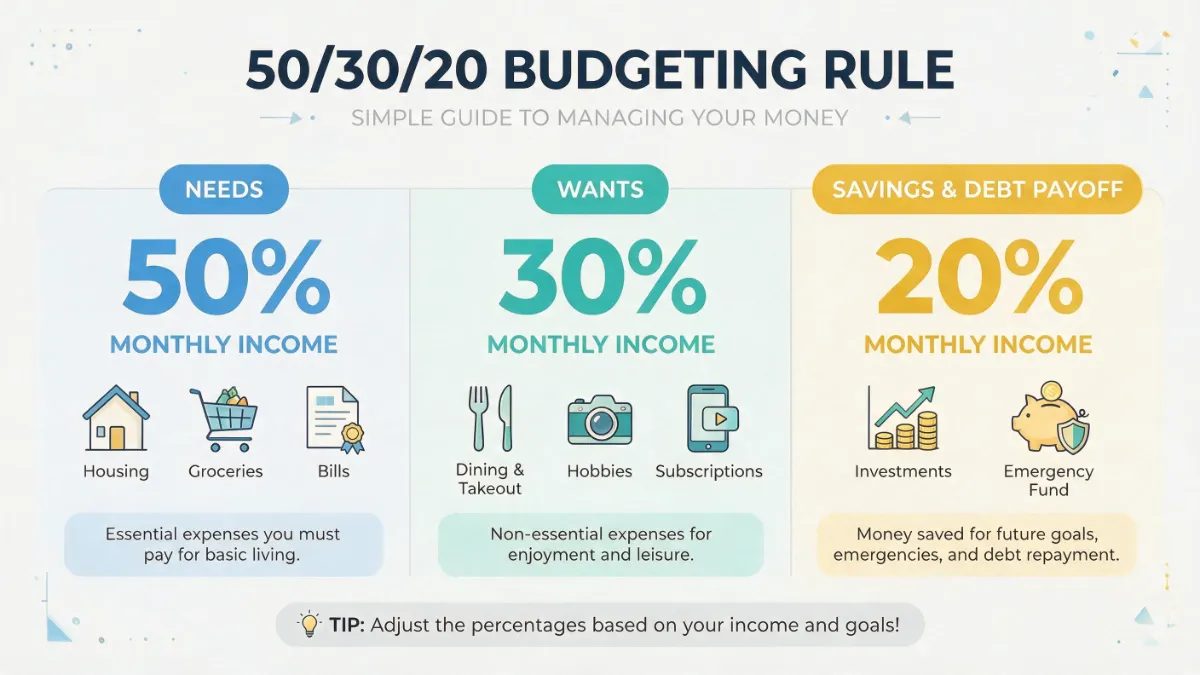
What is the 50/30/20 budget rule? The 50/30/20 rule divides your after-tax take-home pay into three buckets: 50% for essential needs, 30% for discretionary wants, and 20% for savings and extra debt repayment. It gives you broad guardrails without line-item expense tracking.
The idea is simple: split your after-tax income into three broad buckets. Instead of tracking dozens of tiny categories, you keep the three major areas of your financial life in balance.
Table 1 — The 50/30/20 Rule Breakdown
| Category | Allocation | Typical Expenses |
|---|---|---|
| Needs | 50% | Housing, utilities, groceries, transportation, minimum debt payments, essential insurance |
| Wants | 30% | Dining out, entertainment, streaming subscriptions, hobbies, travel, lifestyle upgrades |
| Savings & Debt | 20% | Emergency fund, retirement accounts, investments, extra debt payments, sinking funds |
Source: 50/30/20 framework popularized in All Your Worth (Warren & Warren Tyagi, 2005). Needs vs. wants guidance: CFPB — Budgeting for needs and wants.
Needs are the expenses that keep your basic life running. Wants are the discretionary choices that improve your lifestyle but aren’t strictly necessary. The remaining 20% builds future security and speeds up debt reduction.
Adjusting for High Cost of Living (HCOL) Areas
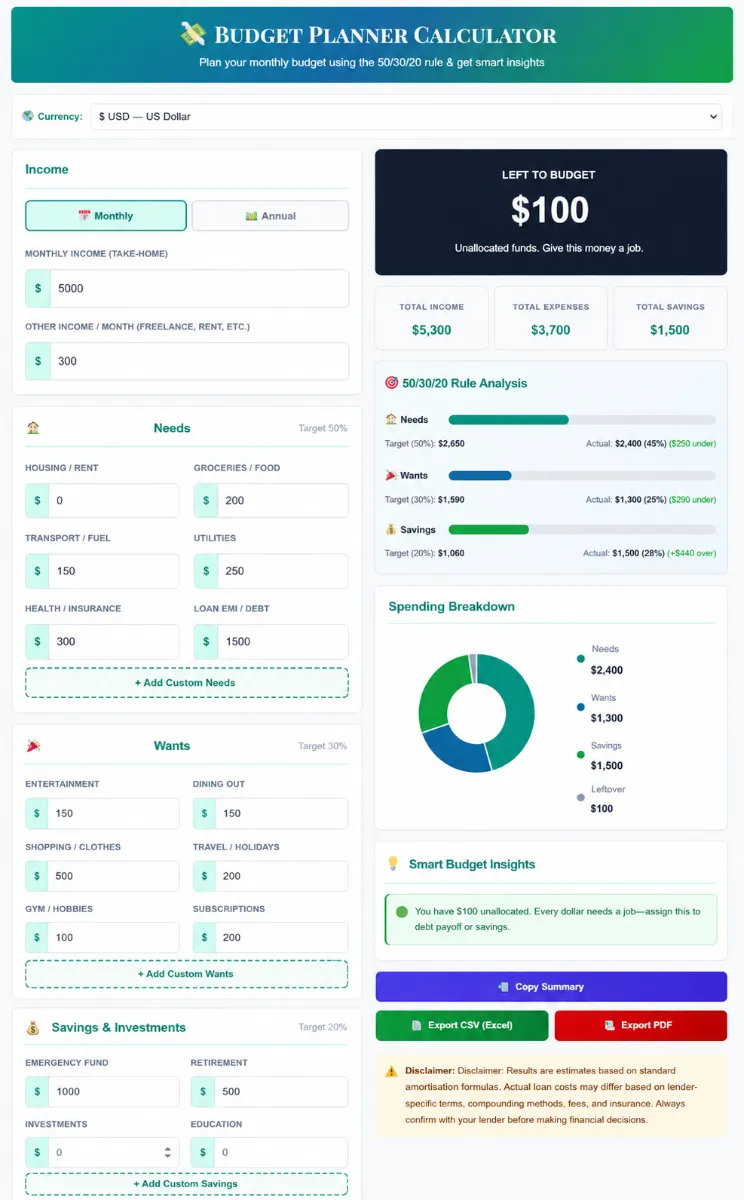
If housing eats more than 35% of your take-home pay, holding total needs under 50% gets hard. In high-cost areas, households often shift to 60/25/15 or 65/25/10.
Take a $5,000 monthly take-home pay. An adjusted split might set $3,000 for Needs (60%), $1,250 for Wants (25%), and $750 for Savings/Debt (15%). The percentages move, but every dollar keeps a clear job.
💰 Try the SaveXpert Budget Planner Calculator
I ran a few take-home figures through SaveXpert’s Budget Planner to see how the buckets shift in high-cost areas — the standard 50/30/20 and an adjusted 60/25/15 sit side by side in seconds. Enter your take-home pay, adjust the allocations, and watch your Needs, Wants, and Savings buckets update in real time.
Educational note: This calculator helps you explore budgeting scenarios and does not provide personalized financial advice. General budgeting guidance: CFPB.
Zero-Based Budgeting: Best for Aggressive Debt Payoff
How does zero-based budgeting work? Zero-based budgeting (ZBB) assigns every dollar of expected income to a specific category before the month begins. The formula Income − All Assigned Expenses = $0 makes sure all earnings go deliberately toward expenses, savings, or debt.
Zero-Based Budgeting in Action
Take a monthly take-home income of $4,500. Under zero-based budgeting, you assign the full balance across designated categories:
- Housing & Utilities: $1,800 total ($1,500 rent/mortgage + $300 utilities & insurance).
- Everyday Living: $900 total ($500 groceries + $400 transportation).
- Debt & Savings: $1,500 total ($500 minimum debt + $500 extra debt payoff + $500 savings).
- Discretionary: $300 lifestyle spending.
Total assigned equals $4,500, leaving a planned balance of $0. That level of control makes ZBB unusually effective for debt snowball or debt avalanche plans.
💸 Quick 50/30/20 Budget Check
Enter your income and top expenses to see where you stand.
Needs (50%)
Wants (30%)
Savings (20%)
Pay Yourself First: The Automated “Reverse Budgeting” Method
What is the pay yourself first budgeting method? Pay Yourself First (reverse budgeting) prioritizes savings by automatically routing a set percentage of income — typically 10%–20% — into savings and investments on payday. You then spend freely from the remaining balance without tracking every item.
Pay yourself first flips traditional budgeting upside down. Instead of saving whatever’s left at month-end, you save first and build your lifestyle spending around the leftover balance.
Reverse Budgeting Workflow
- Select a savings rate: Pick a realistic target, such as 10% to 20% of net income.
- Automate on payday: Schedule automatic transfers to your emergency fund, 401(k), IRA, or sinking funds.
- Spend the remainder: Cover recurring fixed bills and variable lifestyle expenses from what’s left.
On a $5,000 net income, automating $750 (15%) into savings leaves $4,250 for all living expenses. This method fits steady-income earners who want hands-off consistency.
The Envelope System & Digital Cash Stuffing
How does the envelope system work for budgeting? The envelope system allocates cash to physical envelopes labeled for variable spending categories like groceries and dining out. Once an envelope is empty, spending stops for that cycle. Digital versions use separate sub-accounts to get the same result.
If discretionary overspending is your main challenge, the envelope system draws a hard spending line. Physical cash creates a tactile barrier that prevents mindless card swiping.
In 2026, digital envelope budgeting copies that discipline electronically. Using digital sub-accounts or budgeting apps, you can assign set balances to categories like Groceries ($500), Dining Out ($200), and Entertainment ($100) without carrying physical cash.
Zero-Based Budgeting vs. 50/30/20: What Is the Difference?
What is the difference between zero-based budgeting and 50/30/20? The 50/30/20 rule groups your income into three broad percentage targets, prioritizing simplicity and flexibility. Zero-based budgeting tracks every dollar individually until your unallocated balance reaches zero, giving you tighter control and precision for specific goals.
Table 2 — Zero-Based Budgeting vs. 50/30/20 Comparison
| Feature | 50/30/20 Rule | Zero-Based Budgeting (ZBB) |
|---|---|---|
| Core Philosophy | Broad percentage targets | Every dollar gets a specific job |
| Complexity | Low | High |
| Tracking Required | Moderate (category-level) | High (transaction-level) |
| Best For | Beginners and simplicity | Control and aggressive goals |
| Debt Payoff Power | Moderate to Good | Excellent |
| Maintenance Effort | Minimal monthly review | Active adjustments throughout the month |
Framework comparison compiled by SaveXpert. General budgeting guidance: CFPB — How to create a budget and stick with it.
Pay Yourself First vs. Zero-Based Budgeting
How does pay yourself first compare to zero-based budgeting? Pay Yourself First automates savings upfront with minimal transaction tracking, which suits hands-off savers. Zero-based budgeting requires detailed tracking of all income and expenses, which makes it better for spotting spending leaks and clearing debt.
Table 3 — Pay Yourself First vs. Zero-Based Budgeting Comparison
| Attribute | Pay Yourself First | Zero-Based Budgeting |
|---|---|---|
| Primary Focus | Automated savings growth | Complete spending control |
| Effort / Tracking | Low maintenance | High ongoing maintenance |
| Automation Potential | High (set-and-forget transfers) | Moderate (requires manual oversight) |
| Ideal User | Predictable W-2 income earners | Detail-oriented planners & debt reducers |
| Key Vulnerability | May conceal discretionary leaks | Can lead to spreadsheet fatigue |
Framework comparison compiled by SaveXpert. General budgeting guidance: CFPB.
Decision Framework: Which Budgeting Method Fits Your Life?
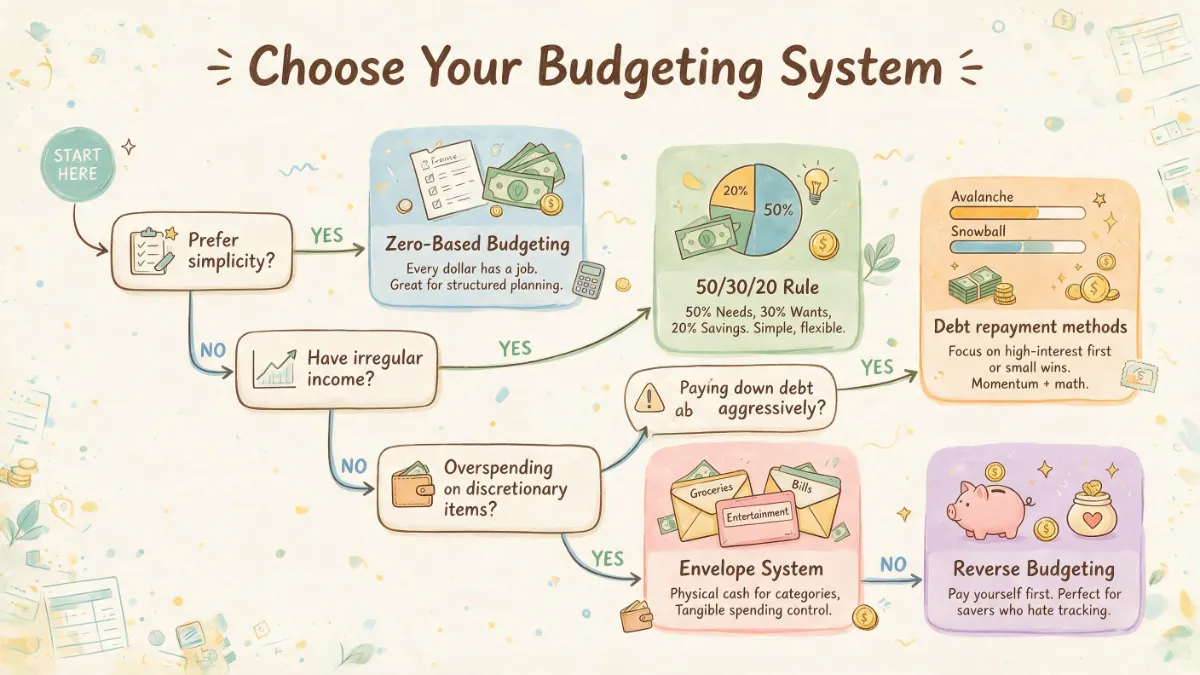
How do I choose the best budgeting method? Choose your budgeting method by matching your personality and goals to the framework: pick 50/30/20 for beginner simplicity, zero-based budgeting for strict debt payoff, pay yourself first for automated saving, or envelopes for curbing overspending.
Table 4 — Quick Matching Table (Situation to Best-Fit Method)
| Your Current Situation | Best-Fit Budgeting Method |
|---|---|
| Beginner seeking a simple, low-stress start | 50/30/20 Rule |
| Living in a high cost of living area | Adjusted 50/30/20 (e.g., 60/25/15) |
| Aggressively paying down high-interest debt | Zero-Based Budgeting |
| Freelancer or variable income earner | Zero-Based Budgeting + Baseline Buffer |
| Dislike tracking every expense; prefer automation | Pay Yourself First |
| Prone to overspending on dining and shopping | Envelope System (Cash or Digital) |
Matching guide compiled by SaveXpert for educational use. Individual circumstances vary; see CFPB budgeting resources.
💡 Research note: You don’t have to pick just one. A common hybrid manages macro targets with 50/30/20, automates savings with Pay Yourself First, and applies digital envelopes strictly to a leaky category like dining out.
Which Budgeting Method Is Best for Debt Payoff?
Which budgeting method is best for debt payoff? Zero-based budgeting is the strongest method for aggressive debt payoff. It accounts for every dollar, which lets you deliberately channel all surplus cash into a structured debt snowball or debt avalanche plan.
Zero-based budgeting closes hidden financial leaks and stops unassigned cash from drifting into discretionary buys. By assigning every surplus dollar to your debt target, you speed up repayment.
A modified 50/30/20 framework can work too, by temporarily lifting the savings-and-debt category to 30% or 40%. But ZBB gives you the direct visibility that shortens repayment timelines.
How to Budget Variable Income
How do you budget with a variable income? To budget a variable income, calculate a conservative baseline using your lowest-earning recent months. Fund essential needs from that baseline and keep a 1-to-3-month expense buffer, sending surplus earnings from high-income months to savings and debt.
Variable income makes fixed-percentage budgeting tricky. A freelancer earning $6,000 one month and $3,500 the next risks a shortfall if fixed spending is anchored to peak earnings.
Build your core spending plan around your lower-income baseline — say $3,800. Keep a cash buffer covering one to three months of baseline expenses to absorb seasonal dips. When income tops the baseline, steer the extra toward emergency reserves, tax obligations, and investments.
The Bottom Line: 5-Step Quick-Start Action Plan
How do I set up a budget in 30 days? To set up a budget in 30 days, calculate your monthly take-home pay, pick one core framework, audit three months of bank statements, configure your categories or automated transfers, and run a 30-day review to adjust your allocations.
The best budgeting method in 2026 is the one you can sustain. Here’s a research-based 5-step plan to launch yours over the next 30 days:
1. Calculate monthly take-home pay:
Use your true after-tax income, or a conservative baseline if your earnings fluctuate.
2. Select one primary method:
Match the framework to your goal — 50/30/20 for simplicity, ZBB for control, Pay Yourself First for automation, or Envelopes for category limits.
3. Audit 90 days of statements:
Spot recurring fixed bills, forgotten subscriptions, and your average discretionary spending.
4. Set up categories and automations:
Build your 50/30/20 buckets, zero-based line items, or automated payday transfers.
5. Run a 30-day review:
Check your actual spending at month-end, adjust category limits without self-judgment, and refine for the next cycle.
Pick one framework, automate what you can, and give it a full month before you judge it. The system you’ll still be using in March beats the perfect one you quit in January.
“What the research on budgeting keeps showing is that the method matters far less than whether you’ll stick with it. The systems that survive aren’t the strictest ones — they’re the repeatable, automated ones that fit the habits someone already has.”
— Kevin Brown, Lead Researcher at SaveXpert.com
Frequently Asked Questions
Ans: The 50/30/20 rule is widely considered the easiest method for beginners because it uses three broad categories (50% Needs, 30% Wants, 20% Savings/Debt) instead of requiring itemized tracking for every purchase.
Ans: To budget with irregular income, base your core living expenses on a conservative estimate of your lowest recent monthly earnings. Keep a 1-to-3-month expense buffer in savings and allocate extra income from peak months directly into reserves or debt reduction.
Ans: In high-cost areas where housing exceeds 35% of income, a standard 50% allocation for needs may not be possible. In these cases, adjusting the ratio to 60/25/15 or 65/25/10 provides a more practical, sustainable structure.
Ans: Cash stuffing is the physical version of the envelope budgeting system. You withdraw physical cash for discretionary categories (like groceries and dining out) and place it into labeled envelopes, stopping spending in each category once its envelope is empty.
Ans: Zero-based budgeting is the most effective method for aggressive debt repayment because it assigns every available dollar a designated task, allowing you to route all surplus funds into your debt payoff plan.
Ans: Yes. Many people run a hybrid system: manage macro targets with 50/30/20, automate savings with Pay Yourself First, and apply digital envelopes to a single leaky category like dining out. The best combination is whichever one you can maintain consistently.