

ⓘ Educational Disclosure:
This article is for educational and informational purposes only. It does not constitute financial, legal, tax, lending, or investment advice. SaveXpert and its authors are not licensed financial advisors, CPAs, attorneys, or tax advisors. All data comes from publicly available government and institutional sources. Always consult a qualified professional before making investment decisions.
How do you negotiate a raise at a year-end review in 2026? According to the Bureau of Labor Statistics Employment Cost Index, private-sector wages grew 3.1% nominally over the year ending June 2026 — but real wages fell 0.4% after inflation. Research shows the most effective approach combines documented individual accomplishments with that broader labor market context. Survey data indicates roughly 66% of workers who ask receive at least a partial increase. Workers who don’t ask receive only the employer’s default offer.
Key Takeaways
- Problem: Nominal wages rose 3.1% in 2026, but real wages fell 0.4% after inflation — meaning most workers are losing purchasing power even when they receive a raise that matches the market average.
- Solution: The research shows the most effective negotiation approach combines documented individual accomplishments with official BLS labor market data — giving the conversation a factual foundation rather than an emotional one.
- Result: Survey data shows roughly 66% of workers who ask for a raise receive at least part of what they request. Workers who don’t ask tend to receive only the employer’s default offer.
- Source: BLS Employment Cost Index (June 2026), Atlanta Fed Wage Growth Tracker (July 2026)
- Time To Read: 8 Minutes
Table of Contents
1. Why 2026 Year-End Negotiations Look Different
2. What BLS Wage Data Shows About Raises in 2026
3. What Real Wages Say — and Why the Gap Matters
4. How to Prepare for the Salary Negotiation Conversation
5. What to Say When Your Manager Says There’s No Budget
6. Should You Have Another Job Offer Before Negotiating?
7. A Realistic Raise Percentage to Ask For in 2026
8. What Changed at BLS in 2025 and 2026
9. What the Research Shows Works (and What Doesn’t)
10. Bottom Line: 5 Steps to Prepare Your Year-End Raise Request
Private-sector wages rose 3.1% in the 12 months ending June 2026. Real private-sector wages fell 0.4% over the same period after inflation. That gap — between what nominal wages look like on paper and what they actually buy — is the factual backdrop for every year-end raise conversation happening right now. Going into that conversation without knowing those numbers puts you at a disadvantage before you’ve said a word.
Why 2026 Year-End Negotiations Look Different
The environment for raise conversations changed between 2024 and 2026. Wage growth slowed — the BLS Employment Cost Index shows private-sector wage growth dropped from 3.9% in 2024 to 3.1% by mid-2026. That’s a meaningful shift in the labor market’s momentum.
At the same time, one common assumption about year-end negotiations doesn’t hold up in the official data. Many workers assume January budgets create a universal window that makes December the best time to ask. The BLS, IRS, CFPB, and Federal Reserve don’t track the success rates of annual review negotiations by month. No official U.S. data source supports calling December or January universally “the best” time.
Third-party career research points to a different framing: timing around your employer’s specific budget cycle and periods after visible, measurable accomplishments matters more than the calendar month. Budget cycles vary by company — some set headcount and compensation budgets in September, others in November, others at the start of the fiscal year. Knowing your employer’s cycle is more useful than assuming December is the right moment.
💡 Research note: No federal agency tracks negotiation success rates by month or season. The BLS, CFPB, and Federal Reserve measure wage aggregates across the full labor market — not the outcomes of individual salary conversations. The year-end timing assumption comes from private career guidance, not official data.
What BLS Wage Data Shows About Raises in 2026
I went through the BLS Employment Cost Index, Current Employment Statistics, Occupational Employment and Wage Statistics, and Current Population Survey data. Here’s what those measures actually show.
| BLS Measure | Figure | Period | Source |
|---|---|---|---|
| Private-industry wages and salaries (nominal) | +3.1% | 12 months ending June 2026 | BLS ECI |
| Total compensation costs (wages + benefits) | +3.3% | 12 months ending June 2026 | BLS ECI |
| Benefit costs alone | +3.8% | 12 months ending June 2026 | BLS ECI |
| Average private-sector hourly earnings | $37.64 | June 2026 | BLS CES |
| Year-over-year hourly earnings growth | +3.5% | June 2026 YoY | BLS CES |
| Average annual wage (all occupations) | $69,770 | May 2025 | BLS OEWS |
| Median annual wage (all occupations) | ~$51,000 | May 2025 | BLS OEWS |
| Median weekly earnings (full-time) | $1,251 (~$65,052/yr) | Q2 2026 | BLS CPS |
| Unemployment rate | 4.1% | August 2026 | BLS CES |
| Atlanta Fed Wage Growth Tracker | 3.8% | July 2026 | Atlanta Fed |
| Job changers wage growth | 4.4% | July 2026 | Atlanta Fed |
| Job stayers wage growth | 3.6% | July 2026 | Atlanta Fed |
Source: BLS Employment Cost Index · BLS Current Employment Statistics · BLS OEWS · Atlanta Fed Wage Growth Tracker
Two things about this table are worth naming directly. First, the BLS measures describe broad national wage movement — not what any individual employer will approve. Second, wage growth of 3.1% to 3.5% across these measures doesn’t translate into a standard raise percentage. An employer considers performance, internal pay structures, company finances, and its own budget cycle alongside whatever the BLS reports.
⚠️ The job-changer vs. job-stayer gap: The Atlanta Fed data showing 4.4% growth for job changers versus 3.6% for stayers reflects a market reality. Changing employers has historically produced faster wage growth than staying — and that gap has been consistent for several years. It doesn’t mean internal negotiation is pointless. It means internal negotiation needs to be active, not passive.
What Real Wages Say — and Why the Gap Matters
This is the finding that stood out most when I went through the data.
The BLS Employment Cost Index shows private-industry wages and salaries grew 3.1% nominally in the 12 months ending June 2026. Adjusted for inflation, those same wages declined 0.4% in real terms. Separately, BLS real average hourly earnings data (published August 18, 2026) shows a 0.2% real decline from July 2025 to July 2026.
These are two different measures, but they tell the same story: nominal wages went up, and purchasing power still fell.
That changes how to frame a raise conversation. Inflation isn’t a legal entitlement to a matching raise — no federal law requires employers to adjust wages for CPI changes. But the real wage data gives any worker a factual case for why a 3% offer may not actually be a real increase at all.
Third-party salary surveys cited in the research put 2026 pay-raise budgets around 3.4%–3.6% on average. Those figures come from private surveys, not BLS — so they shouldn’t be treated as official benchmarks. But they do suggest many employers are budgeting in a range that, after inflation, produces flat or slightly negative real wage outcomes for employees who receive only the budget average.
💡 Research note: The real wage decline doesn’t create an automatic negotiating claim. What it does is give the conversation a factual foundation. A worker who says “the BLS data shows real wages fell 0.4% this year” is making a specific, verifiable statement — not an emotional one. That’s a different kind of opening.
How to Prepare for the Salary Negotiation Conversation
I want to be direct about what the official data does and doesn’t cover here. The BLS, IRS, CFPB, and Federal Reserve don’t publish optimal negotiation scripts. Salary negotiation sits outside their statistical mandates. What they do publish is wage context — and context is what makes a conversation grounded.
What the academic research found
A field experiment involving 3,858 technology job seekers — associated with researchers at Harvard, Brown, and UCLA — found that salary negotiators improved compensation by an average of 12.45%, or roughly $27,000 per year. This isn’t official government research, but it’s a peer-reviewed finding, and the scale of the study makes the result meaningful.
Pew survey data found that 28% of workers received the full amount they requested when they negotiated, and another 38% received a partial increase. That’s roughly a 66% success rate among people who asked. Fidelity’s research from the same period found 85% of Americans who negotiated received at least part of the increase they requested.
A practical preparation structure
The research points toward three categories of information to bring to the conversation:
| Category | What to Prepare | Why It Matters |
|---|---|---|
| Individual accomplishments | Specific outcomes with measurable results — revenue generated, costs reduced, projects delivered, problems solved | Connects your raise request to value already demonstrated, not anticipated |
| Expanded responsibilities | Document any scope changes since your last compensation review — new reports, new clients, new systems owned | Makes the case that your current salary no longer reflects your current role |
| Market context | BLS wage data, the real wage figure, industry-specific BLS OEWS data for your occupation | Grounds the number you’re asking for in external data, not a personal preference |
Source: BLS Occupational Employment and Wage Statistics · BLS Employment Cost Index
The BLS OEWS database provides median and mean wages by occupation and geographic area. Looking up your specific occupation code gives you a credible external benchmark — not a private salary site estimate, but a federal statistical dataset that carries more weight in a professional conversation.
What to Say When Your Manager Says There’s No Budget
The research brief makes a specific finding on this: a “no budget” response is typically an internal business decision, not a federal compliance limitation. No federal law requires an employer to give raises or to negotiate them.
What federal employment law actually covers
| Law | What It Covers | What It Doesn’t Cover |
|---|---|---|
| Fair Labor Standards Act (FLSA) | Minimum wage, overtime, recordkeeping | Required raises or salary negotiation rights |
| National Labor Relations Act (NLRA) | Right to discuss wages with coworkers; protected concerted activity | Right to receive a raise |
| Equal Pay Act | Prohibits sex-based wage discrimination for equal work | Required pay increases outside discrimination context |
| Title VII (EEOC) | Employment discrimination including compensation decisions | Required negotiation outcomes |
| IRS / Internal Revenue Code | Tax raises as ordinary income | Rules on negotiation timing or raise amounts |
Source: DOL — FLSA · NLRB · EEOC
A “no budget” answer closes the current conversation — it doesn’t close the door permanently. The practical response the research points to: ask what the budget cycle looks like and what specific accomplishments or milestones would justify revisiting compensation in the next quarter. That shifts the conversation from a flat rejection to a conditional roadmap — and gives you something concrete to work toward.
💡 Research note: The NLRA protects employees’ rights to discuss wages with colleagues. If you’ve been told not to discuss your salary with coworkers, that’s worth knowing: in most private-sector workplaces, blanket prohibitions on wage discussions between employees aren’t enforceable under federal law.

Should You Have Another Job Offer Before Negotiating?
The research doesn’t establish that an outside offer is required before negotiating internally. But the data around it is worth understanding.
Third-party research reports that 58% of job seekers accepted their first salary offer without negotiating at all. Among those who did negotiate, average starting compensation increased by 7.4%. Fewer than 1% of job offers were rescinded because a candidate negotiated.
That last data point matters. The research shows the risk of asking is very low. The risk of not asking is concrete: you leave the default offer as the final number.
An outside offer can provide one specific type of leverage: external market validation of what your skills are worth at this moment. But the research brief doesn’t establish that an outside offer automatically produces a successful internal raise — and it doesn’t suggest workers should obtain one before asking internally.
What it does suggest is that job changers consistently see higher wage growth than job stayers in the BLS data. The Atlanta Fed’s July 2026 figures — 4.4% for changers versus 3.6% for stayers — reflect that reality. That’s not a prescription to leave. It’s context for understanding what your skills might command externally, which is useful information whether or not you ever share it with a manager.
Estimate your tax, effective rate, and take-home pay.
A Realistic Raise Percentage to Ask For in 2026
The research doesn’t support a single “right” percentage — and I want to be clear about why. The BLS measures describe national aggregate wage movement. They don’t tell an individual employee what their employer can or will approve.
With that said, the data does create a useful range for framing a request:
| Data Point | Figure | Source |
|---|---|---|
| BLS private-sector wage growth (nominal) | 3.1% | BLS ECI, 12 months ending June 2026 |
| BLS average hourly earnings growth | 3.5% | BLS CES, YoY June 2026 |
| Atlanta Fed Wage Growth Tracker | 3.8% | Atlanta Fed, July 2026 |
| Third-party pay-raise budget surveys | 3.4%–3.6% | Multiple private surveys (not BLS) |
| Real wage growth (inflation-adjusted) | -0.4% | BLS ECI, same period |
Source: BLS ECI · BLS CES · Atlanta Fed
A 3.1% nominal raise matches the broad market average but produces a real-terms pay cut after inflation. A request grounded in individual accomplishments — with the real wage data as context — has a stronger factual basis than citing a percentage alone.
The academic field experiment found negotiators improved compensation by 12.45% on average among tech job seekers. That’s a hiring negotiation, not an internal raise conversation, and the population is specific. It doesn’t translate directly into a target percentage for a year-end review. But it does show that the gap between what you ask for and what an employer opens with can be substantial — and that asking moves the number.
💰 See the After-Tax Difference: SaveXpert Income Tax Calculator
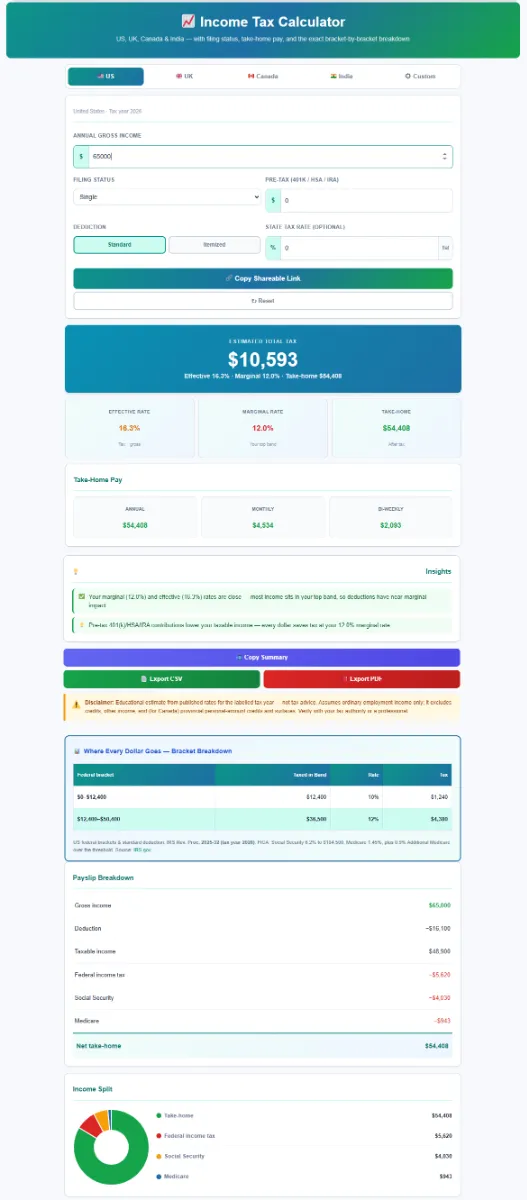
I ran a raise scenario through the Income Tax Calculator to check what a 3.5% increase on a $65,000 salary actually produces after federal income tax, Social Security, and Medicare. The gross increase was $2,275. The after-tax addition to take-home pay was noticeably smaller — which matters when comparing a 3% offer to a 5% counteroffer. The headline percentage can look different once you see the actual dollars.
Educational note: This calculator models federal income tax scenarios for informational purposes only and does not provide personalized financial or career advice. Source: IRS Tax Topic 401
What Changed at BLS in 2025 and 2026
A few developments in the BLS data infrastructure are worth knowing about — they affect how wage figures are published and interpreted.
New ECI relative-importance estimates
Beginning with the June 2026 ECI publication, the BLS added relative-importance estimates to its Employment Cost Index database. These estimates help measure how much each industry and occupation group contributes to overall wage and benefit cost changes. For workers in high-relative-importance sectors, this data can make occupation-specific BLS benchmarks more useful in a negotiation.
2025 QCEW annual averages published
BLS published its 2025 Quarterly Census of Employment and Wages annual averages on August 28, 2026. The release covers 155.7 million workers and $12.3 trillion in total wages — the broadest single-year compensation dataset BLS produces. Occupation-level wage data from this release can supplement ECI figures when making a case for industry-specific compensation comparisons.
October 2025 government shutdown created a data gap
A federal government shutdown in October 2025 created a gap in BLS data releases, affecting ECI and Current Population Survey publications during that period. That gap means some 2025 quarterly figures in the ECI series have slightly irregular spacing. When citing BLS figures in a negotiation, it’s worth using the June 2026 ECI data — which covers the full 12-month period ending June 2026 — rather than any quarter-specific 2025 figure that may reflect the shutdown disruption.
What the Research Shows Works (and What Doesn’t)
What the data consistently supports
Combining individual documented results with market data.
The research consistently points to this combination as the strongest foundation for a raise conversation. BLS figures alone don’t make the case — they show what the market did broadly. Your documented accomplishments show what you specifically contributed. Both together are stronger than either alone.
Asking — even when the outcome is uncertain.
The Pew data showing 66% receive something after asking, and the Fidelity finding of 85%, both point to the same pattern: asking produces better outcomes than not asking. The risk of the offer being rescinded for negotiating is documented at less than 1% in third-party research.
Using BLS OEWS occupation-level data.
The BLS Occupational Employment and Wage Statistics database lets workers look up median and mean wages for their specific occupation in their geographic area. That’s a more precise benchmark than national averages — and it comes from a federal statistical agency rather than a commercial salary site.
Understanding the employer’s budget cycle before asking.
Third-party career research points to timing around budget cycles rather than calendar months. A request made after a company’s compensation budget has already been finalized faces a different conversation than one made during the planning window.
What the data doesn’t support
Treating BLS aggregate wage figures as a guaranteed raise standard.
The BLS measures national wage movement. An employer that approved 2.5% raises last year is not obligated to match the 3.1% BLS figure this year. Citing BLS data sets context — it doesn’t create a legal or contractual entitlement.
Assuming year-end is universally the best time.
No federal data source supports this. Budget cycles vary. A December conversation can be excellent timing or the worst possible moment depending on when your employer’s budget was set. Know the cycle.
Anchoring only on the nominal raise percentage.
The Income Tax Calculator makes clear what different gross percentages actually mean in after-tax take-home pay. A 3% raise on a $65,000 salary produces a different take-home increase than a 3% raise on a $120,000 salary. The percentage alone doesn’t tell the full story.

Bottom Line: 5 Steps to Prepare Your Year-End Raise Request
1. Know the BLS numbers before you walk in:
Private-sector wages grew 3.1% nominally but fell 0.4% in real terms for the 12 months ending June 2026. Your employer likely knows these figures. Walking in with the same data — and understanding what it means in real terms — levels the information playing field before the conversation starts.
2. Document specific accomplishments — outcomes, not tasks:
“I managed the client relationship” is a task. “The account renewed at a 20% higher contract value in June” is an outcome. The research shows measurable results create a stronger foundation for a raise request than a description of responsibilities. Write down three to five concrete outcomes before the meeting.
3. Time the conversation to your employer’s budget cycle — not the calendar:
Find out when your company sets its compensation budget for the coming year. A raise request made before that window closes has a chance of influencing the budget. The same request made in January, after the budget was finalized in October, is fighting for an exception rather than a standard allocation.
4. Ask — because not asking has a documented cost:
Pew data shows 66% of people who ask for a raise receive at least something. The risk of an offer being rescinded for negotiating is under 1% in third-party research. The worker who doesn’t ask receives the employer’s default. The worker who asks has a 66% chance of improving on it.
5. Run the after-tax number before deciding whether to push further:
A 3% raise and a 5% raise look like a 2-percentage-point difference on paper. After federal income tax, Social Security, and Medicare, that difference in monthly take-home pay can be smaller than expected. Use the Income Tax Calculator to see the actual dollar difference — then decide whether to accept or counteroffer based on real numbers.
“What stood out to me in the Atlanta Fed’s Wage Growth Tracker data for July 2026 was the gap between job changers and job stayers. Workers who changed employers saw 4.4% wage growth. Workers who stayed saw 3.6%. That 0.8 percentage point difference is real money over a career. It doesn’t mean everyone should leave — but it does mean staying and saying nothing isn’t the same as staying and negotiating.”
— Kevin Brown, Lead Researcher at SaveXpert.com
Frequently Asked Questions
Ans: No federal agency tracks negotiation success rates by month, so there’s no officially supported “best” time. The BLS, CFPB, and Federal Reserve measure wage aggregates — not the outcomes of individual salary conversations. Third-party career research points to timing around your employer’s budget cycle and periods after visible, measurable accomplishments as more important than the calendar month. A December conversation can be excellent or poorly timed depending on when your company sets its compensation budget.
Ans: The BLS Employment Cost Index shows private-industry wages and salaries increased 3.1% nominally over the 12 months ending June 2026. Total compensation costs, including benefits, rose 3.3%. Benefit costs alone rose 3.8%. Adjusted for inflation, real private-industry wage growth declined 0.4% over the same period. The Atlanta Fed Wage Growth Tracker showed 3.8% in July 2026, with job changers at 4.4% and job stayers at 3.6%.
Ans: The research points to three categories of preparation: documented individual accomplishments with measurable outcomes (not just responsibilities), expanded responsibilities since your last compensation review, and market context from official BLS sources. The BLS OEWS database provides median and mean wages by occupation and geographic area — a more precise federal benchmark than commercial salary sites. Academic research found that people who negotiate using specific performance metrics are more likely to receive at least a partial increase.
Ans: No federal standard sets a required raise percentage. BLS data shows private-sector nominal wage growth of 3.1%, average hourly earnings growth of 3.5%, and the Atlanta Fed tracking 3.8% in July 2026. Third-party salary surveys put 2026 pay-raise budgets around 3.4%–3.6%. These figures provide market context — they don’t create an entitlement. A raise request grounded in individual documented accomplishments alongside BLS wage context tends to be more effective than citing a percentage alone.
Ans: A “no budget” response is an internal business decision, not a federal compliance limitation. No federal law requires employers to give raises or to negotiate them. The Fair Labor Standards Act covers minimum wage and overtime — not annual raises. A practical response: ask what the budget cycle looks like and what specific milestones would justify revisiting compensation in the next quarter. That shifts the conversation from a closed door to a conditional roadmap with defined next steps.
Ans: No federal data tracks this distinction. Third-party career research suggests timing around visible accomplishments and the employer’s budget cycle matters more than whether the conversation happens during a formal review or a standalone meeting. Annual reviews provide a natural opening, but a well-prepared separate conversation tied to measurable results and budget timing can be equally or more effective — particularly if the formal review is more backward-looking and the raise conversation requires forward-looking budget input.