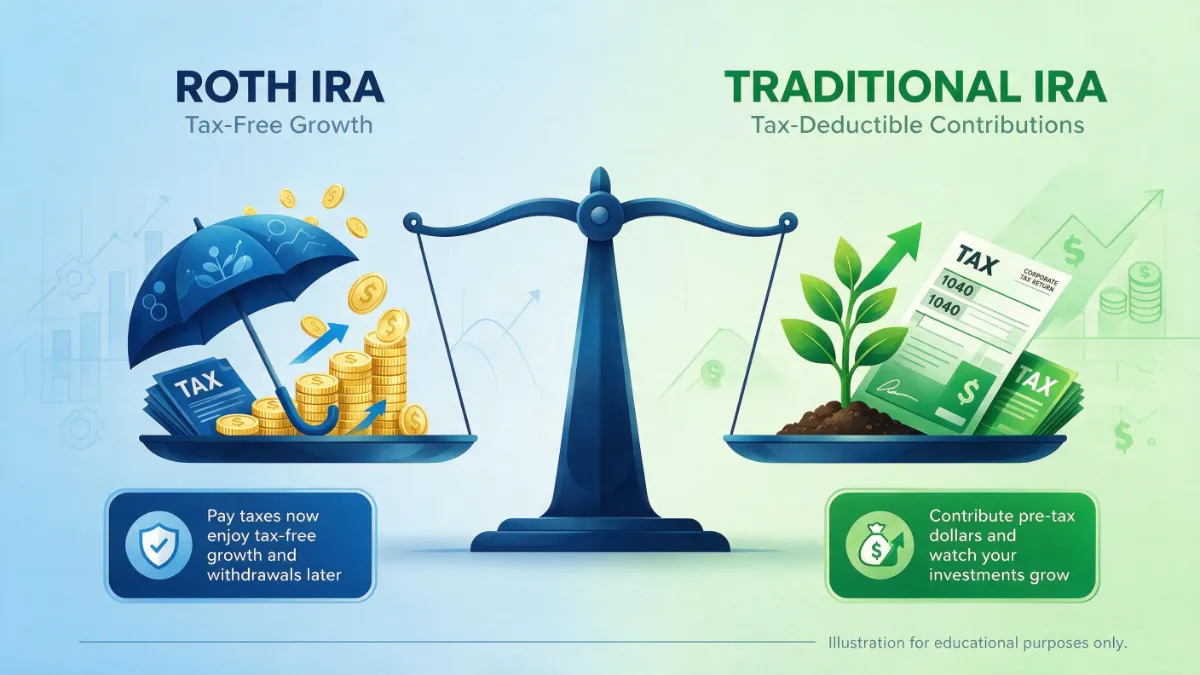
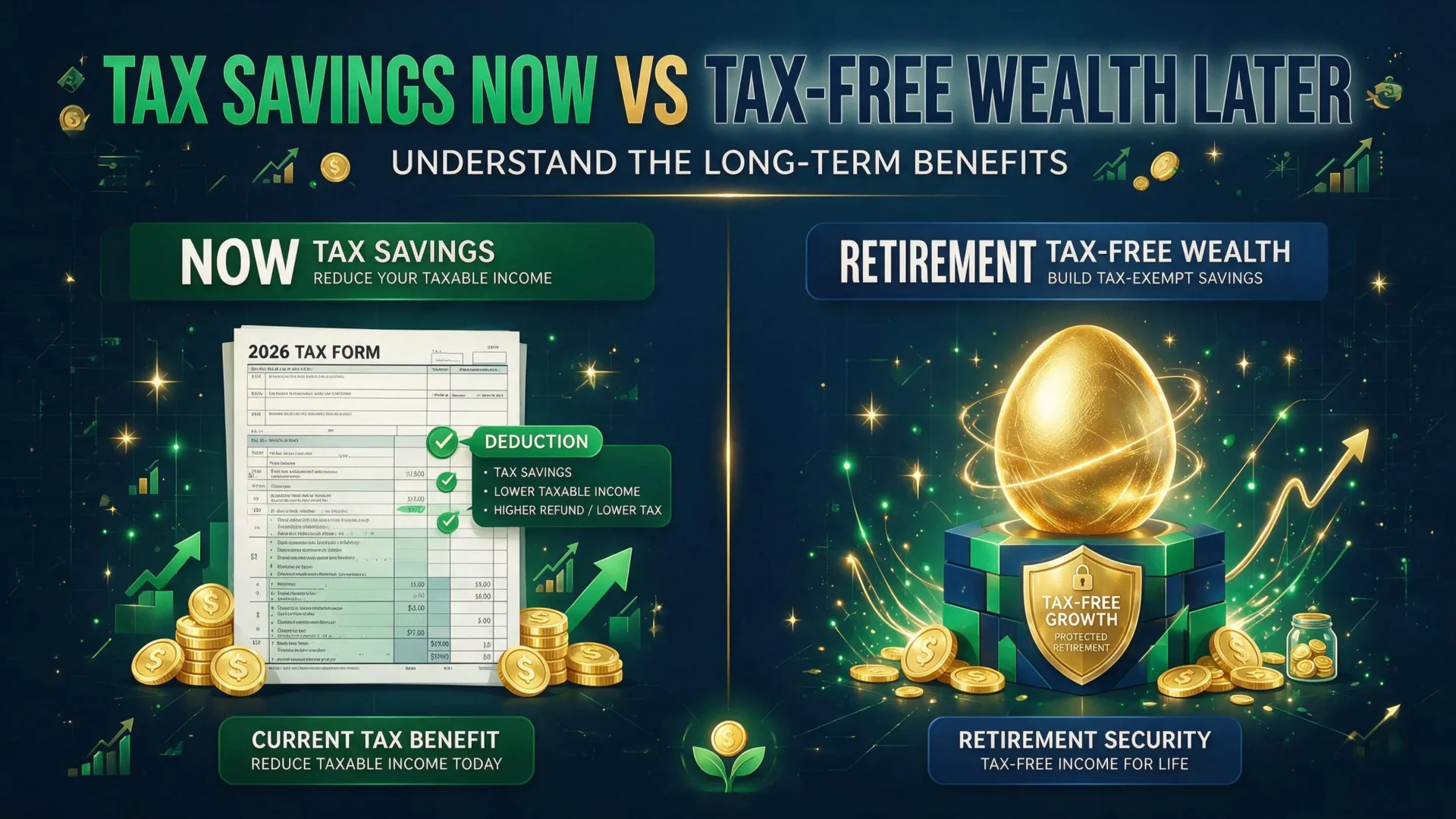
The core trade-off between a Roth IRA vs Traditional IRA in 2026 is tax timing. Traditional IRAs offer potential upfront tax deductions today with taxable withdrawals in retirement. Roth IRAs provide no upfront deduction but deliver tax-free qualified withdrawals and no lifetime required minimum distributions (RMDs).
Key Takeaways: AT A GLANCE
- 2026 Contribution Limits: The maximum combined limit is $7,500 for workers under age 50 and $8,600 for those age 50+ (includes $1,100 catch-up).
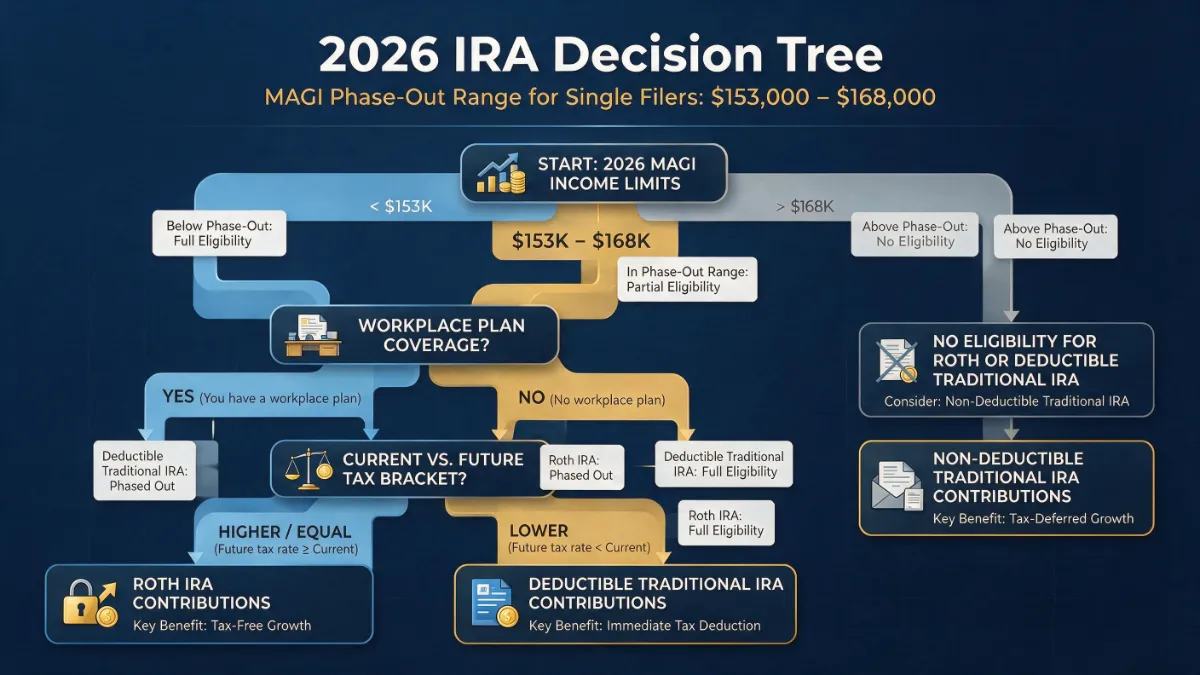
- Roth MAGI Phase-Outs: Direct Roth IRA contributions phase out between $153,000–$168,000 for single filers and $242,000–$252,000 for married couples filing jointly.
- Traditional IRA Deductions: Taxpayers covered by workplace plans face deduction phase-outs between $81,000–$91,000 (Single) and $129,000–$149,000 (Married Filing Jointly).
- RMD Differences: Traditional IRAs mandate distributions starting at age 73 under SECURE 2.0 rules, while original Roth IRA owners face zero lifetime RMDs.
Table of Contents
1. 2026 IRA Contribution & Income Limits: Roth vs. Traditional
2. Traditional IRA vs. Roth IRA Taxes: Pay Now or Pay Later?
3. Feature-by-Feature Comparison Matrix
4. Required Minimum Distributions (RMDs): SECURE 2.0 Rules
5. Which IRA Is Best for Me? (Decision Framework)
6. Roth IRA or 401(k) First in 2026?
7. High Earners: Backdoor Roth IRA Basics & Pro-Rata Warning
8. Roth IRA Phase-Out Calculator 2026: A Worked Example
9. Roth IRA Five-Year Rule Explained
The Roth vs. Traditional IRA debate comes up every tax season. And it should — the decision has real consequences that follow people into retirement for decades.
Here’s the thing: it’s not actually a question of which one is better. It’s a question of which one is better for your specific tax situation right now. That’s a meaningfully different frame, and it’s the one worth working through carefully.
I pulled together the IRS guidance, SECURE 2.0 rules, and tax mechanics to put this guide together. Every number in this article comes from official IRS sources. The goal is to make a genuinely complex decision as clear as possible — so the right answer for your situation becomes obvious.
2026 IRA Contribution & Income Limits: Roth vs. Traditional
For 2026, the basic IRA contribution limit is $7,500 ($8,600 for age 50+) shared across all IRAs. Direct Roth contributions depend on strict Modified Adjusted Gross Income (MAGI) phase-outs, while Traditional IRA deductibility depends on workplace retirement coverage.
Start here before anything else. The IRS rules on what you can contribute — and what you can deduct — depend heavily on income and whether a workplace retirement plan is already in the picture.
For 2026, the IRS sets the basic IRA contribution limit at $7,500. Taxpayers age 50 and older qualify for an additional $1,100 catch-up contribution, bringing the total to $8,600. One important detail: this limit is shared across all Traditional and Roth IRAs combined. Opening both account types doesn’t double the ceiling.
| Contributor Age | 2026 IRA Contribution Limit |
|---|---|
| Under age 50 | $7,500 |
| Age 50 or older (with catch-up) | $8,600 |
| Note: Limit is shared across Traditional & Roth IRAs |
2026 Roth IRA Income Limits
Direct Roth IRA contributions are limited by Modified Adjusted Gross Income (MAGI). Here’s where the phase-outs sit for 2026:
| Filing Status | Full Contribution | Partial Contribution | Direct Contribution Unavailable |
|---|---|---|---|
| Single / Head of Household | Under $153,000 | $153,000–$168,000 | $168,000+ |
| Married Filing Jointly | Under $242,000 | $242,000–$252,000 | $252,000+ |
| Married Filing Separately | N/A | $0–$10,000 | $10,000+ |
If income falls in the partial contribution range, it doesn’t mean the Roth IRA is off the table — it means the allowable contribution is reduced proportionally. The worked example below shows exactly how that math works.
2026 Traditional IRA Deduction Limits
Anyone with taxable compensation can contribute to a Traditional IRA. But whether that contribution is tax-deductible is a separate question — and it depends on workplace retirement plan coverage:
| Filing Status | Full Deduction | Partial Deduction | No Deduction |
|---|---|---|---|
| Single / Head of Household (Covered by workplace plan) | ≤ $81,000 | $81,000–$91,000 | ≥ $91,000 |
| Married Filing Jointly (Contributor covered) | ≤ $129,000 | $129,000–$149,000 | ≥ $149,000 |
| Married Filing Jointly (Spouse covered only) | ≤ $242,000 | $242,000–$252,000 | ≥ $252,00 |
If neither spouse is covered by a workplace retirement plan, the Traditional IRA contribution is fully deductible regardless of income level. That’s a meaningful exception worth knowing.
Traditional IRA vs. Roth IRA Taxes: Pay Now or Pay Later?
Traditional IRAs provide immediate tax relief through deductible contributions, taxing distributions as ordinary income in retirement. Roth IRAs use after-tax dollars today, eliminating tax deductions now in exchange for tax-free growth and qualified withdrawals later.
The whole debate between these two accounts comes down to one question: when do taxes get paid?
Traditional IRAs reduce taxable income today. Withdrawals in retirement are then taxed as ordinary income. Roth IRAs flip that — no tax deduction now, but growth and qualified withdrawals come out completely tax-free later.
Which timing advantage wins depends on where tax rates sit today versus where they’re expected to be in retirement. Neither option is universally superior. The math changes with the individual.
A Worked $10,000 Tax Example
Here’s how the same $10,000 plays out under each structure, using a 24% current marginal tax rate and a projected 20% retirement tax rate:
- Traditional IRA path:
- Contributing $10,000 pre-tax generates an immediate tax saving of $2,400 ($10,000 × 24%). When withdrawn in retirement, that same $10,000 principal is taxed at 20%, creating a $2,000 future liability. On principal alone, that’s a net $400 advantage for the Traditional IRA.
- Roth IRA path:
- Contributing $10,000 provides no tax deduction today. But the entire balance — including decades of investment growth on top of that $10,000 — comes out completely tax-free. If that $10,000 grows to $80,000 over 30 years, none of that growth is taxed at withdrawal.
TRADITIONAL IRA: [Pre-Tax Dollars] → Grows Tax-Deferred → [Taxed at Withdrawal]
ROTH IRA: [After-Tax Dollars] → Grows Tax-Free → [Tax-Free Withdrawal]
The traditional IRA wins on principal when the future tax rate is lower. The Roth IRA wins when growth is large, and the future tax rate holds steady or rises. That’s the core comparison — and it’s exactly why income trajectory and time horizon both matter so much to the decision.
Feature-by-Feature Comparison Matrix
A side-by-side comparison reveals core structural differences: Traditional IRAs focus on upfront deductions and tax-deferred growth, while Roth IRAs prioritize tax-free withdrawals, flexible contribution access, and exemption from lifetime required minimum distributions.
| Feature | Traditional IRA | Roth IRA |
|---|---|---|
| Upfront Tax Benefit | May be deductible depending on income & workplace plan | No tax deduction today |
| Investment Growth | Tax-deferred | Tax-free |
| Retirement Withdrawals | Taxable as ordinary income | Tax-free if qualified |
| Lifetime RMDs (Original Owner) | Required starting at age 73 | None during owner’s lifetime |
| Early Principal Access | Tax + 10% penalty (unless exception applies) | Original contributions can be withdrawn anytime tax/penalty-free |
| 2026 Contribution Limit | $7,500 ($8,600 if age 50+) | $7,500 ($8,600 if age 50+) |
One structural difference that often gets overlooked: Roth IRA owners can withdraw their original contributions (not earnings) at any time without taxes or penalties, regardless of age. The Traditional IRA offers no equivalent flexibility — early withdrawals generally trigger both income tax and a 10% penalty unless a specific IRS exception applies.
Required Minimum Distributions (RMDs): SECURE 2.0 Rules
Under SECURE 2.0 guidelines, Traditional IRA owners must begin taking Required Minimum Distributions (RMDs) at age 73. Original Roth IRA owners are completely exempt from lifetime RMDs, enabling uninterrupted tax-free compounding.
This is one of the most underappreciated differences between the two account types — and it becomes more relevant as retirement actually approaches.
Traditional IRAs require distributions starting at age 73. The IRS mandates these withdrawals under SECURE 2.0 rules, and they’re added directly to taxable income for the year. That can push retirees into higher tax brackets, affect Medicare premium calculations, and reduce flexibility in managing retirement income.
Original Roth IRA owners face no lifetime RMDs at all. The money can sit in the account, compounding tax-free, for the owner’s entire lifetime. It can also be passed to heirs under inherited IRA rules, making the Roth IRA a meaningful estate planning tool in addition to a retirement savings vehicle.
For someone who doesn’t need to draw down retirement assets immediately — or who wants to leave assets to the next generation — that RMD exemption represents a structural advantage that no other common retirement account offers.
Which IRA Is Best for Me? (Decision Framework)
Select an account based on four core criteria: your current tax bracket versus future expectations, your career income trajectory, your time horizon, and your desire for tax diversification across retirement accounts.
There’s no universal answer. The right account type for any individual depends on four variables — and working through them honestly usually makes the decision clearer.
1. Current Tax Bracket
Taxpayers in higher brackets today generally get more value from the Traditional IRA’s upfront deduction. Taxpayers in lower brackets today generally benefit more from locking in tax-free Roth growth now.
2. Income Trajectory
Early-career workers expecting income to grow substantially over time may want to consider the Roth IRA while their bracket is lower. Paying taxes now at a lower rate — rather than later at a higher one — is the mathematical argument here.
3. Time Horizon
The longer the investment window, the more years Roth’s tax-free compounding has to build. A 25-year-old and a 55-year-old face very different calculations even at the same income level.
4. Tax Diversification
Holding both tax-deferred and tax-free accounts in retirement gives more flexibility to manage taxable income year by year. That flexibility can have real value — particularly when managing Medicare income thresholds, Social Security taxation, and RMD-driven bracket effects.
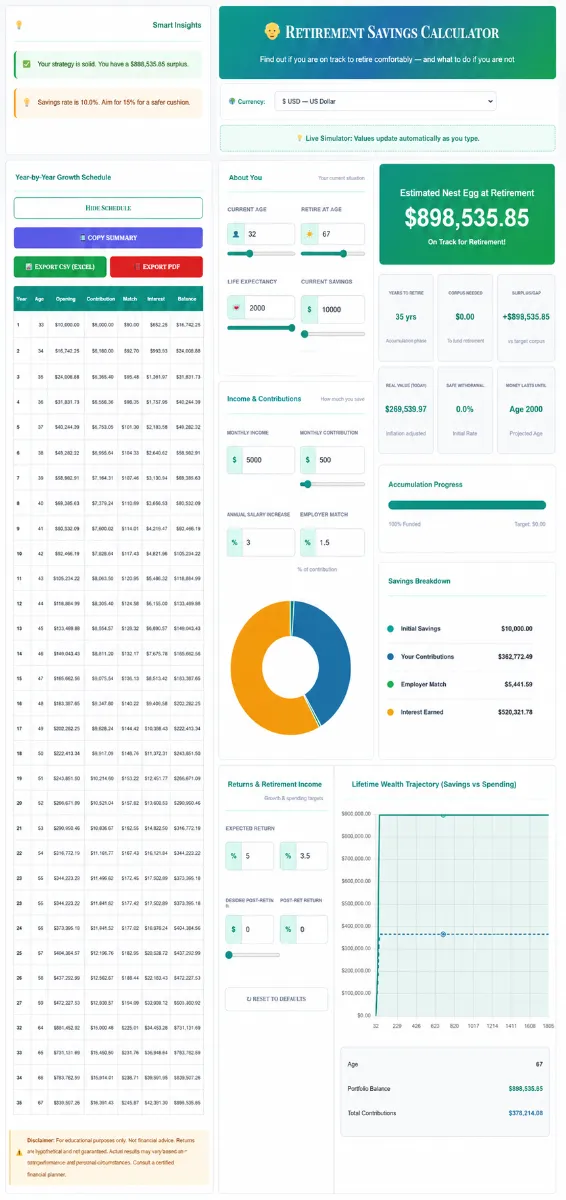
SaveXpert Tip: Want to model how a Roth versus a traditional IRA affects a specific wealth trajectory? The SaveXpert Retirement Savings Calculator takes income, filing status, tax bracket, and time horizon as inputs and compares projected outcomes across both account types. The result reflects whatever numbers are entered — not a generic national average. (Note: Calculator results are estimates for educational purposes.)
Roth IRA or 401(k) First in 2026?
A common educational hierarchy recommends funding your 401(k) up to the full employer match first, then maxing out a Roth or Traditional IRA ($7,500/$8,600), and finally returning to fill the remaining 401(k) capacity ($24,500 limit).
This is a common question — and the answer that appears most frequently in retirement planning research follows a straightforward priority order.
[1. 401(k) Match] → [2. Max Out IRA ($7,500/$8,600)] → [3. Remaining 401(k) Capacity ($24,500 Limit)]
For 2026, the employee elective deferral limit for 401(k) plans sits at $24,500. Capturing the full employer match is typically the first priority in this framework — it’s an immediate return on that money that no investment vehicle can replicate.
After securing the match, the IRA comes next. The choice between Roth and Traditional at that step runs through the same framework described above — current bracket, income trajectory, time horizon, and tax diversification goals.
👴 Quick Retirement Check
Estimate your future nest egg based on your current savings.
Years to Retire
Total Contributed
Est. Nest Egg
High Earners: Backdoor Roth IRA Basics & Pro-Rata Warning
High earners over income limits can perform a Backdoor Roth IRA by making a non-deductible Traditional IRA contribution and converting it to a Roth. Beware of the IRS pro-rata rule, which taxes conversions proportionally if you hold pre-tax IRA assets.
If MAGI exceeds $168,000 (Single) or $252,000 (Joint), direct Roth IRA contributions aren’t available. High earners who still want Roth access have a two-step workaround:
- Make a non-deductible contribution to a Traditional IRA.
- Convert those funds to a Roth IRA and report the transaction on IRS Form 8606.
This is what’s commonly called the “Backdoor Roth IRA.” It’s a legal strategy — but it comes with a significant tax trap worth understanding before executing it.
The Pro-Rata Rule Warning (IRC §408(d)(2))
Here’s the trap: a common assumption is that only the freshly contributed after-tax dollars get converted. The IRS disagrees.
Under IRC §408(d)(2), the IRS aggregates all IRA balances — Traditional, Rollover, SEP, and SIMPLE IRAs — when calculating taxes on any conversion. After-tax and pre-tax dollars can’t be selectively isolated.
Here’s what that looks like with real numbers:
After-Tax Basis: $7,500 (7.5%)
+ Pre-Tax Assets: $92,500 (92.5%)
─────────────────
Total IRA Value: $100,000 (100%) → Conversion is 92.5% Taxable
In this example, a $7,500 backdoor conversion gets 92.5% taxed rather than being clean. For anyone holding significant pre-tax IRA balances, the pro-rata rule can eliminate most of the Backdoor Roth strategy’s advantage. This is exactly the kind of situation where a qualified CPA’s input makes a meaningful difference before acting.
Roth IRA Phase-Out Calculator 2026: A Worked Example
For single filers earning between $153,000 and $168,000 in 2026, direct Roth IRA contributions are proportionally reduced. A single filer earning $160,500 MAGI can make a partial direct contribution of $3,750.
Falling in the phase-out range doesn’t mean the Roth IRA is closed — it means the allowable contribution is reduced proportionally. Here’s exactly how that math works for a single filer under age 50 with a $160,500 MAGI:
| Step | Calculation |
|---|---|
| Phase-Out Range | $153,000 to $168,000 ($15,000 width) |
| Excess Income | $160,500 − $153,000 = $7,500 |
| Reduction Ratio | $7,500 ÷ $15,000 = 50% |
| Allowed Contribution | $7,500 × (1 − 0.50) = $3,750 |
At $160,500 MAGI, this single filer can still contribute $3,750 directly to a Roth IRA in 2026 — exactly half the normal maximum. The remaining $3,750 could go into a Traditional IRA instead, or the backdoor Roth strategy becomes relevant at incomes above $168,000.
Roth IRA Five-Year Rule Explained
Two distinct five-year rules exist: one requires your Roth IRA account to be open for five tax years before withdrawing investment earnings tax-free, and another imposes a five-year holding period on converted funds to avoid early withdrawal penalties.
The five-year rule is one of the most misunderstood parts of Roth IRA mechanics — and confusing the two separate rules can create unexpected tax consequences.
- Rule 1: The Earnings Rule
- Rule 2: The Conversion Rule
- Each backdoor Roth conversion carries its own separate five-year clock. Withdrawing converted principal before that five-year window closes — and before age 59½ — can trigger a 10% early withdrawal penalty, even though the original conversion was already taxed.
These two rules operate independently. Meeting the requirements of one doesn’t automatically satisfy the other.
The Bottom Line: Your Decision Checklist
Working through the Roth vs. Traditional decision starts with an honest look at the current tax situation and expected retirement income. Here’s a summary of what the research and IRS framework point toward for each scenario:
- Traditional IRA makes sense when: The full tax deduction is available, current income sits in peak earning years, and a lower effective tax rate in retirement is a reasonable expectation.
- Roth IRA makes sense when: Income and bracket are lower now than they’re likely to be later, tax-free retirement growth is the priority, and avoiding lifetime RMDs matters — either for retirement income flexibility or for estate planning purposes.
- Using both makes sense when: Combined income falls below the contribution limits, and building tax diversification across retirement accounts is the goal. Holding both tax-deferred and tax-free balances gives more options for managing taxable income year by year in retirement.
“Choosing between a Roth and Traditional IRA in 2026 isn’t about guessing what tax rates will be 30 years from now. It’s about evaluating your current marginal bracket against your expected future cash flow, maintaining tax diversification, and avoiding costly traps like the pro-rata rule.”— Kevin Brown, Lead Researcher & Founder of SaveXpert
Frequently Asked Questions
Ans: According to IRS guidance and widely accepted tax-planning principles, contributing to a Roth IRA when income and tax bracket are lower locks in lower tax rates while allowing wealth to grow tax-free for decades. That timing advantage is the core argument for Roth contributions early in a career.
Ans: The pro-rata rule under IRC §408(d)(2) requires the IRS to treat all pre-tax IRA balances — across Traditional, SEP, and SIMPLE IRAs — as part of a single pool when calculating the taxable portion of any conversion. After-tax and pre-tax dollars cannot be selectively isolated. A qualified tax professional can help model the actual tax impact before a conversion is executed.