ⓘ Educational Disclosure:
This guide explains current U.S. federal IRA rules and provides general educational information only. It does not provide personalized tax, investment, or retirement-planning advice. IRA rules have specific exceptions, phaseouts, and eligibility requirements that vary by individual circumstance. Always consult a qualified tax or financial professional before executing any retirement strategy.
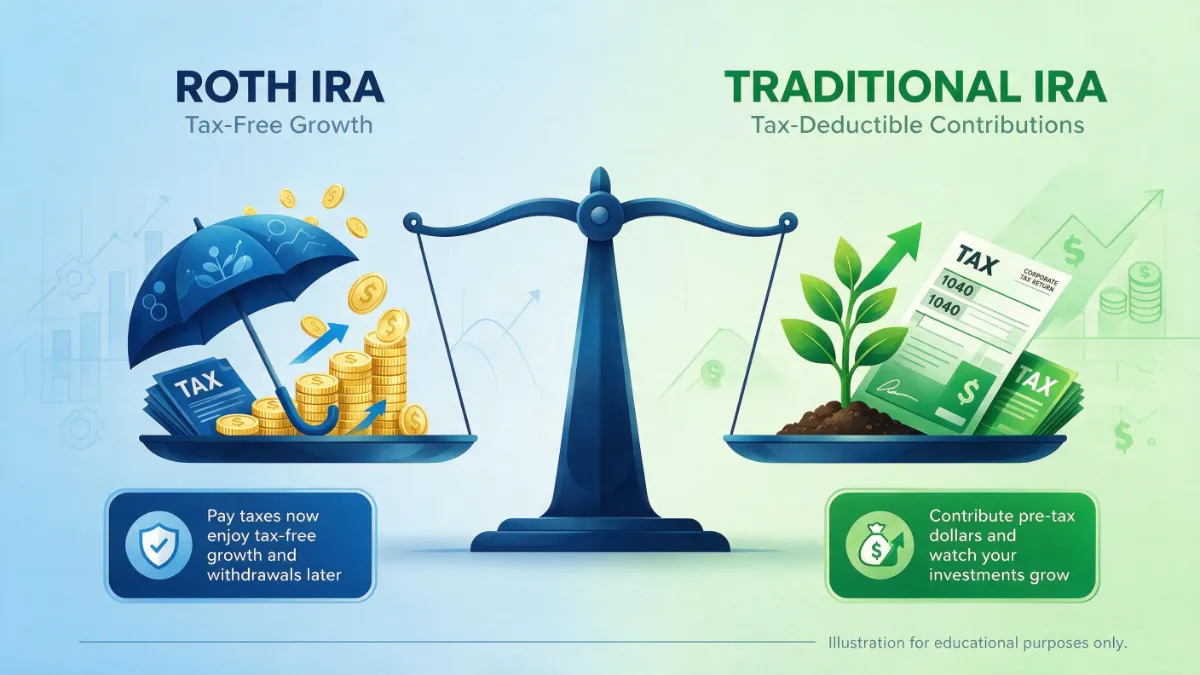
What is the difference between a Traditional IRA and a Roth IRA? A Traditional IRA provides an upfront tax deduction today, but you pay ordinary income taxes on withdrawals in retirement. A Roth IRA accepts after-tax dollars today, giving you tax-free qualified withdrawals later. For 2026, the IRS caps combined annual contributions at $7,500, or $8,600 if you are 50 or older.
Key Takeaways
- Problem: Most people pick an IRA type based on a hunch — without knowing how the 2026 MAGI phase-outs, the 5-year rule, or RMDs will affect their actual tax bill in retirement.
- Solution: Match the vehicle to your tax situation — Traditional IRA if you expect a lower tax rate in retirement; Roth IRA if you expect the same or higher rate; backdoor Roth if you earn over the income limits.
- Result: For 2026, the IRS allows up to $7,500 ($8,600 if 50+) in combined contributions — deploying that in the right account type can reduce lifetime taxes on your retirement income.
- Source: IRS — 2026 IRA limit announcement, IRS Publication 590-A
- Time To Read: 9 Minutes
Table of Contents
1. 2026 IRA Contribution Limits & The Combined Limit Rule
2. Traditional IRA Tax Rules: Deductions & Phase-Outs
3. Roth IRA Tax Rules: Tax-Free Growth & Income Limits
4. Withdrawal Rules & The Roth 5-Year Rule
5. Required Minimum Distributions (RMDs)
6. The Backdoor Roth IRA Strategy
7. Full Roth vs. Traditional IRA Comparison
Your choice between a Roth IRA and a Traditional IRA directly dictates when you pay taxes on your retirement wealth. That’s not a minor detail — it can add up to tens of thousands of dollars in lifetime taxes, depending on where your tax rate lands when you stop working. I’ve gone through IRS revenue bulletins, Publication 590-A, and the 2026 COLA adjustment notice to map out exactly what the rules say.
The decision comes down to one core question: do you want the tax break now, or do you want it in retirement? Research shows that most people guess wrong because they don’t account for how their income and tax rate will actually shift over time.
2026 IRA Contribution Limits & The Combined Limit Rule
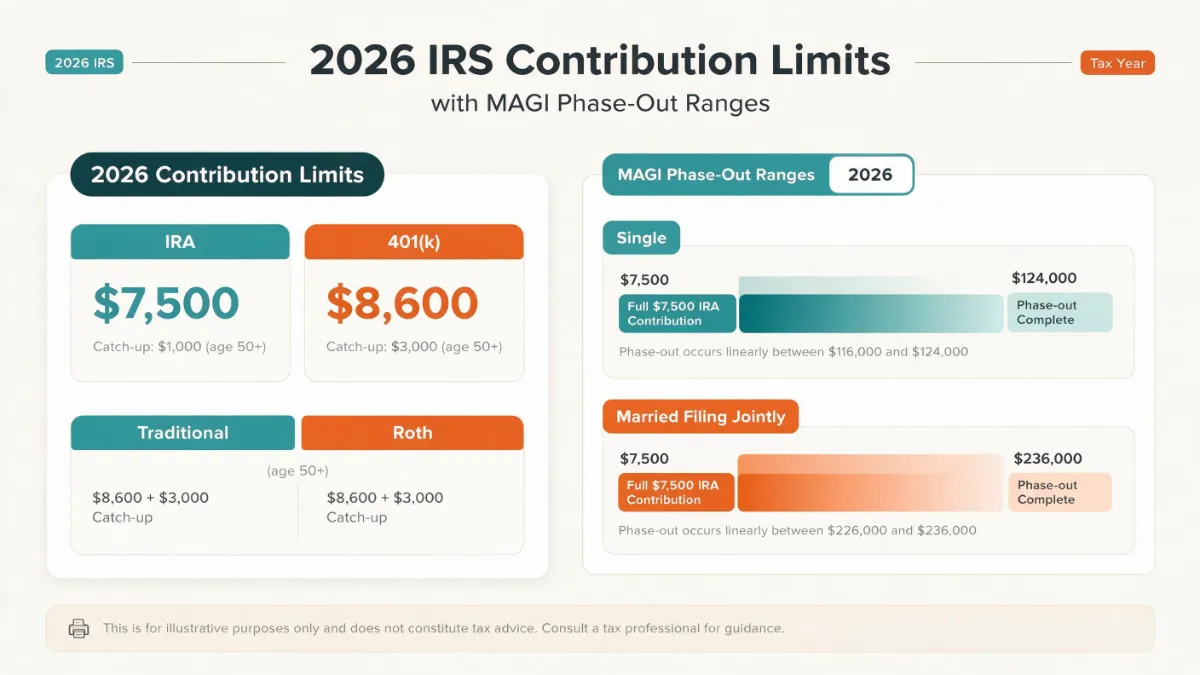
For 2026, the IRS increased the annual IRA contribution ceiling for the first time since 2023. According to the IRS’s 2026 COLA announcement, the limits now stand at $7,500 if you are under 50 and $8,600 if you are 50 or older — the extra $1,100 is the indexed catch-up contribution amount.
Table 1 — 2026 IRA Contribution Limits (Under 50 vs. Age 50+ Catch-Up)
| Age Tier | 2026 Maximum Contribution Limit |
|---|---|
| Under age 50 | $7,500 |
| Age 50 or older | $8,600 |
| Age 50+ catch-up amount | $1,100 |
Source: IRS — 401(k) and IRA limit increases for 2026 · IRS Publication 590-A
Here’s the rule most people miss. The IRS enforces a strict combined cap across all personal IRAs. You can’t put $7,500 into a Roth IRA and another $7,500 into a Traditional IRA for the same tax year. Your total contributions across both account types for yourself must stay at or below $7,500 (under 50) for 2026.
You can split contributions between both account types in the same year — but the combined total can’t exceed the annual ceiling. And if your taxable compensation for the year falls below the limit, your contribution cap is your actual earnings, not the full $7,500.
Traditional IRA Tax Rules: Deductions & Phase-Outs
What are the Traditional IRA tax rules for 2026? A Traditional IRA gives you the opportunity to claim an upfront tax deduction. You fund the account, the IRS potentially reduces your current taxable income, and your investments grow tax-deferred. You pay ordinary income taxes when you withdraw in retirement. But the deduction is only available in full if your Modified Adjusted Gross Income stays below the phase-out thresholds — and those thresholds tighten if a workplace retirement plan covers you or your spouse.
Table 2 — 2026 Traditional IRA MAGI Deduction Phase-Outs
| Filing Status (Covered by Workplace Plan) | 2026 MAGI Range | Deduction Effect |
|---|---|---|
| Single / Head of Household | Below $81,000 | Full deduction generally available |
| Single / Head of Household | $81,000–$91,000 | Partial deduction |
| Single / Head of Household | Above $91,000 | Deduction generally unavailable |
| Married Filing Jointly | Below $129,000 | Full deduction generally available |
| Married Filing Jointly | $129,000–$149,000 | Partial deduction |
| Married Filing Jointly | Above $149,000 | Deduction generally unavailable |
Source: IRS — 401(k) and IRA limit increases for 2026 · IRS Publication 590-A
💡 Research note: If you don’t have a workplace retirement plan, but your spouse does, different phase-out rules apply. The IRS phases out your Traditional IRA deduction between $242,000 and $252,000 MAGI for 2026 in that situation. You can always make a nondeductible Traditional IRA contribution regardless of your income — and high earners frequently use this as the first step in a backdoor Roth conversion.
Roth IRA Tax Rules: Tax-Free Growth & Income Limits
What are the Roth IRA tax rules for 2026? The Roth IRA flips the tax timing entirely. You fund the account with after-tax dollars today. The IRS gives you no upfront deduction, but your investments grow tax-free inside the account. In retirement, qualified withdrawals come out completely tax-free — no tax on the growth, ever, provided you meet the distribution rules.
Unlike Traditional IRAs, the IRS restricts direct Roth IRA contributions based on your income. If your MAGI exceeds the phase-out range, you can’t make a direct Roth contribution at all — though the backdoor Roth strategy (covered below) offers a legal workaround.
Table 3 — 2026 Roth IRA MAGI Direct Contribution Phase-Outs
| Filing Status | 2026 MAGI Range | Direct Roth Contribution |
|---|---|---|
| Single / Head of Household | Below $153,000 | Full contribution generally allowed |
| Single / Head of Household | $153,000–$168,000 | Partial contribution |
| Single / Head of Household | $168,000+ | Direct contribution generally unavailable |
| Married Filing Jointly | Below $242,000 | Full contribution generally allowed |
| Married Filing Jointly | $242,000–$252,000 | Partial contribution |
| Married Filing Jointly | $252,000+ | Direct contribution generally unavailable |
| Married Filing Separately | $0–$10,000 | Highly restrictive phase-out |
Source: IRS — 2026 IRA limit announcement · IRS Publication 590-A
Withdrawal Rules & The Roth 5-Year Rule
What are the IRA early withdrawal rules? If you pull money from either type of IRA before age 59½, you typically face ordinary income taxes plus a 10% early withdrawal penalty on the taxable amount. The IRS does provide certain exceptions — for qualified higher education expenses, first-time home purchases, and others — but these are narrow.
Roth IRA Contribution Flexibility
Roth IRAs offer one piece of flexibility that Traditional IRAs don’t. Because you already paid taxes on your original Roth contributions, the IRS lets you withdraw that contribution basis at any time, tax-free and penalty-free. The earnings on those contributions are a different story — they stay locked under the distribution rules until you qualify.
The Roth IRA 5-Year Rule
To withdraw Roth earnings tax-free, you must clear two hurdles: you must have held the Roth IRA for at least five tax years (counting from January 1 of the year you made your first contribution to any Roth IRA), and you must be at least age 59½ — or meet another qualifying condition such as disability or a first-time home purchase.
⚠️ Important caveat: The 5-year clock starts on January 1 of the first tax year you made a Roth IRA contribution — not the date of your first deposit. Opening a Roth at age 58 means your earnings won’t qualify for tax-free treatment until age 63 if you’re opening a Roth later in life; timing matters.
Required Minimum Distributions (RMDs)
When do RMDs start for Traditional IRA owners? The IRS requires Traditional IRA owners to begin taking Required Minimum Distributions starting at age 73, under the SECURE 2.0 Act rules that took effect in 2023. These are forced annual withdrawals calculated from your account balance and IRS life-expectancy tables — and you pay ordinary income taxes on every dollar pulled out.
This is where the tax math gets real. If your Traditional IRA grows to $1 million by retirement, the IRS will eventually require you to take distributions whether you need the income or not. Those withdrawals can push you into a higher tax bracket, increase Medicare premiums, and affect Social Security taxation.
💡 Research note: Roth IRAs carry no lifetime RMDs for the original account owner. The IRS never forces you to pull money from a Roth during your lifetime. This distinction makes the Roth a particularly effective vehicle for leaving tax-free wealth to heirs — and for controlling your own taxable income in retirement, since you’re not forced to take distributions you don’t need.
The Backdoor Roth IRA Strategy
What is the backdoor Roth IRA? The backdoor Roth IRA is a two-step legal strategy that lets high earners who exceed the direct Roth contribution income limits still get money into a Roth IRA. Step one: make a nondeductible contribution to a Traditional IRA. Step two: convert those funds into a Roth IRA. The IRS imposes no MAGI limit on Roth conversions — only on direct contributions.
The Pro-Rata Rule Trap
Here’s the part that catches people off guard. The backdoor Roth looks clean in theory, but the IRS’s pro-rata rule can create a significant tax bill if you’re not careful.
⚠️ Important caveat: If you hold any existing pre-tax balances in a Traditional, SEP, or SIMPLE IRA, the IRS requires you to calculate the taxable portion of your Roth conversion proportionally across all your IRA assets — not just the after-tax dollars you just contributed. You can’t cherry-pick only the nondeductible amount to convert. This can trigger a larger-than-expected tax bill. Anyone with existing pre-tax IRA balances should model this carefully with a tax professional before executing the strategy.
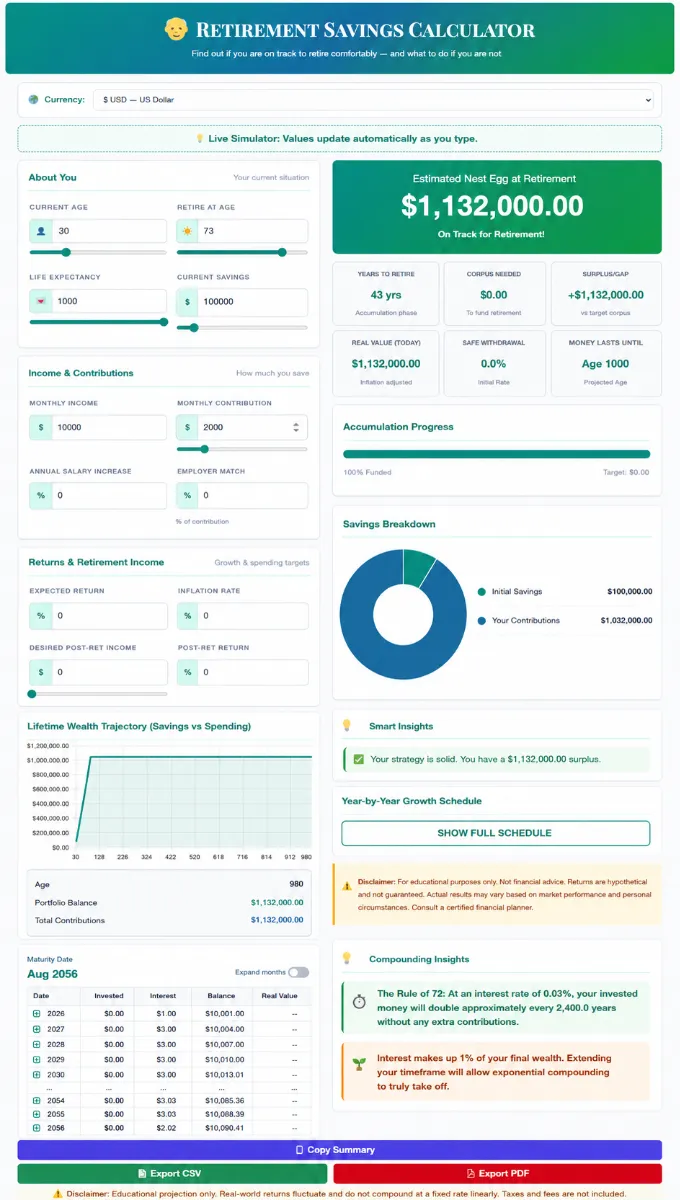
Estimate your future nest egg from your current savings.
Full Roth vs. Traditional IRA Comparison
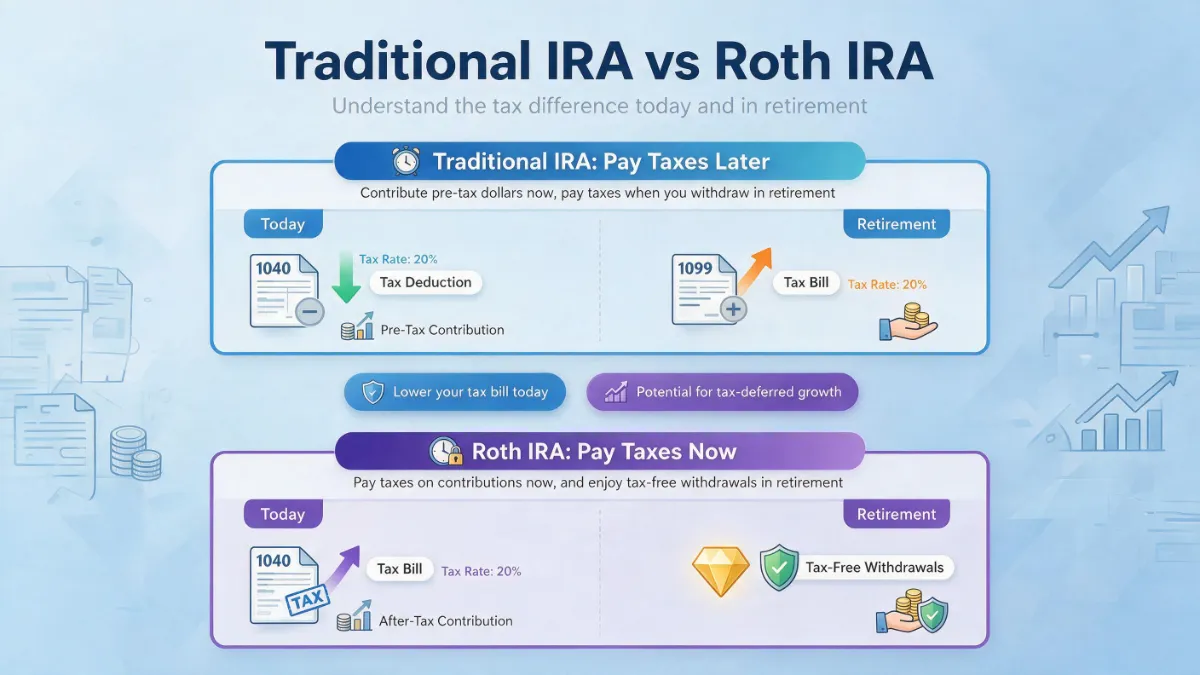
How do Roth and Traditional IRAs compare side by side? The table below maps the key structural differences. The right choice depends almost entirely on whether you expect your tax rate to rise or fall between now and retirement.
Table 4 — Which Vehicle Fits Your Tax Strategy?
| Feature | Traditional IRA | Roth IRA |
|---|---|---|
| Tax Treatment of Contributions | Potentially pre-tax (deductible) | After-tax (no deduction) |
| Investment Growth | Tax-deferred | Tax-free within account |
| Qualified Withdrawals | Generally taxable as ordinary income | Generally tax-free |
| Direct Income Limits | No general income limit to contribute | Yes — MAGI phase-outs apply |
| Deduction Limits | MAGI phase-outs apply if workplace plan exists | Not applicable |
| Lifetime RMDs (Original Owner) | Yes — generally starting at age 73 | No lifetime RMDs |
| Ideal Tax Scenario | You expect a lower tax rate in retirement | You expect the same or higher tax rate in retirement |
Source: IRS Publication 590-A · IRS — IRA Contribution Limits. Compiled by SaveXpert for educational use.
💰 Try the SaveXpert Retirement Savings Calculator
I ran a basic scenario through SaveXpert’s Retirement Savings Calculator — same contribution amount, same assumed return, but with the tax-free vs. tax-deferred treatment applied at the end. The difference in after-tax value at age 73, once you factor in RMDs on the Traditional IRA side, is material. Enter your current age, annual contributions, expected return, and retirement age to model your own numbers.
Educational note: Calculator outputs are hypothetical illustrations only. They do not guarantee investment performance or future tax rates. For official IRA rules, see IRS Publication 590-A.
The Bottom Line: 5-Step Action Plan
How do I choose between a Roth and Traditional IRA in 2026? Stop debating and start funding. Here’s a research-based 5-step plan to lock in your IRA strategy for 2026:
1. Check your MAGI and eligibility:
Calculate your 2026 Modified Adjusted Gross Income to verify your direct Roth eligibility and your Traditional IRA deductibility status against the phase-out tables above.
2. Pick your tax structure:
Choose the Traditional IRA to reduce today’s tax bill if you expect a lower rate in retirement. Choose the Roth IRA for tax-free qualified withdrawals if you expect your rate to stay the same or rise.
3. Open the account:
Select a low-cost brokerage that offers automation features and zero account fees. The IRA is only a tax wrapper — you still need to invest the cash inside it to generate growth.
4. Automate your contributions:
Set up recurring transfers to hit the $7,500 (under 50) or $8,600 (50+) annual ceiling before the tax deadline. Automating removes the decision from your monthly to-do list.
5. Invest the cash:
Buy diversified, low-cost assets — broad-market index funds are a common starting point. An IRA sitting in cash doesn’t compound; the tax wrapper only works if assets are growing inside it.
One account type isn’t universally better. The right answer depends on your current marginal rate, your expected retirement rate, and how much control you want over your taxable income once RMDs kick in for any Traditional IRA balance.
“When I look at the IRS data on retirement account usage, one pattern stands out: people consistently underestimate how much tax-deferred accounts will cost them in RMDs later. The research case for the Roth gets stronger the more you factor in forced withdrawals at age 73 and the loss of control over your tax bill.”
— Kevin Brown, Lead Researcher at SaveXpert.com
Frequently Asked Questions
Ans: Yes. Your employer-sponsored retirement plan, such as a 401(k), carries entirely separate contribution limits. Participating in a workplace plan doesn’t by itself stop you from funding an IRA — though it can affect your ability to deduct Traditional IRA contributions if your MAGI exceeds the phase-out thresholds shown in Table 2.
Ans: Yes. You can contribute to both types in the same tax year. But the IRS restricts your combined total to the annual limit — $7,500 for those under 50 in 2026. Splitting across both account types doesn’t raise your ceiling; it just changes the allocation within it.
Ans: Yes, your original contribution basis can generally come out tax-free and penalty-free at any time, because you already paid taxes on those dollars. The earnings on those contributions are different — they stay subject to the 5-year rule and age 59½ requirement before they qualify for tax-free treatment.
Ans: If you hold any existing pre-tax balances in a Traditional, SEP, or SIMPLE IRA, the pro-rata rule requires you to calculate the taxable portion of your Roth conversion proportionally across all your IRA assets — not just the nondeductible dollars you just contributed. You can’t isolate only the after-tax money for conversion, which can result in a larger-than-expected tax bill.
Ans: The 5-year rule requires that your Roth IRA has been open for at least five tax years before your investment earnings qualify for tax-free withdrawal. The clock starts on January 1 of the year you made your first contribution to any Roth IRA. You must also be at least 59½ — or meet another qualifying condition — to take tax-free distributions of earnings.
Ans: Under the SECURE 2.0 Act, Traditional IRA owners must begin taking RMDs at age 73. These forced withdrawals are calculated using IRS life-expectancy tables and your prior year-end account balance. Roth IRAs are not subject to lifetime RMDs for the original account owner — which is one reason many investors convert Traditional IRA balances to Roth before the RMD clock starts.