ⓘ Educational Disclosure:
This article is for educational and informational purposes only. It does not constitute financial, legal, tax, lending, student-loan or insurance advice. SaveXpert and its authors are not licensed financial aid professionals.Federal student aid rules, loan limits, and repayment options can change. Always verify current requirements directly at StudentAid.gov before making enrollment or borrowing decisions.
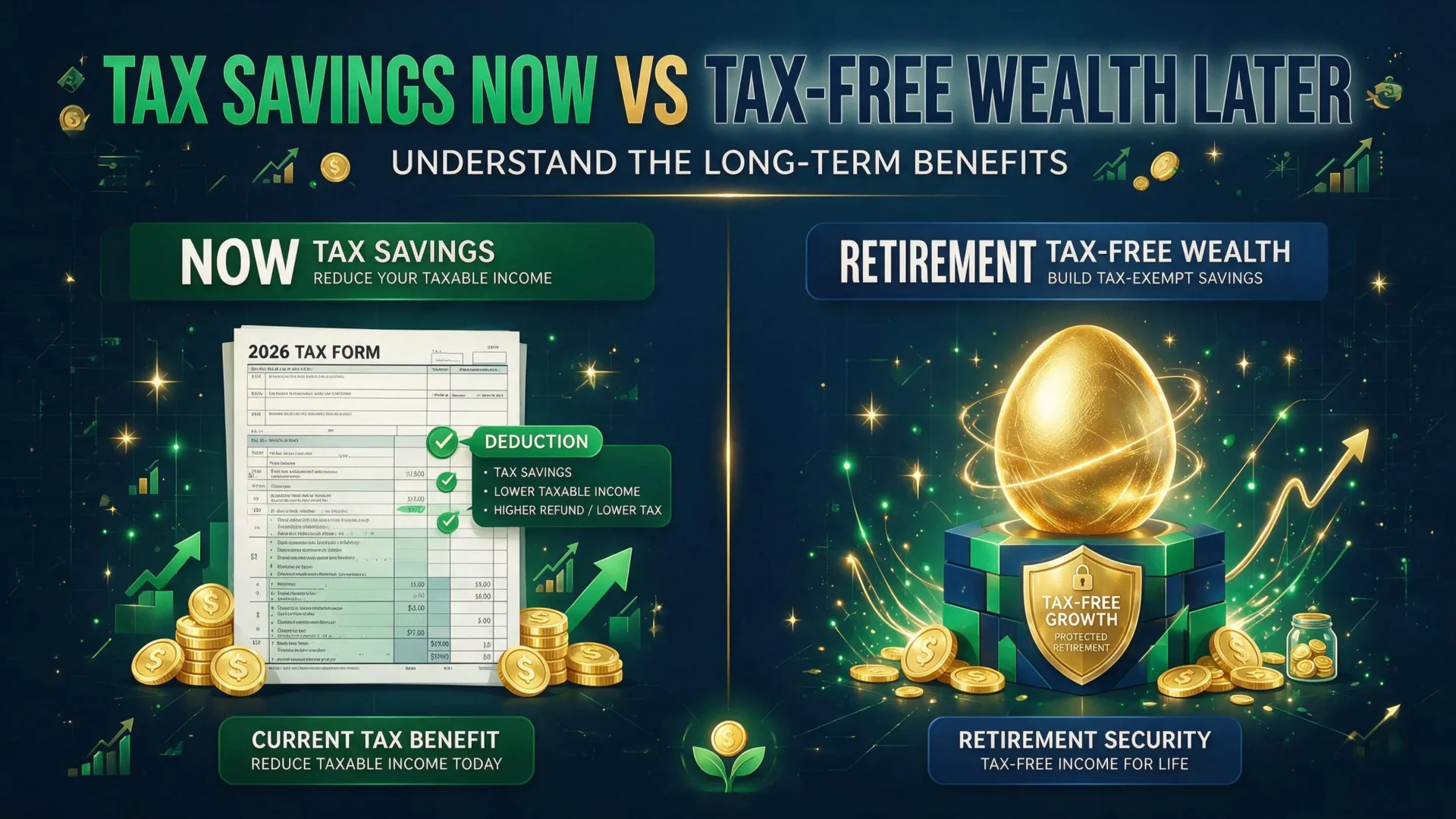
The core trade-off between a Roth IRA and a Traditional IRA in 2026 is tax timing. Traditional IRAs offer a potential upfront tax deduction today with taxable withdrawals in retirement. Roth IRAs provide no upfront deduction but deliver tax-free qualified withdrawals and no required minimum distributions (RMDs) during the owner’s lifetime. For 2026, the IRS sets the combined annual contribution limit at $7,500 (or $8,600 for those age 50 or older). Neither account type is universally superior — the right choice depends on current tax bracket, income trajectory, time horizon, and desire for tax diversification.
What This Research Found
- 2026 combined IRA limit: $7,500 ($8,600 for age 50+, including $1,100 catch-up). This limit is shared across all Traditional and Roth IRAs — opening both does not double the ceiling.
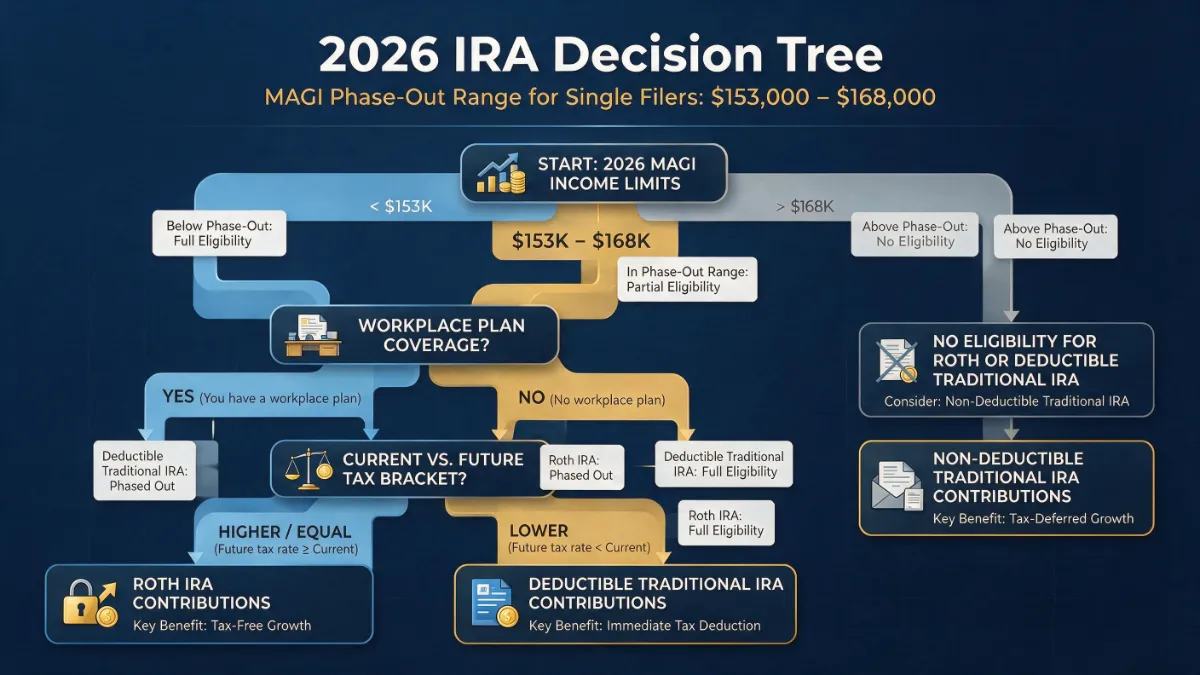
- Roth IRA direct contributions phase out between $153,000–$168,000 MAGI (Single) and $242,000–$252,000 MAGI (Married Filing Jointly). Above those thresholds, only backdoor Roth conversions are available.
- Traditional IRA deductibility phases out between $81,000–$91,000 (Single, covered by workplace plan) and $129,000–$149,000 (MFJ, contributor covered). If neither spouse has a workplace plan, contributions are fully deductible regardless of income.
- RMD rules diverge sharply: Traditional IRA owners must begin taking Required Minimum Distributions at age 73 under SECURE 2.0. Original Roth IRA owners face zero lifetime RMDs.
- Backdoor Roth warning: The IRS pro-rata rule (IRC §408(d)(2)) aggregates all pre-tax IRA balances when taxing a conversion — after-tax and pre-tax dollars cannot be selectively isolated. This can make backdoor conversions largely taxable for those with existing Traditional IRA assets.
- Two separate five-year rules exist for Roth IRAs — one governing tax-free earnings withdrawals, one governing penalty-free converted principal withdrawals. They operate independently.
- Time To Read: 8 Minutes
Table of Contents
1. 2026 IRA Contribution and Income Limits
2. Pay Now or Pay Later? The Tax Timing Trade-Off
3. Feature-by-Feature Comparison Matrix
4. Required Minimum Distributions: SECURE 2.0 Rules
5. Which IRA Is Right? A Four-Factor Decision Framework
6. Roth IRA or 401(k) First in 2026?
7. High Earners: Backdoor Roth and the Pro-Rata Rule
The Roth vs. Traditional IRA question comes up every tax season — and it should. The decision has real consequences that follow into retirement for decades. But it’s not a question of which account is objectively better. It’s a question of which one is better for a specific tax situation right now.
I pulled together every piece of official IRS guidance on the topic — 2026 contribution limits, income phase-outs, SECURE 2.0 RMD rules, and the backdoor Roth pro-rata rule — to make what’s genuinely complex as clear as possible. Every number in this article comes directly from official IRS publications.
2026 IRA Contribution and Income Limits
Before choosing between account types, the IRS rules on what can actually be contributed — and what can be deducted — need to be established. These depend on income, age, and whether a workplace retirement plan is already in the picture.
For 2026, the IRS sets the annual IRA contribution limit at $7,500. Taxpayers age 50 and older qualify for an additional $1,100 catch-up contribution, bringing the total to $8,600. This limit is shared across all Traditional and Roth IRAs combined — opening both account types does not increase the ceiling.
2026 IRA Annual Contribution Limits
| Contributor Age | 2026 IRA Contribution Limit |
|---|---|
| Under age 50 | $7,500 |
| Age 50 or older (with catch-up) | $8,600 |
The $7,500/$8,600 limit applies to the combined total across all Traditional and Roth IRAs held by one taxpayer. Source: IRS IRA guidelines.
2026 Roth IRA Income Phase-Out Limits
Direct Roth IRA contributions are limited by Modified Adjusted Gross Income (MAGI). For 2026:
2026 Roth IRA Direct Contribution Eligibility by MAGI
| Filing Status | Full Contribution | Partial Contribution (Phase-Out Range) | No Direct Contribution |
|---|---|---|---|
| Single / Head of Household | Under $153,000 | $153,000 – $168,000 | $168,000 or more |
| Married Filing Jointly | Under $242,000 | $242,000 – $252,000 | $252,000 or more |
| Married Filing Separately | N/A | $0 – $10,000 | $10,000 or more |
Income falling in the partial contribution range reduces the allowable contribution proportionally — not to zero. A worked example calculating the partial contribution amount appears in the Phase-Out section below. Source: IRS Roth IRA guidance.
2026 Traditional IRA Deduction Limits
Any taxpayer with earned compensation can contribute to a Traditional IRA. Whether that contribution is tax-deductible depends on workplace retirement plan coverage:
2026 Traditional IRA Deductibility by Income and Coverage Status
| Filing Status / Coverage | Full Deduction | Partial Deduction | No Deduction |
|---|---|---|---|
| Single / HoH (covered by workplace plan) | $81,000 or less | $81,000 – $91,000 | Over $91,000 |
| Married Filing Jointly (contributor covered) | $129,000 or less | $129,000 – $149,000 | Over $149,000 |
| Married Filing Jointly (non-covered spouse of covered worker) | $242,000 or less | $242,000 – $252,000 | Over $252,000 |
| Neither spouse covered by a workplace plan | Fully deductible at any income level | — | — |
The “neither spouse covered” row is a meaningful exception often overlooked: if neither filer participates in a workplace retirement plan (401k, 403b, SIMPLE IRA, SEP IRA, or pension), Traditional IRA contributions are fully deductible regardless of income. Source: IRS IRA Deduction Limits.
Pay Now or Pay Later? The Tax Timing Trade-Off
Both accounts hold the same investments and grow in the same markets. The structural difference is entirely about when taxes are paid — and that timing question is what the Roth vs. Traditional decision ultimately comes down to.
Traditional IRA — Pay Later
After-tax or pre-tax dollars contributed
↓ Growth is tax-deferred
↓ Withdrawals taxed as ordinary income
↓ RMDs required starting at age 73
Roth IRA — Pay Now
After-tax dollars contributed (no deduction)
↓ Growth is tax-free
↓ Qualified withdrawals are tax-free
↓ No lifetime RMDs for original owner
A Worked $10,000 Tax Timing Example
Using a 24% current marginal tax rate and a projected 20% retirement rate to illustrate the difference on the same $10,000:
$10,000 Contribution — Tax Timing Comparison
| Account Type | Tax Treatment Today | Tax Treatment at Retirement | Result on Growth |
|---|---|---|---|
| Traditional IRA | $2,400 saved now (24% × $10,000) | Withdrawal taxed at 20% ($2,000 owed on principal) | Net $400 advantage on principal — but all growth is taxed at withdrawal rate |
| Roth IRA | No deduction — $10,000 contributed from after-tax dollars | Tax-free — all growth and principal withdrawn without tax | If $10,000 grows to $80,000, the entire $80,000 is tax-free at withdrawal |
This illustration uses hypothetical tax rates for clarity. Individual marginal rates, retirement income, and growth vary. Not a prediction of future outcomes or tax rates.
The Traditional IRA produces a net advantage on principal when the future tax rate is lower than the current rate. The Roth IRA produces an advantage when the time horizon is long, growth is substantial, and the future tax rate is similar to or higher than the current rate. Neither is always better — the individual’s tax trajectory determines which timing advantage outweighs the other.
Feature-by-Feature Comparison Matrix
Roth IRA vs Traditional IRA — 2026 Feature Comparison
| Feature | Traditional IRA | Roth IRA |
|---|---|---|
| Upfront tax benefit | May be deductible (income and coverage dependent) | No deduction today |
| Investment growth | Tax-deferred | Tax-free |
| Retirement withdrawals | Taxed as ordinary income | Tax-free if qualified |
| Lifetime RMDs (original owner) | Required starting at age 73 (SECURE 2.0) | None during owner’s lifetime |
| Early contribution access | Tax + 10% penalty (exceptions apply) | Original contributions withdrawable anytime, tax- and penalty-free |
| 2026 contribution limit | $7,500 ($8,600 if age 50+) | $7,500 ($8,600 if age 50+) |
| Income limits to contribute | None (deductibility limited by income/coverage) | MAGI phase-out starts at $153,000 (Single) / $242,000 (MFJ) |
One structural difference that often gets overlooked: Roth IRA owners can withdraw their original contributions (not earnings) at any time, at any age, without taxes or penalties. The Traditional IRA offers no equivalent flexibility — early withdrawals generally trigger both ordinary income tax and a 10% penalty unless a specific IRS exception applies.
Required Minimum Distributions: SECURE 2.0 Rules
This is one of the most underappreciated structural differences between the two accounts — and it becomes increasingly relevant as retirement approaches.
Traditional IRA owners must begin taking Required Minimum Distributions (RMDs) at age 73 under SECURE 2.0 Act rules. These are mandatory annual withdrawals calculated from the account balance and IRS life expectancy tables. RMDs are added to taxable income for the year received — they can push retirees into higher tax brackets, increase Medicare premium calculations, and reduce flexibility in managing retirement cash flow.
Original Roth IRA owners face no lifetime RMDs at all. The money can sit in the account, compounding tax-free, for the owner’s entire lifetime. For someone who doesn’t need to draw down retirement assets immediately — or who wants to maximize assets passed to the next generation — that RMD exemption represents a meaningful structural advantage that no other common retirement account type provides.
Estimate your future nest egg from your current savings.
Which IRA Is Right? A Four-Factor Decision Framework
There’s no universal answer. What the IRS data and tax-planning research point toward is a four-variable analysis — working through each one honestly usually clarifies the decision significantly.
Factor 1: Current Tax Bracket
Taxpayers in higher marginal brackets today generally get more value from the Traditional IRA’s upfront deduction — the deduction reduces a larger amount of tax at the current rate. Taxpayers in lower brackets today generally benefit more from locking in tax-free Roth growth now, paying a lower rate upfront rather than a potentially higher rate on larger sums in retirement.
Factor 2: Income Trajectory
Early-career workers expecting income to grow substantially may find the Roth advantageous while their bracket is still lower. Paying tax now at 22% rather than later at a projected 32% is the core mathematical argument. Conversely, someone in peak earning years expecting to retire into a lower bracket may find the Traditional’s upfront deduction more valuable.
Factor 3: Time Horizon
The longer the investment window, the more years Roth’s tax-free compounding has to build — and the greater the advantage of keeping all growth out of future taxable income. A 25-year-old and a 55-year-old face very different calculations even at identical income levels, because compounding’s impact scales dramatically with time.
Factor 4: Tax Diversification
Holding both tax-deferred (Traditional) and tax-free (Roth) accounts in retirement gives the flexibility to manage taxable income year by year — drawing from each source strategically to stay below thresholds that trigger higher Medicare premiums, Social Security taxation, or RMD-driven bracket creep. That optionality has real economic value and is often underweighted in the single-account comparison.
Roth IRA or 401(k) First in 2026?
A frequently asked adjacent question. The priority sequence that appears most consistently in retirement planning research:
1. Capture the full 401(k) employer match.
An employer match is an immediate 50%–100% return on those dollars — no IRA or other investment vehicle matches that. This comes first.
2. Max out an IRA ($7,500 / $8,600).
After the match is secured, the IRA comes next — the Roth vs. Traditional decision runs through the four-factor framework above. The 2026 IRA limit is far lower than the 401(k) limit, so filling it first is efficient.
3. Return to the 401(k) with remaining capacity.
The 2026 employee elective deferral limit for 401(k), 403(b), and most 457 plans is $24,500 ($35,750 for ages 60–63 under SECURE 2.0). After the IRA is maxed, remaining investable dollars can go here.
📈 Model How IRA Contributions Build Your Retirement Nest Egg
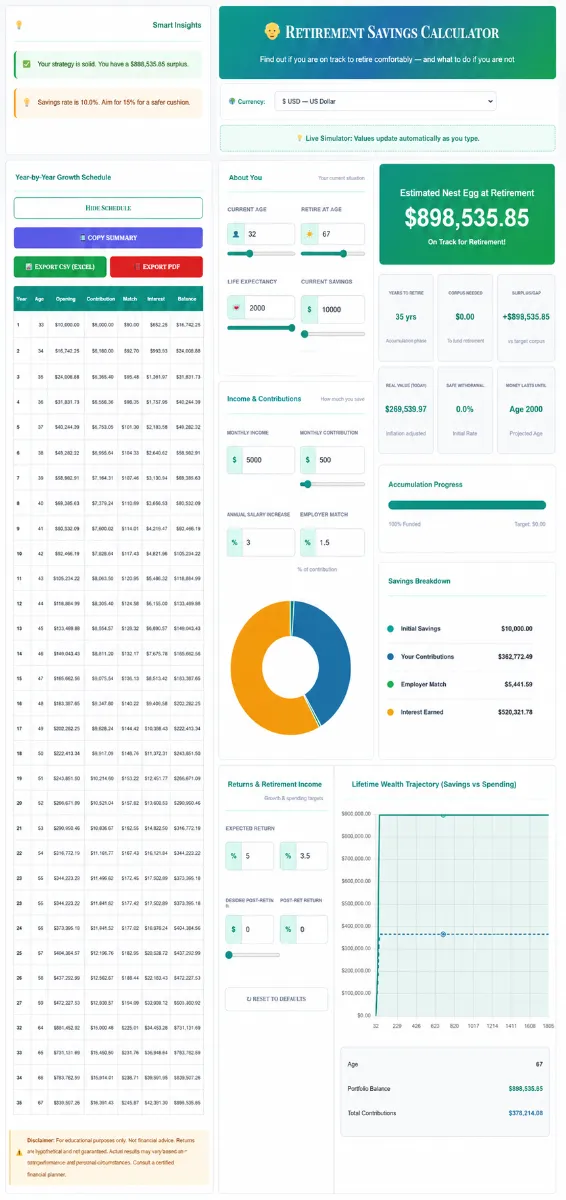
The SaveXpert Retirement Savings Calculator takes current savings, monthly contribution amount, retirement age, and assumed return to project the estimated account balance at retirement — useful for seeing how early IRA contributions compound differently from contributions started later.
Educational note: This calculator models hypothetical borrowing scenarios. Calculator results are estimates for educational purposes only. All investments carry risk. Results are not guaranteed.
High Earners: Backdoor Roth and the Pro-Rata Rule
When MAGI exceeds $168,000 (Single) or $252,000 (Married Filing Jointly), direct Roth IRA contributions are unavailable. The two-step workaround commonly called the “backdoor Roth IRA”:
Make a non-deductible contribution to a Traditional IRA (no income limit to contribute — only deductibility is income-limited).
Convert those funds to a Roth IRA and report the transaction on IRS Form 8606.
This is a legal strategy — but it comes with a significant and often misunderstood tax trap.
The Pro-Rata Rule Warning (IRC §408(d)(2))
The common assumption is that only the freshly contributed after-tax dollars get converted tax-free. The IRS position under IRC §408(d)(2) is different: all IRA balances — Traditional, Rollover, SEP, and SIMPLE IRAs — are aggregated into a single pool when calculating the taxable portion of any conversion. After-tax and pre-tax dollars cannot be selectively isolated.
⚠️ Pro-Rata Rule — Worked Example
| Component | Amount | Share of Total |
|---|---|---|
| After-tax (new contribution) | $7,500 | 7.5% |
| Pre-tax IRA assets (existing) | $92,500 | 92.5% |
| Total IRA value | $100,000 | 100% |
| A $7,500 conversion = 92.5% taxable — not tax-free | ||
In this example, what looks like a clean backdoor Roth conversion is 92.5% taxable because of the pre-existing pre-tax IRA balance. The pro-rata rule can substantially or entirely eliminate the strategy’s advantage for those holding significant Traditional, Rollover, SEP, or SIMPLE IRA assets. A qualified tax professional should model the actual tax impact before executing a conversion.
Phase-Out Worked Example
Falling in the partial contribution range doesn’t close the Roth IRA — it reduces the allowable contribution proportionally. Here’s exactly how the math works for a single filer under age 50 with a $160,500 MAGI in 2026:
2026 Roth IRA Partial Contribution Calculation — Single Filer, Under 50
| Step | Calculation | Result |
|---|---|---|
| Phase-out range width | $168,000 − $153,000 | $15,000 |
| Excess income above phase-out floor | $160,500 − $153,000 | $7,500 |
| Reduction ratio | $7,500 ÷ $15,000 | 50% |
| Allowable Roth IRA contribution | $7,500 × (1 − 0.50) | $3,750 |
At $160,500 MAGI, this filer can still contribute $3,750 directly to a Roth IRA in 2026. The remaining $3,750 could go to a Traditional IRA, or the backdoor Roth strategy becomes relevant above $168,000. Source: IRS Roth IRA guidance.
The Roth IRA Five-Year Rule — Two Separate Rules
The five-year rule is one of the most frequently misunderstood parts of Roth IRA mechanics. There are actually two separate five-year rules — confusing them can create unexpected tax or penalty consequences.
Rule 1: The Earnings Rule
To withdraw Roth IRA investment earnings tax-free, two conditions must both be met: the account must have been open for at least five tax years, and the account holder must be age 59½ or meet a qualifying IRS exception. The five-year clock starts on January 1 of the tax year for which the first Roth IRA contribution is made — not the calendar date the contribution is deposited.
Rule 2: The Conversion Rule
Each backdoor Roth conversion carries its own separate five-year clock. Withdrawing converted principal before that five-year window closes — and before age 59½ — can trigger a 10% early withdrawal penalty, even though the conversion itself was already taxed when it occurred. Each conversion year creates its own separate tracking clock.
These two rules operate independently. Satisfying Rule 1 does not automatically satisfy Rule 2, and vice versa. The five-year clock also runs separately from account to account — a Roth IRA opened in Year 1 and a different Roth IRA opened in Year 5 have different starting points for the earnings rule. For detailed guidance, IRS Publication 590-B covers Roth IRA distribution rules in full.
“Choosing between a Roth and a Traditional IRA in 2026 isn’t about guessing what tax rates will be 30 years from now. It’s about evaluating the current marginal bracket against expected future cash flow, building tax diversification, and understanding traps like the pro-rata rule before acting.”
— Kevin Brown, Lead Researcher at SaveXpert.com
Frequently Asked Questions
Ans: Yes. Contributions to both account types are permitted in 2026, provided the combined total does not exceed $7,500 (or $8,600 for those age 50 or older). The limit is per person across all IRA accounts — opening both types does not increase the annual ceiling. See IRS IRA deduction limits for eligibility rules by account type.
Ans: Excess IRA contributions trigger a 6% IRS penalty tax assessed on the excess amount for each year it remains in the account. The penalty can be avoided by withdrawing the excess contribution along with its net attributable earnings before the tax filing deadline — including extensions — for the year the excess was made. The rules are detailed in IRS Publication 590-A.
Ans: According to established tax-planning principles consistent with IRS guidance, contributing to a Roth IRA when the current marginal bracket is lower locks in that lower tax rate on contributions while allowing all future growth to compound tax-free. If future income is expected to push into a higher bracket, paying tax on contributions now at a lower rate can produce a better long-run outcome than paying tax on potentially much larger withdrawals later at a higher rate.
Ans: The pro-rata rule under IRC §408(d)(2) requires the IRS to treat all IRA balances — Traditional, Rollover, SEP, and SIMPLE IRAs — as a single aggregated pool when calculating the taxable portion of any Roth conversion. After-tax and pre-tax dollars cannot be selectively isolated for conversion purposes. If a taxpayer holds significant pre-tax IRA assets, the pro-rata calculation can make a backdoor Roth conversion substantially or entirely taxable. A qualified tax professional should model the actual impact before executing a conversion.
Ans: Original Roth IRA contributions — not earnings — can be withdrawn at any time, at any age, without income tax or penalties. Contributions were made with after-tax dollars and are not taxed again on withdrawal. However, withdrawing Roth IRA investment earnings before age 59½ generally triggers ordinary income tax plus a 10% early withdrawal penalty unless a qualifying IRS exception applies and the five-year rule has been satisfied.
Ans: IRA contributions for Tax Year 2026 can be made up to the federal tax filing deadline for that tax year — generally April 15, 2027 — regardless of whether a tax return extension is filed. A contribution made in early 2027 before that deadline can be designated as a 2026 contribution. Importantly, filing a tax extension does not extend the IRA contribution deadline. This means the contribution and the tax return can be filed on different timelines. See IRS IRA guidance for contribution timing details.