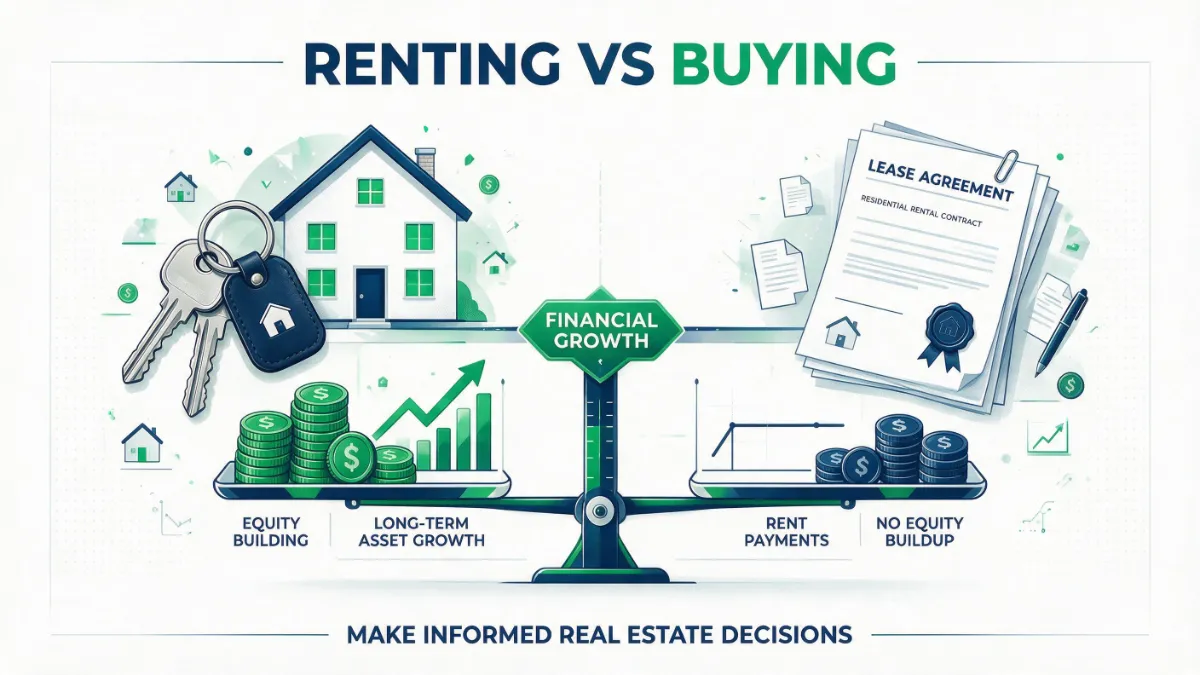
When deciding if it is better to rent or buy in 2026, compare unrecoverable costs like rent against mortgage interest, property taxes, and maintenance. Additionally, evaluate your local price-to-rent ratio and ensure you plan to stay in the home for the 5-to-7 year break-even timeline.
Key Takeaways: AT A GLANCE
- Understand Unrecoverable Costs: Renting expenses (rent, renter’s insurance) and homeownership expenses (mortgage interest, taxes, maintenance, HOA fees) are both unrecoverable costs.
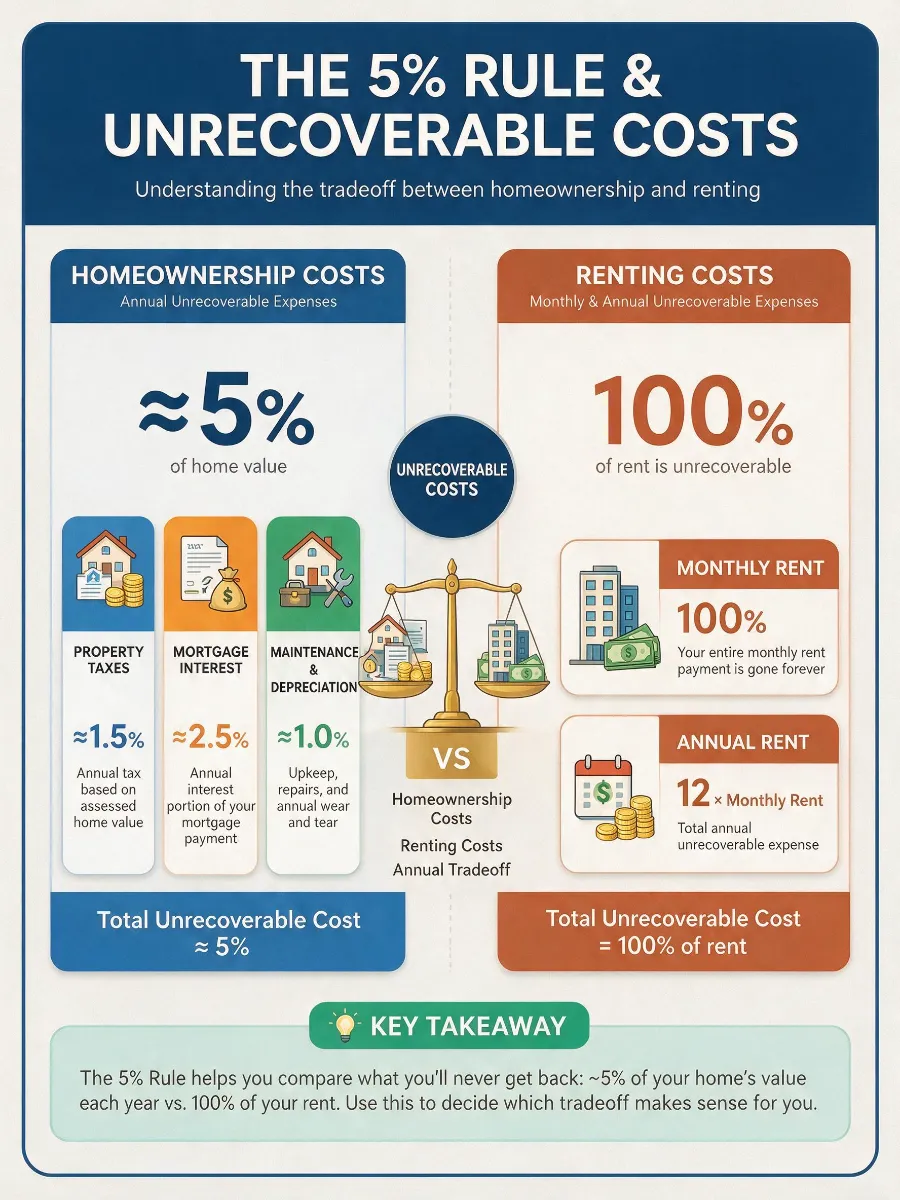
- Apply the 5% Rule: Annual unrecoverable costs of owning a home can be estimated at roughly 5% of the property’s total value.
- Check the Price-to-Rent Ratio: A national ratio sits around 16 for mid-2026, but local thresholds matter: ratios under 15 generally favor buying, while ratios over 20 favor renting.
- Monitor 2026 Benchmarks: With median home prices near $400,000 and 30-year fixed mortgage rates in the mid-6% range, financing costs severely impact homeownership affordability.
- Plan for the 5-to-7 Year Timeline: Due to high closing costs and slow early equity build-up, it typically takes 5 to 7 years to break even on a home purchase.
Table of Contents
1. Unrecoverable Costs Explained: Renting vs. Buying
2. The 5% Rule & Price-to-Rent Ratio: How to Do the Math
3. 2026 Housing Market Anchors: Home Prices and Mortgage Rates
4. How Long to Stay Before Buying a Home? The 5-to-7 Year Rule
5. Renting vs. Buying Pros and Cons in 2026
Few financial decisions carry as much emotional weight as the rent-or-buy question. It feels like it should have a clear right answer. It doesn’t — at least not a universal one.
What it does have is a framework. And once you run your real numbers through it, the answer for your specific situation tends to get a lot clearer.
I went through U.S. Census Bureau data, FRED and Freddie Mac mortgage rate figures, and the math behind the 5% rule and price-to-rent ratio to put this guide together. The goal is to replace the gut-feeling debate with an actual comparison — one that accounts for costs most people overlook entirely.
Unrecoverable Costs Explained: Renting vs. Buying
Unrecoverable costs are expenses that do not build home equity, such as monthly rent for tenants. For homeowners, these include mortgage interest, property taxes, insurance premiums, maintenance, HOA fees, and transaction closing costs.
Most people start the rent-vs-buy debate with the wrong comparison: “Is my rent payment higher than a mortgage payment?”
That comparison is dangerously incomplete. A mortgage payment blends two very different things — equity-building principal and unrecoverable interest. Homeowners also carry a stack of additional costs that have nothing to do with equity: property taxes, insurance, maintenance, HOA fees, and closing costs. None of those dollars come back when the home is sold.
The concept to understand here is the unrecoverable cost — money spent on housing that doesn’t return as equity. Not every housing dollar is economically equal, and the whole rent-or-buy decision hinges on understanding which dollars build something and which ones simply don’t.
For renters, the math is relatively simple. Rent pays for the right to live in the property. It creates zero ownership equity. Renter’s insurance adds a small additional unrecoverable cost. That’s essentially the full picture.
For homeowners, the picture is significantly more complex. A home with a $2,000 monthly mortgage payment often costs considerably more on a true economic basis once all expenses are counted. Here’s what typically falls into the unrecoverable category:
- Mortgage interest: The interest portion of each payment is a financing fee — it doesn’t increase ownership stake.
- Property taxes: These fund local government services and don’t contribute to home equity.
- Homeowners insurance: Protects the physical property but remains an ongoing, non-recoverable expense.
- Maintenance and repairs: Roofs, HVAC systems, plumbing, and appliances consume cash without directly building equity.
- HOA fees: Fund community amenities and services, not personal home equity.
- Closing costs: Loan origination, title, and recording fees can become economically unrecoverable — especially if the home is sold quickly.
Comparing monthly rent directly to mortgage principal and interest misses all of this. It ignores taxes, insurance, and maintenance entirely. It also ignores the reality that early mortgage payments go heavily toward interest — not equity.
The 5% Rule & Price-to-Rent Ratio: How to Do the Math
The 5% rule estimates annual unrecoverable homeownership costs at roughly 5% of a property’s value. Meanwhile, the price-to-rent ratio compares home prices to annual rent, helping determine if buying or renting makes better financial sense in your specific local market.
Once unrecoverable costs are understood, two simple frameworks help apply that concept to a real decision.
The 5% Rule
The 5% rule is a back-of-the-envelope test. It estimates that the annual unrecoverable cost of owning a home is approximately 5% of its total value. That bundled figure accounts for mortgage interest, property taxes, maintenance, insurance, and annualized transaction costs.
The formula: Monthly Breakeven Rent = (5% × Home Price) ÷ 12
Here’s what that looks like for a $400,000 home:
- 5% of $400,000 = $20,000 per year
- $20,000 ÷ 12 = $1,667 per month
| Comparable Monthly Rent | 5% Rule Interpretation |
|---|---|
| Below $1,667 | Renting may carry the lower unrecoverable cost |
| Around $1,667 | Roughly balanced under this simplified test |
| Above $1,667 | Buying may look more attractive economically |
Worth being clear about what this framework is and isn’t. The 5% rule is a simplified heuristic — a fast first test, not a precision model. It can’t account for specific local tax rates, insurance premiums, HOA charges, financing structures, or rent growth trajectories. It’s a starting point, not a conclusion.
The Price-to-Rent Ratio
A more specific secondary test is the price-to-rent ratio, calculated by dividing the home price by the annual rent for a comparable property.
Example: A $400,000 home with annual comparable rent of $24,000 produces a ratio of 16.7.
| Price-to-Rent Ratio | General Interpretation | City Examples in 2026 |
|---|---|---|
| Below 15 | Generally favors buying | Detroit, Cleveland, Memphis, Pittsburgh, St. Louis, Indianapolis |
| 15–20 | Neutral zone | National average (~16) |
| Above 20 | Generally favors renting | Seattle, Miami, Boston, Washington D.C., New York, San Diego, San Francisco |
These ratios offer educational thresholds — a way to quickly calibrate whether a local market leans toward buyers or renters. The national average sits around 16 for mid-2026, which puts most of the country in neutral territory. But local markets vary enormously, and the city in which the property sits matters far more than the national average.

2026 Housing Market Anchors: Home Prices and Mortgage Rates
In 2026, the housing market features median new single-family home prices hovering around $400,000, paired with 30-year fixed mortgage rates averaging in the mid-6% range. These elevated financing costs directly increase unrecoverable homeownership expenses, requiring careful calculation.
The national housing backdrop in 2026 significantly shapes the rent-versus-buy math. Here’s what the official data shows.
According to U.S. Census Bureau data, the median new single-family home price was $398,300 in June 2026, with a first-quarter 2026 median of $403,200. The first-quarter average was notably higher at $514,600 — a figure that shows how expensive new builds pull averages upward and why median figures tend to be the more useful benchmark.
On the financing side, FRED and Freddie Mac data indicate the 30-year fixed mortgage average sat at roughly 6.69% in early August 2026. Earlier in the year, in March 2026, rates were slightly lower at around 6.22%.
Higher mortgage rates matter more than most buyers initially realize. A higher rate dramatically increases the interest portion of each payment — which is the unrecoverable portion. The same $400,000 home financed at today’s rates carries very different economics from the same home financed at rates several percentage points lower. The home price is only part of the equation.
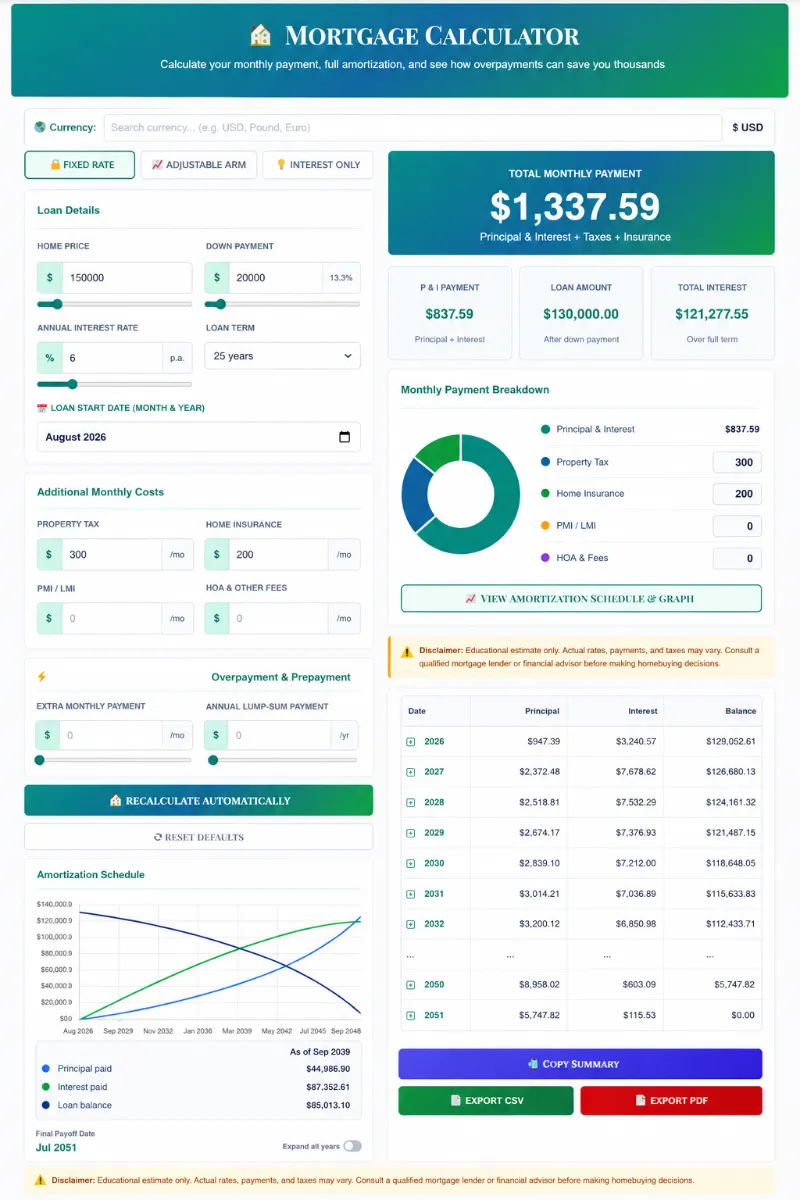
SaveXpert Tip: Before you can effectively compare renting to buying, you need to know exactly what a home purchase will cost you every month. Use the SaveXpert Mortgage Calculator to estimate your monthly principal and interest payments based on current 2026 rates. Once you know your baseline financing costs, you can accurately compare them against local rent prices and calculate your unrecoverable costs. (Note: Calculator results are estimates for educational purposes.)
How Long to Stay Before Buying a Home? The 5-to-7 Year Rule
It typically takes 5 to 7 years to break even on a home purchase due to high upfront closing costs and early mortgage payments largely going toward interest. Staying less than five years often makes renting cheaper, while staying over seven favors buying.
How long someone plans to stay is just as important as the home’s price. Maybe more so.
A widely used educational benchmark is the 5-to-7 year break-even horizon. Buying generally takes several years before the economic benefits begin to outweigh the costs of renting.
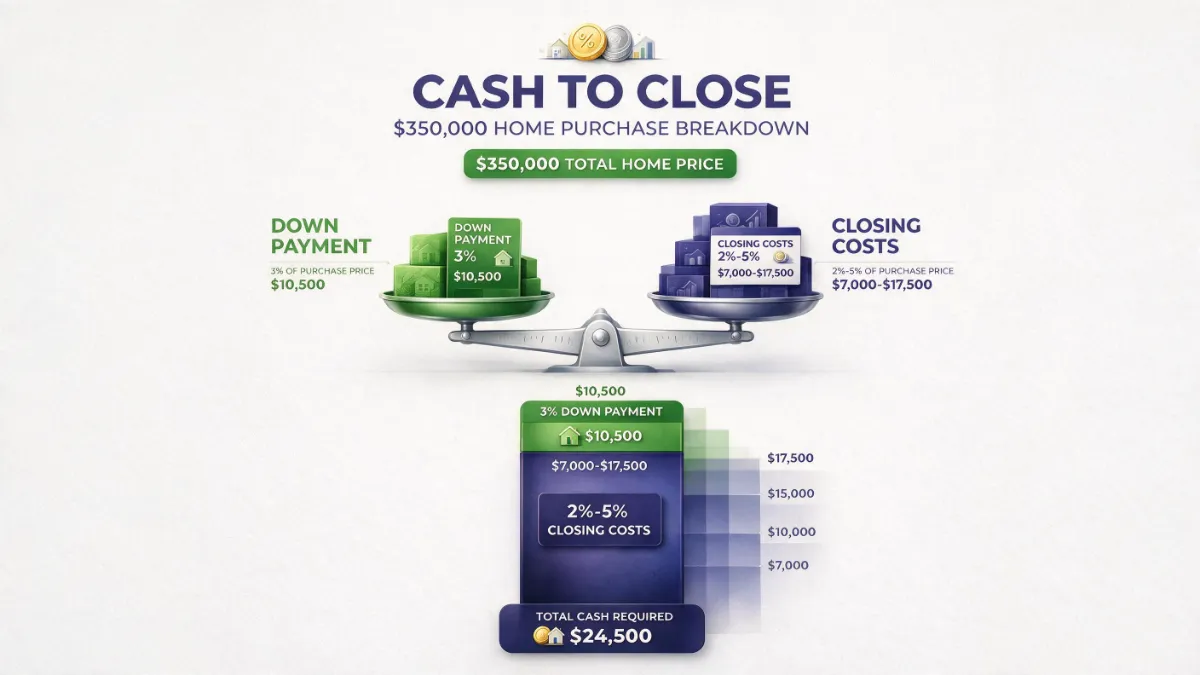
The core reason is upfront financial friction. Closing costs — loan origination fees, title costs, recording fees — arrive immediately and consume several percent of the purchase price. These are very difficult to recover if the home is sold shortly after purchase.
Mortgage amortization adds to the challenge. On a typical 30-year loan, a large portion of early payments goes toward interest rather than principal. Equity builds much more slowly than most new buyers expect. Selling early means encountering fresh transaction costs — real estate commissions, transfer taxes, title fees — which can erase whatever small equity accumulated in the early years.
The data-supported framework breaks down roughly like this:
- Under 5 years: Renting tends to have the lower total unrecoverable cost in most markets.
- 5–7 years: Outcome is highly sensitive to local market conditions and holding cost specifics.
- 7+ years: Buying generally has enough time to overcome upfront friction and become economically competitive.
Time is a financial variable in real estate. It’s not incidental to the decision — it’s central to it.
🏠 Quick Mortgage Check
Estimate your monthly payments and total interest.
P&I Payment
Loan Amount
Total Interest
Renting vs. Buying Pros and Cons in 2026
Renting offers high flexibility, lower upfront cash requirements, and zero maintenance obligations. Buying builds long-term equity and stabilizes housing costs but carries risks like unexpected repairs, significant transaction fees, and high upfront capital needs.
There’s no universally superior housing strategy. The best approach is to honestly assess the trade-offs against 2026’s specific market conditions — relatively high mortgage rates, fluctuating price-to-rent ratios by city, and significant transaction costs on both sides.
| Factor | Renting | Buying |
|---|---|---|
| Mobility & Flexibility | High — easy to relocate | Lower — harder to move quickly |
| Upfront Cash | Usually lower | Usually higher (down payment, closing costs) |
| Equity Building | None from rent payments | Principal payments can build equity over time |
| Maintenance | Usually limited or none | Complete homeowner responsibility |
| Closing/Selling Costs | None associated | Can be significant on both ends |
The biggest renting advantage is flexibility. When employment, household size, or location might change within a few years, renting provides optionality that doesn’t show up on a spreadsheet but carries real economic value.
The biggest buying advantage is long-term equity accumulation — converting housing payments into a meaningful asset over time. In lower price-to-rent markets, that process can be quite efficient. In expensive coastal markets where ratios exceed 20, the economic hurdle for buying to come out ahead is significantly higher.
Neither outcome is inherently “right.” The local ratio, the financing cost, the planned holding period, and personal life circumstances all feed into which side of the trade-off makes more sense for a specific person at a specific moment.
The Bottom Line: A Simple Rent-or-Buy Checklist for 2026
Before committing to either path, working through five core questions helps clarify which direction makes sense:
- What is the expected holding period?
- Under 5 years generally favors renting in most markets. Between 5 and 7 years, the answer becomes highly sensitive to local conditions. Beyond 7 years, buying typically has enough time to overcome upfront friction and become economically competitive.
- What is the local price-to-rent ratio?
- Divide the home price by the annual comparable rent. Ratios below 15 favor buying. The 15–20 range is neutral. Above 20 generally favors renting. The national average sits around 16 for mid-2026 — but local markets vary significantly.
- Does the full unrecoverable cost of ownership pencil out?
- The calculation goes beyond principal and interest. Mortgage interest, property taxes, insurance, maintenance, HOA fees, and transaction costs all belong in the total. Stopping at the mortgage payment alone produces a number that’s misleading in most cases.
- Are emergency reserves adequate after the purchase?
- Buying requires a down payment, closing costs, moving expenses, and a financial cushion for unexpected repairs. A purchase that depletes all reserves creates real financial vulnerability — even if the purchase price itself is mathematically sound.
- How stable is the next 5 to 10 years?
- Real estate is illiquid. When employment, household structure, or location plans are uncertain, the flexibility that renting provides carries substantial economic value that often isn’t fully priced into the comparison.
There’s no single national answer to whether it’s better to rent or buy in 2026. The decision involves comparing the unrecoverable costs of both options, accounting for the local price-to-rent ratio, and being honest about how long staying in one place is realistic.
“Rent is not automatically ‘throwing money away,’ and buying is not automatically ‘building wealth.’ True financial clarity comes when you stop comparing your rent to a mortgage quote, and start comparing the true unrecoverable costs of both options.“— Kevin Brown, Lead Researcher & Founder of SaveXpert
Frequently Asked Questions
Ans: No. Renters pay for housing services — just as homeowners pay unrecoverable costs like mortgage interest, property taxes, insurance, maintenance, HOA fees, and closing costs. Both options involve spending money that doesn’t come back. The “throwing money away” framing only holds up if homeownership’s unrecoverable costs are ignored entirely.
Ans: It depends on the objective. A ratio below 15 generally suggests buying is more favorable. A ratio between 15 and 20 is considered a neutral zone. A ratio above 20 heavily favors renting. The national average sits around 16 for mid-2026, but local variation is significant — coastal markets frequently exceed 20, while Midwestern and Southern cities often fall below 15.
Ans: Buying creates substantial upfront closing costs that arrive immediately. Early mortgage payments also go mostly toward interest rather than principal, so equity builds slowly in the beginning. Staying in the home longer gives equity growth time to offset those initial expenses. Selling early typically means encountering fresh transaction costs on the way out — which can wipe out whatever equity accumulated.
Ans: When buying a home, unrecoverable costs include mortgage interest, property taxes, homeowners insurance, maintenance and repairs, HOA fees, and transaction closing costs. None of these expenses contribute to home equity. They’re the true economic cost of ownership — separate from the principal payments that do build equity over time.