ⓘ Educational Disclosure:
This article is for educational and informational purposes only. It does not constitute financial, legal, tax, lending, student-loan, insurance or real estate advice. SaveXpert and its authors are not licensed financial aid or real estate professionals. Housing market data changes frequently. Always consult a qualified financial and real estate professional before making any home purchase or rental decisions. Individual circumstances vary significantly.
Whether it is better to rent or buy in 2026 depends on three variables: the local price-to-rent ratio (the national mid-2026 average is approximately 16, with ratios under 15 generally favoring buying and above 20 generally favoring renting), the planned holding period (research-based break-even typically runs 5 to 7 years due to upfront closing costs and slow early equity accumulation), and a full comparison of unrecoverable costs on both sides — not just rent versus mortgage payment. According to the U.S. Census Bureau, the median new single-family home price was $398,300 in June 2026. Per FRED data, the 30-year fixed mortgage average was approximately 6.69% in early August 2026.
What This Research Found
- Unrecoverable costs exist on both sides. Rent is unrecoverable for renters. Mortgage interest, property taxes, insurance, maintenance, HOA fees, and closing costs are unrecoverable for homeowners. Comparing only rent to mortgage P&I produces a dangerously incomplete picture.
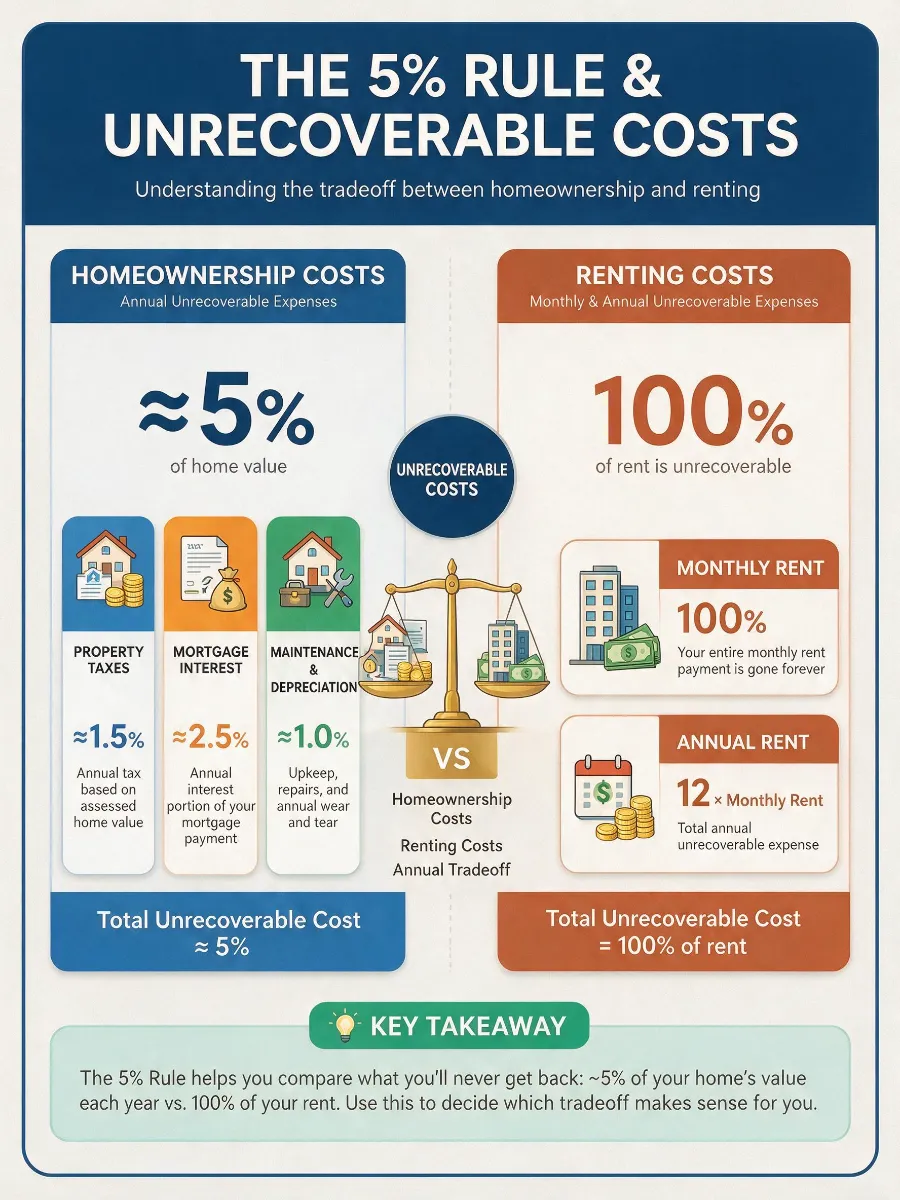
- The 5% rule estimates annual unrecoverable homeownership costs at roughly 5% of the property’s value. On a $400,000 home, that is approximately $1,667/month — the monthly rent figure below which renting may be more economical.
- Price-to-rent ratio of ~16 nationally (mid-2026): ratios under 15 favor buying, 15–20 is neutral, above 20 generally favors renting. Coastal markets frequently exceed 20; Midwest cities often fall below 15.
- 2026 market benchmarks: median new home price $398,300 (Census Bureau, June 2026); 30-year fixed mortgage rate ~6.69% (FRED, early August 2026). High financing costs increase the unrecoverable portion of each payment.
- The 5-to-7 year break-even exists because closing costs arrive immediately and early mortgage amortization is front-loaded toward interest. Selling before year 5 often results in a net economic loss compared to renting.
- Flexibility has economic value that doesn’t appear in spreadsheets. When employment, location, or household size is uncertain over the next 3–5 years, renting preserves optionality that can be worth thousands of dollars.
- Time To Read: 7 Minutes
Table of Contents
1. Unrecoverable Costs: The Framework That Changes Everything
2. The 5% Rule and Price-to-Rent Ratio
3. 2026 Housing Market Data: Home Prices and Mortgage Rates
4. The 5-to-7 Year Break-Even Timeline
5. Renting vs. Buying: What the Trade-Offs Actually Look Like
The rent-or-buy question carries more emotional weight than almost any other financial decision. It feels like it should have a clear right answer. It doesn’t — at least not a universal one.
What it has is a framework. I went through U.S. Census Bureau housing price data, FRED and Freddie Mac mortgage rate figures, CFPB homeownership guidance, and the math behind the 5% rule and price-to-rent ratio to put this together. The goal is to replace the gut-feeling debate with a comparison that accounts for costs most people overlook entirely — and to make the right answer for a specific situation genuinely clear.
Unrecoverable Costs: The Framework That Changes Everything
Most people start the rent-versus-buy debate with the wrong question: “Is my rent higher than a mortgage payment?” That comparison is dangerously incomplete.
A mortgage payment blends two very different things — equity-building principal and unrecoverable interest. Homeowners also carry a stack of additional costs that have nothing to do with equity: property taxes, insurance, maintenance, HOA fees, and closing costs. None of those dollars come back when the home is sold.
An unrecoverable cost is money spent on housing that doesn’t return as equity. Not every housing dollar is economically equal, and the rent-or-buy decision hinges on understanding which dollars build something and which ones simply don’t.
For renters, the calculation is relatively simple: monthly rent pays for the right to occupy the property. Renter’s insurance adds a small additional unrecoverable cost. That’s essentially the full picture. For homeowners, the picture is significantly more complex:
Mortgage interest:
The interest portion of each payment is a financing fee — it doesn’t increase ownership stake, and it dominates early payments under standard amortization.
Property taxes:
These fund local government services and don’t contribute to home equity regardless of how long the home is held.
Homeowners insurance:
Protects the physical structure but remains an ongoing, non-recoverable expense.
Maintenance and repairs:
Roofs, HVAC systems, plumbing, and appliances consume cash without directly building equity. Research-based estimates run at approximately 1% of home value annually.
HOA fees:
Fund community amenities and services, not personal home equity.
Closing costs:
Loan origination, title, and recording fees can total 2–5% of the purchase price and become economically unrecoverable if the home is sold quickly.
Stopping the analysis at principal and interest misses all of this. It also ignores the reality that early mortgage payments go heavily toward interest rather than equity — the equity build-up most buyers imagine is front-loaded toward the back half of a 30-year loan.
The 5% Rule and Price-to-Rent Ratio
Once unrecoverable costs are understood, two frameworks help apply that concept to a real decision. Neither is a precision model — both are starting points for deeper analysis.
The 5% Rule
The 5% rule is a back-of-the-envelope test. It estimates that the annual unrecoverable cost of owning a home is approximately 5% of its total value, bundling mortgage interest, property taxes, maintenance, insurance, and annualized transaction costs into a single figure.
Monthly Break-Even Rent = (5% × Home Price) ÷ 12
If comparable rent is lower than this figure, renting may carry the lower unrecoverable cost
Applied to a $400,000 home: 5% of $400,000 = $20,000 per year, or $1,667 per month.
5% Rule Interpretation — $400,000 Home Example
| Comparable Monthly Rent | 5% Rule Signal |
|---|---|
| Below $1,667 | Renting may carry the lower unrecoverable cost in this market |
| Around $1,667 | Roughly balanced — additional local factors become decisive |
| Above $1,667 | Buying may look more economically attractive |
The 5% rule cannot account for specific local tax rates, insurance premiums, HOA charges, financing structures, or rent growth trajectories. It is a fast first test, not a conclusion.
Estimate your monthly payment and total interest in seconds.
The Price-to-Rent Ratio
A more specific secondary test is the price-to-rent ratio, calculated by dividing the home price by the annual rent for a comparable property in the same location.
Example: A $400,000 home with annual comparable rent of $24,000 produces a ratio of 16.7 ($400,000 ÷ $24,000).
Price-to-Rent Ratio — General Interpretation (Mid-2026)
| Ratio Range | General Signal | Representative 2026 Markets |
|---|---|---|
| Below 15 | Generally favors buying | Detroit, Cleveland, Memphis, Pittsburgh, St. Louis, Indianapolis |
| 15–20 | Neutral zone — hold cost specifics matter | National average (~16, mid-2026) |
| Above 20 | Generally favors renting | Seattle, Miami, Boston, Washington D.C., New York, San Diego, San Francisco |
City examples are illustrative. Price-to-rent ratios shift with local market conditions. The national mid-2026 average sits around 16, placing most of the country in neutral territory. Individual neighborhoods within a city can diverge significantly from metro-wide averages. Sources: U.S. Census Bureau; FRED.

2026 Housing Market Data: Home Prices and Mortgage Rates
The national housing backdrop in 2026 substantially shapes the rent-versus-buy math for any individual decision.
📈 2026 Housing Market Benchmarks — Official Sources
Median new single-family home price (June 2026): $398,300 — U.S. Census Bureau
Q1 2026 median new home price: $403,200 — U.S. Census Bureau
Q1 2026 average new home price: $514,600 (averages pull higher due to expensive new builds)
30-year fixed mortgage rate (early August 2026): ~6.69% — FRED / Freddie Mac
30-year fixed mortgage rate (March 2026): ~6.22% — FRED / Freddie Mac
Two things these figures confirm: first, national median prices are anchored near $400,000, making the 5% rule’s $1,667 monthly benchmark a reasonable reference point for many markets. Second, mortgage rates in the mid-6% range mean the interest portion of each payment — the unrecoverable portion — is substantially larger than it was when rates were below 4%.
At a 6.69% rate on a $320,000 loan (reflecting a 20% down payment on a $400,000 home), the monthly principal and interest payment is approximately $2,090. Of that payment in month one, roughly $1,784 goes toward interest and only $306 toward principal. That ratio shifts gradually over time, but the early-year unrecoverable cost of ownership is significantly higher than a simple payment comparison suggests.
💰 Try the SaveXpert Mortgage Calculator
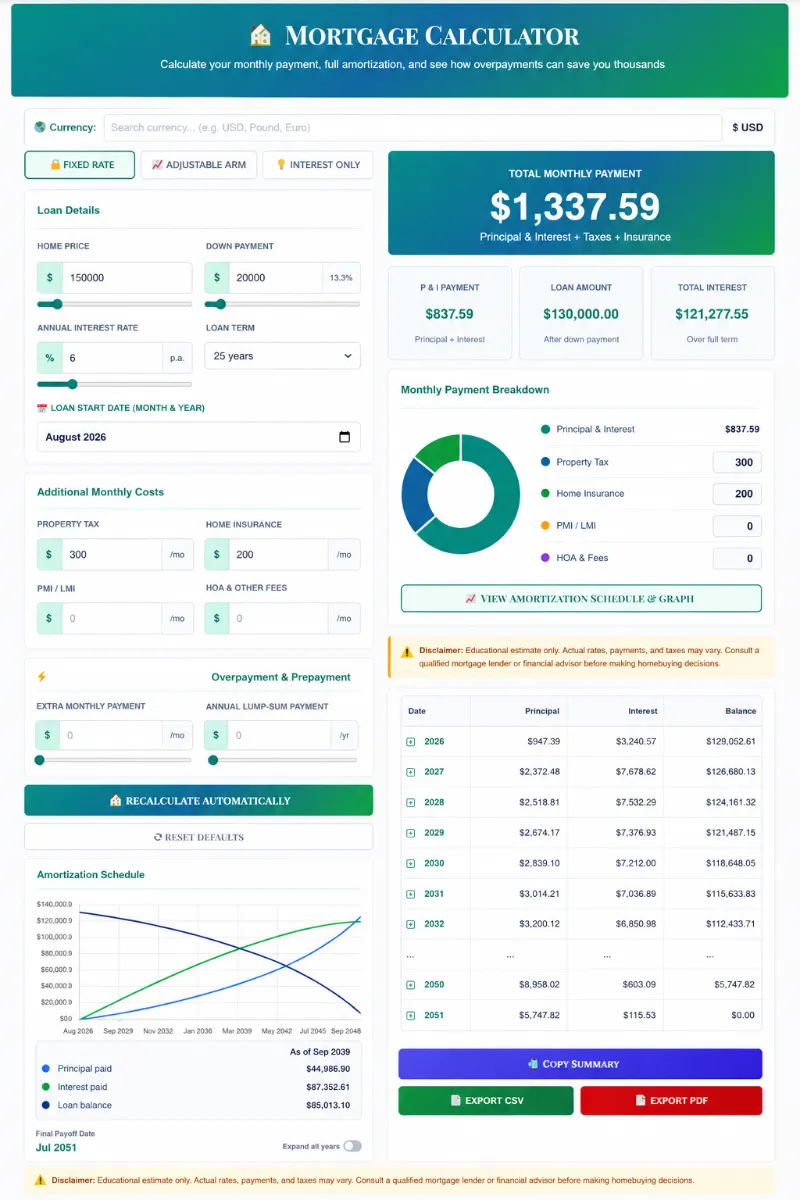
The SaveXpert Mortgage Calculator estimates monthly principal and interest payments based on home price, down payment, interest rate, and loan term — and shows the amortization schedule so the principal/interest split at each year is visible. Knowing the baseline financing cost is necessary before comparing it accurately against local rents.
Educational note: This calculator models hypothetical borrowing scenarios. Calculator results are estimates for educational purposes only.
The 5-to-7 Year Break-Even Timeline
How long someone plans to stay is just as important as home price. In some situations, more so.
A widely cited educational benchmark is the 5-to-7 year break-even horizon. Two structural factors drive this timeline:
Closing costs arrive immediately.
Loan origination fees, title charges, and recording fees typically add up to 2–5% of the purchase price — on a $400,000 home, potentially $8,000 to $20,000 paid at signing. These don’t contribute to equity. If the home is sold within a year or two, they’re simply gone.
Early amortization is front-loaded toward interest.
Under a standard 30-year fixed mortgage, the vast majority of early payments go to the lender rather than to the owner. Equity builds much more slowly than most new buyers expect. Selling early means encountering fresh transaction costs going out — real estate commissions (typically 5–6%), transfer taxes, and title fees — that can eliminate whatever small equity accumulated in the first few years.
Holding Period and Break-Even Signal
| Planned Holding Period | Research-Based Signal | Primary Reason |
|---|---|---|
| Under 3 years | Renting strongly favored in most markets | Closing costs and interest front-loading virtually impossible to overcome |
| 3–5 years | Renting still favored in most markets | Closing costs likely not recovered; equity still modest |
| 5–7 years | Outcome highly market-specific | Depends on local price-to-rent ratio, appreciation, and financing cost |
| 7+ years | Buying generally becomes economically competitive | Equity has accumulated, closing costs amortized, interest share declining |
Time is a financial variable in real estate — not incidental to the decision, but central to it. The same purchase that makes mathematical sense for a 10-year resident may represent a net economic loss for someone who sells in 3 years.
Renting vs. Buying: What the Trade-Offs Actually Look Like
There is no universally superior housing strategy. The right approach is an honest assessment of the trade-offs against 2026’s specific conditions — mid-6% mortgage rates, elevated prices, and significant transaction friction on both entry and exit.
🏠 Advantages of Renting
- Maximum mobility — easier to relocate for employment or life changes.
- Lower and more predictable upfront cash requirement.
- No maintenance or repair responsibility.
- No exposure to property value declines.
- No transaction costs when moving.
- Preserves capital that could be invested elsewhere.
🏠 Advantages of Renting
- Principal payments convert housing cost into equity over time.
- Fixed-rate mortgage locks in predictable P&I payments for 30 years.
- Potential appreciation increases net worth if prices rise.
- Property tax deductions may apply (subject to IRS limits).
- Stability and control over the physical property.
- Estate asset that can be passed to heirs.
Renting vs. Buying — Key Factor Comparison
| Factor | Renting | Buying |
|---|---|---|
| Mobility and flexibility | High — easy to relocate | Lower — illiquid asset, transaction costs to exit |
| Upfront cash required | Usually security deposit and first/last month | Down payment (3.5–20%+) plus 2–5% closing costs |
| Equity building | None from rent payments | Principal payments build equity over time (slowly at first) |
| Maintenance responsibility | Typically the landlord’s | Entirely the homeowner’s |
| Market risk exposure | None (price changes don’t affect renter) | Full exposure — values can decline as well as rise |
| Closing/selling costs | None when moving | Significant on both purchase and eventual sale |
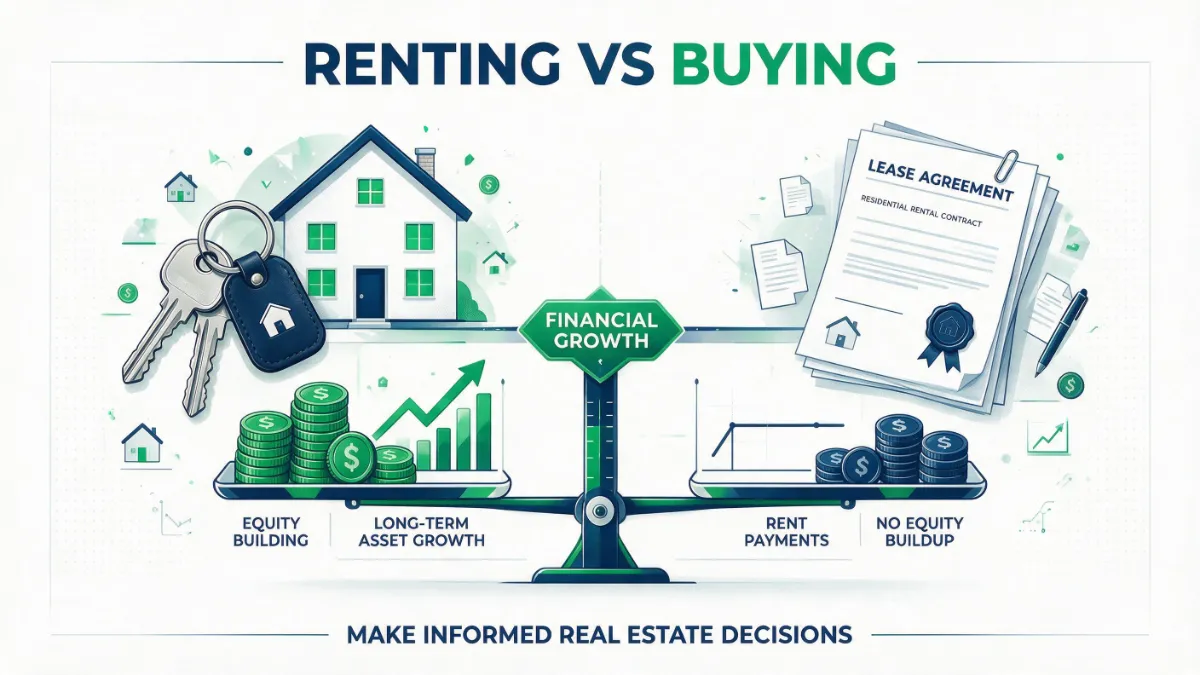
The biggest renting advantage is flexibility — when employment, household size, or location plans may change within a few years, renting preserves optionality that doesn’t show up in a spreadsheet but carries real economic value. The biggest buying advantage is long-term equity accumulation — converting housing payments into a meaningful balance-sheet asset over time. In lower price-to-rent markets with longer holding periods, that process can be highly efficient. In expensive coastal markets with ratios exceeding 20, the economic hurdle for buying to come out ahead is significantly higher.
A Five-Question Rent-or-Buy Checklist for 2026
Working through five honest questions tends to clarify which direction makes more sense for a specific person at a specific moment. The research and CFPB guidance on homeownership readiness both point toward the same sequence:
1. What is the expected holding period?
Under 5 years generally favors renting in most markets. Between 5 and 7 years, the answer becomes highly sensitive to local conditions. Beyond 7 years, buying typically has enough time to overcome upfront friction and become economically competitive.
2. What is the local price-to-rent ratio?
Divide the target home price by the annual comparable rent. Ratios below 15 favor buying. The 15–20 range is neutral. Above 20 generally favors renting. The national average sits around 16 for mid-2026 — but local markets vary significantly and the city matters far more than the national average.
3. Does the full unrecoverable cost of ownership pencil out?
The calculation goes beyond principal and interest. Mortgage interest, property taxes, insurance, maintenance (roughly 1% of value annually), HOA fees, and amortized closing costs all belong in the total. Stopping at the mortgage payment produces a number that understates the true cost of ownership.
4. Are emergency reserves adequate after the purchase?
A down payment plus closing costs can consume a significant portion of liquid savings. A purchase that depletes reserves entirely creates real financial vulnerability — the first unexpected repair or income disruption becomes a financial crisis. CFPB homeownership guidance emphasizes maintaining a cash buffer beyond the purchase itself.
5. How stable are the next 5 to 10 years?
Real estate is illiquid. When employment, household structure, or location plans are uncertain, the flexibility that renting provides carries economic value that is often underweighted in the rent-versus-buy comparison. Optionality is worth something concrete.
“Rent is not automatically ‘throwing money away,’ and buying is not automatically ‘building wealth.’ Genuine clarity comes when the full unrecoverable costs of both options are compared honestly — and when the local price-to-rent ratio and planned holding period are factored in alongside the payment.”
— Kevin Brown, Lead Researcher at SaveXpert.com
Frequently Asked Questions
Ans: No. Renters pay for housing services — the right to occupy a property. Homeowners similarly pay unrecoverable costs: mortgage interest, property taxes, homeowners insurance, maintenance and repairs, HOA fees, and closing costs. Both arrangements involve spending money that doesn’t return as equity. The “throwing money away” framing only holds up if homeownership’s unrecoverable costs are ignored entirely, which produces an unfair comparison.
Ans: The price-to-rent ratio is calculated by dividing a home’s price by the annual rent for a comparable property. A ratio below 15 generally indicates buying is more favorable. Between 15 and 20 is considered a neutral zone. Above 20 generally favors renting. The national average sits around 16 for mid-2026 — but local markets vary significantly. Coastal cities like San Francisco, Miami, and New York frequently exceed 20, while Midwestern and Southern cities often fall below 15. The local ratio matters far more than the national average. Sources: U.S. Census Bureau; FRED.
Ans: Home purchases involve substantial upfront closing costs — loan origination fees, title charges, recording fees — that arrive immediately and are very difficult to recover if the home is sold shortly after. Early mortgage payments also go disproportionately toward interest rather than principal under standard 30-year amortization, meaning equity builds slowly at first. Selling early typically means encountering fresh transaction costs going out — real estate commissions, transfer taxes, title fees — which can erase whatever equity accumulated in the early years.
Ans: Unrecoverable homeownership costs include mortgage interest, property taxes, homeowners insurance premiums, maintenance and repair expenses, HOA fees, and transaction closing costs on both purchase and sale. None of these expenses contribute to home equity — they represent the true economic cost of owning, separate from the principal payments that do build equity over time. For a $400,000 home at current 2026 rates, these unrecoverable costs often exceed the equity-building portion of the mortgage payment in the early years.
Ans: According to the Consumer Financial Protection Bureau (CFPB), most conventional mortgages require a minimum FICO score of 620. FHA loans are available to borrowers with scores as low as 500 (with a 10% down payment) or 580 (for a 3.5% down payment). Higher credit scores typically unlock lower interest rates — a meaningful consideration at 2026 rates averaging around 6.7%, where even a half-point rate improvement significantly reduces the monthly interest (unrecoverable) portion of the payment.
Ans: Down payment requirements vary by loan type. Conventional loans typically require 5–20% down, with private mortgage insurance (PMI) required below 20%. FHA loans require 3.5% down for borrowers with a 580+ credit score. VA loans for eligible veterans and USDA loans for eligible rural properties may offer 0% down options. The U.S. Department of Housing and Urban Development (HUD) provides a homeownership resources page listing first-time buyer assistance programs available by state.