ⓘ Educational Disclosure:
SaveXpert provides this guide for educational purposes only. We outline standard mortgage underwriting, loan programs, and down-payment assistance mechanics. This article does not constitute mortgage lending, legal, tax, or real estate advisory services. Lending criteria and grant terms vary by jurisdiction, lender, and individual financial profile. Always consult a licensed professional and a qualified advisor regarding your specific circumstances.
What do first-time home buyers need to know in 2026? Buying a first home in 2026 does not require a 20% down payment. Qualified buyers can use 3% Conventional, 3.5% FHA, or 0% VA and USDA loans. Beyond the down payment, buyers must budget an additional 2% to 5% of the loan amount for closing costs, and should check their state housing finance agency for down-payment assistance grants that can offset both.
Key Takeaways
- Problem: Most first-time buyers delay homeownership because they assume 20% down is the law — and they don’t know that closing costs add another 2%–5% on top of whatever they do save.
- Solution: Government-backed loan programs allow 0%–3.5% down; state housing finance agency grants can offset both the down payment and closing costs; the real number to model is total cash-to-close, not just the down payment.
- Result: A buyer with a 620+ credit score and state grant eligibility can reach the closing table with materially less cash than the 20% myth suggests — but only if they calculate the full out-of-pocket cost upfront.
- Source: HUD — FHA Loan Programs, CFPB — Owning a Home
- Time To Read: 10 Minutes
Table of Contents
1. Core Mortgage Programs for First-Time Buyers
2. The 20% Down Myth and Mortgage Insurance Mechanics
3. Closing Costs Explained: What First-Time Buyers Actually Pay
4. Credit Scores and Debt-to-Income (DTI) Ratios
5. Down Payment Assistance: Grants, Silent Seconds, and MCCs
6. How to Find Legitimate First-Time Home Buyer Programs by State
7. How to Buy a House With No Money Down: The Reality Check
Buying your first home doesn’t require decades of savings or a massive 20% down payment. Multiple federal loan programs let qualified buyers purchase a home with as little as 0% to 3.5% down. What I found when I went through the HUD loan guidelines and CFPB homebuyer data is that the 20% number stops people who could already qualify — not because they can’t afford a home, but because they’re chasing the wrong target.
The real challenge isn’t the down payment — it’s calculating your total cash-to-close number before you sign a purchase agreement. That means down payment plus lender fees, title insurance, prepaid taxes, and escrow setup. Buyers who don’t model that full number hit the settlement table underfunded.
Core Mortgage Programs for First-Time Buyers
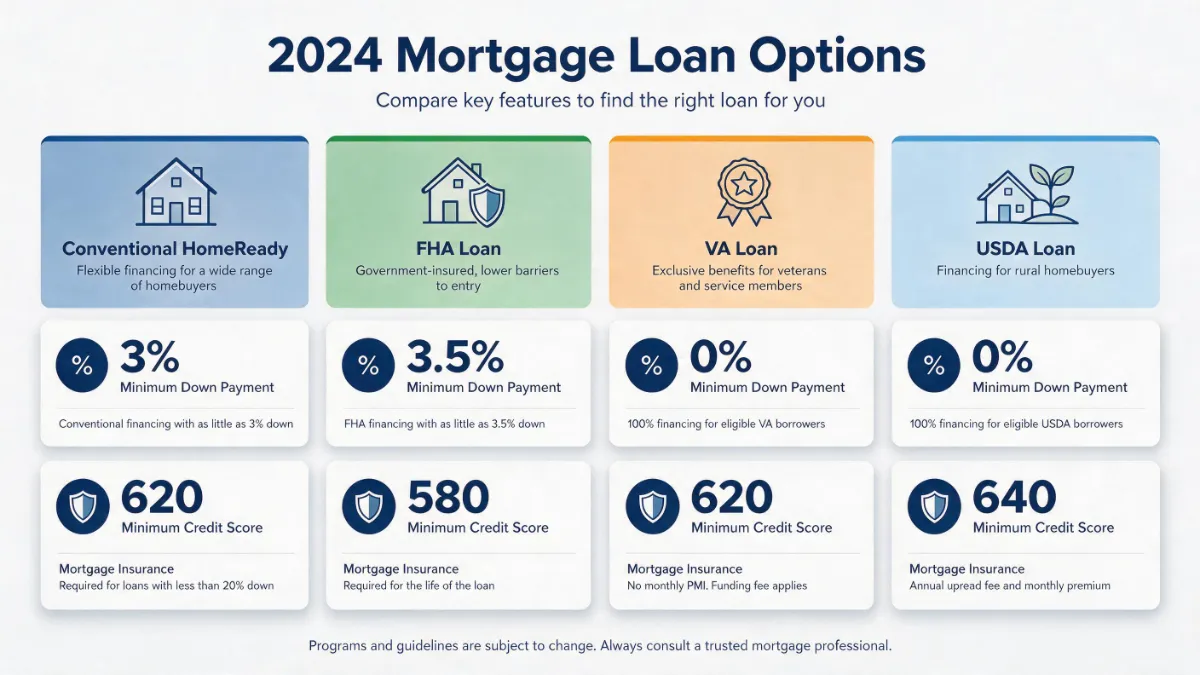
The right mortgage depends on your credit profile, monthly cash flow, and property location. Here’s what the main 2026 programs actually require.
Conventional Loans: 3% Down Options
Fannie Mae’s HomeReady and Freddie Mac’s Home Possible programs let qualified buyers purchase homes with just 3% down. Borrowers generally need a credit score of 620 or higher to pass automated underwriting. Conventional loans have one long-term financial advantage: once your equity reaches 20%, you can cancel Private Mortgage Insurance — which immediately lowers your monthly payment. That option doesn’t exist with FHA.
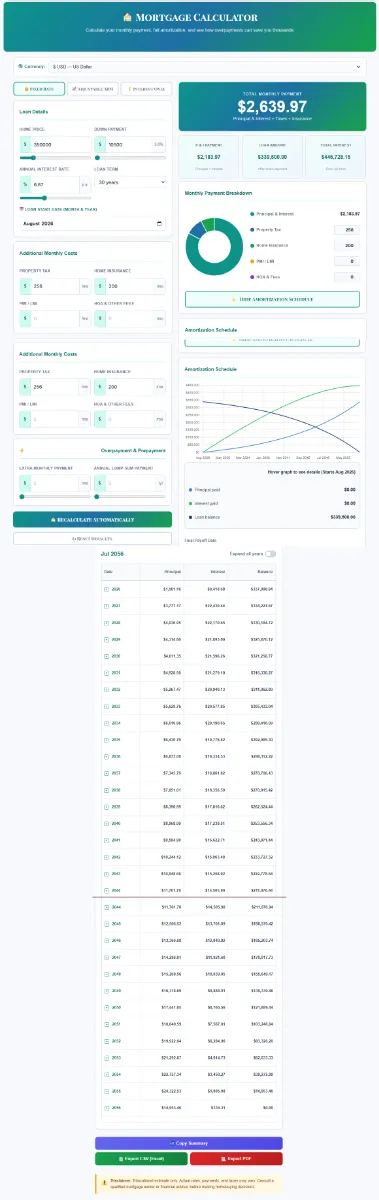
💡 Research note: Conventional 3% down math on a $350,000 purchase: minimum down payment = $10,500, leaving a base loan balance of $339,500. That’s the number your DTI calculation works from.
FHA Loans: Flexible 3.5% Down Financing
The Federal Housing Administration, through HUD, backs FHA loans specifically to help buyers rebuilding credit enter the housing market. An FHA loan requires 3.5% down with a credit score of 580 or higher. If your score falls between 500 and 579, the minimum rises to 10%.
FHA financing requires two types of mortgage insurance: an Upfront Mortgage Insurance Premium (UFMIP) of 1.75% of the base loan amount added to the loan balance, and an annual MIP (typically 0.55%) divided across your monthly payments. For buyers putting down less than 10%, FHA MIP stays for the full life of the loan — a meaningful long-term cost difference compared to conventional PMI.
VA-Backed Loans: True 0% Down for Military Families
The Department of Veterans Affairs guarantees VA home loans for active-duty military, veterans, and qualifying surviving spouses. VA loans remove the down payment requirement entirely on purchases up to the appraised value. There’s no monthly mortgage insurance premium. Instead, borrowers pay a one-time VA funding fee at closing — which lenders allow you to roll directly into the total loan balance.
USDA Loans: 100% Financing for Rural Properties
The U.S. Department of Agriculture’s Single Family Housing Guaranteed Loan Program backs zero-down mortgages for low-to-moderate-income families buying homes in designated rural and suburban areas. USDA guidelines cap household income at 115% of the Area Median Income (AMI), and the home must serve as your primary residence within an officially designated USDA-eligible zone.
Table 1 — 2026 First-Time Buyer Loan Program Comparison
| Loan Program | Min. Down Payment | Credit Score Benchmark | Key Characteristics |
|---|---|---|---|
| Conventional (HomeReady / Home Possible) | 3% | 620+ | PMI drops off at 80% LTV; income limits apply on specific programs. |
| FHA Loan | 3.5% | 580+ | Upfront + monthly MIP applies; flexible credit underwriting; MIP stays for life of loan if <10% down. |
| VA Loan | 0% | No agency minimum (lender sets threshold) | Exclusive to eligible veterans and active service members; zero PMI; one-time VA funding fee required. |
| USDA Guaranteed Loan | 0% | No agency minimum (often 640) | Eligible rural and suburban zones only; household income cannot exceed 115% of area median. |
Source: HUD — FHA Loan Programs · VA — Home Loans · USDA Rural Development — Single Family Housing Guaranteed Loan Program
The 20% Down Myth and Mortgage Insurance Mechanics
Do I really need 20% down to buy a house? No. Lenders don’t legally require 20% down to approve a mortgage. The 20% figure is a private mortgage insurance threshold — not a law. Data from HUD shows first-time buyers routinely close with significantly less, using the low-down-payment loan programs above. The 20% down payment eliminates conventional PMI, which is financially beneficial long-term. But it’s not the entry requirement most people assume.
Understanding Mortgage Insurance
Mortgage insurance protects the lender against borrower default. It doesn’t protect the homeowner, and it doesn’t replace standard homeowners insurance. It’s purely a lender risk-management fee that you pay.
Under the federal Homeowners Protection Act, the CFPB confirms that conventional mortgage servicers must automatically cancel PMI once your principal balance reaches 78% of the home’s original value — provided your payments stay current. You can also request manual cancellation once your balance hits 80% LTV.
Conventional PMI vs. FHA MIP — Know the Difference
This distinction prevents expensive long-term payment surprises. The two types of mortgage insurance work very differently:
Table 2 — Conventional PMI vs. FHA Mortgage Insurance (MIP)
| Feature | Conventional PMI | FHA Mortgage Insurance (MIP) |
|---|---|---|
| Protected Party | Private mortgage lender | FHA Loan Insurance Fund |
| Upfront Fee | None required (typical structure) | 1.75% of base loan amount |
| Monthly Fee | Varies by credit score (0.2%–1.5% annually) | Typically 0.55% annually for base tiers |
| Cancellation Policy | Cancels automatically at 78% LTV | Stays for full loan term if down payment <10% |
Source: CFPB — When can I remove PMI? · HUD — FHA Loan Programs
⚠️ Important caveat: Conventional PMI has an exit. FHA MIP (for buyers putting down less than 10%) stays for the entire loan term. Over a 30-year mortgage, that ongoing MIP cost is a material difference — worth modeling before choosing FHA over conventional.
Estimate your monthly payment and total interest in seconds.
Closing Costs Explained: What First-Time Buyers Actually Pay
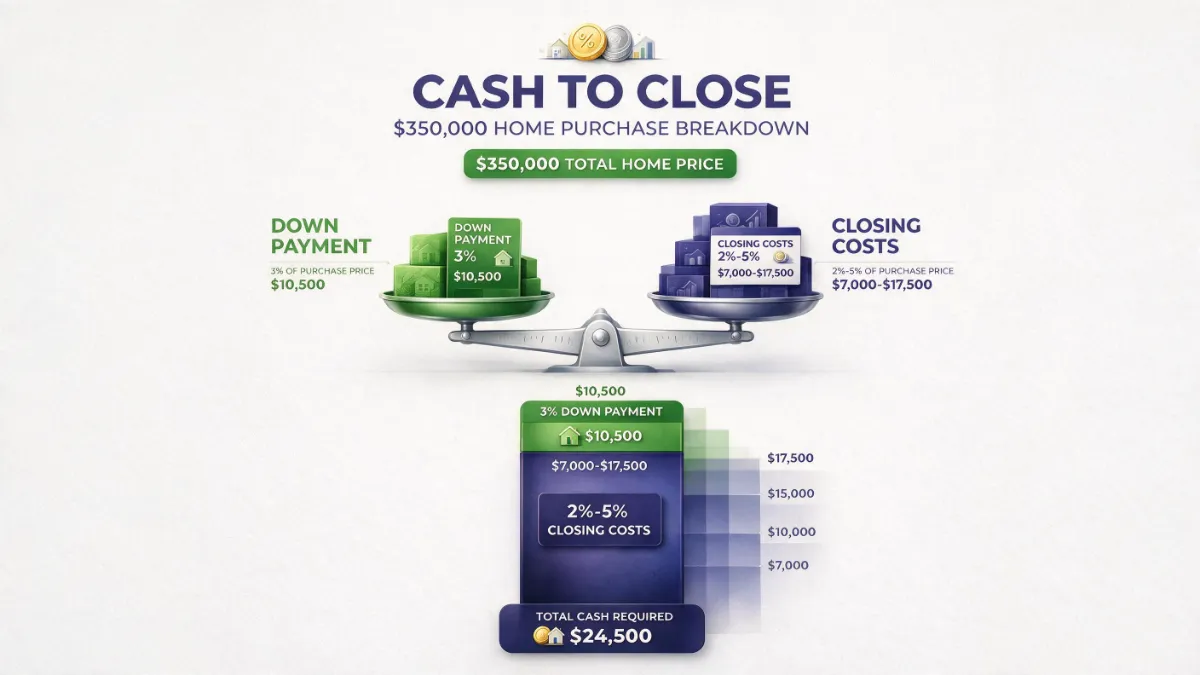
How much are closing costs for first-time buyers? Closing costs cover the fees required to originate your mortgage and legally transfer property title. Buyers typically spend between 2% and 5% of the purchase price on closing costs — completely separate from the down payment. On a $350,000 purchase, that’s $7,000 to $17,500 in additional cash required at closing.
Table 3 — Itemized Closing Cost Breakdown
| Closing Cost Line Item | Purpose and Expense Description |
|---|---|
| Origination & Underwriting | Lender charges for processing, underwriting, and establishing the mortgage. |
| Appraisal Fee | Independent valuation confirming market value of the property ($400–$800). |
| Title Search & Lender’s Title Policy | Title company review verifying clear ownership and insuring the lender’s lien position. |
| Government Recording Fees | Municipal fees to record the deed and mortgage into public county records. |
| Prepaid Taxes & Homeowners Insurance | Initial funds deposited into escrow to pay property taxes and annual hazard insurance. |
| Prepaid Daily Interest | Per diem interest charges running from the closing date to the end of the month. |
Source: CFPB — Understanding closing costs. Actual amounts vary by lender, location, and transaction.
Worked Cash-to-Close Example ($350,000 Purchase)
Your total cash requirement combines the down payment with estimated closing costs. The formula: Total Cash Required = Down Payment + Closing Costs − Any Seller or Grant Credits.
Table 4 — Total Cash-to-Close: Low vs. High Closing Cost Estimate
| Transaction Component | Low Estimate (2% Closing) | High Estimate (5% Closing) |
|---|---|---|
| Purchase Price | $350,000 | $350,000 |
| 3% Down Payment | $10,500 | $10,500 |
| Estimated Closing Costs | $7,000 | $17,500 |
| Total Cash Needed at Closing | $17,500 | $28,000 |
Source: Cash-to-close illustration compiled by SaveXpert using 2%–5% CFPB closing cost range. CFPB — Closing process overview.
💰 Try the SaveXpert Mortgage Calculator
I ran the $350,000 example above through SaveXpert’s Mortgage Calculator — entering the 3% down payment, comparing PMI scenarios, and adding estimated taxes and insurance to see the full monthly housing cost. Enter your purchase price, down payment, loan term, and rate to model your complete Principal + Interest + Taxes + Insurance + PMI payment and compare low-down-payment strategies against larger down payment scenarios before making an offer.
Educational note: This calculator models mortgage payment scenarios and does not constitute lending advice. Actual loan terms, tax assessments, and insurance rates depend on individual transaction terms. For official mortgage guidance, see CFPB — Owning a Home.
Credit Scores and Debt-to-Income (DTI) Ratios
What credit score and DTI ratio do I need to buy a house? Lenders evaluate your credit profile and existing debt obligations to measure your ability to repay a mortgage. Standard conventional programs require a minimum 620 credit score. FHA accepts 580+ for 3.5% down. But credit score is only half the picture — your Debt-to-Income ratio determines how large a loan you can actually qualify for.
Understanding DTI Ratios
Your DTI ratio measures total monthly debt payments against gross monthly income: DTI = (Total Monthly Debt Obligations ÷ Gross Monthly Income) × 100.
Lenders review two separate DTI figures. The front-end ratio measures only your proposed housing payment (principal, interest, taxes, insurance, and any HOA fees) — lenders prefer this at or below 28%–35%. The back-end ratio adds student loans, auto payments, and credit card minimums to the housing cost — underwriting benchmarks generally target 36%–45%.
💡 Real-world DTI example: On $7,000 gross monthly income, a proposed mortgage payment of $2,100 equals a 30% front-end ratio. Add $500 auto loan + $250 student loans + $150 credit card minimums = $3,000 total obligations. Back-end DTI: $3,000 ÷ $7,000 = 42.8% — within typical guidelines but near the ceiling. High non-housing debt restricts your borrowing capacity even with a strong credit score and solid down payment savings.
Down Payment Assistance: Grants, Silent Seconds, and MCCs
What down payment assistance programs are available in 2026? State and municipal programs offer Down Payment Assistance (DPA) to help first-time buyers bridge the cash-to-close gap. Three main structures exist: outright grants, forgivable silent second mortgages, and Mortgage Credit Certificates.
Down Payment Grants:
Provide direct financial assistance covering 3%–5% of the purchase price. Grants require no repayment when you comply with program occupancy and income rules.
Forgivable Silent Second Mortgages:
Are subordinate loans carrying 0% interest and zero monthly payments. The agency forgives the principal balance after you occupy the home for a set term — typically 5 to 10 years. Sell or refinance before the forgiveness window closes, and the balance typically becomes repayable.
Mortgage Credit Certificates (MCCs):
Provide a direct federal tax credit based on a portion of your annual mortgage interest paid, directly lowering your annual federal tax bill — not just a deduction, but a dollar-for-dollar credit.
How to Find Legitimate First-Time Home Buyer Programs by State
How do I find state first-time home buyer programs? Follow this structured protocol to identify and apply for legitimate state assistance without falling for predatory or unofficial programs.
Locate your State Housing Finance Agency (HFA):
Search official state government directories for your state’s HFA — for example, CalHFA in California, SONYMA in New York, or TDHCA in Texas.
Review assistance requirements:
Check household income limits, county purchase price caps, and minimum credit score standards for each program.
Select a participating approved lender:
State housing programs don’t lend money directly. You must work with a lender certified to originate state DPA loans.
Complete HUD-certified homebuyer education:
Most grant programs require buyers to complete a HUD-approved homebuyer counseling course before closing.
Verify repayment and occupancy rules:
Check lien terms to confirm whether funds convert to a repayable loan if you sell or refinance within the first 5 to 10 years.
How to Buy a House With No Money Down: The Reality Check
Can you really buy a house with no money down in 2026? VA and USDA loans allow buyers to finance 100% of the purchase price. But 0% down doesn’t mean $0 cash out of pocket. Even on a zero-down loan, buyers must fund certain costs that can’t be rolled into the loan balance.
Out-of-pocket costs on zero-down loans still include: earnest money deposits at contract signing, home inspection and appraisal fees, prepaid property taxes and insurance escrow accounts, and title settlement and government recording fees.
💡 Research note: To reduce out-of-pocket costs on zero-down loans, negotiate seller concessions (sellers can cover up to 3%–6% of closing costs under most program guidelines) or apply for state closing-cost assistance grants through your state HFA. These two strategies, used together, can bring actual cash-to-close close to $0 for eligible buyers.
The Bottom Line: Your 5-Step Action Plan for 2026
What are the steps to buy a first home in 2026? Purchasing your first home requires clear milestones. Here’s the research-based 5-step sequence — the order matters:
1. Audit credit scores and calculate back-end DTI: Pull reports from all three major bureaus, correct errors, pay down high-balance revolving accounts, and confirm your back-end ratio sits below 43%.
2. Build a dedicated down payment and closing cost fund: Save 3% for the down payment plus an additional 3% for closing costs — 6% total — before starting house searches in earnest.
3. Apply for state and local DPA programs: Contact your state HFA for grants, silent second financing, or MCC tax credits. Complete HUD-certified homebuyer counseling before signing any purchase contract — most programs require it anyway.
4. Secure an underwritten mortgage pre-approval: Submit tax returns, pay stubs, and asset statements to at least three lenders. Compare Loan Estimates side by side — not just the rate, but the full fee structure on each.
5. Review the Closing Disclosure three business days before closing: Federal law requires lenders to deliver it at least three business days before closing. Compare it line by line against your original Loan Estimate and flag any unexpected fee increases before you show up to sign.
The 20% down myth delays real buyers who already qualify. Calculate total cash-to-close, not just the down payment figure, and check state grant eligibility before you assume you’re not ready.
“What the CFPB’s consumer data consistently shows is that it isn’t the down payment that surprises first-time buyers — it’s the closing costs arriving on the settlement sheet. The research case is clear: buyers who model their total cash-to-close before making an offer are far less likely to reach closing day underfunded.”
— Kevin Brown, Lead Researcher at SaveXpert.com
Frequently Asked Questions
Ans: No. Lenders don’t legally require 20% down. Conventional programs accept as little as 3% down, FHA loans accept 3.5% down, and VA or USDA loans allow 0% down. A 20% down payment simply removes the requirement to pay conventional Private Mortgage Insurance — it’s a PMI threshold, not a law.
Ans: Standard conventional loan programs require a minimum score of 620. FHA loans allow 3.5% down with scores as low as 580 — and scores between 500 and 579 qualify with 10% down. VA and USDA programs carry no official agency minimum, but most participating lenders set internal thresholds at 620 to 640.
Ans: Yes. Many state housing finance agency grants and forgivable second mortgages allow buyers to allocate funds toward both the minimum down payment and third-party closing costs. Verify the individual program guidelines with a state-approved participating lender — every program has its own rules on what the funds can cover.
Ans: Under the federal Homeowners Protection Act, your mortgage servicer must automatically cancel PMI once your loan balance reaches 78% of the original home value — provided your payments stay current. You can also request early removal once your balance hits 80% LTV. The CFPB’s PMI guidance covers both the automatic and requested removal processes.
Ans: Conventional loans have lower long-term costs for buyers with credit scores above 620 because PMI cancels once you reach 20% equity. FHA loans accept buyers with scores between 580 and 620 or higher debt ratios, but mortgage insurance premiums typically stay for the full loan term if you put down less than 10% — that ongoing MIP is the key long-term cost difference.
Ans: A forgivable silent second mortgage is a subordinate loan from a state or local housing agency that carries 0% interest and requires no monthly payments. Instead of being repaid monthly, the principal balance is gradually forgiven — usually over 5 to 10 years of continued occupancy. If you sell or refinance before the forgiveness period ends, the remaining balance typically becomes repayable in full. Many buyers use these alongside a primary mortgage to cover their down payment or closing costs at no immediate out-of-pocket cost.