
ⓘ Educational Disclosure:
This article is for educational and informational purposes only. It does not constitute financial, legal, tax, or lending advice. SaveXpert and its authors are not licensed financial advisors or tax professionals. RMD rules have specific exceptions and individual circumstances vary. Always consult a qualified professional before making retirement distribution decisions.
Can you take all your RMD from one account? If you own traditional, SEP, and SIMPLE IRAs, the answer is yes. According to IRS Publication 590-B, you calculate the RMD separately for each of those IRAs, then withdraw the combined total from just one — or from any combination of those accounts. That rule doesn’t extend to 401(k) plans or 403(b) plans, which follow different aggregation rules entirely. The key distinction the IRS draws is between calculation and withdrawal. Those are two different steps, and that’s where most people with multiple IRAs get confused.
Key Takeaways
- Problem: Managing multiple retirement accounts makes it hard to know whether you can simplify Required Minimum Distributions into a single withdrawal — or whether each account must be handled separately.
- Solution: According to IRS Publication 590-B, you can calculate the RMD separately for each traditional, SEP, and SIMPLE IRA you own — then withdraw the combined total from just one of those IRAs. This aggregation rule does not apply to employer plans like 401(k)s.
- Result: The IRS aggregation rule can simplify compliance and let you take distributions from your most liquid IRA — avoiding forced sales of less liquid investments held elsewhere.
- Source: IRS Publication 590-B · IRS — Retirement Topics: RMDs
- Time To Read: 7 Minutes
Table of Contents
1. Can You Take All Your RMD From One Account? IRS Rules Explained
2. Do RMDs Need to Be Taken From Each Account?
3. Does It Matter Which Account You Take Your RMD From?
4. How Does RMD Work With Multiple Accounts?
5. When Do RMDs Have to Be Taken?
6. What Happens If You Don’t Take All Your RMD?
7. Do You Have to Take Your RMD All at Once?
8. What Accounts Have Required Minimum Distributions?
Here’s the RMD rule that surprises most people with multiple retirement accounts: you don’t always have to take money from every account you own. I spent time going through IRS Publication 590-B and the supporting Treasury regulations on RMD aggregation, and the answer turns out to be very specific — specific enough that getting it wrong can trigger a 25% excise tax on whatever you missed.

Can You Take All Your RMD From One Account? IRS Rules Explained
The biggest finding from my research into IRS RMD guidelines was surprisingly specific. IRS Publication 590-B confirms that you can calculate the RMD separately for each traditional IRA, SEP IRA, and SIMPLE IRA you own — and then take the combined total from any one or more of those IRAs.
This rule operates within the IRA group. It doesn’t create one universal RMD pool across every retirement account type you own. The IRS bases each IRA’s RMD on that account’s prior December 31 balance, divided by the applicable Uniform Lifetime Table divisor. That divisor changes with age — 26.5 at age 73, for example, and 24.6 at age 75.
So the aggregation rule isn’t just about simplifying paperwork. It’s about how you satisfy the requirement once you’ve done the math correctly. The math must happen per-account first. The withdrawal can then come from one account.
This distinction comes from IRC §408(a)(6) and Treasury Regulation §1.408-8. Those rules explain why the calculation stays per-account even when the final withdrawal consolidates into one IRA.
Do RMDs Need to Be Taken From Each Account?
This is the most common misconception. You don’t need to withdraw an RMD from every traditional IRA separately. But you do need to calculate the RMD for each account first.
Here’s a concrete example. Say you hold two traditional IRAs — one produces a $4,000 RMD, and the other produces a $6,000 RMD. The IRS aggregation rule allows you to satisfy the combined $10,000 requirement by withdrawing from just one of those accounts.
⚠️ Important: Skipping the per-account calculation and combining balances before applying the divisor produces the wrong required amount. The IRS divisor applies to each account’s individual balance — combining too early creates an under-withdrawal and a potential excise tax. Calculate each account separately first. Then aggregate for the withdrawal step.
The same aggregation rule applies to SEP and SIMPLE IRAs within the covered IRA group. It does not extend to employer-sponsored plans like 401(k)s.
Does It Matter Which Account You Take Your RMD From?
Yes — and this is where the aggregation flexibility becomes genuinely useful. Since you can satisfy the combined IRA RMD from any account in the group, the choice of which IRA to withdraw from has real practical consequences.
Taking the aggregated amount from an IRA holding more liquid assets — cash or money market holdings, for example — avoids forced sales of less liquid investments held in your other accounts. If one IRA holds easily accessible cash while another holds assets that aren’t easy to sell quickly, the IRS rule lets you pull from the liquid account without touching the other.
💡 Research note: Consolidating multiple traditional IRAs into fewer accounts can simplify RMD tracking. Since applicable IRA RMDs aggregate, fewer accounts mean fewer separate calculations to monitor. Rolling multiple old 401(k) balances into a single IRA can similarly reduce the number of separate RMD requirements — though it does not absorb the RMD obligation of an active 401(k) plan you’re currently contributing to.
How Does RMD Work With Multiple Accounts?
Different account types follow completely different aggregation rules. This is the part that trips people up most often. The assumption that all retirement accounts work like IRAs is wrong — and acting on that assumption can leave you short on a required withdrawal.
Here’s the three-way split the IRS actually uses:
Table — RMD Aggregation Rules by Account Type
| Account Type | Can RMDs Be Aggregated? | Aggregation Partners |
|---|---|---|
| Traditional / SEP / SIMPLE IRA | Yes | Other traditional, SEP, or SIMPLE IRAs only |
| 401(k) Plan | No | Each plan must satisfy its own RMD separately |
| 403(b) Plan | Yes — but limited | Other 403(b) plans only; not IRAs or 401(k)s |
| Roth IRA (original owner) | No lifetime RMD | Not applicable — no lifetime RMD for original owner |
| Designated Roth in 401(k)/403(b) | No lifetime RMD | Exempt from lifetime RMDs since 2024 (SECURE 2.0) |
Source: IRS Publication 590-B · IRS — Retirement Topics: Required Minimum Distributions. IRC §401(a)(9) and Treasury Regulation §1.401(a)(9)-1 govern employer plan rules.
The practical implication: an owner with several traditional IRAs, one 401(k), and one 403(b) faces three separate RMD calculations and three separate withdrawal processes. The IRA group aggregates internally. The 403(b) aggregates with other 403(b) accounts internally. The 401(k) stands alone. None of them cross-aggregate with the others.

When Do RMDs Have to Be Taken?
The timing rules matter as much as the account rules. The IRS RMD guidance identifies two starting ages under the SECURE 2.0 Act: age 73 for people born from 1951 through 1959, and age 75 for people born in 1960 or later.
For IRA owners, the first RMD can generally be delayed until April 1 of the year following the year they reach their applicable starting age. After that first deadline, all subsequent RMDs carry a December 31 annual deadline.
⚠️ The double-RMD trap: Delaying the first RMD to April 1 doesn’t eliminate the next year’s obligation. A person who delays their first RMD will have two required distributions in the following calendar year — the delayed first distribution (due April 1) and that year’s RMD (due December 31). Both apply. Both must be satisfied.
The IRS also bases each year’s RMD calculation on the account balance from the prior December 31 — not today’s balance. That’s the balance that drives the math.
What Happens If You Don’t Take All Your RMD?
An incomplete RMD triggers an excise tax under IRC §4974 as amended by the SECURE 2.0 Act. The standard penalty is 25% of the shortfall. That penalty drops to 10% if you correct the shortfall within two years (reduced from the previous 50% rate before SECURE 2.0).
💡 Penalty math example: An owner required to take $10,000 withdraws only $8,000. The shortfall is $2,000. At the standard 25% excise tax rate, that’s a $500 tax penalty on top of ordinary income taxes owed on the distribution itself.
One critical warning: taking money from the wrong account type doesn’t fix the shortfall. Withdrawing from an IRA doesn’t satisfy an outstanding 401(k) RMD. Each plan’s obligation stays tied to its own withdrawal rules. Missing that distinction — and assuming cross-type substitution works — is one of the most expensive RMD mistakes retirees make.
Do You Have to Take Your RMD All at Once?
No. The IRS doesn’t require a single annual distribution. The requirement is that the total amount is satisfied by the applicable deadline — not that it happens in one transaction.
For traditional IRA owners using the aggregation rule, the combined IRA total can come from one or more of those accounts, in as many separate withdrawals as needed, as long as the full required amount clears by December 31. The same flexibility doesn’t apply across different account types — a 401(k) obligation stays with the 401(k) plan regardless of how many IRA withdrawals you take.
What Accounts Have Required Minimum Distributions?
IRS RMD guidance identifies the following account types as subject to RMD rules: traditional IRAs, SEP IRAs, SIMPLE IRAs, 401(k) plans, and 403(b) plans.
Roth IRAs are a specific exception — original Roth IRA owners face no lifetime RMD requirement while alive. Designated Roth accounts within 401(k) and 403(b) plans also became exempt from lifetime RMDs starting in 2024 under the SECURE 2.0 Act §107. That change brought designated Roth accounts in employer plans in line with the original Roth IRA treatment.
The phrase “retirement account” covers a wide range of plan types. The IRS doesn’t apply one identical RMD rule to all of them — and that’s exactly why account-type clarity matters before consolidating or aggregating any distribution.
💡 Penalty math example: Rolling multiple old 401(k) balances into one IRA can reduce the number of separate RMD requirements going forward. Once rolled into an IRA, the balances join the IRA group and fall under the IRA aggregation rule — simplifying future calculations. This doesn’t eliminate RMD requirements; it shifts them into a structure that allows aggregation. Consult a tax professional before initiating any rollover for RMD purposes.
👴 Quick Retirement Check
Estimate your future nest egg based on your current savings.
Years to Retire
Total Contributed
Est. Nest Egg
💰 Try the SaveXpert Retirement Savings Calculator
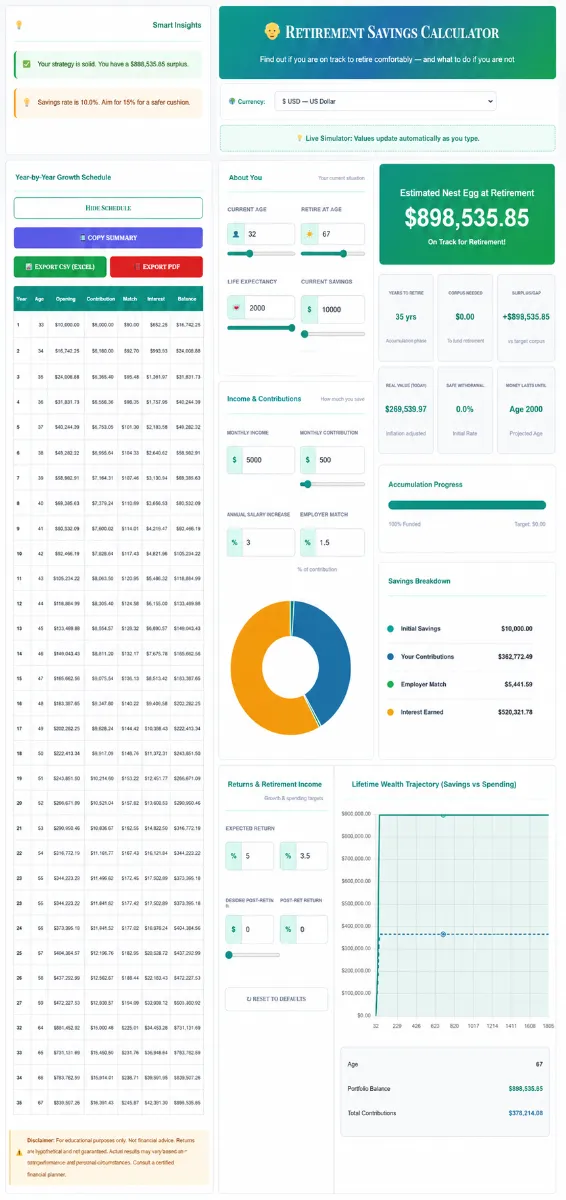
I ran a basic retirement-saving scenario through SaveXpert’s Retirement Savings Calculator to see how accumulated account balances affect the numbers at RMD age. The balance used for the RMD calculation comes directly from your prior December 31 account value — so projected balances matter more than most people realise until they’re actually at RMD age. Enter your current savings, contribution rate, and projected retirement date to model how your balances might look when RMDs begin.
Educational note: This calculator models retirement savings scenarios and does not calculate your actual IRS RMD amount. For official RMD calculations, use the IRS Uniform Lifetime Table and consult IRS Publication 590-B.
The Bottom Line: 5-Step RMD Action Plan
How do you apply the IRS aggregation rules correctly? I spent time going through IRS Publication 590-B, current IRS RMD guidance, and the supporting Treasury regulations, and the approach that consistently holds up is keeping account-type rules clearly separated while using aggregation exactly where the IRS permits it. Here’s the 5-step sequence:
1. Identify your RMD starting age:
Born 1951–1959 → age 73. Born 1960 or later → age 75. Mark the year you hit that age and the April 1 first-deadline and December 31 annual deadlines that follow.
2. Calculate each account’s RMD separately:
Use each account’s prior December 31 balance divided by the applicable IRS Uniform Lifetime Table divisor for your age. Never combine balances before this step.
3. Aggregate only where the IRS permits:
Traditional, SEP, and SIMPLE IRA RMDs can be combined for a single withdrawal from one account in that group. 401(k)s must each satisfy their own. 403(b)s aggregate only with other 403(b)s.
4. Choose the most liquid IRA for the combined withdrawal:
Pull the aggregated IRA total from whichever account holds the most accessible assets — cash or money market holdings — to avoid forced sales of less liquid positions elsewhere.
5. Track deadlines and verify with a professional:
Don’t delay the first RMD without understanding the double-distribution consequence. And verify your specific RMD calculations with a qualified tax professional — the excise tax for a missed amount is 25% of the shortfall.
For traditional, SEP, and SIMPLE IRA owners, the IRS aggregation rule is one of the most practically useful provisions in the RMD rulebook. The key is calculating each account separately first — then using the flexibility the IRS grants for the withdrawal step.
“The most counterintuitive finding when I went through IRS Publication 590-B was how the aggregation rules split calculation from withdrawal. The IRS requires you to figure out each account’s required amount separately — but once you’ve done that math, you don’t have to pull from every account individually. For traditional IRA owners, that distinction is one of the most practically useful things in the entire RMD rulebook.”
— Kevin Brown, Lead Researcher at SaveXpert.com
Frequently Asked Questions
Ans: According to IRS Publication 590-B, yes — for traditional, SEP, and SIMPLE IRAs. You must calculate the RMD separately for each of those IRAs first. Once you’ve done that, you can aggregate the total and withdraw the combined amount from just one of those applicable IRAs, or any combination of them.
Ans: No. Cross-type aggregation isn’t permitted under IRS rules. Each 401(k) plan must satisfy its own RMD separately. You can’t take your 401(k) RMD from an IRA, nor can an IRA withdrawal satisfy a 401(k) obligation — even if the amounts are identical. See IRS RMD guidance for employer plan rules.
Ans: It depends entirely on the account type. Traditional, SEP, and SIMPLE IRAs allow for aggregation — calculate each separately, then withdraw the combined total from one or more accounts within that group. Employer-sponsored 401(k) plans require separate withdrawals per account. 403(b) plans can only aggregate with other 403(b) accounts, not with IRAs or 401(k)s.
Ans: Under IRC §4974 as amended by the SECURE 2.0 Act, failing to take the full required amount triggers an excise tax. The standard rate is 25% of the shortfall. That rate can drop to 10% if the missed withdrawal is corrected within two years. The previous rate before SECURE 2.0 was 50%.
Ans: Your first RMD can generally be delayed until April 1 of the year following the year you reach your required starting age (73 or 75, depending on your birth year). All subsequent annual RMDs must be taken by December 31. Be aware that delaying the first RMD means two distributions fall in the following calendar year — both the delayed first and that year’s regular RMD.
Ans: Partially. 403(b) plan RMDs can aggregate with other 403(b) plans — meaning you can calculate each 403(b) separately and then satisfy the combined 403(b) total from one account within that group. But 403(b) RMDs cannot aggregate with IRA RMDs or 401(k) RMDs. Each account type follows its own aggregation rules under the IRS guidelines, and cross-type substitution isn’t permitted.