
ⓘ Educational Disclosure:
This article is for educational and informational purposes only. It does not constitute financial, legal, tax, or lending advice. SaveXpert and its authors are not licensed financial advisors. Social Security rules have specific exceptions and individual circumstances vary. Always consult a qualified professional before making Social Security claiming decisions.
How much can you make while drawing Social Security at 62? According to SSA Publication 05-10069, the 2026 earnings limit is $24,480 annually ($2,040 per month) for people who remain below full retirement age for the entire year. Earning above this amount results in $1 withheld for every $2 you earn over the limit. Those withheld benefits aren’t permanently lost — the SSA recalculates and increases your monthly payment at full retirement age to account for the months affected by withholding.
Key Takeaways
- Problem: Many Americans don’t know whether they can keep working after claiming Social Security at 62 — or exactly how employment income can reduce their monthly checks.
- Solution: According to the SSA, you can earn up to $24,480 in 2026 without a benefit reduction if you remain below full retirement age for the entire year. Earnings above this limit result in the SSA withholding $1 in benefits for every $2 earned over the threshold.
- Result: Working at 62 doesn’t automatically stop Social Security payments. Earnings above the limit can temporarily reduce current payments — but the SSA recalculates and adjusts your benefit upward when you reach full retirement age.
- Source: SSA Publication 05-10069 — How Work Affects Your Benefits · SSA 2026 COLA Fact Sheet
- Time To Read: 8 Minutes
Table of Contents
1. Understanding the 2026 Social Security Earnings Test
2. What Income Counts Toward the Earnings Limit?
3. How Much Can I Make While Drawing Social Security at 62?
4. What Happens If You Earn More Than $24,480?
5. What Happens to Benefits Withheld Because You Worked?
6. Age, Limits, and Benefit Reductions Explained
7. How Self-Employment Changes the Calculation
8. The 2026 Rules Compared With 2025
9. Planning Your Retirement Income Strategy
You can earn $24,480 in 2026 while collecting Social Security before full retirement age without triggering the earnings test. The surprising part is what happens beyond that limit — and what happens to the payments the SSA withholds.
Working at 62 while collecting Social Security is possible. But the account type, the income type, and the timing of your earnings all determine whether — and how much — your current payments get reduced.
Understanding the 2026 Social Security Earnings Test
Many people hear that claiming Social Security at 62 means they can’t keep working. The SSA data shows something different. You can work while collecting benefits — but your wages can affect how much Social Security you actually receive before full retirement age.
I spent time going through SSA Publication No. 05-10069, the 2026 COLA Fact Sheet, and the SSA’s published earnings-test guidance. The core rules haven’t fundamentally changed in 2026 — but the annual earnings limits increased.
Here’s the number that matters first: $24,480 for 2026 if you’re under full retirement age for the entire year. That’s $2,040 per month. The SSA also sets a higher $65,160 annual limit — or $5,430 per month — for people who reach full retirement age during 2026.
Table 1 — 2026 Social Security Earnings Limits at a Glance
| Situation in 2026 | Annual Earnings Limit | Monthly Equivalent | Withholding Formula |
|---|---|---|---|
| Under full retirement age for the entire year | $24,480 | $2,040 | $1 withheld for every $2 over the limit |
| Reaching full retirement age during 2026 | $65,160 | $5,430 | $1 withheld for every $3 over the limit (until the month FRA begins) |
| At or past full retirement age for the entire year | No limit | — | Earnings test no longer applies |
What Income Counts Toward the Social Security Earnings Limit?
Not every type of income counts toward the earnings test. This distinction matters a lot for someone combining work income with other retirement sources.
According to SSA Publication 05-10069, wages from employment and net earnings from self-employment count toward the earnings test. Investment income, pensions, annuities, and capital gains don’t count.
💡 Research note: A 62-year-old receiving Social Security who also earns wages from a part-time job and receives dividend income from investments only has the wages counted against the earnings limit. The dividend income doesn’t enter the calculation at all. The SSA data doesn’t support treating every dollar entering your household as earnings for this specific test.

How Much Can I Make While Drawing Social Security at 62?
The 2026 threshold is clear. Someone who claims Social Security at 62 and stays below full retirement age for the entire year can earn up to $24,480 during 2026 without a reduction under the earnings test. That’s $2,040 per month.
For part-time workers, SSA Publication 05-10069 also identifies a special monthly rule for the first year of retirement. Under this rule, you can receive the full benefit for any month when your earnings don’t exceed $2,040 — even if your annual earnings for the full year exceed $24,480.
💡 Why this matters: Someone who retires in July 2026 but earned $40,000 in the first half of the year could still receive full Social Security for each remaining month where their monthly wages stay under $2,040. The special monthly rule treats retirement status month by month in the first year — not just by the annual total. This rule specifically applies in the first year of retirement.
What Happens If You Earn More Than $24,480 at Age 62?
Exceeding the limit isn’t an all-or-nothing cutoff. The SSA applies the earnings test using a formula, not a binary switch.
For people below full retirement age, the SSA withholds $1 in benefits for every $2 earned above the $24,480 limit. Earning $1 over the limit doesn’t eliminate the entire benefit — it reduces it proportionally.
Here’s a concrete example. Someone earns $30,000 from work in 2026 while collecting Social Security at 62. That’s $5,520 above the $24,480 limit. Under the $1-for-$2 formula, the earnings test produces a $2,760 benefit withholding for the year.
Someone earning significantly above the limit can experience withholdings across multiple months — in some cases effectively delaying when actual payments begin. But the SSA withholds only enough to account for the earnings-test reduction. Benefits don’t stop entirely unless the calculated withholding exceeds the total annual benefit.
What Happens to Benefits Withheld Because You Worked?
This is one of the more important findings from the SSA research. Benefits withheld due to excess earnings aren’t permanently lost.
According to SSA Publication 05-10069, the SSA recalculates the monthly benefit at full retirement age. The recalculation accounts for months when benefits were withheld because of the earnings test — effectively giving back credit for those withheld months through a higher monthly payment going forward.
💡 Research note: The recalculation doesn’t erase the short-term cash-flow impact. Someone relying on monthly Social Security income can still experience reduced or suspended payments during the months the withholding occurs. The long-term benefit effect and the short-term payment effect are two different things — and the SSA data distinguishes them clearly.
Age, Limits, and Benefit Reductions Explained
Two separate effects can hit someone who claims at 62 and continues working. The first is the earnings-test withholding, covered above. The second is the permanent early-claiming reduction — and these don’t represent the same calculation.
At What Age Can You Earn Unlimited Income?
The SSA identifies full retirement age as the point when the earnings test ends entirely. For people born in 1960 or later, the SSA lists full retirement age as 67. Beginning with the month a person reaches full retirement age, the earnings test no longer applies — there’s no limit on earned income after that point.
For people who reach full retirement age during 2026, the higher $65,160 annual limit applies before the month FRA begins. The SSA withholds $1 for every $3 earned above that higher limit — a less aggressive formula than the $1-for-$2 rate used earlier.
How Much Does Claiming at 62 Reduce Social Security?
For someone born in 1960 or later — where full retirement age is 67 — claiming Social Security at 62 produces a 30% permanent reduction in the monthly benefit compared with waiting until full retirement age.
According to SSA Publication 05-10069, the reduction formula works like this: 5/9 of 1% for each of the first 36 months before full retirement age, then 5/12 of 1% for each additional month beyond those first 36. Claiming at exactly 62 with a FRA of 67 means 60 months early — the full 30% reduction.
⚠️ Two separate reductions: The 30% early-claiming reduction and the earnings-test withholding are calculated independently. Claiming at 62 and earning above $24,480 triggers both effects simultaneously — the permanent percentage reduction applies to your base benefit, and the earnings test then withholds a portion of what remains. The SSA recalculates for withheld amounts at FRA, but the 30% early-claiming reduction is permanent.
For context, the SSA 2026 COLA Fact Sheet lists an average monthly benefit of $2,071 for all retired workers and a maximum monthly benefit of $4,152 at full retirement age. The 2026 COLA increased benefits by 2.8%.
A Simple 2026 Example
Consider two workers who both claim Social Security at 62 and work throughout 2026.
Worker A earns $24,000. The 2026 limit is $24,480. Worker A stays below the limit by $480. No benefit reduction applies from the earnings test.
Worker B earns $34,480. That’s $10,000 above the $24,480 limit. The $1-for-$2 formula produces a $5,000 withholding for the year. Worker B’s monthly payments get suspended until the SSA recovers that $5,000 — then regular payments resume for the remainder of the year.
👴 Quick Retirement Check
Estimate your future nest egg based on your current savings.
Years to Retire
Total Contributed
Est. Nest Egg
How Self-Employment Changes the Calculation
Self-employed workers face a slightly different set of rules. The SSA counts net earnings from self-employment toward the earnings test — not gross revenue. The SSA also applies monthly work measures to determine retirement status in certain situations.
According to SSA Publication 05-10069, more than 45 hours per month of self-employment activity indicates the person isn’t retired under that test. Less than 15 hours per month indicates retirement. These figures matter most when the SSA evaluates retirement status under the special first-year monthly rule.
Someone running a business shouldn’t apply a simple hourly assumption to their situation without reviewing the published guidance. Self-employment retirement status under SSA rules is its own calculation — separate from the net-earnings dollar test.
The 2026 Rules Compared With 2025
The core earnings-test structure didn’t change in 2026. The annual dollar limits did — driven by the 2.8% COLA adjustment.
Table 2 — 2025 vs. 2026 Social Security Earnings Limits
| Earnings Limit Type | 2025 Limit | 2026 Limit | Change |
|---|---|---|---|
| Under FRA for the full year (annual) | $23,400 | $24,480 | +$1,080 |
| Under FRA for the full year (monthly) | $1,950 | $2,040 | +$90 |
| Reaching FRA during the year (annual) | $62,160 | $65,160 | +$3,000 |
| Reaching FRA during the year (monthly) | $5,180 | $5,430 | +$250 |
| Maximum taxable earnings (Social Security) | $176,100 | $184,500 | +$8,400 |
| Quarter of coverage amount | $1,730 | $1,890 | +$160 |
Source: SSA 2026 COLA Fact Sheet · SSA Publication 05-10069

Planning Your Retirement Income Strategy
Understanding the earnings test is only part of the picture. Two common mistakes make the situation harder than it needs to be.
The first is not reporting earnings changes to the SSA. If your income increases above the annual limit and you don’t tell the SSA, the agency can pay out benefits it wasn’t supposed to — then require you to repay the overpayment later. The SSA expects beneficiaries to report changes promptly.
The second is misunderstanding which income counts. People sometimes restrict pension income or investment withdrawals to stay under the earnings limit — when those income types don’t trigger the earnings test at all. Investment income, pensions, annuities, and capital gains don’t count toward the $24,480 threshold under the current rules.
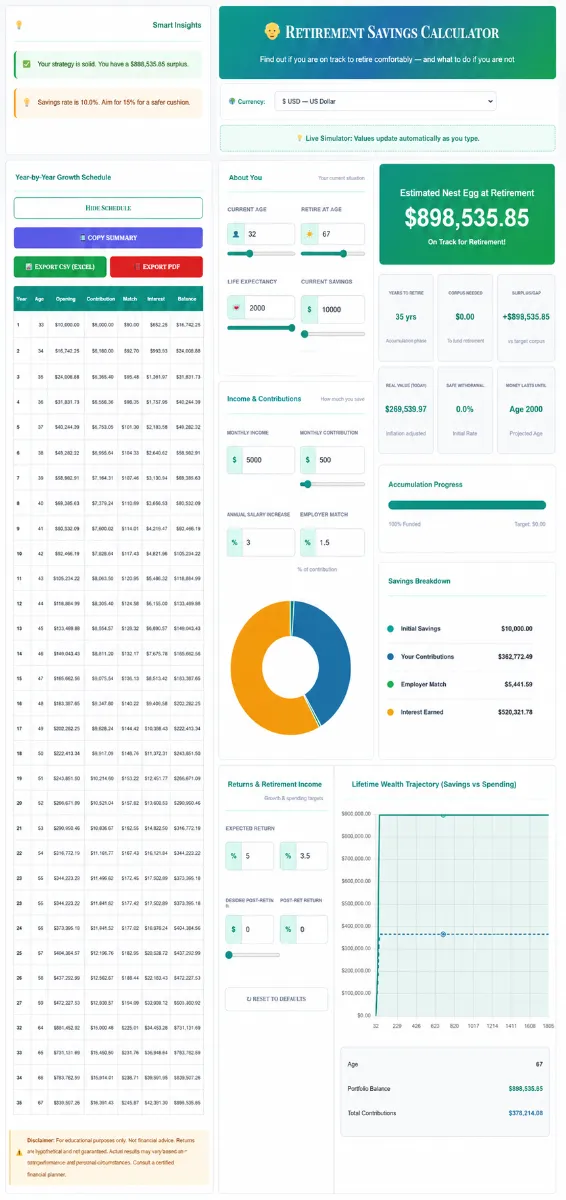
💰 Try the SaveXpert Retirement Savings Calculator
I ran a retirement-income scenario through SaveXpert’s Retirement Saving Calculator using an early-claiming situation with continued work. Even when work income continues, the long-term savings target matters — because the 30% permanent reduction from claiming at 62 (with FRA at 67) changes how much your savings need to cover. Enter your current age, savings rate, and expected retirement date to see how your retirement savings interact with an early-claiming decision.
Educational note: This calculator models retirement savings scenarios and does not calculate your actual Social Security benefit. For official earnings-test rules and benefit projections, see SSA Publication 05-10069.
The Bottom Line: 5-Step Action Plan
If you’ve been wondering how much you can make while drawing Social Security at 62, here’s what the SSA data actually shows — and the 5 steps to apply it correctly:
1. Know your 2026 threshold:
If you’re under full retirement age all year, the limit is $24,480 ($2,040/month). If you reach FRA during 2026, the limit is $65,160 ($5,430/month) for the months before your FRA begins. After FRA, there’s no limit.
2. Count only what the SSA counts:
Wages and net self-employment earnings go against the limit. Investment income, pensions, annuities, and capital gains don’t. Don’t restrict income sources that aren’t part of the earnings test.
3. Model the withholding before it surprises you:
If your wages will exceed the limit, calculate the withholding upfront — $1 withheld for every $2 over $24,480. This can affect multiple months of payments, not just a one-time deduction.
4. Remember the FRA recalculation:
Withheld benefits aren’t permanently gone. The SSA recalculates your monthly benefit at full retirement age, increasing it to credit the months when payments were withheld. The short-term cash-flow impact and the long-term benefit effect are two different numbers.
5. Don’t confuse the two reductions:
The 30% permanent reduction from claiming at 62 (for those with FRA of 67) and the earnings-test withholding are separate calculations. The first is permanent. The second gets adjusted at FRA. Report any earnings changes to the SSA promptly — overpayments must be repaid.
Working at 62 doesn’t automatically stop Social Security. But claiming early and earning well above the limit simultaneously triggers two separate effects on your benefit — and they work on different timescales. Use SaveXpert’s Retirement Saving Calculator to explore the savings side of the decision, then compare those numbers against the official SSA rules before making any claiming decisions.
“When I went through SSA Publication 05-10069 and the 2026 COLA Fact Sheet, the detail most people miss was the recalculation at full retirement age. The SSA doesn’t permanently take withheld amounts. It adjusts the monthly benefit upward at FRA to account for those withheld months. That’s a meaningful difference from permanent loss — and it changes how you should think about working while claiming at 62.”
— Kevin Brown, Lead Researcher at SaveXpert.com
Frequently Asked Questions
Ans: According to the SSA 2026 COLA Fact Sheet, you can earn up to $24,480 annually — or $2,040 per month — without triggering the earnings test, provided you remain below full retirement age for the entire year. Earnings above that amount result in the SSA withholding $1 for every $2 over the limit.
Ans: No. According to SSA Publication 05-10069, investment income, pensions, annuities, and capital gains don’t count toward the Social Security earnings test. Only wages from employment and net earnings from self-employment are measured against the annual limit.
Ans: The SSA withholds $1 in benefits for every $2 you earn above the $24,480 annual limit. This isn’t an all-or-nothing cutoff — it’s a proportional formula. If the calculated withholding spans several months, the SSA suspends payments for those months rather than cutting the monthly amount. The withheld benefits are not permanently lost — the SSA adjusts your payment upward at full retirement age.
Ans: According to SSA Publication 05-10069, the earnings test ends beginning with the month you reach full retirement age. For people born in 1960 or later, that’s age 67. Once you reach full retirement age, you can earn unlimited income with no benefit reduction from the earnings test.
Ans: The SSA data shows the key issue isn’t your hours — it’s your total countable earnings. You can work full time as long as your wages don’t exceed the annual limit. Self-employed workers also face specific monthly hour tests under certain SSA rules, so self-employment has its own additional layer of guidance beyond the dollar threshold.
Ans: SSA Publication 05-10069 identifies a special monthly rule that applies in the first year of retirement. Under this rule, you can receive the full Social Security benefit for any month in which your earnings don’t exceed $2,040 — even if your total earnings for the year exceed $24,480. This matters most when someone retires mid-year after earning significant income in the earlier months. It’s a month-by-month test, not an annual one, and it only applies in the first year of retirement.