
ⓘ Educational Disclosure:
This article is for educational and informational purposes only. It does not constitute financial, legal, tax, or lending advice. SaveXpert and its authors are not licensed financial advisors. Federal student-loan rules under Public Law 119-21 are subject to final regulations and ongoing implementation guidance. Always verify current eligibility, loan type, and repayment rules at studentaid.gov or with a qualified financial-aid professional before making borrowing decisions.
Federal Student Aid processed 8.9 million 2026–27 FAFSA applications through February 28, 2026 — during the very cycle that social media posts and political headlines suggest might not exist. That’s the most direct evidence against the “FAFSA is going away” claim, and it comes straight from the government’s own tracking data.
Key Takeaways
- Problem: Many students and families are confused by recent legislative updates and are asking whether FAFSA is going away in 2026 — and whether it’s safe to rely on it for next year’s aid.
- Solution: Official data confirms FAFSA is not ending. The 2026–27 form is fully available and actively processing applications — the Department of Education called its September 24, 2025 launch the earliest in program history. Federal Student Aid is already planning the 2027–28 cycle.
- Result: Students can safely rely on the 2026–27 FAFSA to access federal grants, work-study, and federal student loans for the upcoming academic year. Changes are happening to how the system works — not to whether FAFSA exists.
- Source: U.S. Department of Education — 2026–27 FAFSA launch announcement · Federal Student Aid
- Time To Read: 6 Minutes
Table of Contents
1. Is FAFSA Going Away in 2026? The Official Record Says No
2. The 2026–27 FAFSA at Scale: What the Federal Data Shows
3. What Changed in 2026 Instead of FAFSA Disappearing
4. Why FAFSA Rumors Can Sound Believable
5. FAFSA Changes Can Affect Aid Rules Without Ending FAFSA
6. What Students and Families Can Realistically Expect
Is FAFSA going away in 2026? No. The 2026–27 Free Application for Federal Student Aid is currently available and actively processing applications. The U.S. Department of Education announced its launch on September 24, 2025 — calling it the earliest in program history — and the form covers the award year running from July 1, 2026 through June 30, 2027. Federal Student Aid has already published planning materials for the 2027–28 FAFSA cycle.
The confusion isn’t random. Major system changes — new fraud controls, simplified fields, legislative updates to Pell Grants and loan limits — can look like program shutdown from a distance. I spent time going through the Federal Student Aid and Department of Education materials to separate what’s actually happening from what the headlines imply.
Is FAFSA Going Away in 2026? The Official Record Says No
I also checked related legislative sources in Congress.gov and FSA Partner Connect. The official record points toward continued operation, with several changes to processing, fraud controls, Pell Grant eligibility, and federal student loans — not elimination.
The clearest finding comes from Federal Student Aid itself. The 2026–27 FAFSA is available to students and contributors and covers the award year from July 1, 2026 through June 30, 2027. The federal filing deadline for that award year falls on June 30, 2027.
Federal Student Aid has also published planning materials for the 2027–28 FAFSA, expecting it to become available by October 1, 2026. That future-cycle planning conflicts directly with the idea that FAFSA disappears during 2026.
💡 Research note: The official materials state that students must submit a FAFSA each year for consideration for that year’s aid. That ongoing annual requirement means the current system continues into the 2026–27 award year — not that it ends when the previous cycle closes. Federal Student Aid processed 19.2 million FAFSA forms in fiscal year 2025 and reported more than $131.1 billion in Title IV aid for 10.5 million postsecondary students.
The 2026–27 FAFSA at Scale: What the Federal Data Shows
The strongest operational evidence that FAFSA isn’t disappearing appears in the Federal Student Aid Partner Connect data from March 2026. For a family worried about whether the system still works, these figures offer a concrete reality check.
Table — 2026–27 FAFSA Processing Metrics (Through February 28, 2026)
| Metric | Data Point |
|---|---|
| Applications started | 10.6 million |
| Applications submitted | 9.0 million |
| Applications processed | 8.9 million |
| Processed without rejection | 8.8 million |
| ISIRs delivered to institutions | 30 million |
| ISIRs delivered to states | 13.4 million |
| FAFSA corrections filed | 1.4 million (95% online) |
| Average completion time | 33 minutes |
| User satisfaction (agency survey) | 95% |
| Beta applications started (pre-launch) | 43,531 |
Source: FSA Partner Connect — 2026–27 FAFSA Improvements and Beta Testing Plan (updated Sept. 24, 2025). Satisfaction figures are agency-reported survey results, not independent peer-reviewed data.
Those numbers don’t prove every student had a smooth experience. They do show active federal processing at very large scale during the cycle that rumors describe as non-existent.
Federal Student Aid also reported a streamlined account experience for 2026–27: the form shrank from eight pages and 23 required fields to six pages and 12 required fields. The agency reported more than $1 billion in savings from enhanced FAFSA fraud analytics during the same period.

What Changed in 2026 Instead of FAFSA Disappearing
The Department of Education announced the 2026–27 FAFSA on September 24, 2025 — describing it as the earliest FAFSA launch in program history. A restricted beta period opened August 3, 2025, generating 43,531 applications started, 27,246 submitted, and 23,840 processed without rejection, with 97% beta-tester satisfaction.
The research shows several real changes to FAFSA operations — and this is where confusion enters. Major changes can look like program shutdown from the outside.
1. Contributor invitation:
Federal Student Aid redesigned the contributor invite process — previously the largest single drop-off point for students who didn’t finish the form.
2. Account verification:
Immediate identity verification replaced the previous one-to-three-day waiting period for users with a Social Security number.
3. Real-time fraud detection:
The agency reported real-time fraud screening on the FAFSA form during spring 2026.
4. Processing improvements:
ISIRs now reach institutions within one business day of submission in most cases.
Congress also considered proposals around FAFSA identity verification and fraud controls — including H.R. 7891 and H.R. 7893. Their existence doesn’t show Congress abolished FAFSA. These are proposed changes to how the form works, not votes to eliminate it.
Why FAFSA Rumors Can Sound Believable
The data shows that FAFSA participation can fall sharply when the application process runs into serious problems. That historical pattern helps explain why shutdown rumors take hold.
The Department reported 2024–25 submissions of 5.0 million through the cited comparison period — against 8.1 million for the 2023–24 cycle. The research connects that gap with a delayed and troubled 2024–25 FAFSA rollout. A large, sudden drop in applications can read as a dying program even when the cause is a temporary processing crisis.
⚠️ Watch the definitions: Federal Student Aid uses at least five distinct terms — started, submitted, completed, processed, and processed without rejection — that do not describe the same event. Headlines mixing these definitions can make the FAFSA look far more dysfunctional than the underlying data supports. A lower count in one metric at one point in time doesn’t mean the program ended.
⚖️ Quick Loan Comparison
Compare two loans side-by-side to find the cheapest option.

FAFSA Changes Can Affect Aid Rules Without Ending FAFSA
The official rules confirm that FAFSA remains the application used to determine eligibility for federal student aid — grants, work-study, and federal student loans.
But FAFSA itself has changed structurally. The FAFSA Simplification Act replaced the Expected Family Contribution (EFC) with the Student Aid Index (SAI), modified Pell Grant eligibility, and changed certain application requirements. The FUTURE Act expanded data sharing between the IRS and the Department of Education for federal student-aid purposes. These are changes to how aid is calculated through FAFSA — not evidence that the form is going away.
Research also points to the One Big Beautiful Bill Act, which carries provisions affecting Pell Grants, federal loan limits, and other Title IV rules. FSA Partner Connect materials identified implementation dates beginning April 26, 2026, July 1, 2026, or later depending on the provision — and note that implementation information was preliminary and could change before final regulations.
💡 Research note: This distinction matters. Reorganizing the Department of Education, implementing student loan changes, tightening fraud controls, and modifying Pell Grant eligibility are all separate from eliminating the FAFSA form. The governing laws — the Higher Education Act of 1965, the FAFSA Deadline Act, the FAFSA Simplification Act, and the FUTURE Act — establish FAFSA as the federal student-aid application mechanism. None of the reviewed materials repealed that framework.
I also found a useful scale figure in the Department of Education’s fiscal 2025 report: nearly $40 billion in Pell Grants reached more than 7 million students during that fiscal year. That doesn’t mean the rules stay unchanged — but it does show federal student aid operating at substantial scale while FAFSA remained active.
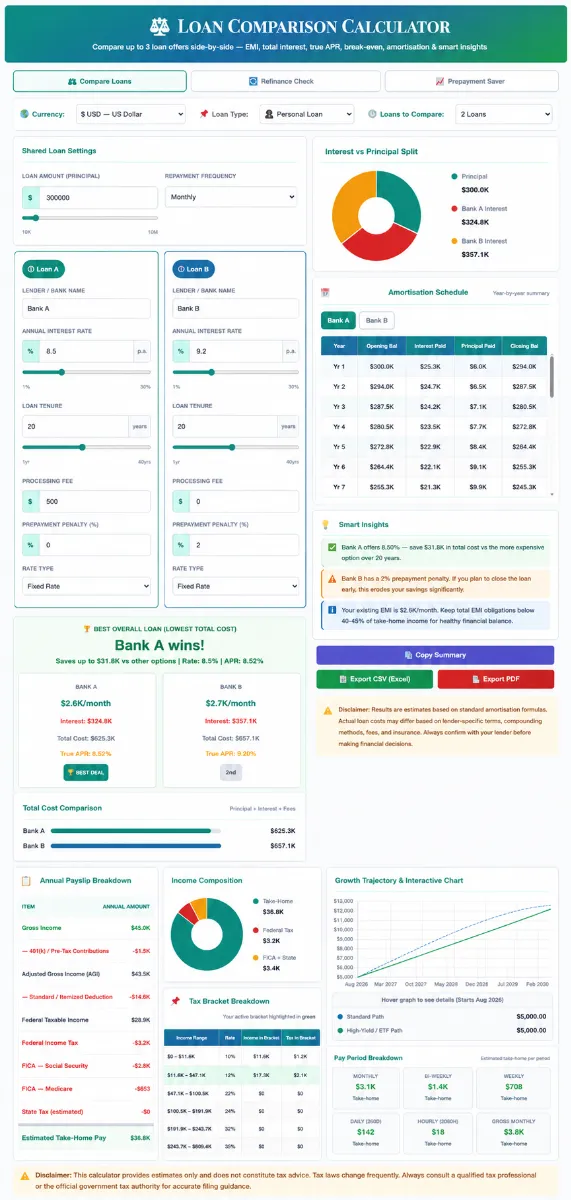
💰 Try the SaveXpert Loan Comparison Calculator
I ran a realistic student-loan scenario through SaveXpert’s Loan Comparison Calculator. The numbers show how different borrowing amounts — and changes to federal loan limits under the One Big Beautiful Bill Act — can shift the projected payment burden, even when the FAFSA application process itself stays in place. Enter different loan amounts, terms, and rates to compare how much total interest changes across borrowing scenarios before accepting any federal loan offer.
Educational note: This calculator models loan repayment scenarios for educational purposes. It does not calculate your actual federal aid eligibility or predict future interest rates. For official aid information, visit studentaid.gov.
What Students and Families Can Realistically Expect
The research suggests the 2026–27 FAFSA remains part of the federal student-aid process throughout its published award year. The current federal deadline runs through June 30, 2027. Federal Student Aid expects the 2027–28 FAFSA by October 1, 2026.
That doesn’t mean every FAFSA experience stays unchanged. Federal Student Aid has already introduced processing, verification, and fraud-screening changes. The data also shows that federal student-loan and Pell Grant rules can shift on their own separate timelines — driven by legislation, not by the existence or absence of the FAFSA form itself.
The realistic picture from the evidence is continued FAFSA operation, alongside ongoing changes to how the system processes applications and how federal aid rules work. The more useful question isn’t whether FAFSA vanishes — it’s how FAFSA processing, Pell Grants, verification requirements, and federal loan rules change in 2026 and beyond.
The Bottom Line: 5-Step FAFSA Action Plan
What should students and families do right now? After going through the official data, here’s the research-based 5-step sequence:
1. File the 2026–27 FAFSA now:
The form is live at fafsa.gov. The federal deadline is June 30, 2027 — but state and institutional deadlines arrive much earlier. Most states award limited grant funds on a rolling basis. Early filing protects eligibility for every aid category.
2. Check your state and school deadlines first:
The Federal Student Aid deadline calendar lists state-by-state and institutional deadlines — many fall months before the federal June 30 cutoff. Missing your state’s deadline can cost you grant money that doesn’t return.
3. Separate form changes from program elimination:
New fraud controls, simplified fields, redesigned contributor invitations, and changed Pell Grant eligibility rules are operational changes — not signs that FAFSA is ending. The system processed 8.9 million applications through February 2026.
4. Monitor loan and Pell Grant rule changes separately:
The One Big Beautiful Bill Act provisions affect borrowing limits and grant eligibility on their own implementation schedule. Watch for final regulations — the FSA Partner Connect materials note that preliminary implementation dates could change before rules are finalized.
5. Model different borrowing amounts before accepting loans:
FAFSA determines your eligibility for federal aid — but how much you borrow is a separate decision. Use SaveXpert’s Loan Comparison Calculator to see how different loan amounts and terms change total interest costs before you sign any promissory note.
FAFSA isn’t going away in 2026. The federal evidence shows 8.9 million processed applications, $40 billion in Pell Grants, and planning already underway for the next cycle. What is changing is how the system works and what some aid programs pay. Those two things are different — and keeping them separate is the most useful thing a student or family can do right now.
“When I went through Federal Student Aid’s Partner Connect data for the 2026–27 cycle, the scale of active processing was the most direct counter-evidence to the ‘FAFSA disappearing’ narrative. 8.9 million applications processed by February 28 — during the very cycle headlines suggested might not exist. Reorganizing a federal department, tightening fraud controls, and changing Pell Grant rules are all very different things from eliminating the FAFSA form.”
— Kevin Brown, Lead Researcher at SaveXpert.com
Frequently Asked Questions
Ans: Yes. According to the U.S. Department of Education, the FAFSA remains available and active in 2026. The 2026–27 form is currently available to students and contributors and covers the award year running through June 30, 2027. Federal Student Aid is also actively planning the subsequent 2027–28 FAFSA cycle, expected to open by October 1, 2026.
Ans: According to FSA Partner Connect materials, certain changes to federal student loan limits and Pell Grant eligibility were scheduled to take effect beginning in mid-2026 under the One Big Beautiful Bill Act provisions. Federal implementation details are preliminary and subject to finalized rulemaking — check FSA Partner Connect for the most current guidance.
Ans: Students must submit a FAFSA each year to be considered for that year’s aid. The federal 2026–27 FAFSA deadline is June 30, 2027. But individual states and colleges typically enforce much earlier deadlines for state-based or institutional aid — often months before the academic year begins. Check the Federal Student Aid deadline calendar for your specific state and school.
Ans: According to Federal Student Aid implementation materials, the 2025 One Big Beautiful Bill Act includes provisions affecting federal student aid — specifically Pell Grants, federal loan limits, and other Title IV program rules. Implementation was scheduled for dates starting April 26, 2026, and July 1, 2026, depending on the provision. Those dates and details are preliminary and subject to change before final regulations are issued.
Ans: The U.S. Department of Education announced the 2026–27 FAFSA went broadly live on September 24, 2025 — marking the earliest FAFSA launch in program history. A restricted beta testing period opened August 3, 2025. The form is currently open and accepting applications at fafsa.gov.
Ans: Federal Student Aid has published planning information indicating the 2027–28 FAFSA is expected to become available by October 1, 2026. That published planning for the next cycle is itself strong evidence against the claim that FAFSA ends in 2026 — agencies don’t plan future cycles for programs they intend to eliminate.