
ⓘ Educational Disclosure:
This article is for educational and informational purposes only. It does not constitute financial, legal, tax, or lending advice. SaveXpert and its authors are not licensed financial advisors. Federal student-loan rules under Public Law 119-21 are subject to final regulations and ongoing implementation guidance. Always verify current eligibility, loan type, and repayment rules at studentaid.gov or with a qualified financial-aid professional before making borrowing decisions.
The One Big Beautiful Bill Act became law on July 4, 2025, as Public Law 119-21. For most borrowers, the confusion isn’t finding the headline — it’s figuring out which of the eight separate changes actually applies to their specific loan type, enrollment date, and program. The rules for a new graduate student starting in fall 2026 look nothing like the rules for someone who borrowed before July 1, 2026.
Key Takeaways
- Problem: American borrowers are confused about how the Big Beautiful Bill student loan changes affect their specific federal borrowing limits, repayment plans, and eligibility — because the answer differs by loan type, enrollment date, and program.
- Solution: The One Big Beautiful Bill Act (Public Law 119-21) introduces strict new annual and aggregate loan caps for graduate and professional students, caps Parent PLUS at $65,000 per dependent student, eliminates Grad PLUS for new borrowers, and replaces older income-driven plans with the new Repayment Assistance Plan — all starting July 1, 2026.
- Result: New borrowers face lower ceilings and fewer repayment options. Existing borrowers may qualify for legacy exceptions and transition protections. The right answer depends on your specific loan type, disbursement date, and program enrollment.
- Source: Federal Student Aid — One Big Beautiful Bill Act updates · Congress.gov — Public Law 119-21
- Time To Read: 9 Minutes
Table of Contents
1. New Graduate, Professional & Parent PLUS Loan Limits Starting July 1, 2026
2. Grad PLUS Loans Eliminated for New Borrowers — With a Legacy Exception
3. Parent PLUS Cap: $65,000 Per Dependent Student
4. Repayment Plans, Deferment, and Default Rules
5. Why Borrower Status and Timing Determine Which Rules Apply
6. The Numbers: GAO Data on the $1.5 Trillion Federal Portfolio
What are the Big Beautiful Bill student loan changes? According to Federal Student Aid, the One Big Beautiful Bill Act (Public Law 119-21) introduces strict new federal borrowing limits for graduate and professional students, eliminates Grad PLUS loans for new borrowers, caps Parent PLUS at $65,000 per dependent student, and replaces certain repayment options with the Repayment Assistance Plan — all starting July 1, 2026. Existing borrowers may qualify for legacy exceptions and transition protections depending on their loan status.
I spent time going through the official congressional summary, Federal Student Aid implementation materials, CFPB borrower resources, and GAO data. The research shows that the answer depends heavily on loan type, timing, enrollment, and applicable exceptions — and that treating every borrower as subject to the same new rule produces the wrong conclusion.
New Graduate, Professional & Parent PLUS Loan Limits Starting July 1, 2026
According to Congress.gov, Public Law 119-21 changes several parts of the federal student-loan system. The biggest surprise in the official data is the scale of the new limits — and the meaningful gap between graduate and professional borrowing ceilings.
Table — 2026 OBBBA Federal Loan Limits at a Glance
| Borrower Category | Annual Limit | Aggregate / Lifetime Limit | Effective Date |
|---|---|---|---|
| Graduate student (new borrowers) | $20,000 | $100,000 (excl. undergrad debt) | July 1, 2026 |
| Professional student (new borrowers) | $50,000 | $200,000 (excl. undergrad debt) | July 1, 2026 |
| Graduate/professional (interim exception) | $20,500 (Unsubsidized) | $138,500 aggregate (Unsubsidized + Subsidized) | Per FSA implementation notice |
| All federal borrowers (lifetime cap) | — | $257,500 (excl. Parent PLUS) | July 1, 2026 |
| Parent PLUS (per dependent student) | $20,000 per year | $65,000 lifetime per dependent | 2026–27 award year |
Source: Federal Student Aid — One Big Beautiful Bill Act · Congress.gov — Public Law 119-21. The $257,500 lifetime figure and interim exception details remain subject to final regulations. Always verify current figures at studentaid.gov.
The distinction between graduate and professional students matters directly. The research does not support treating every graduate and professional program as having the same ceiling. A graduate student in a program classified under the graduate limit faces the $20,000 annual cap. A qualifying professional student faces the $50,000 annual cap instead.
The timing also matters. Congress.gov identifies an exception lasting up to three academic years for certain students already enrolled in a program who already received a loan for that program before July 1, 2026. The phrase “new loan limit” doesn’t tell the whole story without knowing which exception applies.
Grad PLUS Loans Eliminated for New Borrowers — With a Legacy Exception
One of the clearest Big Beautiful Bill student loan changes involves graduate and professional Direct PLUS Loans. Section 30011 of Public Law 119-21 terminates Direct PLUS Loans for graduate and professional students beginning July 1, 2026.
But Congress included a legacy exception. Students who were already enrolled in their program and already received a loan for that program before July 1, 2026, can continue borrowing under the Grad PLUS program for up to three academic years — or until the end of their published program length, whichever comes first. Continuous enrollment in the same program at the same institution is required. A withdrawal, enrollment lapse, or program change can terminate the exception.
⚠️ Key eligibility requirement: The Grad PLUS legacy exception requires continuous enrollment in the same credentialed program at the same institution. Any lapse in enrollment — including a leave of absence or change in degree program — can end the exception and subject the borrower to the new caps. Verify your specific status with your school’s financial aid office.
Federal Student Aid issued implementation updates in 2026 as agencies prepared systems for the new eligibility rules. The OBBBA information page warns readers to review current implementation materials and regulations as agencies complete the process.

Parent PLUS Cap: $65,000 Per Dependent Student
Parent PLUS borrowing also changed. Federal Student Aid identifies a $65,000 aggregate Parent PLUS limit per dependent student beginning with the 2026–27 award year. The limit is $20,000 per year per dependent student.
That “per dependent student” framing is one of the most commonly misread details. A family could misunderstand the $65,000 figure as a separate limit for every parent. The official FSA implementation notice specifically describes it as an aggregate limit tied to the dependent student — not per parent.
💡 Research note: The law also allows colleges and universities to establish lower loan limits than the federal maximum. A federal ceiling doesn’t automatically mean your school will permit the full amount. Check with your institution’s financial aid office for school-specific limits. Federal Student Aid began publishing implementation materials before every operational detail reached final form.
Repayment Plans, Deferment, and Default Rules
The repayment portion of the Big Beautiful Bill student loan changes creates an important distinction between new and existing loans.
The New Repayment Assistance Plan (RAP)
For covered loans first disbursed on or after July 1, 2026, the Department of Education may offer a revised standard repayment plan and the new Repayment Assistance Plan. Existing borrowers may fall under transition and grandfathering rules — the research brief specifically warns against saying that every existing borrower must switch plans on July 1, 2026.
Borrowers with no new loans made on or after July 1, 2026, can continue on the current Standard, Income Based (IBR), Graduated, and Extended repayment plans, and can also opt into the new RAP. SAVE, PAYE, and ICR borrowers must transition to an eligible repayment plan by July 1, 2028.
Importantly, Congress.gov confirms that payments made under the Repayment Assistance Plan can count as qualifying PSLF payments under the new law.
Deferment and Forbearance Changes
Congress.gov states that economic-hardship and unemployment deferments ended beginning July 1, 2025. The law also reduces the total period available for forbearance. It creates a medical or dental internship and residency forbearance provision with no interest accrual during the first four 12-month periods — interest then accrues during later periods.
Default Rehabilitation Changes
Default rehabilitation changed too. The law permits two rehabilitation opportunities instead of the previous one. It sets a $10 minimum payment for rehabilitation beginning July 1, 2025.
💡 Research note: The CFPB’s borrower guidance notes that lower monthly payments can extend the repayment period and may increase total interest paid over the life of the loan. Monthly affordability and total cost are two different metrics — the right repayment comparison requires evaluating both alongside loan type, income, family size, and current borrower status.
Find out exactly how long it takes to become debt-free.

Why Borrower Status and Timing Determine Which Rules Apply
The official timeline gives borrowers several different dates rather than one single change date.
July 4, 2025:
Public Law 119-21 enacted. Economic hardship and unemployment deferments end. $10 minimum rehabilitation payment begins.
July 1, 2026:
New graduate and professional loan limits take effect. Grad PLUS eliminated for new borrowers. Parent PLUS $65,000 cap begins. New borrowers limited to RAP and revised standard repayment.
July 1, 2028:
SAVE, PAYE, and ICR plan borrowers must have transitioned to an eligible repayment plan. (Verify this date against final regulations for your specific plan.)
The practical picture from the data isn’t a single outcome. A new borrower faces lower federal borrowing ceilings. A professional student faces a different limit from a graduate student. A Parent PLUS borrower faces the $65,000 aggregate cap per dependent student. An existing borrower with loans disbursed before July 1, 2026, may fall under legacy exceptions or transition rules instead.
⚠️ Watch the implementation pace: Federal Student Aid issued multiple updates during 2026 covering FAFSA processing changes, NSLDS eligibility updates, loan-limit FAQs, and borrower-facing guidance. Some details were marked preliminary and subject to change before final regulations. The pace of implementation makes checking current official guidance at studentaid.gov/one-big-beautiful-bill-act especially important before making any borrowing decision.
The Numbers: GAO Data on the $1.5 Trillion Federal Portfolio
One broader statistic puts these changes into perspective. GAO reported that the federal student loan portfolio held about $1.5 trillion in loans as of January 2024, covering nearly 43 million borrowers.
Only 17.8 million of those borrowers were current on payments as of January 31, 2024 — about half of borrowers in repayment. GAO also found that nearly 30% of non-defaulted borrowers were not current, representing roughly $290 billion in loans.
Those figures explain why repayment rules matter beyond the loan amount itself. A July 2026 GAO report also discusses repayment-plan changes and implementation issues under the new law. The research brief identifies some transition details as requiring plan-specific verification against final regulations.
💡 Research note: The research does not identify a peer-reviewed study establishing the long-term causal effects of RAP or the new borrowing caps on graduate enrollment, private borrowing, default rates, or program completion. Those outcomes should not be treated as settled findings in the current data.
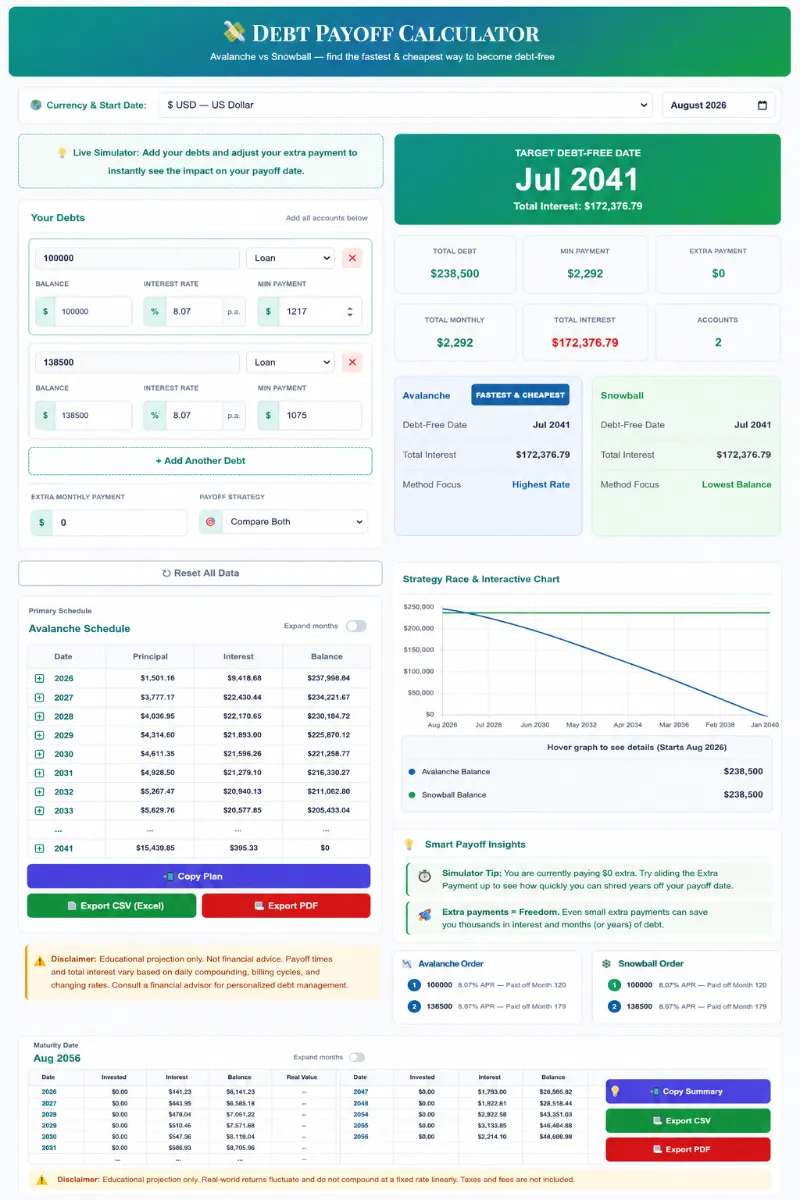
💰 Try the SaveXpert Debt Payoff Calculator
I ran a simple $100,000 versus $138,500 borrowing comparison through SaveXpert’s Debt Payoff Calculator. The difference is $38,500, but eligibility depends entirely on whether the borrower falls under the standard graduate limit or the applicable interim exception. Enter different total loan amounts and repayment periods to see how the new caps translate into real monthly payment and total interest scenarios before making a borrowing decision.
Educational note: This calculator models hypothetical debt payoff scenarios and does not determine actual loan eligibility or predict repayment outcomes. For official borrowing limits and repayment plan eligibility, see studentaid.gov.
The Bottom Line: 5-Step Action Plan
What should borrowers do right now? The Big Beautiful Bill student loan changes are less about one new rule and more about several borrower-specific rules taking effect on different dates. Here’s the 5-step sequence for applying them correctly:
1. Determine your borrower category:
Identify whether you’re a new borrower (first disbursement on or after July 1, 2026), an existing borrower eligible for a legacy exception, or a current repayment borrower facing a plan-transition date. Each group faces different rules.
2. Know your program classification:
Graduate and professional programs carry different annual and aggregate caps ($20,000/$100,000 vs. $50,000/$200,000). Confirm with your institution which classification applies to your specific degree program.
3. Review your repayment plan status:
If you’re on SAVE, PAYE, or ICR, you must transition to an eligible plan by July 1, 2028. Confirm your transition timeline and options at studentaid.gov. Borrowers on IBR or Standard plans don’t face the same mandatory transition.
4. Model your numbers before borrowing:
Use SaveXpert’s Debt Payoff Calculator to compare borrowing scenarios under the new caps. Then compare the monthly payment and total interest across the RAP and revised standard plan before accepting any loan offer.
5. Verify current rules — they’re still being finalised:
Federal Student Aid’s OBBBA page carries the most current official guidance. Some provisions remain subject to final rulemaking. Matching the rule to your specific loan, program, and disbursement date is the only way to get the right answer.
The numbers are clear, but the application can vary significantly by borrower. Research these rules now so the next borrowing or repayment decision is based on what actually applies to your situation — not just the headline.
“What I found when I went through the congressional summary and Federal Student Aid implementation materials is that the One Big Beautiful Bill isn’t one student loan change — it’s at least eight separate changes taking effect on three different dates. The most important research finding is that your enrollment date, disbursement date, and program classification all determine which rules actually apply to you. The headline number rarely tells the whole story.”
— Kevin Brown, Lead Researcher at SaveXpert.com
Frequently Asked Questions
Ans: According to Congress.gov, the One Big Beautiful Bill Act introduces strict federal loan limits for graduate students ($20,000/$100,000) and professional students ($50,000/$200,000), caps Parent PLUS borrowing at $65,000 per dependent student, eliminates Grad PLUS for new borrowers, replaces older income-driven repayment plans with the Repayment Assistance Plan for new loans, and eliminates economic-hardship deferments starting July 1, 2025.
Ans: The official congressional summary shows that payments made under the new Repayment Assistance Plan can count as qualifying payments for Public Service Loan Forgiveness. According to CFPB guidance, existing income-driven repayment plans previously offered forgiveness after 20 or 25 years. Borrowers must verify their specific transition rules — particularly if they’re on SAVE, PAYE, or ICR, which must transition to an eligible plan by July 1, 2028.
Ans: According to Federal Student Aid, specific FAFSA processing updates were implemented to apply the new eligibility rules — including the $65,000 Parent PLUS limit per dependent student and the new graduate loan limits for the 2026–27 award year. FAFSA itself continues to operate as the gateway for federal student aid eligibility.
Ans: The Congress.gov data shows that for covered loans first disbursed on or after July 1, 2026, the Department of Education may only offer a revised standard plan and the Repayment Assistance Plan. Existing borrowers enrolled in previous income-driven plans may remain eligible under transition rules — but SAVE, PAYE, and ICR borrowers must transition to an eligible plan by July 1, 2028. Verify your specific plan with Federal Student Aid.
Ans: A July 2026 GAO report discusses repayment-plan changes and implementation issues under the new law. SAVE, PAYE, and ICR borrowers must transition to an eligible repayment plan by July 1, 2028. New borrowers are restricted to the Repayment Assistance Plan and a revised standard plan. Existing borrowers face plan-specific transition rules currently being finalized by the Department of Education — check studentaid.gov for the latest transition timeline.
Ans: According to Congress.gov, economic-hardship and unemployment deferments ended beginning July 1, 2025 — before most of the other provisions took effect. The law also reduces the total forbearance period available. A new medical or dental internship and residency forbearance was created, with no interest accrual during the first four 12-month periods; interest accrues in later periods. Borrowers who previously relied on economic-hardship deferment should review their current options directly with their loan servicer.