
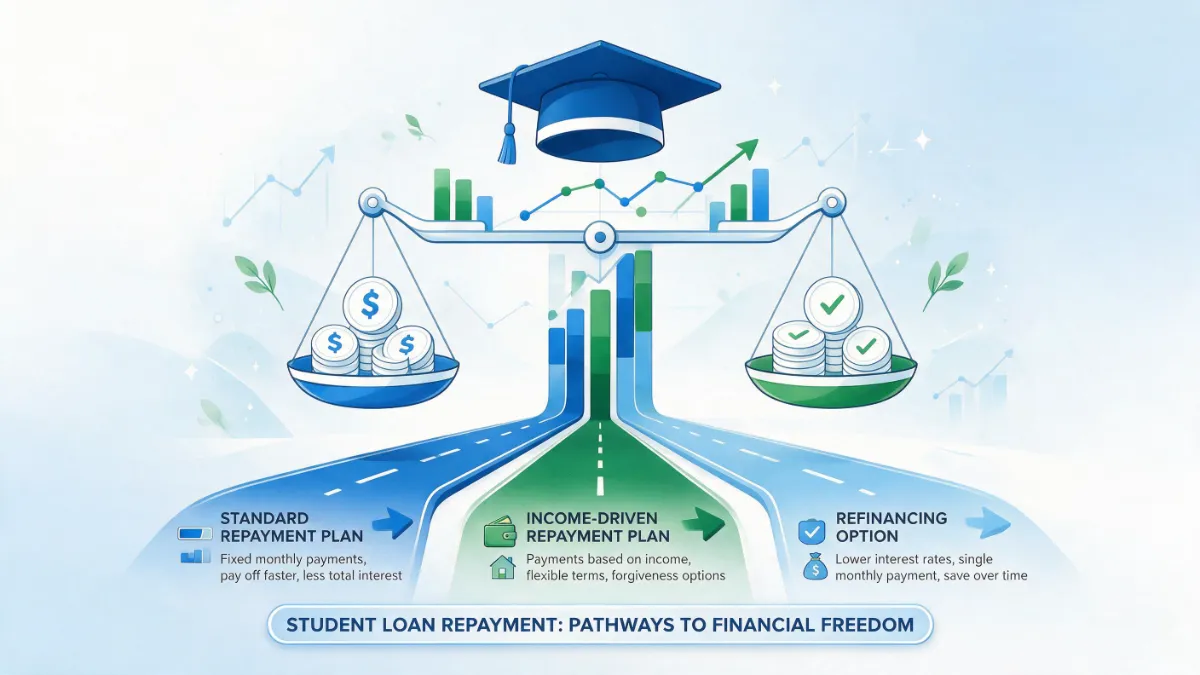
ⓘ Educational Disclosure:
This article is for educational and informational purposes only. It does not constitute financial, legal, tax, or lending advice. SaveXpert and its authors are not licensed financial advisors. Federal student loan rules, plan availability, and forgiveness programs are subject to frequent legal and regulatory change — always verify current options at StudentAid.gov. Always verify current eligibility, loan type, and repayment rules at studentaid.gov or with a qualified financial-aid professional before making borrowing decisions.
In 2026, federal student loan repayment changed significantly. Borrowers with new Direct Loans first disbursed on or after July 1, 2026, generally have access to two new plans: the income-driven Repayment Assistance Plan (RAP) and the fixed-payment Tiered Standard Plan. The SAVE Plan ended March 10, 2026, following a court ruling. Borrowers with older loans can generally maintain legacy plans through a transition period — but taking out new federal loans after July 1, 2026 can shift all Direct Loans into the new framework. All options, eligibility, and transition deadlines are managed through StudentAid.gov.
Key Takeaways: AT A GLANCE — THE 2026 STUDENT LOAN LANDSCAPE
- July 1, 2026 Rule Change: New Direct Loans disbursed on or after this date generally only access the Tiered Standard Plan and RAP — not legacy plans like IBR, PAYE, or ICR.
- SAVE ended March 10, 2026. RAP is its structural replacement — but RAP uses AGI directly on a 1%–10% sliding scale, not the discretionary-income formula SAVE used. They are not the same plan.
- Legacy IDR transition deadlines: PAYE and ICR enrollment closes July 1, 2027. Broader transitions continue through June 30, 2028. Existing borrowers who don’t take new loans can generally stay on current plans through this window.
- New Direct Loan borrowing triggers the new framework for ALL loans. Taking out a single new Direct Loan on or after July 1, 2026, can move all existing Direct Loans into the new plan structure — not just the new one.
- Daily simple interest means extra payments compound forward. Every dollar applied to principal reduces the base on which future daily interest calculates — but servicers can route excess payments to “paid ahead” status instead of principal unless explicitly instructed otherwise.
- PSLF strategy inverts the payoff logic. For borrowers pursuing Public Service Loan Forgiveness, lower qualifying IDR payments over 120 months leave more balance to be forgiven — making aggressive prepayment counterproductive in that scenario.
- Time to Read: 8 Minutes
Table of Contents
1. All Federal Repayment Plans Compared: Legacy vs. 2026 Rules
2. The New 2026 Plans: RAP vs. SAVE — What Actually Changed
3. How Student Loan Interest Accrues: The Daily Simple Interest Formula
4. The Debt Avalanche Applied to Student Loans
4. Income-Driven Repayment and Discretionary Income Explained
5. How to Pay Off Student Loans Faster— and the Paid-Ahead Trap
Picking the wrong student loan repayment plan can cost thousands of dollars in unnecessary interest over the life of the loan. Picking a plan that’s mathematically optimal but financially unsustainable is just as costly — if the payment can’t be maintained, the strategy falls apart anyway.
In 2026, that calculation got significantly more complicated. New federal repayment options officially took effect July 1, 2026. The SAVE Plan ended months earlier. The options available now depend heavily on when loans were disbursed — and whether new borrowing is planned.
I went through StudentAid.gov repayment guidance, CFPB explanations of servicer payment practices, and the statutory framework behind the 2026 plan changes to put this together. Here’s what the 2026 landscape actually looks like — and how to navigate it.
All Federal Repayment Plans Compared: Legacy vs. 2026 Rules
Two different systems now exist side by side. Borrowers with eligible new Direct Loans first disbursed on or after July 1, 2026, generally have access to the Tiered Standard Plan and RAP. Borrowers with existing loans can generally keep their current repayment options during the transition period. The critical caveat: taking out any new federal Direct Loan after July 1, 2026, can move all existing Direct Loans into the new framework — not just the newly disbursed one.
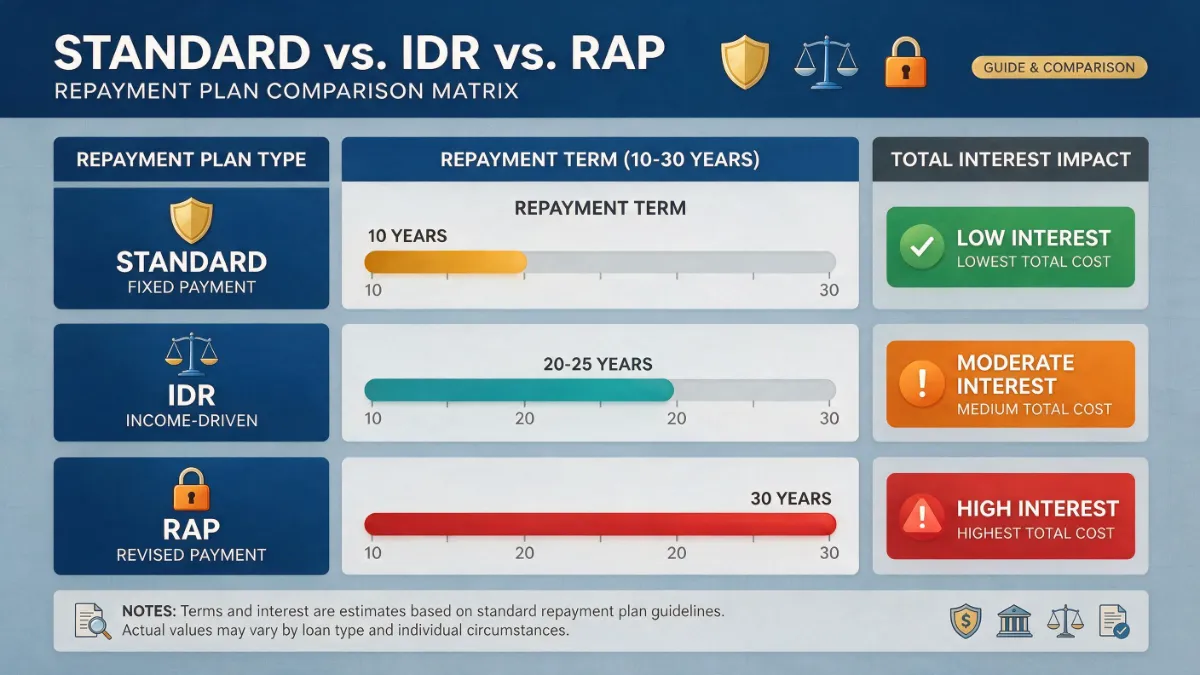
Federal Student Loan Repayment Plans — Structure, Term, and Interest Impact
| Repayment Plan | Payment Structure | Typical Term | Long-Run Interest Impact |
|---|---|---|---|
| Standard 10-Year (legacy) | Fixed monthly payments | 10 years | Lowest total interest among traditional fixed plans |
| Graduated (legacy) | Starts lower, rises every two years | 10 years | Higher than Standard due to slower early principal reduction |
| Extended (legacy) | Fixed or graduated payments (eligible borrowers) | Up to 25 years | Higher because repayment extends substantially longer |
| Legacy IDR (IBR, PAYE, ICR) | 10%–20% of discretionary income | 20–25 years | Can exceed Standard; remaining balance may qualify for forgiveness |
| Tiered Standard (2026) | Stepped fixed payments based on total loan balance | 10–25 years (balance-dependent) | Longer terms for larger balances increase total interest vs. old Standard |
| RAP (2026) | 1%–10% of AGI; $10 minimum; $50/dependent reduction | Up to 30 years | Interest subsidy and principal-matching features can slow balance growth at low incomes |
Source: StudentAid.gov — Repayment Plans. Plan availability depends on loan type, disbursement date, and borrower eligibility. Borrowers should verify their specific options directly through their servicer or StudentAid.gov.
The pattern worth noting across all plan types: extending repayment by decades to lower the monthly bill almost always increases lifetime interest costs. The lower payment costs something on the back end — and the longer the term, the more that back-end cost accumulates.
The New 2026 Plans: RAP vs. SAVE — What Actually Changed
RAP is not a renamed SAVE Plan. They are structurally different — and that distinction matters significantly for borrowers who were enrolled in SAVE or planning to be.
The SAVE Plan ended following a court action on March 10, 2026. RAP officially became available July 1, 2026, under a new statutory framework from Federal Student Aid.
RAP vs. SAVE — Key Structural Differences
| Feature | SAVE Plan (ended March 2026) | RAP (available July 2026) |
|---|---|---|
| Income basis | Discretionary income (AGI minus 225% of poverty guideline) | Adjusted Gross Income (AGI) directly — no poverty deduction |
| Payment range | 5%–10% of discretionary income depending on loan type | 1%–10% of AGI on a sliding scale |
| Minimum payment | Could result in $0 payment at sufficiently low income | $10 strict minimum regardless of income |
| Dependent consideration | Built into the poverty guideline calculation | Explicit $50/month reduction per dependent |
| Principal-matching feature | Interest subsidy for qualifying low-payment situations | Principal-matching for qualifying low-principal-payment situations |
| Maximum repayment term | 20 years (undergrad), 25 years (grad/professional) | Up to 30 years |
Source: StudentAid.gov — Income-Driven Repayment Plans. Borrowers transitioning from SAVE should not assume RAP functions identically. Verifying plan terms with the servicer before enrollment is recommended.
How Student Loan Interest Accrues: The Daily Simple Interest Formula
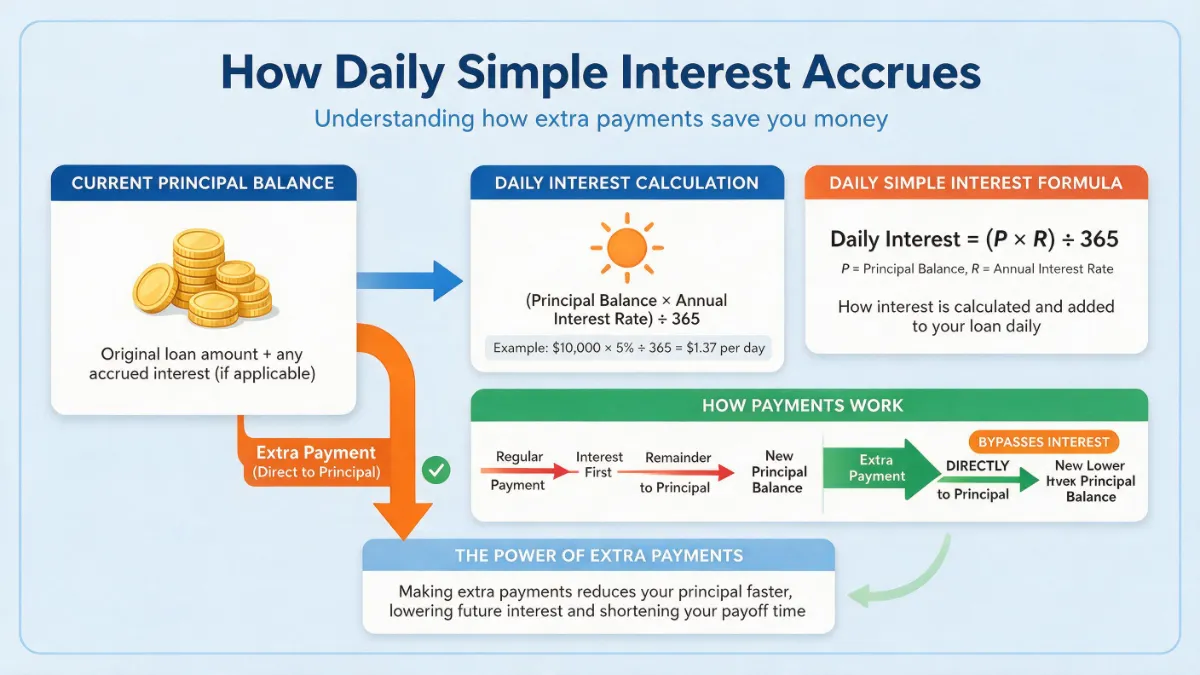
Repayment plans don’t all reduce the balance at the same speed — and understanding why starts with how interest is calculated daily. This is the math that makes extra payments strategically valuable.
Federal student loans generally accrue interest daily based on the outstanding principal, using a formula described in Federal Student Aid interest rate guidance:
Daily Interest = Outstanding Principal × (Annual Interest Rate ÷ 365)
Applied every day between scheduled monthly payments
Daily Interest and Payment Allocation — Worked Example ($30,000 Loan)
| Step | Calculation | Result |
|---|---|---|
| Loan variables | Principal: $30,000 | Annual rate: 6.00% | Monthly payment: $400 | Baseline parameters |
| Daily interest accrual | ($30,000 × 0.06) ÷ 365 | $4.93 per day |
| Interest accrued over 30 days | $4.93 × 30 | $147.95 |
| $400 payment allocation | $400.00 − $147.95 interest portion | $252.05 goes to principal |
| New balance after payment | $30,000.00 − $252.05 | $29,747.95 |
📌 Servicer precision note: Some federal-loan servicer systems use 365.25 days in the actual daily interest calculation rather than 365. The servicer’s exact figure may differ slightly from a simplified 365-day illustration. Always confirm the exact calculation method with the servicer directly.
Because interest calculates against the current principal daily, every dollar applied to principal reduction today reduces the base on which tomorrow’s interest accrues. The earlier in the loan’s life that principal is reduced, the more future daily interest is avoided — which is precisely why the Debt Avalanche approach produces real mathematical savings on student loans specifically.
Find out exactly how long it takes to become debt-free.
The Debt Avalanche Applied to Student Loans
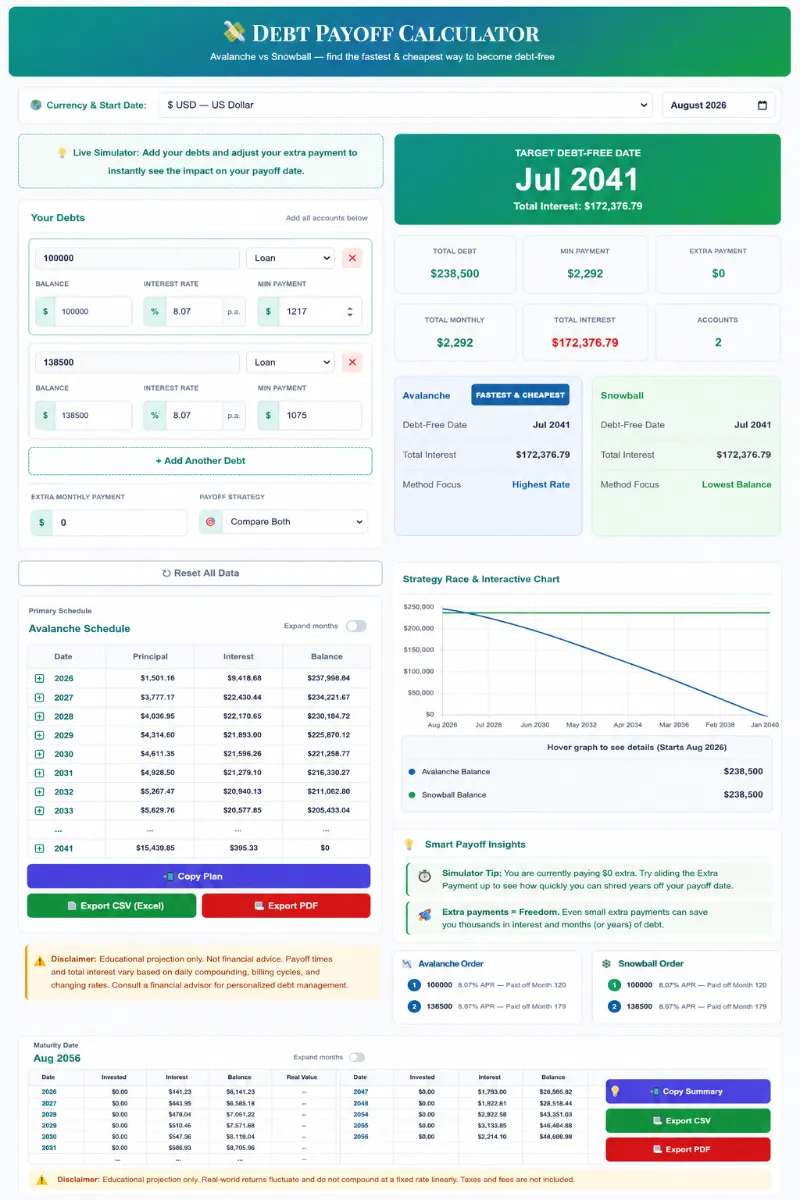
For borrowers with multiple federal loans at different interest rates, the Debt Avalanche method works as follows: make the required minimum payment on every loan first — missing a required payment on one loan to overpay another creates delinquency risk that undermines the strategy entirely. Then identify the loan with the highest interest rate and direct every available extra dollar toward that balance until it reaches zero. The freed-up payment then rolls to the next-highest rate.
💰 Try the SaveXpert Debt Payoff Calculator
The SaveXpert Debt Payoff Calculator allows entry of each loan’s balance, interest rate, minimum payment, and planned extra payment — then compares projected payoff dates and total interest costs across different payment strategies. Entering the actual numbers produces a result specific to a real debt profile, not a national average.
Use The Free Debt Payoff Calculator→Educational note: This calculator models hypothetical debt payoff scenarios and does not determine actual loan eligibility or predict repayment outcomes. For official borrowing limits and repayment plan eligibility, see studentaid.gov.
Income-Driven Repayment and Discretionary Income Explained
Income-driven repayment plans are easier to understand once two concepts are clearly separated: income is what someone earns, while discretionary income is the specific portion the applicable formula treats as available for payment calculation purposes. They are not the same number.
Discretionary Income Calculation — Legacy IDR vs. RAP (2026)
| Variable / Step | Legacy IDR (e.g., 10% IBR or PAYE) | 2026 RAP |
|---|---|---|
| Income basis used | Discretionary income (after poverty deduction) | Full AGI — no poverty guideline deduction |
| Poverty line deduction | Subtracts 150% of applicable Federal Poverty Guideline | No poverty deduction applied |
| Example with $50,000 AGI | $50,000 − $30,000 (150% poverty line) = $20,000 discretionary income | $50,000 AGI placed directly on 1%–10% sliding scale |
| Payment result | 10% × $20,000 = $166.67/month | Slides with AGI; $10 minimum applies |
| Dependent adjustment | Factored into the poverty guideline threshold used | Explicit $50/month reduction per dependent |
Example figures are illustrative. Actual poverty guideline thresholds vary by household size and state. Source: StudentAid.gov — IDR Plans.
The trade-off built into every IDR structure runs throughout the full repayment plan comparison: a lower required payment today preserves cash flow but keeps the balance outstanding significantly longer — which increases lifetime interest costs. Whether that trade-off is worth it depends on income stability, forgiveness eligibility, and how long the payment relief needs to last.
How to Pay Off Student Loans Faster Strategically
For borrowers whose priority is eliminating debt rather than pursuing forgiveness, the strategy shifts. The goal becomes less about finding the smallest monthly payment and more about directing extra cash efficiently against the daily interest calculation.
The “Paid Ahead” Status Trap
This is one of the most consequential and least-known features of how federal loan servicers handle extra payments — and it works against borrowers who don’t know to address it directly.
⚠ How Federal Servicers Can Misroute Extra Payments
When borrowers send more than the required monthly payment, federal loan servicers can place the account into “paid ahead” status. This means the excess advances the due date for future scheduled payments rather than reducing the outstanding principal balance. The daily interest calculation continues accruing against the unreduced principal balance — defeating the purpose of the extra payment entirely.
The CFPB explains that borrowers can explicitly instruct their servicer to apply excess payments directly to principal — but that instruction must be given clearly and specifically. The default behavior without that instruction is paid-ahead status. Borrowers making extra payments should confirm in writing with their servicer exactly how those funds are being applied.
The framework for effective extra payments:
- Make the required minimum payment on every loan first. Missing a required payment on any loan to send extra money elsewhere creates delinquency risk that damages the credit file and potentially triggers servicer fees.
- Explicitly instruct the servicer to apply the excess to principal. This instruction needs to be in place before overpayments are made — not discovered after the fact that the extra money went to advance next month’s payment instead.
- Direct extra principal payments toward the highest-interest loan first. This is the Debt Avalanche applied to student debt — mathematically optimal for minimizing total interest on a multi-loan profile.
The Bottom Line: 3-Part Objective Decision Framework
There is no universally “best” federal student loan repayment plan. What changes is the borrower’s objective — and three different objectives point toward three meaningfully different strategies, according to Federal Student Aid guidance and CFPB consumer resources on student loan repayment.
1. Pay the debt off as quickly as possible
When income is stable and predictable, a faster fixed-payment approach — the Standard Plan for legacy loans or the Tiered Standard for new ones — generally minimizes lifetime interest. The trade-off is a higher monthly payment now in exchange for a shorter repayment period and significantly less accumulated interest. Extra payments directed to principal under the Debt Avalanche accelerate this further.
2. Keep monthly payments manageable
When a fixed payment would consume too much cash flow to sustain, an income-driven plan — RAP for new loans, IBR or PAYE for existing loans within the transition window — provides payment flexibility tied to income. The trade-off is keeping the balance outstanding for a much longer period, which meaningfully increases lifetime interest costs. The lower payment preserves cash flow; it does not eliminate the interest that continues accruing.
3. Pursue Public Service Loan Forgiveness (PSLF)
For qualifying borrowers, PSLF can forgive the remaining balance on eligible Direct Loans after exactly 120 qualifying payments made while employed full-time by a qualifying public service employer. In a PSLF strategy, aggressively prepaying principal actually works against the borrower — lower qualifying IDR payments over the 120-payment window mean more balance remains to be forgiven. The optimal PSLF approach often involves the lowest available qualifying payment, not the fastest possible payoff.
Before making aggressive prepayments, switching plans, or enrolling in any program, verifying current options, loan type, and eligibility through StudentAid.gov and the official federal loan servicer is the recommended starting point for every scenario. Plan availability has changed significantly in 2026, and the data at StudentAid.gov reflects the most current eligibility rules.
“Choosing a repayment plan isn’t just about hunting for the lowest monthly bill. It’s about understanding how the 2026 rules affect long-term interest costs, knowing how daily accrual works, instructing the servicer to apply extra payments to principal, and — for PSLF borrowers — recognizing that the math actually runs in the opposite direction.”— Kevin Brown, Lead Researcher, SaveXpert
Frequently Asked Questions
Ans: The SAVE Plan ended following a court action on March 10, 2026. For new Direct Loans first disbursed on or after July 1, 2026, the Repayment Assistance Plan (RAP) serves as the primary income-driven replacement, available alongside the fixed-payment Tiered Standard Plan. RAP uses Adjusted Gross Income (AGI) directly on a 1%–10% sliding scale, which differs structurally from the discretionary-income formula SAVE used. Borrowers should verify their specific options and current eligibility at StudentAid.gov.
Ans: Borrowers with existing loans can generally retain their current repayment options during a transition period. PAYE and ICR enrollment closes July 1, 2027; broader transitions continue through June 30, 2028. However, taking out any new Direct Loan on or after July 1, 2026, can move all existing Direct Loans into the new repayment framework — not just the newly disbursed one. Borrowers planning additional federal borrowing should review this impact carefully before proceeding, using the loan simulator at StudentAid.gov/loan-simulator.
Ans: No. Federal student loan payments are applied first to fees, then to accrued interest, and finally to principal. Servicers can also place borrowers in “paid ahead” status, where excess payments advance the due date for future scheduled payments rather than reducing the outstanding balance. The CFPB explains that borrowers can explicitly instruct their servicer to apply excess funds directly to principal — but that instruction must be given clearly, in writing, and in advance of the extra payment.
Ans: For qualifying borrowers, PSLF can forgive the remaining balance on eligible Direct Loans after exactly 120 qualifying payments while working full-time for a qualifying public service employer. In a PSLF strategy, aiming for the lowest available qualifying IDR payment is generally more advantageous than aggressively prepaying — because more balance remaining at the 120-payment milestone means more is ultimately forgiven. Aggressive principal prepayment in a PSLF situation reduces the amount that would be forgiven and does not accelerate the 120-payment count.
Ans: The old Standard 10-Year Plan set uniform fixed payments calculated to pay off any balance in exactly 10 years. The new 2026 Tiered Standard Plan uses a stepped fixed-payment structure where the repayment term and payment tiers are determined by total loan balance — ranging from 10 to 25 years depending on how much is owed. Borrowers with larger balances under the Tiered Standard may face a longer repayment period than the old Standard would have required, which increases total lifetime interest costs. Borrowers with loans disbursed before July 1, 2026, generally retain access to the original Standard Plan during the transition period. See StudentAid.gov — Standard Repayment Plan.
Ans: Generally yes, though restrictions apply. Federal Student Aid allows borrowers to change repayment plans, but available options depend on loan type, disbursement date, and current balance. Some plan changes require income recertification. Borrowers pursuing PSLF should confirm that any plan switch does not interrupt their qualifying payment count. The July 1, 2027 deadline for PAYE and ICR enrollment means those specific plans cannot be newly enrolled in after that date. Borrowers should review options directly with their servicer or at StudentAid.gov/manage-loans/repayment before switching.