

ⓘ Educational Disclosure:
This article is for educational and informational purposes only. It does not constitute financial, legal, tax, or lending advice. SaveXpert and its authors are not licensed financial advisors. Financial data and regulations change frequently. Always consult a qualified financial professional before making any financial decisions.
The debt avalanche method — targeting the highest interest rate first — generally saves more in total interest because it reduces the most expensive compounding as quickly as possible. The debt snowball method — targeting the smallest balance first — tends to produce better behavioral outcomes for some borrowers by creating visible wins early. CFPB guidance recommends addressing high-consequence obligations (housing, utilities, secured debt) before choosing either method. According to Federal Reserve Q1 2026 data, the average APR on credit card accounts assessed interest was 21.52% — making the question of which debt gets the extra dollar a genuinely expensive one.
What This Research Found
- Avalanche is the mathematical winner — it directs extra payments to the highest APR first, which typically minimizes total interest paid across all accounts.
- Snowball is the behavioral winner for some borrowers — behavioral research suggests people focusing on smaller accounts show measurably higher rates of debt elimination over time.
- The CFPB consequence framework comes before either method — high-consequence obligations (housing, essential utilities, secured debts, tax arrears) need to be assessed before deciding where extra dollars go.
- Federal Reserve Q1 2026 data: average credit card APR was 21.52% on interest-assessed accounts; the New York Fed reported approximately $1.25 trillion in U.S. credit card balances.
- Credit score and interest-minimization are different objectives — heavily utilized credit cards matter most for scoring, while high-APR debts matter most for interest savings.
- FTC warnings apply: debt-relief companies cannot legally collect upfront fees or guarantee results; the same debt payoff work can be done independently at no cost.
- Time To Read: 8 Minutes
Table of Contents
1. The CFPB Framework: Priority Debts Come First
2. The Debt Avalanche Method: Targeting the Highest APR
3. The Debt Snowball Method: Targeting the Smallest Balance
4. Snowball vs. Avalanche: A Side-by-Side Look
5. What This Means for Your Credit Score
I went through CFPB guidance, Federal Reserve consumer credit data, FICO educational materials, behavioral research from Kellogg and Harvard Business Review, and FTC warnings on debt-relief companies to work through this question properly. Here’s what I concluded.
The avalanche is generally the better financial-math strategy. The snowball can be the better behavioral strategy for some people. The difference comes down to what keeps a repayment plan moving — and that varies meaningfully from person to person.
Before getting into either method, there’s a piece of context worth establishing first. The Federal Reserve’s Q1 2026 data puts the average APR on credit card accounts assessed interest at 21.52%. The New York Fed reported approximately $1.25 trillion in U.S. credit card balances during the same period. At those rates, the question of where the extra repayment dollar goes isn’t academic — it’s expensive in a very real, compounding way.
📈 Federal Reserve Q1 2026 Data
Average APR on credit card accounts assessed interest: 21.52%
Average APR across all credit card accounts: 21.00%
U.S. credit card balances (New York Fed, Q1 2026): ~$1.25 trillion
The CFPB Framework: Priority Debts Come First
Before the snowball-versus-avalanche question becomes relevant, the CFPB makes a useful point that most debt articles skip: not all obligations carry the same consequences for nonpayment. A credit card at 29% APR looks mathematically urgent. But missing a mortgage payment carries consequences that are categorically different — and losing housing, transportation, or essential utilities destabilizes everything else.
The CFPB encourages ranking obligations by the severity of nonpayment consequences rather than applying a one-size-fits-all priority list. Obligations that typically require attention first include:
Rent or mortgage payments — eviction and foreclosure have cascading practical consequences.
Property taxes and income-tax arrears — government collection carries enforcement powers not available to private creditors.
Essential utilities — disconnection affects housing habitability.
Transportation needed for employment — job loss amplifies all other debt problems.
Child support and court-ordered obligations — nonpayment can trigger legal enforcement.
Secured debts where collateral can be repossessed — losing the collateral typically exceeds the debt cost.
Credit cards and medical bills generally fall into the unsecured category. Their consequences differ — no immediate repossession risk, different collection timelines — though they still require consistent attention to avoid collections and credit damage.
The CFPB framework comes before the snowball-versus-avalanche decision. Mapping what happens when each obligation goes unpaid is the foundation. Only after that does the question of where extra repayment dollars go become the right one to address.
The Debt Avalanche Method: Targeting the Highest APR
The avalanche method is built on compound interest logic working in reverse. Every dollar applied to a 29% APR account prevents more future interest from accruing than the same dollar applied to a 10% balance. The structure is straightforward:
1. Continue making required minimum payments on all accounts.
2. Identify the debt carrying the highest interest rate.
3. Direct every available extra dollar toward that balance.
4. When it reaches zero, redirect that entire freed-up payment to the next-highest APR.
This approach produces the lowest total interest cost — when the plan is followed consistently all the way through. That final condition is important, and it’s the source of one of the avalanche’s practical limitations.
Why the Avalanche Generally Saves More Interest
Here’s a simplified example showing how the ordering changes outcomes:
Sample Debt Profile — Avalanche Targeting Order
| Debt | Balance | APR | Avalanche Target Order |
|---|---|---|---|
| Credit Card A | $1,200 | 29.99% | ① First |
| Credit Card B | $3,800 | 22.99% | ② Second |
| Personal Loan | $6,000 | 11.00% | ③ Third |
| Medical Balance | $1,000 | 0% | ④ Last |
Notice that Credit Card A — not the largest balance — goes first because it carries the highest APR. The 0% medical balance goes last because it accrues no interest cost while waiting.
Research modeling estimated that a snowball repayment sequence could cost approximately 1.8% to 4.3% more in total interest compared to an interest-minimizing strategy. These are modeled figures, not a universal guarantee — the actual difference shifts based on the APR spread between accounts, individual balances, minimum-payment formulas, repayment capacity, and whether promotional rates or new borrowing enter the picture.
Find out exactly how long it takes to become debt-free.
Where the Avalanche Can Fall Short
If the highest-APR debt is also the largest balance, progress can feel invisible for a long time. Months of extra payments may reduce the balance only modestly before the first account is eliminated. For people who depend on visible wins to stay motivated, this slow early progress has historically been a point where avalanche repayment plans stall or stop.
A mathematically optimal plan that stops halfway delivers far less than a slightly less optimal plan that gets completed. The behavioral data on this is consistent.

The Debt Snowball Method: Targeting the Smallest Balance
The snowball method abandons interest-rate priority in favor of balance-size priority. The mechanics are nearly identical to the avalanche, except the targeting logic changes:
1. Continue making required minimum payments on all accounts.
2. Identify the debt with the smallest outstanding balance.
3. Direct every available extra dollar toward that balance.
4. When it reaches zero, roll that freed-up payment toward the next-smallest balance.
The mathematical disadvantage is built into the design — a small balance can carry a much lower interest rate than a larger, more expensive debt that compounds while waiting. But this is where behavioral research adds a dimension that pure math misses.
The Behavioral Research Behind the Snowball
Kellogg School of Management research found that consumers focusing on smaller accounts were more likely to eliminate their overall debt than those focusing on total dollars repaid. The associated findings were notable: a 14% greater likelihood of debt elimination after one year, and a 43% greater likelihood after four years, for borrowers using the smaller-balance-first approach.
These are study-specific findings, not guarantees for every borrower profile — but the direction of the evidence is consistent with how behavioral economists describe motivation: people experience progress through completed tasks and closed accounts, not just through dollar amounts reduced. Closing an account, seeing a balance reach zero, and eliminating a monthly minimum payment all produce concrete feedback that can sustain a longer repayment effort.
CFPB-referenced behavioral research on “small victories” found participants completing tasks in ascending order were roughly 13% faster than those working in descending order. The same research cautions that a sufficiently large interest-rate difference between accounts can outweigh that behavioral advantage — meaning the snowball’s motivational benefit isn’t unlimited, and the avalanche’s mathematical edge can become decisive when the APR spread is wide enough.
📈 Try the SaveXpert Debt Payoff Calculator
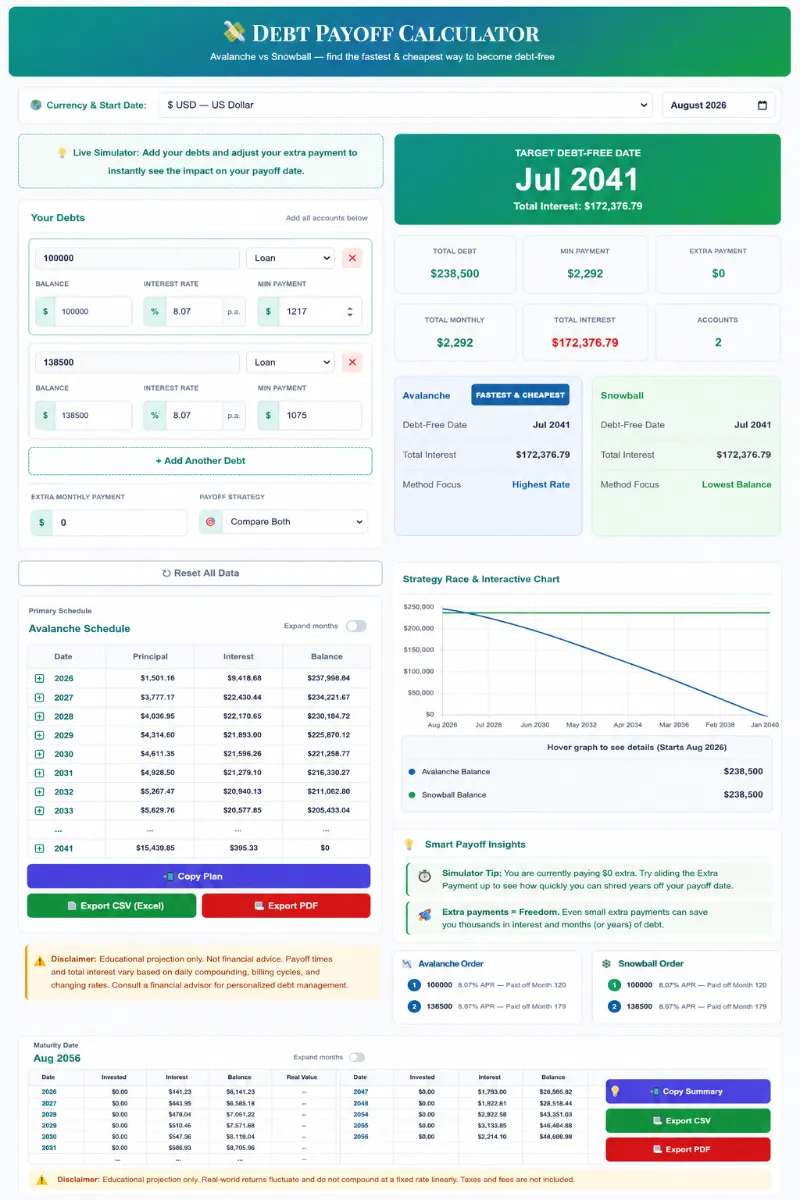
The SaveXpert Debt Payoff Calculator lets you enter each debt’s balance, APR, minimum payment, and extra monthly payment — then compare projected repayment sequences and interest costs under both methods. The difference between snowball and avalanche changes significantly depending on a borrower’s specific debt profile.
Educational note: Calculator results are estimates for educational purposes only.
Snowball vs. Avalanche: A Side-by-Side Look
In purely mathematical terms, the avalanche normally wins. In behavioral terms, the snowball can be more effective for certain borrowers. The real question isn’t which is theoretically superior — it’s which one will actually be followed through to completion.
📅 Debt Avalanche
- Target: Highest APR first.
- Main benefit: Minimizes total interest; shorter payoff when followed completely.
- Main risk: Early progress can feel slow if largest balance has highest APR.
- Best for: Borrowers motivated by dollar savings and who can sustain a long payoff period without quick wins.
🍷 Debt Snowball
- Target: Smallest balance first.
- Main benefit: Faster account closures; behavioral research supports higher completion rates.
- Main risk: High-APR debts continue compounding while small accounts are cleared.
- Best for: Borrowers who need visible momentum to stay committed through a multi-year plan.
Debt Snowball vs. Avalanche — Key Comparison
| Factor | Snowball | Avalanche |
|---|---|---|
| Targeting logic | Smallest balance | Highest APR |
| Total interest cost | Potentially higher | Generally lower |
| Account closures | Faster early wins | May take longer initially |
| Completion rate evidence | Higher in behavioral research | Requires sustained motivation |
| Optimal when | Motivation is the primary obstacle | Interest savings is the primary goal |
What This Means for Your Credit Score
Debt payoff strategy and credit score strategy are related objectives — but they’re not the same thing, and they don’t always point in the same direction.
Estimate your score from the two most important factors.
Revolving vs. Installment Debt: Different Scoring Impact
According to FICO’s published factor breakdown, credit utilization accounts for approximately 30% of the FICO Score — the second-largest factor. This metric applies specifically to revolving accounts, primarily credit cards. A heavily utilized credit card balance has a more immediate relationship with scoring than an installment loan balance of equal or even greater size.
Here’s what that difference looks like concretely:
Revolving Utilization — Example Profile
| Account | Credit Limit | Balance | Individual Utilization |
|---|---|---|---|
| Card A | $10,000 | $8,000 | 80% |
| Card B | $5,000 | $1,500 | 30% |
| Card C | $3,000 | $600 | 20% |
Aggregate utilization in this example: $10,100 ÷ $18,000 = 56.1%. The most heavily utilized individual card (Card A at 80%) also carries the greatest potential scoring improvement from paydown.
FICO materials reference 30% as a commonly cited utilization guideline and indicate that utilization below 10% — combined with strong payment history — tends to correlate with stronger scores. The practical implication: the debt with the highest APR is not automatically the debt with the greatest immediate credit-score relevance. A maximally utilized credit card may be both the highest-rate account and the highest-impact scoring opportunity — but that alignment isn’t guaranteed across all debt profiles.
Installment Loans and Credit Score
Auto loans, personal loans, and mortgages are installment accounts. Paying them down reduces interest cost and monthly obligations — but the scoring impact is generally less immediate than reducing a heavily utilized revolving card. FICO treats credit mix as a separate positive factor, which means eliminating an installment account entirely can occasionally have mixed scoring implications, depending on the composition of the rest of the file.
📊 Try the SaveXpert Credit Score Estimator
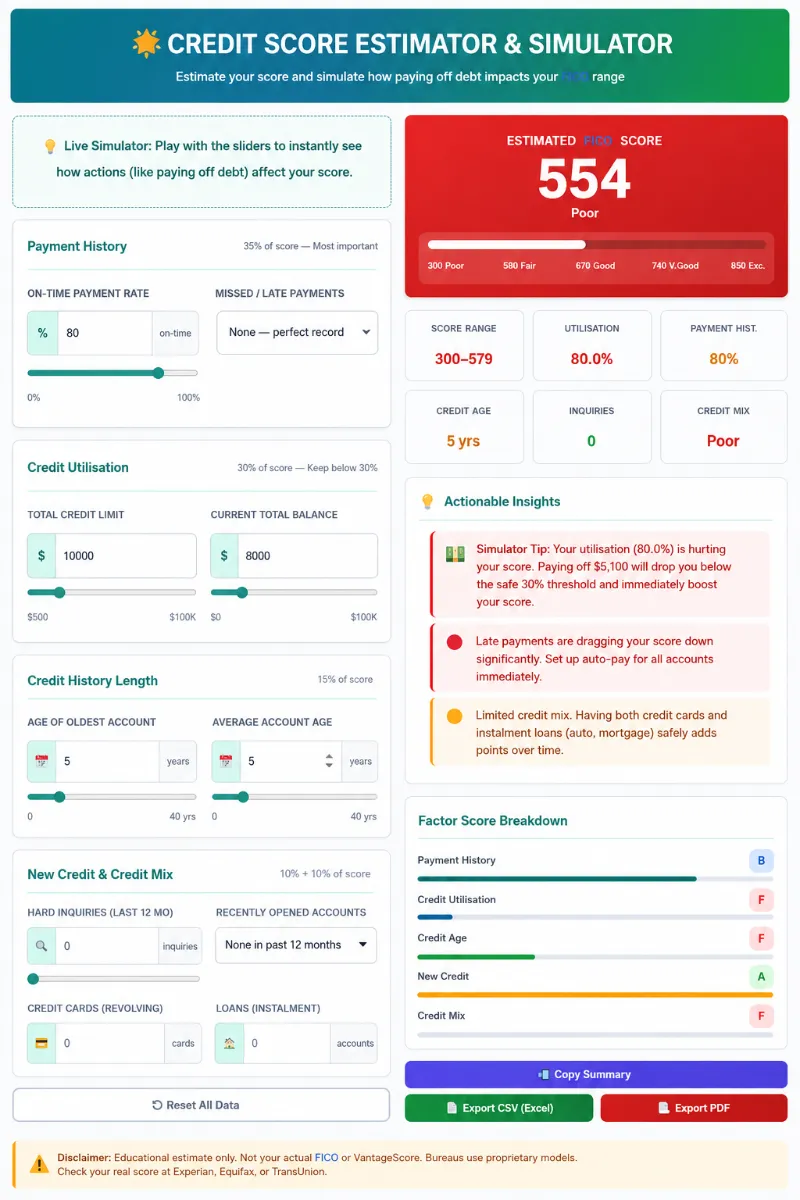
The SaveXpert Credit Score Estimator shows how utilization changes across accounts may affect an estimated score range — useful for understanding which paydowns have the most immediate scoring relevance.
Educational note: Calculator results are estimates for educational purposes only.
Paying Off Debt on a Limited Income
A limited income changes the debt payoff problem fundamentally. The snowball-versus-avalanche question becomes secondary when there’s barely enough money to cover minimum payments after housing, food, transportation, utilities, and taxes.
CFPB guidance for this situation focuses on mapping the full debt picture before deciding where any extra money goes. The relevant information for each obligation: balance, interest rate, minimum payment, overdue amount, and the specific consequence of nonpayment. With that map in place, the evidence suggests working through obligations in this order:
1. High-consequence household bills (rent, mortgage, essential utilities)
2. Legal or government obligations (taxes, child support)
3. Secured debts where collateral can be seized
4. Unsecured debts (credit cards, medical bills)
5. Accounts already in collections
One specific CFPB caution worth noting: putting a medical bill on a credit card to avoid collections can eliminate access to the provider’s own payment plan, which may carry little or no interest. Trading a 0% provider plan for 24% revolving debt isn’t financially advantageous, even if it appears to simplify the picture.
FTC Warnings on Debt-Relief Companies
The Federal Trade Commission is direct about the debt-relief industry. Covered debt-relief companies generally cannot collect certain fees before they’ve delivered qualifying services and met specified conditions. The FTC identifies several specific warning signs:
1. Demanding substantial upfront fees before any work is done.
2. Guaranteeing complete debt elimination or specific settlement amounts.
3. Instructing consumers to stop communicating with creditors — without explaining the legal and credit consequences of doing so.
4. Claiming access to a special government debt-relief program unavailable to the public.
5. Promising to stop all collection calls or prevent lawsuits.
⚠️ What to Know Before Engaging Any Debt-Relief Service: The same debt dispute and negotiation work that credit repair and debt-settlement companies offer can typically be done directly by the consumer at no cost — through AnnualCreditReport.com, individual bureau dispute portals, and direct creditor contact. Nonprofit credit counseling agencies, regulated under state law, are a different category from commercial debt-settlement companies and are generally a lower-risk option for structured repayment planning.
“Debt payoff is partly a math problem and partly a psychology problem. The avalanche can save more interest, but the snowball can make progress easier to see and sustain. The best method is the one a borrower will actually follow through to completion.”
— Kevin Brown, Lead Researcher at SaveXpert.com
Frequently Asked Questions
Ans: The debt avalanche generally saves more in total interest because it targets the highest-APR debt first, reducing the most expensive compounding as quickly as possible. Research modeling has estimated that a snowball repayment sequence can cost approximately 1.8% to 4.3% more in total interest compared to an interest-minimizing strategy. The actual difference depends on the specific balance amounts, APR spread, minimum payments, and whether the plan is followed through to completion.
Ans: The CFPB uses a consequence-based framework rather than a fixed legal category. Priority debts are obligations where nonpayment creates the most serious and immediate consequences — housing (mortgage or rent), essential utilities, transportation needed for employment, property taxes, income-tax arrears, child support, and secured debts where collateral can be repossessed. Credit cards and medical bills are typically unsecured and carry different consequences, though they still require consistent attention.
Ans: CFPB guidance for limited-income situations emphasizes mapping the full debt picture first — balances, APRs, minimum payments, overdue accounts, and the specific consequences of nonpayment for each obligation. High-consequence bills (housing, utilities, secured debt) typically require attention before any extra payments go toward unsecured debt. Hardship programs, direct creditor contact, and nonprofit credit counseling can open options not publicly advertised.
Ans: Heavily utilized revolving credit card balances tend to have the most immediate impact because credit utilization accounts for approximately 30% of the FICO Score calculation — the second-largest factor. Reducing a credit card from high utilization can improve a score within one billing cycle. Installment loans (personal loans, auto loans, mortgages) are scored differently and generally have less immediate utilization impact, though they contribute to credit mix.
Ans: It depends on the objective. For minimizing interest, the debt with the higher APR is generally the priority — regardless of account type. For improving a credit score, a heavily utilized credit card may have greater immediate scoring relevance because of how revolving utilization is weighted in the FICO model. For reducing consequence exposure, a secured loan may carry risks an unsecured credit card doesn’t. The right answer varies by individual debt profile and specific goal.
Ans: A hybrid approach is used by some borrowers — for example, paying off one or two small balances first to reduce monthly minimum obligations and free up cash flow, then switching to highest-APR targeting for remaining accounts. This can capture some of the motivational benefits of the snowball while moving toward the interest-minimizing structure of the avalanche. The most important factor in any hybrid plan is that minimum payments on all accounts remain current throughout. The SaveXpert Debt Payoff Calculator can be used to model different sequencing scenarios. (Calculator results are estimates for educational purposes only.)