
ⓘ Educational Disclosure:
This article is for educational and informational purposes only. It does not constitute financial, legal, tax, lending advice, or credit advice. SaveXpert and its authors are not licensed financial advisors. Credit scoring models, factor weights, and bureau policies may change. Always verify current details with CFPB consumer resources and your specific lender.
A credit score is a three-digit number between 300 and 850 that estimates how likely a borrower is to repay debt on time. FICO — the model used by 90% of top lenders according to FICO’s published data — calculates that number using five factors, with payment history (35%) and credit utilization (30%) controlling nearly two-thirds of the result. A score of 670 or above is generally considered good; 740 and above unlocks preferred rates from most lenders. Free weekly credit reports are available from all three bureaus at AnnualCreditReport.com under the Fair Credit Reporting Act (FCRA).
What This Research Found
- Payment history (35%) and credit utilization (30%) control 65% of the FICO Score — mastering just these two habits drives the majority of credit improvement for most consumers.
- Credit scores are not fixed. They are calculated from reported account data and change every time a creditor sends updated information to the bureaus — typically once per month on the statement closing date.
- FICO ≠ VantageScore. Free monitoring apps (Credit Karma, bank apps) typically display VantageScore; mortgage and auto lenders typically use FICO. The same credit file can produce scores 20–50 points apart across different models.
- Soft inquiries have zero score impact. Checking your own score, pre-qualification tools, and employer background checks are all soft — only formal credit applications trigger score-affecting hard inquiries.
- Rate shopping is protected. Multiple mortgage, auto, or student loan inquiries within a 45-day window (newer FICO models; 14 days for older) count as a single scoring event — not separate deductions.
- The FCRA dispute process removes inaccurate data, not accurate negative marks. Bureaus must investigate within 30 days. Late payments stay for 7 years; Chapter 7 bankruptcies for 10 years.
- Time To Read: 8 Minutes
Table of Contents
1. Credit Score Ranges: What Is a Good Score in 2026?
2. How Is a Credit Score Calculated? The 5 FICO Factors
3. FICO vs. VantageScore 4.0 — Why Your Score Looks Different Everywhere
4. Hard vs. Soft Inquiries: What Actually Affects Your Score
5. How to Check Your Credit Report for Free in 2026
A three-digit credit score can affect access to mortgages, auto loans, credit cards, rental housing, and in some states, insurance premiums. But the number itself is rarely straightforward. Most people know they have a credit score. Far fewer understand what’s actually in it, why it changes, or why the number looks different on different platforms
I went through FICO’s published scoring methodology, VantageScore’s technical documentation, CFPB guidance on credit reporting, and the Fair Credit Reporting Act to put this guide together. What I found is that the system is more logical than most people realize — once the underlying formulas are understood, managing a credit score becomes significantly less complicated.
Credit Score Ranges: What Is a Good Score in 2026?
Most consumer credit-scoring models in the U.S. operate on a 300-to-850 scale. A higher number signals lower historical default risk to lenders. What I found when reading through FICO’s published tier definitions is that the practical difference between score bands isn’t just a label — it directly determines which interest rates and products a borrower qualifies for.
Credit Score Ranges — FICO Tier Definitions and Practical Lending Impact
| Score Range | Tier | What It Typically Means for Borrowers |
|---|---|---|
| 300–579 | Poor | Subprime tier — credit access is significantly restricted; secured cards or collateral typically required; higher fees |
| 580–669 | Fair | Mainstream credit may be accessible but at noticeably higher-than-average interest rates |
| 670–739 | Good | Standard qualifying tier — most lenders offer competitive market rates, subject to income and DTI verification |
| 740–799 | Very Good | Preferred lending tier — strong approval odds and preferred interest rate discounts on most products |
| 800–850 | Exceptional | Prime tier — lowest available rates, fee waivers, and highest available credit limits |
Source: FICO score tier definitions; CFPB credit score guidance. These bands are educational benchmarks — not statutory lending rules. Lenders evaluate complete profiles including income, employment stability, and debt-to-income ratio alongside the score itself.
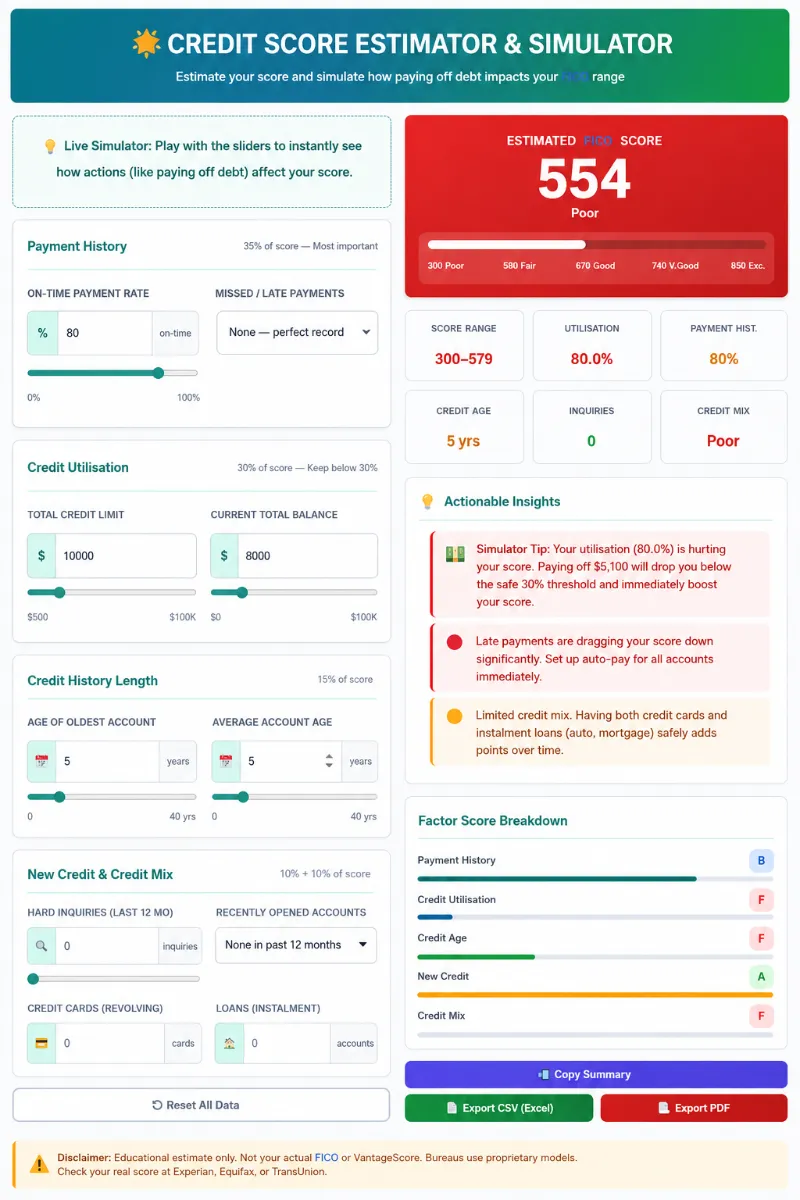
Estimate your score from the two most important factors.
How Is a Credit Score Calculated? The 5 FICO Factors
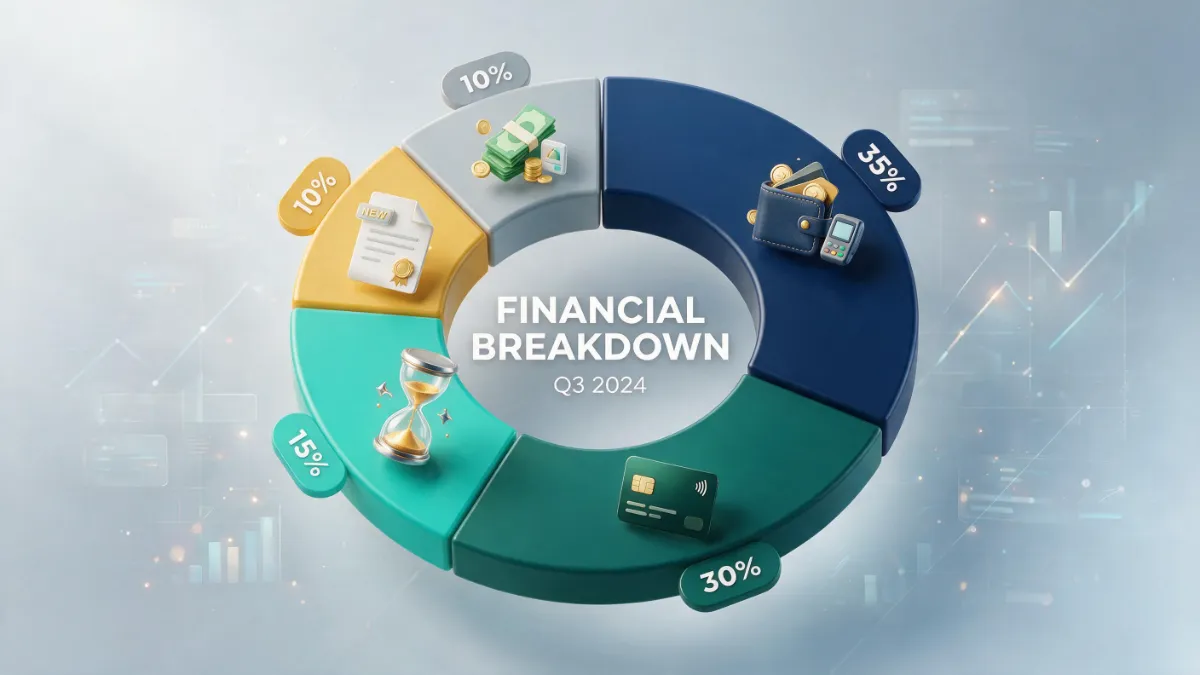
When I worked through FICO’s publicly available methodology documentation, the thing that stood out most was how concentrated the formula is. Two factors — payment history and credit utilization — control nearly two-thirds of the entire calculation. Everything else matters at the margins, but the math is heavily front-loaded toward those two habits.
The 5 FICO Score Factors — Weights and What Each Measures
| FICO Factor | Weight | What Is Actually Being Measured |
|---|---|---|
| Payment History | 35% | On-time payments, 30/60/90+ day delinquencies, charge-offs, collections, bankruptcies |
| Amounts Owed / Utilization | 30% | Credit card balances vs. limits; installment loan balances vs. original amounts |
| Length of Credit History | 15% | Age of oldest account, newest account, and average age of all accounts |
| New Credit | 10% | Hard inquiries in the last 12 months; newly opened accounts |
| Credit Mix | 10% | Balance of revolving accounts (cards, HELOCs) and installment accounts (loans, mortgages) |
Factor 1: Payment History — 35%
35% of Score
Payment History
This is the single largest factor in the FICO formula — by a wide margin. What the data shows is that FICO evaluates not just whether payments were missed, but how recently and how severely. A 30-day delinquency from two months ago creates a substantially larger score drop than a 30-day delinquency from five years ago. Severe marks like bankruptcies remain on credit reports for 7 to 10 years under the FCRA.
💡 CFPB guidance: Setting up automatic minimum payments on all active accounts prevents accidental 30-day delinquencies — which carry disproportionate score damage relative to the amount missed.
Factor 2: Amounts Owed / Credit Utilization — 30%
35% of Score
Credit Utilization
This factor surprised me when I first went through the FICO documentation, because it’s not simply about how much debt someone carries — it’s specifically about revolving credit utilization. The calculation divides total credit card balances by total available credit limits. A $900 balance on a card with a $3,000 limit equals 30% utilization. Paying that balance down to $300 drops it to 10%.
According to FICO’s published guidance, consumers in the exceptional 800+ tier consistently maintain overall utilization below 10%. The 30% threshold is the commonly cited educational benchmark for preventing significant score deductions — but lower is consistently better in the data.
💡 Key timing insight: Balances are typically reported to bureaus on the monthly statement closing date — not the payment due date. Paying down a balance before the statement closes produces a lower reported utilization for that month’s calculation, even if the balance was higher mid-cycle.
Factor 3: Length of Credit History — 15%
15% of Score
Credit History Length
FICO’s methodology tracks three data points here: the age of the oldest active account, the age of the most recently opened account, and the Average Age of Accounts (AAoA) across the entire credit file. A longer track record gives the scoring algorithm more data to evaluate financial reliability over time.
💡 CFPB guidance: Closing old credit cards — particularly no-annual-fee cards — can gradually reduce average account age once closed accounts eventually fall off the report. Keeping the oldest no-fee cards open and occasionally active generally supports this factor without any ongoing cost.
Factor 4: New Credit — 10%
10% of Score
New Credit / Hard Inquiries
This category tracks hard inquiries from formal credit applications over the preceding 12 months. What I found in FICO’s documentation is that it’s a relatively small factor overall — but it matters when multiple applications happen in a compressed timeframe, which signals potential cash-flow pressure to automated underwriting systems.
A formal inquiry is distinct from a newly opened account. The inquiry records the application event; the new account separately affects average credit age and total available credit. Both are tracked independently within this factor.
Factor 5: Credit Mix — 10%
10% of Score
Credit Mix
FICO values experience managing different types of credit over time — both revolving accounts (credit cards, HELOCs) and installment accounts (auto loans, student loans, mortgages). This is the smallest factor in the formula. The CFPB research on this is clear: consumers don’t need to open unnecessary debt or pay extra interest purely to diversify this category. It’s a supplementary factor that rewards existing diversity — it’s not a reason to take on new obligations that aren’t otherwise needed.
📊 Try the SaveXpert Credit Score Estimator
The SaveXpert Credit Score Estimator allows you to input payment history, utilization, and account mix details to see an estimated score range and identify which factors have the most room to move. Utilization changes in particular can show meaningful score movement within a single billing cycle.
Educational note: Calculator results are educational estimates only. They do not calculate official FICO Scores or guarantee any lending outcome.
FICO vs. VantageScore 4.0 — Why Your Score Looks Different Everywhere
Here’s something that confused me when I first started researching this: the number on a free credit monitoring app and the number a mortgage lender sees can differ by 20, 30, or even 50 points — and both are technically correct. They’re just measuring the same credit file with different formulas.
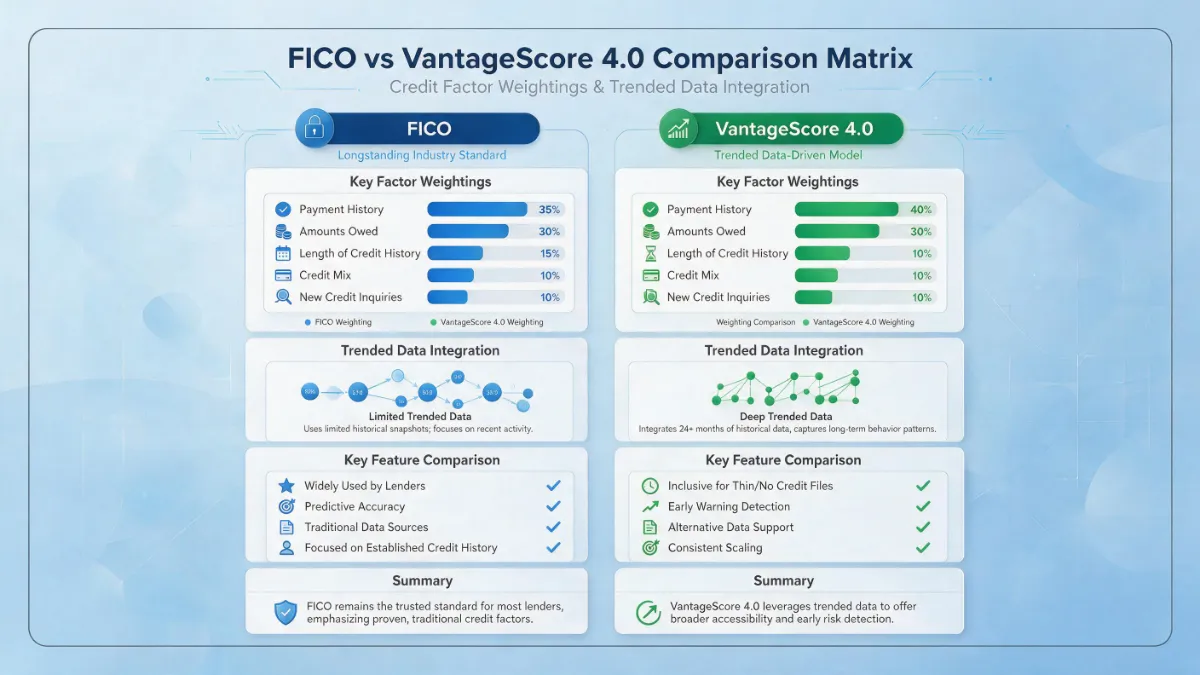
FICO and VantageScore are competing companies with distinct mathematical algorithms. Here’s what the published technical documentation shows about how they differ:
FICO Score 8 vs. VantageScore 4.0 — Key Technical Differences
| Feature | FICO Score 8 (Most Common) | VantageScore 4.0 |
|---|---|---|
| Score range | 300–850 | 300–850 |
| Payment history weight | 35% | 41% (highest-impact factor) |
| Utilization weighting | 30% (Amounts Owed) | ~20% utilization + ~6% balances + ~2% available credit |
| Minimum history to score | 6 months of history + 1 account update in the last 6 months | 1–2 months of history — scores more thin-file consumers |
| Trended data | Used in FICO 10T specialty model; not in standard FICO 8 | Built into core algorithm — reviews 24 months of balance history |
| Paid medical collections | Ignored in FICO 9 and FICO 10; factored in FICO 8 | Excluded entirely from all VantageScore 4.0 calculations |
Source: FICO published methodology; VantageScore 4.0 published technical documentation. Factor weights are approximations based on published company guidance.
What VantageScore 4.0’s Trended Data Actually Means
VantageScore 4.0 reviews up to 24 months of historical balance trajectory — not just a single monthly snapshot. What this means in practice is that the algorithm can distinguish between a transactor (someone who pays their full balance monthly) and a revolver (someone who carries a balance and pays minimums). That behavioral distinction is built directly into the score calculation in a way that the standard FICO 8 model doesn’t capture.
This matters most for consumers who have been paying down balances consistently. Under VantageScore 4.0, that positive trajectory can contribute to a higher score even before the balance actually reaches a lower threshold. Under FICO 8, only the current snapshot balance matters.
Five Reasons the Same Credit File Shows Different Numbers
Based on what the technical documentation shows, there are five structural reasons why credit score numbers vary:
1. Different scoring models.
Free apps typically display VantageScore 3.0 or 4.0, while FICO data shows that 90% of top lenders use FICO models — FICO 8, FICO Auto Score, or FICO mortgage versions.
2. Different bureau files.
Creditors may report monthly account data to only one or two of the three major bureaus. If a creditor reports to Equifax but not Experian, scores from those two bureaus will differ even under the same model.
3. Reporting timing.
Lenders send updated balances to bureaus on different days, creating timing gaps across files. A score pulled today reflects newer balance changes than one pulled two weeks ago.
4. Calculation timestamp.
Every score is a snapshot calculated at the moment of the pull — not a live continuous number.
5. Industry-specific versions.
Mortgage lenders typically use FICO versions 2, 4, or 5; auto lenders use FICO Auto Scores scaled up to 900; standard consumer apps show FICO 8. Each version weights the same data differently.
Hard vs. Soft Inquiries: What Actually Affects Your Score
This is one of the most consistently misunderstood parts of credit scoring. When I went through the CFPB’s consumer guidance on inquiries, the key finding was straightforward: soft inquiries have zero mathematical impact on credit scores under any major scoring model.
✅ Soft Inquiry
Score Impact: Zero
- Checking your own credit score or report.
- Pre-qualified or pre-approved credit offers.
- Employer background checks.
- Existing account reviews by current lenders.
Visible only to you — never to prospective lenders.
⚠ Hard Inquiry
Score Impact: Typically under 5 pts; temporary
- Formal mortgage applications.
- Auto loan applications.
- Credit card applications.
- Personal loan applications.
Visible to all lenders; affects score for 12 months; stays on report for 24 months.
The Rate-Shopping Protection Window
What FICO’s documentation specifically shows is that the scoring model accounts for rate shopping. Multiple hard inquiries for the same loan type — mortgage, auto loan, or student loan — made within a specific window are grouped into a single scoring event:
FICO Rate-Shopping Windows by Model Version
| Scoring Model | Rate-Shopping Window | Applies To |
|---|---|---|
| Newer FICO models (FICO 8, FICO 9, FICO 10) and VantageScore | 45 days | Mortgage, auto loan, student loan applications |
| Older FICO models (FICO 2, 4, 5 — used in mortgage underwriting) | 14 days | Mortgage, auto loan, student loan applications |
| Credit card applications | No protection window | Every application generates an independent hard inquiry |
Source: FICO consumer education on inquiries. The consolidation applies only to rate shopping for the same loan type. Credit card applications are always independent hard inquiries.
How to Check Your Credit Report for Free in 2026
One of the clearest things I found in the FCRA statutes is the distinction between a credit report and a credit score — and it matters practically. A credit report is the raw underlying record of all account data. A credit score is the mathematical calculation applied to that data. Verifying what the score is being calculated from is the foundation everything else builds on.
🏠 FCRA-Guaranteed Free Access in 2026
- Official portal: AnnualCreditReport.com — the only federally authorized source for free consumer credit reports.
- Weekly free access: Reports from Equifax, Experian, and TransUnion can be downloaded every week at no cost — a permanent policy change from the prior annual limit.
- Equifax 2026 additional provision: Up to six additional free Equifax reports per 12-month period are available through the end of 2026.
- Score vs. report distinction: AnnualCreditReport.com provides the report — not the score. The report is what matters for verifying accuracy and identifying errors that may be suppressing the score.
FCRA Dispute Rights: What the Law Requires
When incorrect balances, unauthorized accounts, or inaccurate delinquency marks appear on a credit file, the FCRA provides a clear resolution process. According to CFPB dispute guidance:
1. File a dispute directly with the bureau:
Equifax, Experian, or TransUnion — online, by phone, or by certified mail. Identify the specific account and the nature of the inaccuracy.
2. Notify the data furnisher:
The creditor or lender that supplied the incorrect information to the bureau.
3. The 30-day investigation window opens:
The bureau must complete its investigation within 30 days (extendable to 45 days if additional documentation is submitted during the initial period).
4. Resolution and notification:
If the disputed information cannot be verified, the bureau must correct or delete it and notify the consumer within 5 business days of completion.
One important legal clarification the CFPB research confirms: the dispute process corrects inaccurate information — it does not remove accurate, verified negative history before the statutory period expires. Late payments remain on reports for 7 years from the original delinquency date. Chapter 7 bankruptcies remain for 10 years.
How to Improve Your Credit Score — 5 Steps by Impact
What FICO’s methodology makes clear is that credit scores are not fixed characteristics — they’re calculated estimates that change as reported data changes. The five factor categories give a direct map of where to focus. These steps are ordered by the size of their potential impact based on each factor’s weight in the formula.
1. Protect Payment History
35% of Score
CFPB consumer research shows that a single 30-day late payment can drop a score significantly — far more than the dollar amount of the missed payment would suggest. Setting up automatic minimum payments on all active accounts prevents accidental delinquencies. Even if the full balance isn’t paid, the on-time minimum payment preserves the payment history record and avoids the most damaging category of score event.
2. Reduce Credit Card Utilization — Ideally Below 10%
30% of Score
This is the fastest-moving lever in the formula. Because utilization has no historical memory under standard FICO models — only the current reported balance matters — paying down a card balance can produce a score improvement as soon as the creditor reports the new lower balance, typically within 30 days of the statement closing date. Paying balances before the statement closes (not just before the due date) maximizes the reported utilization reduction for that cycle.
3. Keep Old No-Fee Cards Open and Occasionally Active
15% of Score
Closing a credit card doesn’t immediately remove it from the credit report — it stays visible for roughly 10 years for accounts in good standing. But once it eventually drops off, the average account age decreases. CFPB guidance on this is consistent: keeping the oldest no-annual-fee cards open and occasionally active on small recurring charges supports this factor over time at zero cost.
4. Audit Credit Reports Regularly for Errors
All Factors
An FTC study found that approximately one in five consumers has an error on at least one credit report that could affect their score. Downloading reports weekly from AnnualCreditReport.com surfaces incorrect balance amounts, identity errors, or outdated collection notices before they cause ongoing score damage. Removing a single significant incorrect negative mark can move a score meaningfully within a single billing cycle.
5. Structure Loan Applications Within Rate-Shopping Windows
10% of Score
Using lender pre-qualification tools — which run soft inquiries — allows rate comparisons without any score impact. When formal applications are ready, executing mortgage or auto loan shopping within the 14-to-45-day window (depending on the lender’s scoring model) means multiple hard inquiries count as a single scoring event rather than separate deductions.
“What the research shows most clearly is that two habits drive the majority of the formula: paying on time, every time — and keeping credit card balances low relative to limits. These two factors together control 65% of the FICO Score, and both are habits, not fixed characteristics.”
— Kevin Brown, Lead Researcher at SaveXpert.com
Frequently Asked Questions
Ans: According to FICO’s published data, credit monitoring platforms like Credit Karma typically display VantageScore 3.0 or 4.0 models calculated from TransUnion or Equifax data. Most major banks and mortgage lenders use FICO Score 8 or industry-specific FICO versions. Because the two companies weight credit factors differently and may pull from different bureaus, their scores frequently differ — often by 20–50 points. Neither number is wrong — they are different formulas applied to the same underlying credit file.
Ans: No. Checking your own credit score or downloading your credit reports generates a soft inquiry. According to CFPB consumer credit guidance, soft inquiries have zero mathematical impact on credit scores under any scoring model and are never visible to prospective lenders reviewing a credit history. This applies to score checks through bank apps, free monitoring services, and AnnualCreditReport.com.
Ans: A hard inquiry remains visible on Equifax, Experian, and TransUnion credit reports for 24 months. Under standard FICO scoring calculations, hard inquiries only affect the score for the first 12 months — after which they remain on the report but carry no scoring weight. Under newer FICO models and VantageScore 4.0, multiple mortgage, auto, or student loan inquiries within a 45-day window count as a single scoring event.
Ans: No. Under the Fair Credit Reporting Act (FCRA), credit bureaus are only required to remove or correct information that is inaccurate, incomplete, or unverifiable. Legitimate, verified negative marks — such as late payments or collection accounts — remain on credit files for seven years from the original date of delinquency. Chapter 7 bankruptcies remain for 10 years. The CFPB confirms: the dispute process corrects errors; it does not remove accurate history before the statutory period expires.
Ans: Paying down revolving credit card balances to reduce overall credit utilization is consistently the fastest method, based on FICO’s published factor weights. Because utilization has no historical memory under standard FICO models, scores can update as soon as the creditor reports the lower balance — typically within 30 days of the statement closing date. Paying balances before the statement closes (not just the due date) produces the lowest reported utilization for that cycle.
Ans: According to CFPB mortgage rate guidance, credit scores directly influence the interest rate a lender offers on a mortgage. Higher scores typically qualify for meaningfully lower rates, which compounds significantly over a 30-year loan — a half-point rate difference on a $300,000 mortgage can represent tens of thousands of dollars in additional interest. One important detail: most mortgage lenders use FICO versions 2, 4, or 5 — not FICO Score 8 — so the score a mortgage lender evaluates may differ from what consumer monitoring apps display.