

ⓘ Educational Disclosure:
This article is for educational and informational purposes only. It does not constitute financial, legal, tax, lending, or investment advice. SaveXpert and its authors are not licensed financial advisors, CPAs, attorneys, or tax advisors. All data comes from publicly available government and institutional sources. Always consult a qualified professional before making investment decisions.
What’s the difference between 1099 and W-2 taxes for holiday gig work? According to IRS Publication 15-A and Schedule SE, the difference is worker classification. A W-2 employee splits payroll taxes with the employer — paying 7.65% themselves while the employer covers the other 7.65%. A 1099 independent contractor pays the full 15.3% self-employment tax on 92.35% of net earnings, covering both the employee and employer shares. The 2026 Form 1099-NEC reporting threshold rose from $600 to $2,000 under the OBBBA — but that’s a paperwork change. Income below the threshold remains taxable. The classification, not the season worked and not the form received, drives the tax outcome.
Key Takeaways
- Problem: Holiday gig workers often misread the 2026 Form 1099-NEC threshold change as a tax exemption — and many don’t account for the full 15.3% self-employment tax that applies to 1099 income regardless of how short the season is.
- Solution: IRS rules are clear: worker classification — not the season, not the form received, not the dollar amount — determines the tax treatment. A 1099 worker owes 15.3% self-employment tax on 92.35% of net earnings. A W-2 worker’s employer covers half of the 15.3%.
- Result: The 2026 Form 1099-NEC threshold rose to $2,000 under the OBBBA — but that’s a reporting change, not a tax exemption. Income below the threshold is still taxable. Expense tracking and quarterly estimated payments remain the primary tools for managing 1099 holiday gig tax exposure.
- Source: IRS Schedule SE, IRS Publication 15-A
- Time To Read: 6 Minutes
Table of Contents
1. IRS Classification Comes First — Not the Season, Not the Form
2. The Rate Gap: 15.3% Self-Employment Tax vs. 7.65% Employee Share
3. The 2026 Threshold Change Doesn’t Make Gig Income Tax-Free
4. How Much Tax Can Holiday Gig Work Create?
5. Can Holiday Gig Workers Deduct Expenses?
6. The Half-SE-Tax Deduction Most 1099 Workers Miss
7. Do Holiday Gig Workers Need Estimated Tax Payments?
8. What the Research Shows Works (and What Doesn’t)
The holiday gig economy runs on delivery drivers, freelancers, and seasonal workers — people who earn extra income between October and January and then receive an unfamiliar tax form in the mail. The tax treatment starts with one IRS finding that cuts through most of the confusion: the form you receive doesn’t determine whether your income is taxable. The IRS says taxpayers must report gig income regardless of whether they received an information return.
IRS Classification Comes First — Not the Season, Not the Form
The research points to one finding before any rate or form discussion. Worker classification determines tax treatment. The IRS uses common-law rules from Publication 15-A to make that determination. Those rules examine three factors:
Behavioral control:
Does the business control how the worker does the job, not just what gets done?
Financial control :
Does the business control the economic aspects of the worker’s job, such as how they’re paid, whether expenses are reimbursed, and who provides tools?
Type of relationship:
Are there written contracts, employee benefits, permanent relationships, or work that’s a key part of the business’s regular operations?
These factors determine whether someone is an employee (W-2) or an independent contractor (1099). A holiday job that lasts three weeks doesn’t change the classification test. The IRS applies the same common-law framework regardless of how brief the engagement is.
⚠️ Misclassification has consequences for employers and workers: Calling a worker an independent contractor without meeting the classification test creates employer liability for employment taxes and penalties. Workers who are misclassified as contractors may have underpaid their taxes without knowing it. If you’re unsure about your classification, the IRS offers guidance on its website.
The Rate Gap: 15.3% Self-Employment Tax vs. 7.65% Employee Share
Once classification is established, the rate difference becomes clear.
| Worker Type | Payroll Tax Rate | How It’s Paid | Base It Applies To |
|---|---|---|---|
| W-2 employee | 7.65% (employee share) | Withheld from wages; employer pays matching 7.65% | Gross wages (up to $184,500 for Social Security portion) |
| 1099 independent contractor | 15.3% self-employment tax | Worker pays both shares via Schedule SE | 92.35% of net self-employment earnings |
Source: IRS Schedule SE · IRS Publication 15-A
Breaking down the 15.3%
The self-employment tax rate of 15.3% consists of two components. The Social Security portion is 12.4%, which applies to the first $184,500 of net self-employment earnings for 2026 — the Social Security wage base per IRS Publication 15-A. The Medicare portion is 2.9% with no wage-base cap. Workers with income above $200,000 (single) or $250,000 (married) also face an Additional Medicare Tax of 0.9% on the excess.
Schedule SE applies this calculation to 92.35% of net earnings rather than the gross amount. That 92.35% figure reflects the deductible portion of net earnings — effectively allowing for the employer-equivalent deduction before calculating the tax.
For a W-2 worker, the employer absorbs 7.65% of this payroll tax. For a 1099 worker, no employer exists to split it. Both the employee and employer shares come from the same earnings.

The 2026 Threshold Change Doesn’t Make Gig Income Tax-Free
The One Big Beautiful Bill Act (OBBBA), which became law on July 4, 2025, changed several 1099 reporting thresholds for 2026. These changes affect when a payer must issue a form — not when income becomes taxable.
| Form | Prior Threshold | 2026 Threshold | Statutory Basis | Effective Date |
|---|---|---|---|---|
| Form 1099-NEC | $600 | $2,000 | OBBBA §70433 | Payments after Dec 31, 2025 |
| Form 1099-MISC | $600 | $2,000 | OBBBA §70433 | Payments after Dec 31, 2025 |
| Form 1099-K | $5,000 (2025 phase-in) | $20,000 + 200 transactions | OBBBA §70432 | Retroactive to 2022 |
Source: IRS FAQ — 1099-K Threshold Under OBBBA · IRS — Working Families Tax Cuts: What Gig Workers Should Know
The distinction the IRS is explicit about: the threshold determines when a payer issues a form. It doesn’t determine whether the underlying income is taxable. A holiday freelancer who earns $1,800 from services rendered to a single client in 2026 will not receive a Form 1099-NEC — but every dollar of that $1,800 remains reportable and subject to self-employment tax.
⚠️ No form ≠ no tax: The IRS states clearly that taxpayers must report income regardless of receiving an information return. A worker who earns $1,800 in holiday freelance income and receives no 1099-NEC still owes income tax and self-employment tax on that amount.
Estimate your tax, effective rate, and take-home pay.
One important state-level note
Many states have not adopted the federal $2,000 threshold change. A worker who receives no federal 1099-NEC under the new threshold may still receive a state equivalent form — and still owes state income taxes on the same income. Verify your state’s specific 1099 rules with a tax professional or your state’s department of revenue.
How Much Tax Can Holiday Gig Work Create?
The research gives one number consistently: a 15.3% self-employment tax rate on 92.35% of net earnings. Working through a concrete example shows what that means in dollars.
| Scenario | Gross Gig Income | Business Expenses | Net SE Income | SE Tax Base (92.35%) | SE Tax (15.3%) |
|---|---|---|---|---|---|
| No expense tracking | $5,000 | $0 | $5,000 | $4,617.50 | ~$707 |
| With $800 tracked expenses | $5,000 | $800 | $4,200 | $3,878.70 | ~$594 |
| W-2 equivalent (employee share only) | $5,000 | n/a | n/a | $5,000 | ~$383 (7.65%) |
Illustrative calculation. Source: IRS Schedule SE
The SE tax amount is separate from federal income tax. A 1099 holiday worker owes both — the 15.3% SE tax and federal income tax at their applicable marginal rate on the same net earnings. The research brief specifically notes that the 15.3% figure covers only self-employment tax, not total tax. That’s why the Income Tax Calculator is useful for seeing both layers together.
The tips deduction for 2025–2028
For workers in tipped industries, the IRS guidance on the Working Families Tax Cuts notes a qualified tips deduction — up to $25,000 per return — available for 2025 through 2028. This deduction can reduce income subject to income tax for eligible workers in tipped occupations. It doesn’t eliminate self-employment tax on the tips, but it reduces the income tax portion for qualifying filers.
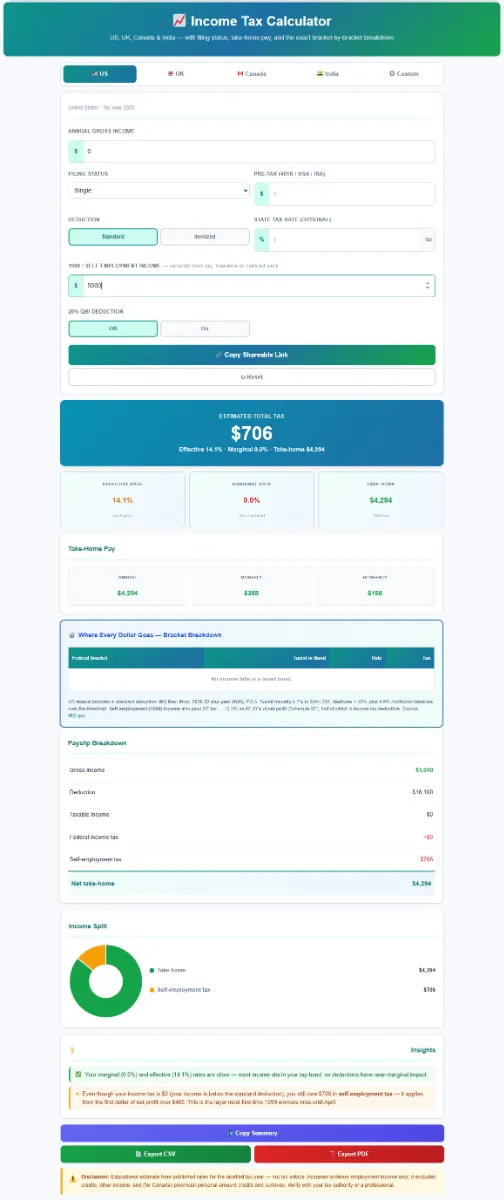
💰 Know the After-Tax Number: SaveXpert Income Tax Calculator
I ran a holiday gig scenario through the Income Tax Calculator to show the combined picture. On $5,000 of net 1099 income, the 15.3% SE tax adds roughly $706 before federal income tax is calculated. Most first-time 1099 gig workers focus on income tax and miss the SE tax layer entirely — then face an unexpected balance due in April. Running the calculator with your gig income shows both layers before they hit your return.
Educational note: This calculator models tax scenarios for informational purposes only and does not provide personalized tax advice. Source: IRS Schedule SE
Can Holiday Gig Workers Deduct Expenses?
Yes — and the research connects expense tracking directly to the SE tax calculation, not just income tax.
Schedule SE applies the 15.3% rate to 92.35% of net self-employment earnings. Net earnings means gross income minus allowable business expenses. So every dollar of tracked business expense reduces the base that Schedule SE uses — reducing SE tax, not just income tax.
| Common Expense Category | Gig Work Context | Effect on SE Tax |
|---|---|---|
| Mileage | Delivery, rideshare, client travel; 2026 standard rate from IRS | Reduces net income before SE tax calculation |
| Phone (business-use portion) | Apps, navigation, client communication | Deductible for the percentage used for business |
| Supplies and equipment | Packaging, tools, holiday delivery equipment | Ordinary and necessary business expenses |
| Platform fees | Marketplace or app fees deducted from gross payments | Reduces net income if not already reflected in the amount received |
Source: IRS Schedule SE · IRS Publication 535 (Business Expenses)
The research brief doesn’t provide a complete list of every potentially deductible expense — that depends on the specific work activity. What it does establish is the relationship: expenses reduce net income, net income is the base for the 15.3% calculation, so expense tracking has a direct multiplier effect on SE tax.
For a delivery gig worker who drives 1,000 miles in the holiday season, the 2026 standard mileage rate produces a deductible expense that reduces both income tax and SE tax. The exact dollar amounts depend on the rate in effect — verify the current standard mileage rate at IRS.gov before using it.
The Half-SE-Tax Deduction Most 1099 Workers Miss
This is a genuinely useful tax benefit that the draft’s research brief doesn’t cover — and it’s entirely built into the IRS code.
The IRS allows self-employed workers to deduct half of their self-employment tax as an above-the-line adjustment to gross income on Schedule 1 of Form 1040. This deduction doesn’t require itemizing. It reduces adjusted gross income — and therefore reduces the income tax calculation — even though it doesn’t reduce the self-employment tax itself.
Using the earlier example of $5,000 in net gig income:
SE tax = $707 (approximately). Half of $707 = $353.50. That $353.50 is deductible from gross income as an adjustment, reducing the income subject to federal income tax.
On $10,000 of net holiday gig income, the SE tax runs approximately $1,413. The deductible half is roughly $706 — reducing the taxable income figure used for the income tax calculation. The effect is modest in lower income brackets but compounds with higher earnings.
💡 Research note: This deduction is sometimes called the “employer-equivalent” deduction because it reflects the fact that a self-employed worker is paying the employer’s share of payroll taxes. The IRS built this deduction into the system to partially offset that additional cost — but claiming it requires completing Schedule 1 and Schedule SE when filing Form 1040.

Do Holiday Gig Workers Need Estimated Tax Payments?
The research addresses this directly. Quarterly estimated payments are the mechanism 1099 workers use to address the fact that no employer withholds taxes from their earnings. For holiday gig work specifically, the timing creates a particular issue.
Holiday income often concentrates in October, November, and December — entirely within Q4. The Q4 estimated tax deadline is January 15 of the following year. Workers who earn significant gig income in the holiday season and don’t make an estimated payment by January 15 may face an underpayment penalty.
| Estimated Tax Element | 2026 Figure / Rule | Source |
|---|---|---|
| 2026 underpayment penalty rate | 7% | IRS / IRC §6654 |
| Safe harbor: current-year tax | Pay ≥90% of 2026 total tax liability | IRS Tax Topic 306 |
| Safe harbor: prior-year tax | Pay 100% of 2025 total tax (110% if prior AGI >$150K) | IRS Tax Topic 306 |
| Q4 2026 payment deadline | January 15, 2027 | IRS Form 1040-ES |
| Form for underpayment calculation | Form 2210 | IRS |
Source: IRS Tax Topic 306 · IRS Estimated Taxes · IRS Form 2210
The research is also clear about an important limit. Not every holiday gig worker automatically owes quarterly payments. The $1,000 threshold — if you expect to owe less than $1,000 after withholding and credits, the quarterly payment requirement typically doesn’t apply — is the key filter. Workers who also have a W-2 job may find their regular withholding covers the estimated tax obligation on their gig income. The only way to know is to run the calculation using IRS Tax Topic 306 guidelines or Form 2210.
What the Research Shows Works (and What Doesn’t)
What the IRS rules support consistently
Establishing correct worker classification before starting a gig.
The IRS common-law test determines the tax treatment. Workers who understand their classification can plan for the right tax structure from the first payment. Employers who misclassify workers face employment tax liability and penalties.
Tracking business expenses throughout the gig season.
Every deductible expense reduces net self-employment income, which directly reduces the base for the 15.3% SE tax calculation. A $500 reduction in net income saves approximately $70.72 in SE tax alone (15.3% × 92.35% × $500). Tracking stops when the gig ends — receipts and mileage logs don’t regenerate in April.
Making a Q4 estimated tax payment by January 15.
For workers who earn most of their 1099 income during the holiday season, the Q4 estimated payment deadline is the relevant one. The 7% underpayment penalty accrues from the due date, not from April 15. The safe-harbor rules (90% of current-year or 100% of prior-year tax) provide protection even if the final tax calculation produces a higher number.
Claiming the deductible half of self-employment tax on Schedule 1.
This above-the-line deduction reduces adjusted gross income. It doesn’t require itemizing. For a first-time 1099 worker, it’s often overlooked — and it partially offsets the double tax burden that makes 1099 income more expensive than W-2 income at the same gross level.
What the data says doesn’t work
Assuming no 1099 form means no tax obligation.
The IRS is explicit: income is reportable regardless of whether an information return was issued. The 2026 $2,000 threshold change for Form 1099-NEC is a paperwork threshold, not a tax exemption. Workers who earn $800 or $1,500 in holiday gig income and receive no form still owe income tax and SE tax.
Focusing only on income tax and ignoring self-employment tax.
The 15.3% SE tax often surprises first-time 1099 workers who estimated their tax bill based on their income tax bracket alone. On $10,000 in net gig income, the SE tax produces roughly $1,413 before any income tax is calculated.
Skipping expense tracking because the gig was “only seasonal.”
Duration doesn’t change the deductibility of ordinary and necessary business expenses. A six-week holiday delivery gig produces the same types of deductible mileage and supply costs as a year-round operation. Not tracking means paying SE tax on gross income rather than net income.

Bottom Line: 5 Steps for 1099 Holiday Gig Workers
1. Identify your worker classification before the first payment arrives:
The IRS common-law test — behavioral control, financial control, type of relationship — determines whether you’re W-2 or 1099. If the gig classifies you as 1099, you’re responsible for both the employee and employer shares of payroll tax. If you’re unsure, check the IRS’s worker classification guidance at IRS.gov before assuming either classification applies.
2. Set aside for SE tax immediately — not just income tax:
The 15.3% self-employment tax on 92.35% of net earnings is typically the larger surprise. On $5,000 in net holiday gig income, that’s approximately $707 before income tax. Run your specific scenario through the Income Tax Calculator to see both layers side by side, then set aside the combined amount from each payment rather than waiting until April.
3. Track business expenses throughout the gig — not just at tax time:
Mileage, phone business-use percentage, supplies, and platform fees all reduce net self-employment income. Expenses tracked before the gig ends reduce the SE tax base. Expenses reconstructed in April are harder to document accurately and may not hold up if the IRS asks questions. A simple mileage log and a folder for receipts are sufficient for most holiday gig workers.
4. Make a Q4 estimated payment by January 15 if holiday gig income is significant:
The 2026 underpayment penalty rate is 7%, accruing from the due date. If your holiday income arrives in Q4 (September–December) and you have no W-2 withholding covering it, the January 15 estimated payment deadline applies. Use the 90% current-year or 100% prior-year safe harbor to calculate the minimum needed. IRS Tax Topic 306 and Form 1040-ES provide the framework.
5. Claim the deductible half of SE tax on Schedule 1 when filing:
The IRS allows self-employed workers to deduct half of their SE tax as an above-the-line income adjustment. It doesn’t reduce the SE tax itself, but it reduces adjusted gross income and therefore reduces the income tax calculation on the same earnings. It doesn’t require itemizing. For a first-time 1099 filer, this deduction is often missed — and it partially offsets the higher tax burden of paying both employee and employer shares.
“When I went through the IRS Schedule SE guidance and the OBBBA threshold documentation, the finding that stood out wasn’t the 15.3% rate — most workers have heard that figure. It was the threshold-change misconception. The 2026 Form 1099-NEC threshold rose from $600 to $2,000. That’s a paperwork change, not a tax exemption. A holiday worker who earns $1,800 from freelance services and receives no 1099-NEC still owes tax on every dollar. The form’s absence doesn’t change what the IRS requires you to report.”
— Kevin Brown, Lead Researcher at SaveXpert.com
Frequently Asked Questions
Ans: According to IRS Publication 15-A, the difference is worker classification — not the season or the form received. A W-2 employee has federal income tax withheld from wages and splits payroll taxes with the employer: the employee pays 7.65%, and the employer pays a matching 7.65%. A 1099 independent contractor receives gross payment without withholding and owes the full 15.3% self-employment tax on 92.35% of net earnings — covering both the employee and employer shares. A holiday job that lasts three weeks doesn’t change which classification applies.
Ans: Yes. IRS Schedule SE applies the 15.3% self-employment tax rate to 92.35% of net self-employment earnings regardless of how brief the engagement was. A holiday delivery gig that runs six weeks in November and December generates SE tax on net income the same as a year-round self-employment arrangement. The tax applies to every dollar of net earnings, not just amounts above the 1099-NEC reporting threshold.
Ans: The IRS data points to two separate obligations. First, 15.3% self-employment tax on 92.35% of net earnings — the SE tax layer. Second, federal income tax at the applicable marginal rate on the same net earnings. Both apply simultaneously. The combined effective rate depends on total income and filing status. The Income Tax Calculator can show both layers for a specific scenario. A rough starting point for planning: many 1099 workers in the 22% federal bracket set aside 25%–30% of net gig income to cover both the SE tax and income tax layers.
Ans: Yes. Independent contractors can deduct ordinary and necessary business expenses, which reduce net self-employment income. That reduction matters because Schedule SE calculates the 15.3% SE tax on net earnings — so expense deductions reduce both the SE tax and income tax simultaneously. Common deductible expenses for holiday gig work include business mileage (at the IRS standard mileage rate), the business-use portion of phone costs, supplies, and equipment. Track expenses throughout the gig, not just at tax time.
Ans: The 2026 self-employment tax rate is 15.3%, consisting of 12.4% for Social Security and 2.9% for Medicare. Per IRS Publication 15-A, the Social Security portion applies to the first $184,500 of net self-employment earnings for 2026 — the 2026 Social Security wage base. The Medicare portion has no wage base cap. Workers with income above $200,000 (single) or $250,000 (married) also owe a 0.9% Additional Medicare Tax on the excess. The 15.3% applies to 92.35% of net earnings, not gross income.
Ans: No. The OBBBA raised the Form 1099-NEC reporting threshold from $600 to $2,000 for payments made after December 31, 2025 — but this is a paperwork change, not a tax exemption. The IRS explicitly states that taxpayers must report all income regardless of whether they received an information return. A holiday gig worker who earns $1,500 and receives no Form 1099-NEC still owes income tax and self-employment tax on every dollar. The threshold determines when a payer issues a form, not when income becomes taxable.