

ⓘ Educational Disclosure:
This article is for educational and informational purposes only. It does not constitute financial, legal, tax, lending, or investment advice. SaveXpert and its authors are not licensed financial advisors, CPAs, attorneys, or tax advisors. All data comes from publicly available government and institutional sources. Always consult a qualified professional before making investment decisions.
What should be on your 2026 workplace benefits open enrollment checklist? According to IRS data for 2026 and BLS Employee Benefits Survey findings, the checklist should prioritise: (1) updating your 401(k) election against the new $24,500 limit ($35,750 for workers ages 60–63); (2) reviewing your Health FSA election against the $3,400 limit and $680 carryover cap; (3) confirming HSA-eligible plan status against the 2026 HDHP thresholds ($1,700/$3,400 minimum deductibles); and (4) comparing medical plan options rather than defaulting to last year’s coverage. The research also notes that 53% of workers with retirement plan access don’t participate, and 45% of workers with medical plan access aren’t enrolled.
Key Takeaways
- Problem: BLS data shows 72% of private industry workers have access to retirement plans — but only 53% participate. For medical plans, the gap is even wider: 72% access, 45% participation. Access isn’t the same as enrollment.
- Solution: Your 2026 open enrollment checklist should start with the updated IRS contribution limits: 401(k) up to $24,500, Health FSA up to $3,400, HSA self-only up to $4,400. If your elections haven’t been updated since last year, you’re likely leaving pre-tax capacity unused.
- Result: Reviewing and actively updating elections captures tax-advantaged capacity that doesn’t automatically carry forward when limits increase. Workers ages 60–63 have a 2026 super catch-up of $11,250 under IRS Notice 2025-67 — an amount many won’t know to claim without reviewing.
- Source: IRS 2026 Contribution Limits, BLS Employee Benefits Survey
- Time To Read: 7 Minutes
Table of Contents
1. The Access-Participation Gap the BLS Data Shows
2. 2026 Retirement Contribution Limits: What Changed
3. 2026 HSA and Health FSA Limits: What to Review
4. Dependent Care FSA: A Limit Change Worth Checking
5. Medical Plan Participation: Access Doesn’t Mean Enrolled
6. Smaller Benefit Elections That Often Get Skipped
7. Connect Benefit Elections to Your Monthly Budget
8. What the Research Shows Works (and What Doesn’t)
9. A Practical 2026 Review Timeline
Seventy-two percent of private industry workers have access to employer-sponsored retirement plans. Only 53% participate. For medical plans, the gap is wider: 72% access, 45% participation. Open enrollment is the one window each year where those gaps can close. And in 2026, it’s worth reopening the benefits portal even if you don’t usually — because the IRS raised contribution limits across 401(k), HSA, and Health FSA accounts, and old elections don’t update automatically when the ceiling moves up.
The Access-Participation Gap the BLS Data Shows
I spent time reviewing the BLS Employee Benefits Survey data behind the access and participation numbers. The gap is large — and it changes significantly by employer size and work status.
| Benefit Type | Access Rate | Participation Rate | Gap |
|---|---|---|---|
| Retirement plans (all private industry) | 72% | 53% | 19 pp |
| Medical care plans (all private industry) | 72% | 45% | 27 pp |
The employer-size breakdown
| Metric | Firms with 500+ Employees | Firms with Fewer Than 100 Employees |
|---|---|---|
| Retirement plan access | 90% | 59% |
| Retirement plan participation | 76% | 40% |
| Medical care access | 87% | 55% |
The work-status breakdown
| Metric | Full-Time Workers | Part-Time Workers |
|---|---|---|
| Retirement plan access | 81% | 47% |
| Retirement plan participation | 62% | 23% |
| Medical care access | 89% | 25% |
| Medical take-up rate (among those with access) | 67% | 44% |
Source: BLS Employee Benefits Survey
The data doesn’t explain why each individual worker makes a particular election. But the consistent pattern across all employer sizes and work statuses is that access doesn’t automatically produce participation. Open enrollment is the window where that gap can close — but only through an active decision.
2026 Retirement Contribution Limits: What Changed
The IRS announced the 2026 401(k) limit on November 13, 2025. The changes are significant enough that last year’s election may no longer represent your optimal contribution level.
| Retirement Contribution Type | 2025 Limit | 2026 Limit | Change |
|---|---|---|---|
| 401(k) elective deferral (under 50) | $23,500 | $24,500 | +$1,000 |
| 401(k) catch-up (age 50–59 and 64+) | $7,500 | $8,000 | +$500 |
| 401(k) super catch-up (ages 60–63) | $11,250 | $11,250 | Unchanged (established 2025) |
| Maximum total (ages 60–63) | Up to $34,750 | Up to $35,750 | Reflects base increase |
| Defined contribution total limit | $70,000 | $72,000 | +$2,000 |
| Annual compensation limitation | $350,000 | $360,000 | +$10,000 |
| IRA contribution limit (under 50) | $7,000 | $7,500* | +$500* |
| IRA catch-up (age 50+) | $1,000 | $1,100* | +$100* |
Source: IRS Notice 2025-67 · IRS Retirement Topics
*IRA figures as reported in the research brief — verify at IRS.gov before acting.
The SECURE 2.0 auto-enrollment detail
The research brief also notes that SECURE 2.0 requires auto-enrollment and auto-escalation for certain newer retirement plans. Plans established after December 29, 2022 must use auto-enrollment rates of 3%–10% and auto-escalation to at least 10%, beginning in 2025.
⚠️ Auto-enrollment isn’t the same as your optimal election: If your plan auto-enrolled you at 3% or 5%, that rate stayed unless you changed it. The IRS limit is $24,500 for 2026. The enrollment window is the opportunity to close the gap between what you were auto-enrolled at and what the research shows you’re permitted to contribute.
The ages 60–63 super catch-up detail
IRS Notice 2025-67 established a specific super catch-up contribution for workers ages 60 through 63 — higher than the standard catch-up available to workers age 50 and older. For 2026, workers in this age window can contribute up to $35,750 total when combining the $24,500 base limit with the $11,250 super catch-up. The research brief also notes a Roth catch-up wage threshold of $150,000 under the same IRS notice. Workers should verify eligibility with their plan administrator.

2026 HSA and Health FSA Limits: What to Review
| Account / Limit Type | 2025 | 2026 | Change |
|---|---|---|---|
| Health FSA contribution limit | $3,300 | $3,400 | +$100 |
| Health FSA maximum carryover | $660 | $680 | +$20 |
| HSA self-only coverage | $4,300 | $4,400 | +$100 |
| HSA family coverage | $8,550 | $8,750 | +$200 |
| HSA catch-up (age 55+) | $1,000 | $1,000 | Unchanged |
| HDHP minimum deductible — self-only | $1,650 | $1,700 | +$50 |
| HDHP minimum deductible — family | $3,300 | $3,400 | +$100 |
| HDHP out-of-pocket maximum — self-only | $8,300 | $8,500 | +$200 |
| HDHP out-of-pocket maximum — family | $16,600 | $17,000 | +$400 |
Source: IRS Publication 969 — HSAs and Other Tax-Favored Health Plans
The Health FSA carryover misconception
Workers don’t automatically lose every unused FSA dollar. The IRS allows up to $680 of carryover for 2026 plan years — or a plan can use a 2.5-month grace period instead. Both provide some protection against year-end forfeiture. But the carryover and grace period are employer plan choices, not universal rules — check your specific plan’s documentation to know which applies.
The carryover figure also affects how to think about the new-year election. If you’re approaching the $680 carryover limit in unused FSA funds, your 2026 election should account for that balance before adding the full new-year amount. The net available spending capacity in the first half of 2026 includes both carryover and new contributions.
Confirming HSA eligibility at enrollment
HSA contributions require enrollment in a qualifying High Deductible Health Plan (HDHP). The 2026 HDHP thresholds — minimum deductible of $1,700 (self-only) or $3,400 (family), out-of-pocket maximum of $8,500 (self-only) or $17,000 (family) — define whether a health plan qualifies. If the employer is offering a plan that meets those thresholds, the HSA contribution limit applies. The research brief doesn’t provide individual eligibility guidance; verify HSA eligibility through the employer’s plan documents and IRS Publication 969.
Dependent Care FSA: A Limit Change Worth Checking
The research brief reports a 2026 Dependent Care FSA limit of $7,500 — described as an increase from the previous $5,000 level for single filers. This would be a significant change for working parents using the account to cover eligible childcare costs like preschool or day camp for children under 13.
⚠️ Verify this with your employer and IRS.gov before electing: The research brief reports $7,500 as the 2026 Dependent Care FSA limit. The traditional limit has been $5,000 for married filing jointly / $2,500 for married filing separately. Any change in this limit should be confirmed directly in IRS Publication 503 and your employer’s enrollment materials before making this election.
Regardless of the specific limit, the Dependent Care FSA deserves a review during open enrollment for any household with qualifying childcare or elder care expenses. Contributions reduce taxable income and cover costs that would otherwise come from after-tax dollars.
Medical Plan Participation: Access Doesn’t Mean Enrolled
The BLS data gives the clearest picture of the medical coverage gap in the research. Access reached 72% for private industry workers. Participation stayed at 45%. That 27-percentage-point gap across the full private-sector workforce is larger than the retirement plan gap.
For workers who have medical coverage through a spouse or domestic partner’s employer plan, the non-participation may be intentional. For workers without alternative coverage, the research flags communication and affordability as possible explanations for the gap — but doesn’t establish which is more common.
The practical point for open enrollment isn’t explaining the aggregate gap. It’s reviewing what’s available in the employer’s specific enrollment system:
Compare plans on total cost, not just premium
The premium is visible on the enrollment screen. The out-of-pocket costs, deductibles, coinsurance, and network structure determine the total cost picture. A lower-premium plan can cost more in a year with higher utilisation.
Check network coverage for your providers.
A plan that doesn’t include your primary care physician or a specialist you use requires either a provider change or out-of-network costs — both of which affect the real cost beyond the premium.
Verify if the plan is HSA-eligible.
If the plan meets the 2026 HDHP thresholds, the HSA becomes available as a companion tax-advantaged account. That changes the total value of selecting the plan.
Enter your income and top expenses to see where you stand.
Smaller Benefit Elections That Often Get Skipped
Life insurance coverage
The research brief doesn’t contain life insurance pricing, coverage limits, or underwriting details — and so doesn’t support a specific election recommendation. What it does establish is the framework: employer plan documents show the available coverage levels, employee cost, and any evidence-of-insurability requirements for amounts above the guaranteed issue. Review those materials rather than defaulting to the minimum or skipping the election.
Disability insurance
Short-term and long-term disability insurance protect income if you’re unable to work due to illness or injury. Like life insurance, the research brief doesn’t provide plan-specific pricing. The enrollment window is the opportunity to verify what’s available and at what cost — since voluntary disability insurance outside employer plans typically carries higher premiums than employer-sponsored group rates.
Beneficiary designations
Open enrollment is also the practical time to review beneficiary designations on 401(k), life insurance, and any other accounts that transfer by designation rather than will. These don’t change automatically when life circumstances change — a divorce, a new child, or a death in the family requires an active update.
💡 Research note: The BLS data identifies communication barriers as one possible explanation for the access-participation gap. Not knowing what’s available or how it works keeps workers from using benefits they’ve already earned. Reviewing the summary plan description for each benefit during open enrollment — even briefly — closes that gap at the knowledge level.

Connect Benefit Elections to Your Monthly Budget
Here’s something the enrollment screen doesn’t show: what the combined pre-tax effect of all your elections does to your actual take-home pay. A 401(k) contribution, an HSA election, and a Health FSA election each reduce taxable income — which means they reduce withholding, increasing take-home slightly — but they also reduce the gross amount hitting your bank account.
The net effect isn’t obvious from looking at each election individually. Maxing all three for a single filer — $24,500 in 401(k), $4,400 in HSA, $3,400 in Health FSA — produces roughly $32,300 in pre-tax deductions. The tax savings from those deductions are real, but the cash-flow impact between paychecks requires its own calculation.
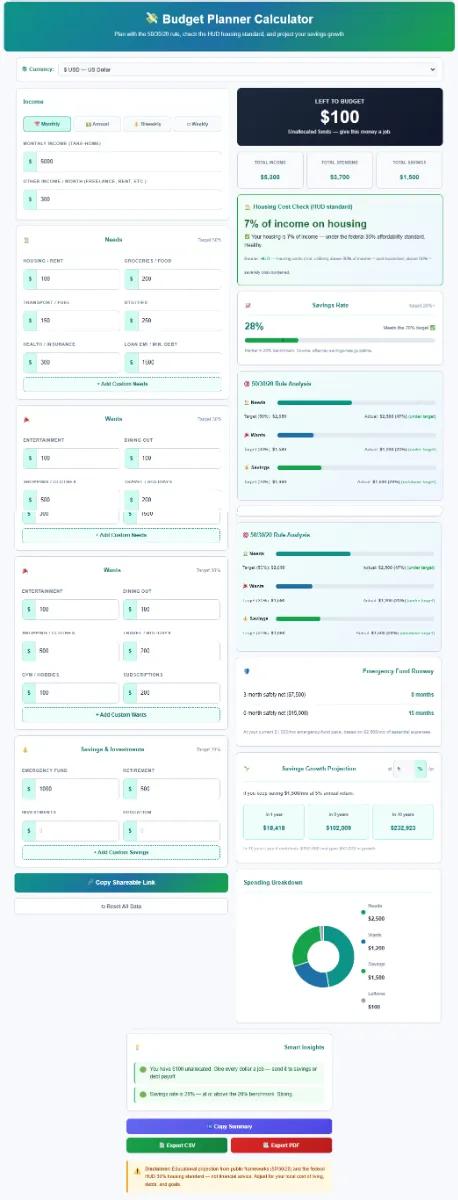
💰 Test the Cash-Flow Impact: SaveXpert Budget Planner Calculator
I ran a hypothetical open enrollment scenario through the Budget Calculator — adjusting for a combined 401(k), HSA, and Health FSA election — to see the actual monthly cash-flow effect. The exercise showed how the combination of pre-tax deductions can reduce the monthly paycheck amount while simultaneously improving tax efficiency. Before finalising elections, running your specific numbers shows how much is available for rent, bills, and discretionary spending after all benefit deductions clear.
Educational note: This calculator models budget scenarios for informational purposes only. Actual take-home pay depends on filing status, state taxes, and employer payroll deductions. Source: IRS 2026 Contribution Limits
What the Research Shows Works (and What Doesn’t)
What the IRS and BLS data consistently supports
Reviewing updated IRS limits before making elections.
The 401(k) limit rose $1,000 to $24,500. The Health FSA rose $100 to $3,400. The HSA self-only rose $100 to $4,400. Old elections don’t update automatically when limits increase — a worker whose 2025 election was calibrated to the prior limits is contributing at a now-outdated ceiling.
Actively confirming enrollment rather than relying on defaults.
For plans using SECURE 2.0 auto-enrollment, the default rate exists to produce participation — but it’s typically set at 3% to 10%, not the maximum. The enrollment window is the mechanism for moving from auto-enrollment to an intentional election.
Comparing medical plans on total cost rather than just premium.
BLS found a 27-point gap between medical access and participation. One factor the research identifies is affordability. The premium is the visible cost — but total cost, including deductibles, coinsurance, and network restrictions, determines the real annual expense. A higher-premium plan with better network coverage and lower deductibles can cost less in total in a high-utilisation year.
Verifying HSA eligibility before contributing.
HSA contributions require an HSA-qualifying HDHP. The 2026 HDHP thresholds set the bar — a plan must meet those minimums for the HSA to be available. Enrolling in an HSA through a non-qualifying plan can create an ineligible contribution issue. Verify the plan’s HDHP status in the enrollment materials before electing HSA contributions.
What the data says doesn’t work
Defaulting to last year’s elections without review.
The limits changed. The plan options may have changed. The premium costs may have changed. An enrollment decision that was optimal for 2025 isn’t automatically optimal for 2026.
Treating access as equivalent to participation.
The BLS data makes this explicit: 72% access with 53% participation means roughly 1 in 4 workers with access to retirement plans doesn’t participate. That gap isn’t corrected automatically — it requires an active enrollment decision.
Waiting until the last day to enroll.
The research doesn’t establish a universal deadline. But plan changes and late enrollment submissions can create administrative processing delays. Reviewing materials early leaves time to ask HR questions about plan terms, HDHP qualification, or HSA eligibility before the window closes.

A Practical 2026 Review Timeline
The research brief doesn’t provide a universal open enrollment deadline — that’s employer-specific. What it does establish is the timing of the key IRS changes, which defines when the information became available.
| Event | Date | Action for Workers |
|---|---|---|
| IRS 401(k) limit announcement | November 13, 2025 | Update 401(k) election in employer portal to reflect new $24,500 ceiling |
| IRS HSA and HDHP limits published | 2025 (plan-year 2026 values) | Confirm HDHP plan qualifies; update HSA election to $4,400 / $8,750 |
| IRS Health FSA limit for 2026 | Effective January 1, 2026 | Review FSA election; check carryover balance from 2025 ($680 max) |
| Employer open enrollment window | Employer-specific (check HR) | All elections due before deadline; changes typically lock for the plan year |
| Research brief completion | September 8, 2026 | Data reflects 2026 plan-year IRS values |
Source: IRS.gov · BLS Employee Benefits Survey
The most important date in that table is the employer’s own enrollment deadline. The research is clear that qualifying life events (marriage, birth of a child, loss of other coverage) generally allow mid-year changes. Outside of qualifying events, elections made — or not made — during open enrollment typically lock for the full plan year.
Bottom Line: 5 Steps Before Open Enrollment Closes
1. Pull the 2026 IRS limits and compare them against your current elections in the benefits portal:
401(k) up to $24,500 (or $35,750 for ages 60–63). Health FSA up to $3,400 with a $680 max carryover. HSA up to $4,400 self-only or $8,750 family. If your current elections match last year’s limits, you have capacity you haven’t elected. The enrollment window is the mechanism to close that gap.
2. If your plan uses SECURE 2.0 auto-enrollment, verify the auto-elected rate and change it if it’s below your intended contribution:
Plans established after December 29, 2022 must auto-enroll at 3%–10%. That rate stays unless you actively change it. Check what you’re currently contributing and whether it matches what you intend to contribute — not just what you were defaulted into.
3. Run your benefit elections through the Budget Calculator before finalising:
The combined pre-tax effect of 401(k), HSA, and FSA elections affects your monthly take-home. Knowing the post-election cash flow before the first paycheck after changes land avoids surprises. The Budget Calculator shows how all the deductions interact with monthly spending needs.
4. Compare medical plans on total cost — premium plus deductible plus out-of-pocket maximum — not just the monthly premium:
The BLS 27-point gap between medical access and participation suggests affordability is a barrier for some workers. For those who do enroll, the plan comparison that matters is total annual cost at realistic utilisation — not the lowest premium on the enrollment screen. A higher-premium HDHP may be lower total cost if the HSA contribution offsets the deductible difference.
5. Review beneficiary designations on all accounts before the enrollment window closes:
Life changes don’t automatically update beneficiary designations on 401(k) plans, life insurance policies, or HSAs. Open enrollment is the practical annual checkpoint for this. A designation that reflects a prior relationship, a deceased relative, or a household that no longer exists can create significant problems that take years to resolve — and can’t be corrected after the fact.
“When I went through the BLS employee benefits survey and the IRS 2026 limit announcements, the finding that stood out wasn’t the new contribution ceiling. It was the access-participation gap. Seventy-two percent of private industry workers had retirement plan access — and only 53% participated. For medical plans: 72% access, 45% participation. That’s not a knowledge problem alone. It’s an inertia problem. The enrollment window is the annual opportunity to fix it.”
— Kevin Brown, Lead Researcher at SaveXpert.com
Frequently Asked Questions
Ans: According to IRS and BLS data, your 2026 open enrollment checklist should cover: (1) 401(k) election updated against the new $24,500 limit — or $35,750 for ages 60–63; (2) Health FSA election reviewed against the $3,400 limit with the $680 carryover in mind; (3) HSA election confirmed against the $4,400 self-only or $8,750 family limit, and HDHP qualification verified; (4) medical plan comparison on total cost, not just premium; (5) life insurance, disability, and beneficiary designations reviewed. For any benefit not covered in the employer’s enrollment system, the employer’s plan documents are the authoritative source — the IRS limits set ceilings, but plan availability varies by employer.
Ans: The IRS raised the 2026 401(k) elective deferral limit from $23,500 to $24,500. Workers age 50 and older can add an $8,000 catch-up. Workers ages 60 through 63 qualify for a super catch-up of $11,250 under IRS Notice 2025-67, bringing their total potential contribution to $35,750. If your current election was set against last year’s lower limit, the enrollment window is the opportunity to update it. SECURE 2.0 auto-enrollment provisions — which set default rates of 3%–10% for plans established after December 29, 2022 — mean many workers are contributing below the limit without realising it.
Ans: Generally, health insurance elections are locked for the plan year once open enrollment closes. Exceptions apply when a qualifying life event occurs — marriage, the birth or adoption of a child, loss of other coverage, or certain other changes in family status typically trigger a special enrollment period. Outside those qualifying events, elections made (or not made) during open enrollment typically remain in place until the next annual enrollment window. Check your employer’s Summary Plan Description for the specific qualifying events and notice requirements that apply to your plan.
Ans: The outcome depends on your employer’s specific plan rules — there’s no universal default across all workplace benefits. For retirement plans subject to SECURE 2.0 auto-enrollment (plans established after December 29, 2022), doing nothing may keep you enrolled at the auto-enrollment rate. For Health FSAs, doing nothing typically means no new-year election — FSAs generally don’t carry forward an election without an active renewal, and you’d lose access to new-year contributions. For medical coverage, some plans auto-renew the prior year’s election; others require active re-enrollment. The safest approach is treating open enrollment as a required annual task, not an optional one.
Ans: A Dependent Care FSA is an employer-sponsored account for eligible caregiving expenses — preschool, summer day camp, and other qualifying care for children under 13 so you can work, as well as care for qualifying disabled dependents. Contributions reduce taxable income. The research brief reports the 2026 limit as $7,500 — verify this at IRS Publication 503 and your employer’s enrollment materials before electing, as the traditional limit has been $5,000 for married filing jointly and the research-reported figure should be confirmed as current IRS guidance. The account is most relevant for working parents or caregivers with qualifying expenses who can use the pre-tax treatment to reduce annual care costs.
Ans: Under IRS Notice 2025-67, workers ages 60 through 63 qualify for a super catch-up contribution of $11,250 for 2026 — higher than the standard $8,000 catch-up available to workers age 50 and older. Combined with the $24,500 base elective deferral limit, workers in the 60–63 age window can potentially contribute up to $35,750 to their 401(k) for the 2026 plan year. This super catch-up was established under SECURE 2.0 and applies specifically to the 60–63 age range. Workers should verify eligibility with their plan administrator and confirm the employer plan supports super catch-up contributions before electing this amount.