
ⓘ Educational Disclosure:
This article is for educational and informational purposes only. It does not constitute financial, legal, tax, or lending advice. SaveXpert and its authors are not licensed financial advisors. Federal student-loan rules under Public Law 119-21 are subject to final regulations and ongoing implementation guidance. Always verify current eligibility, loan type, and repayment rules at studentaid.gov or with a qualified financial-aid professional before making borrowing decisions.
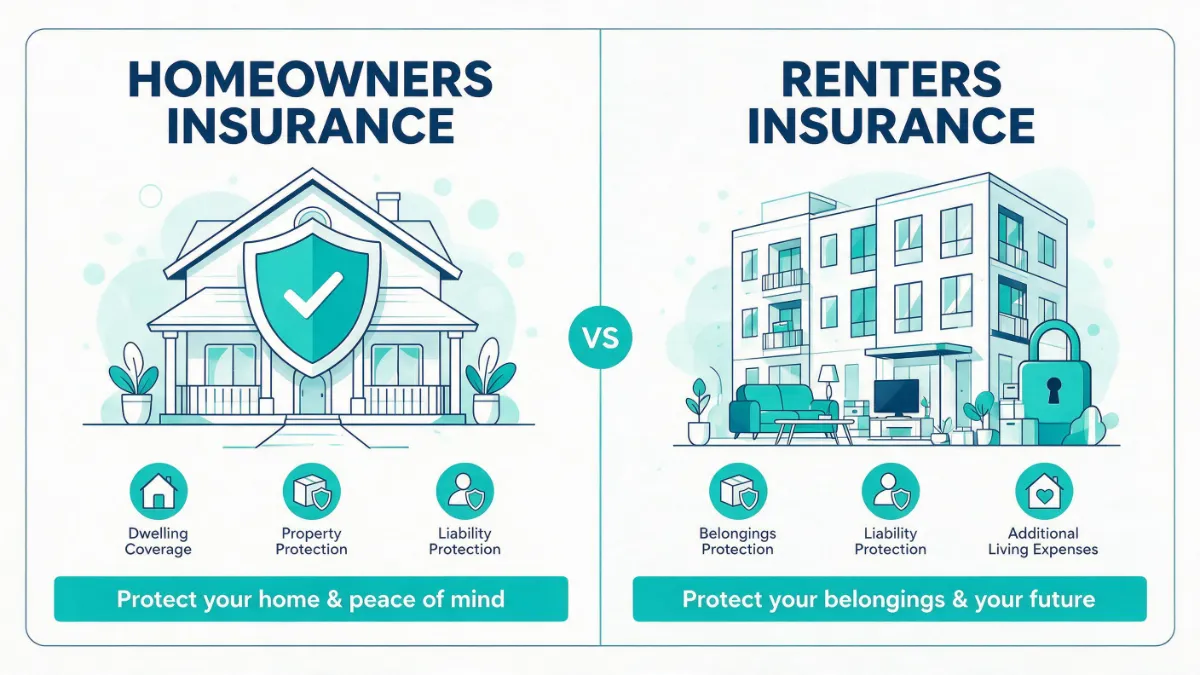
Homeowners insurance (HO-3) protects the building structure, personal belongings, and personal liability for owner-occupants. Renters insurance (HO-4) covers personal belongings, liability, and loss of use for tenants — but explicitly does not cover the physical building itself. That is the landlord’s responsibility. According to CFPB guidance on homeowners insurance, understanding what each policy type covers — and what it excludes — is essential before selecting coverage limits. Industry benchmark premiums in 2026 average approximately $13–$24 per month for renters insurance and $1,200–$1,800 annually for homeowners insurance.
Key Takeaways
- HO-3 vs. HO-4 in one sentence: HO-3 covers building + belongings + liability (homeowners). HO-4 covers belongings + loss of use + liability (renters) — the building is the landlord’s problem.
- Six core coverage sections (A–F) structure both policies. Coverages A and B (structure and other structures) exist only in HO-3. Coverages C, D, E, and F (personal property, loss of use, liability, medical payments) appear in both.
- ACV vs. RCV is a $600 decision on one TV claim: Actual Cash Value deducts depreciation — Replacement Cost Value does not. On a 5-year-old television, the same $1,200 claim produces a $100 payout under ACV and a $700 payout under RCV with a $500 deductible.
- 2026 premium benchmarks: Renters insurance averages $13–$24/month; homeowners insurance averages $1,200–$1,800+/year. The gap exists because structural rebuilding exposure is entirely absent from HO-4.
- The landlord’s policy never protects tenant belongings. A renter who assumes their landlord’s insurance covers their electronics and furniture is financially unprotected in a covered loss.
- Standard policies exclude floods and earthquakes. Separate coverage is required for both, regardless of whether the policy is HO-3 or HO-4.
- Time To Read: 8 Minutes
Table of Contents
1. HO-3 vs. HO-4: What Each Policy Covers
2. The Six Core Coverage Sections (A Through F)
3. Actual Cash Value vs. Replacement Cost Insurance: The Claim Math
4. Average 2026 Premiums: Homeowners vs. Renters Insurance
5. How Much Coverage Do You Actually Need?
Whether renting or owning, insurance protects two core things: what you own and what you could financially owe someone else. The confusion is that homeowners and renters policies share the same industry terminology while covering completely different things.
I went through CFPB consumer insurance guidance, FTC homeowners insurance resources, and the industry standard policy form structures to put this together. The defining line is clear: homeowners insurance protects the physical building alongside the owner’s belongings. Renters insurance protects the tenant’s belongings and liability — but not the building. That’s the landlord’s problem.
HO-3 vs. HO-4: What Each Policy Covers
The two policy forms that matter most for the owner-versus-renter comparison are the HO-3 Special Form and the HO-4 Renters policy. They use similar terminology. They work very differently.
🏠 HO-3 Special Form (Homeowners)
- Designed for owner-occupants.
- Dwelling insured on an open-perils basis — covered against all causes unless explicitly excluded.
- Personal property typically on a named-perils basis.
- Covers: building structure, other structures, personal property, loss of use, personal liability, medical payments.
- Required by most mortgage lenders.
🏠 HO-4 Renters Policy (Tenants)
- Designed for tenants in any rented space.
- No dwelling coverage — tenant doesn’t own the building.
- Personal property on named-perils basis.
- Covers: personal property, loss of use, personal liability, medical payments.
- Often required by lease agreements.
HO-3 vs. HO-4 — Coverage at a Glance
| Coverage Feature | HO-3 (Homeowners) | HO-4 (Renters) |
|---|---|---|
| Who it’s designed for | Owner-occupants | Tenants |
| Dwelling/building structure | Yes | No |
| Other structures (garage, fence) | Yes | No |
| Personal property (belongings) | Yes | Yes |
| Loss of use (temporary housing) | Yes | Yes |
| Personal liability | Yes | Yes |
| Medical payments to others | Yes | Yes |
The Six Core Coverage Sections (A Through F)
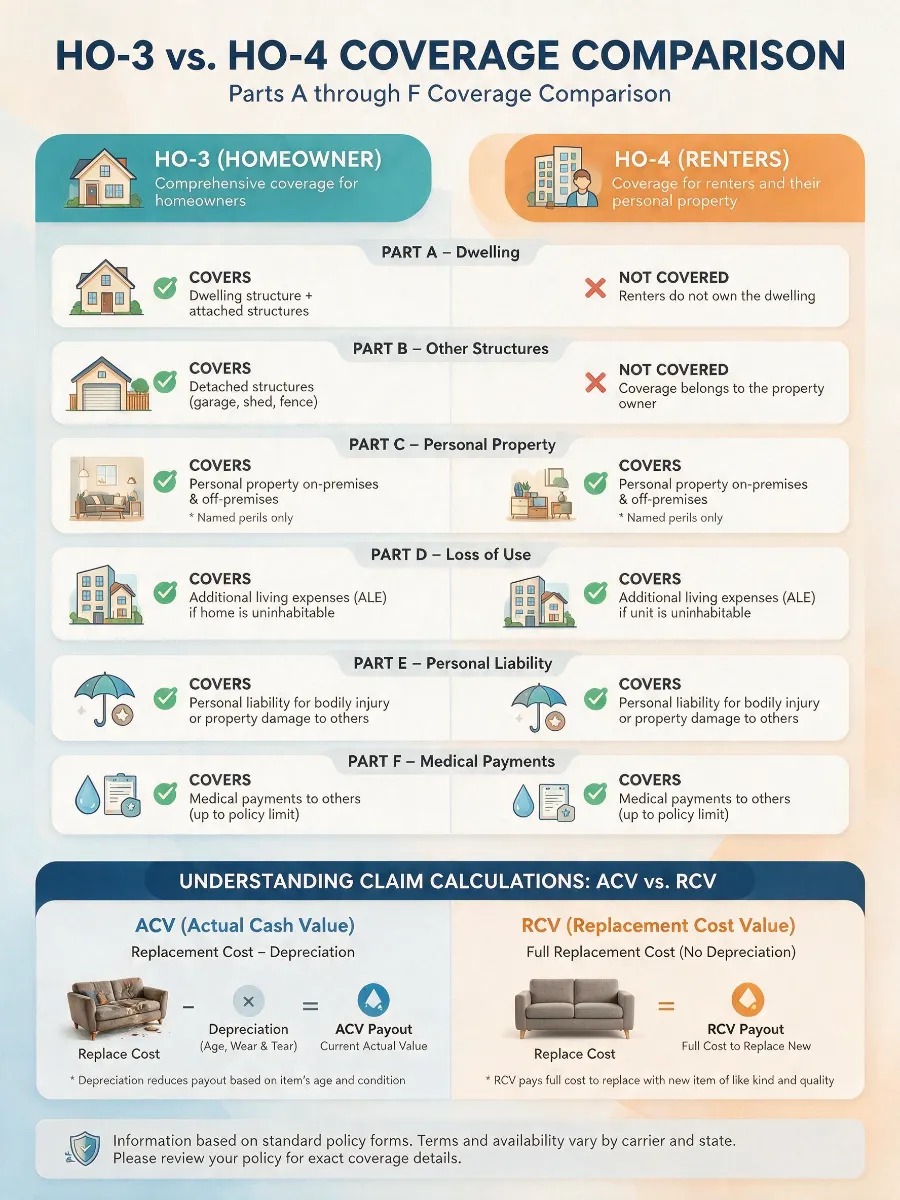
Both HO-3 and HO-4 policies are structured around six labeled coverage sections. Understanding which letters apply to which policy type clarifies the full picture faster than reading through pages of policy language.
Standard Policy Coverage Sections — HO-3 and HO-4
| Section | What It Generally Covers | HO-3 | HO-4 |
|---|---|---|---|
| A — Dwelling | Physical structure: walls, roof, built-in appliances, attached garage | Yes | No |
| B — Other Structures | Detached garage, shed, fence — typically 10% of dwelling limit | Yes | No |
| C — Personal Property | Furniture, electronics, clothing, appliances — subject to deductible and sub-limits | Yes | Yes |
| D — Loss of Use | Additional living expenses (hotel, meals) if the home becomes uninhabitable after a covered loss | Yes | Yes |
| E — Personal Liability | Financial responsibility for injuries or property damage caused to others | Yes | Yes |
| F — Medical Payments | Limited payments for guest injuries regardless of fault — typically $1,000–$5,000 | Yes | Yes |
Coverages A and B — Homeowners Only
Coverage A protects the physical structure. If a fire destroys the home, Coverage A funds the rebuild. Coverage B extends protection to detached structures — a standalone garage, a storage shed, a fence — typically set at 10% of the dwelling limit. Renters don’t need either of these because they don’t own the building. The landlord carries that exposure separately.
Coverage C — Personal Property (Both Policies)
Coverage C matters for both renters and homeowners. It covers personal belongings — furniture, electronics, clothing, and appliances — against the perils listed in the policy. Sub-limits frequently apply to high-value categories. Standard policies often cap coverage for jewelry at $1,500, firearms at $2,500, and certain electronics at specific amounts. Items exceeding those thresholds may require a separate scheduled endorsement for full protection.
One common misconception renters have: assuming the landlord’s insurance covers their belongings. It does not. The landlord’s policy insures the building. Everything inside that belongs to the tenant — electronics, furniture, clothing, jewelry — is the tenant’s financial exposure unless a separate HO-4 policy is in place.
Coverage D — Loss of Use (Both Policies)
If a covered loss makes the home uninhabitable — a fire, a burst pipe, storm damage — Coverage D pays eligible additional living expenses while repairs are completed. This includes hotel costs, restaurant meals above what would normally be spent on food, and similar displacement costs. The CFPB notes that this coverage is one of the most frequently underestimated benefits in both homeowners and renters policies.
Coverages E and F — Liability and Medical Payments (Both Policies)
Coverage E (Personal Liability) protects against financial exposure when someone is injured or suffers property damage and holds the policyholder responsible. If a guest slips and falls, if a pet bites a neighbor, if damage is accidentally caused to adjacent property — Coverage E pays up to the policy limit for defense costs and judgments. Liability limits typically run $100,000–$500,000 for homeowners and $100,000–$300,000 or more for renters.
Coverage F (Medical Payments to Others) provides a smaller, no-fault payment for guest injuries — regardless of who was at fault. It’s designed to cover minor medical costs quickly, without requiring a lawsuit, and typically ranges from $1,000 to $5,000.

Actual Cash Value vs. Replacement Cost: The Claim Math
This distinction sounds like insurance jargon. The financial difference during an actual claim is anything but abstract. The valuation method selected determines how much the insurer pays — and the gap can be substantial.
Actual Cash Value (ACV) is calculated as the cost to repair or replace damaged property minus depreciation for age, wear, and tear. Replacement Cost Value (RCV) pays the full cost to repair or replace the property with materials of like kind and quality — without subtracting depreciation first.
Here’s what that difference looks like on a single claim for a 5-year-old television:
Actual Cash Value (ACV)
$100
$1,200 replacement cost
− $600 depreciation
− $500 deductible
= $100 payout
Replacement Cost Value (RCV)
$700
$1,200 replacement cost
− $0 depreciation
− $500 deductible
= $700 payout
One claim. One television. A $600 gap between policy types. That gap grows significantly when a claim involves multiple items — a common situation in burglary, fire, or water damage events. ACV policies carry lower monthly premiums. RCV policies cost more upfront but pay out far more meaningfully when a covered loss occurs. That trade-off is worth understanding before a loss, not after.
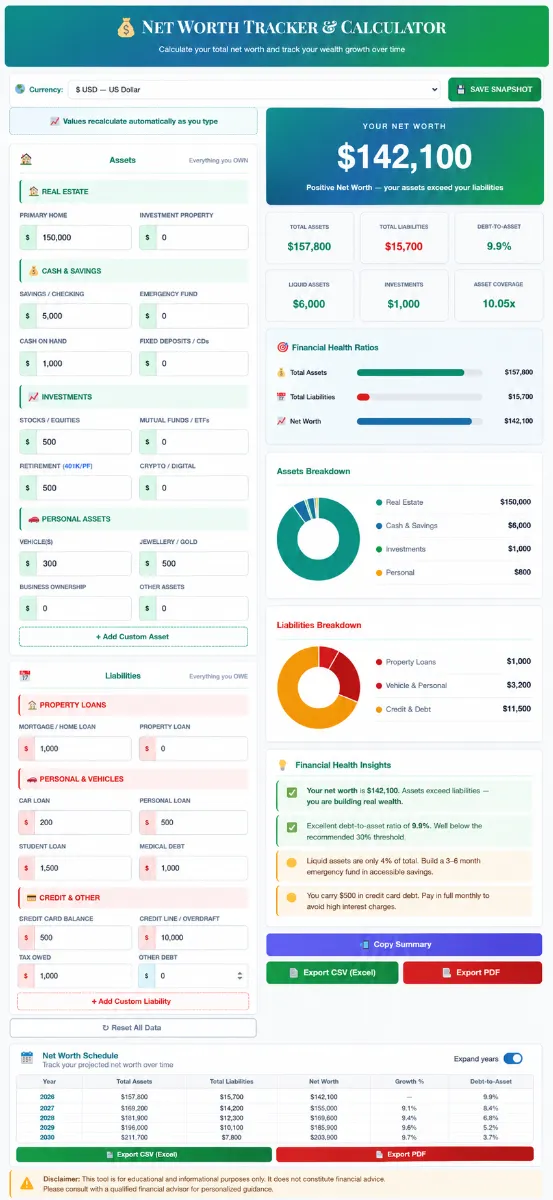
Enter your top assets and debts to see your net worth.
Average 2026 Premiums: Homeowners vs. Renters Insurance
The premium gap between HO-3 and HO-4 policies is enormous — and the reason is straightforward.
An HO-4 insurer primarily takes on the risk of a renter’s personal contents and liability. An HO-3 insurer is exposed to hundreds of thousands of dollars in potential rebuilding costs if a structural loss occurs. The building itself is what drives the price difference.
2026 Insurance Premium Benchmarks — Industry Estimates
| Insurance Type | Approx. Annual Cost | Approx. Monthly Cost |
|---|---|---|
| Renters insurance (HO-4) | $151–$288 | $13–$24 |
| Homeowners insurance (HO-3) — standard | $1,200–$1,800+ | $100–$150+ |
| Homeowners insurance — high-risk coastal or wildfire zones | $2,700–$5,000+ | $225–$415+ |
These are national industry benchmarks. Actual premiums vary materially based on location, state insurance regulations, claims history, coverage limits, deductible selection, construction type, and proximity to flood zones or wildfire risk areas. The FTC’s consumer guide to homeowners insurance recommends comparing quotes from multiple carriers and reviewing exclusions carefully.
Coastal hurricane zones and high-wildfire areas can produce homeowners premiums dramatically above national benchmarks — in some California, Florida, and Louisiana markets, standard policies have become unavailable or unaffordable through private carriers, with residents turning to state-backed insurers of last resort. Location matters more than any other single factor in homeowners premium calculation.
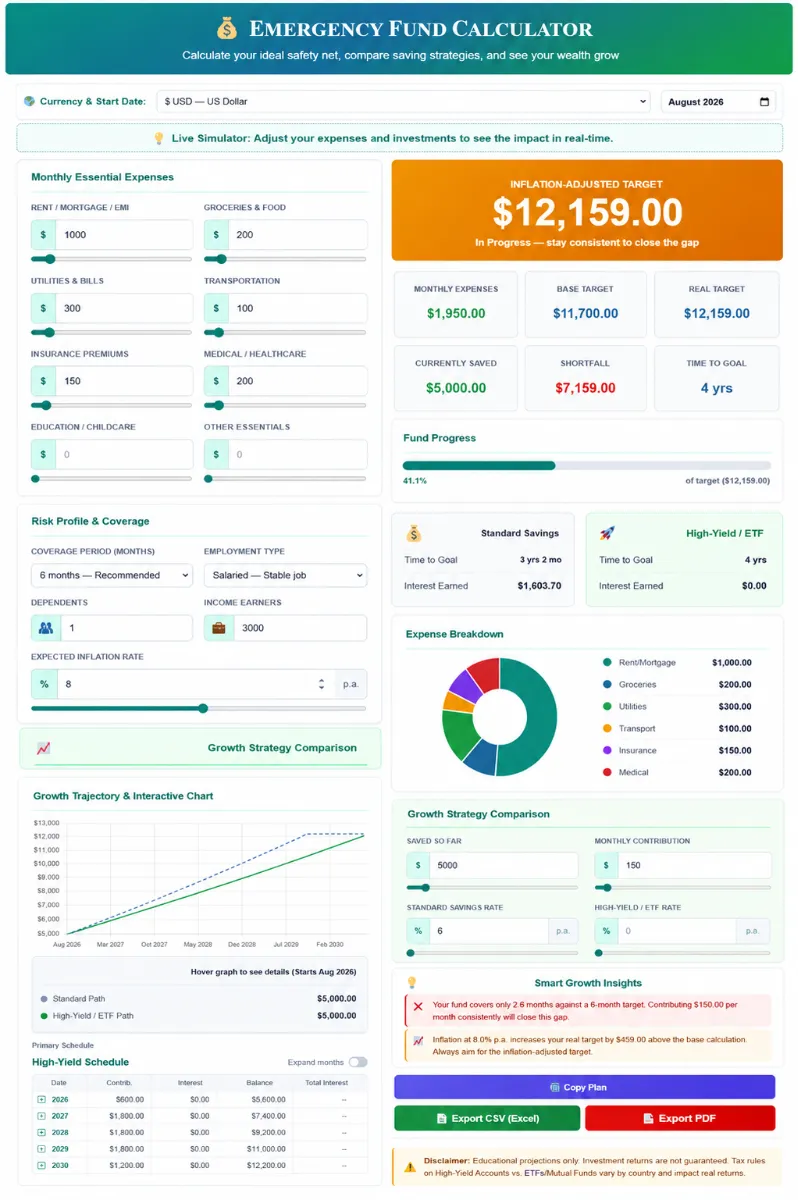
See your target safety net and how close you are.
How Much Coverage Do You Actually Need?
A low-cost policy that falls short during a major claim isn’t actually a deal. The question isn’t just what a policy costs — it’s whether the coverage limits reflect what’s genuinely at stake.
1. Create a home inventory for Coverage C.
List major belongings by category: electronics, furniture, clothing, appliances, and jewelry. Estimate the current replacement cost of each item — not the original purchase price from years ago. That total reveals the realistic Coverage C (Personal Property) limit needed, rather than guessing or defaulting to whatever the insurer suggests.
2. Check for sub-limits on high-value items.
Standard policies frequently cap coverage for specific categories: jewelry, firearms, fine art, electronics. If individual items exceed those sub-limits, scheduling additional coverage as a separate endorsement is worth exploring with the insurer. Discovering a sub-limit during a claim is significantly more costly than discovering it beforehand.
3. Choose a deductible that’s workable.
A higher deductible lowers the monthly premium but requires more out-of-pocket payment when a claim occurs. The practical test: what amount could realistically be paid from existing emergency savings without creating financial strain? The deductible only matters when it needs to be paid — often at the worst possible time.
4. Set liability limits based on total assets.
A common guideline supported by CFPB consumer resources is to carry enough liability coverage (Coverage E) to protect total personal assets — since a judgment in excess of policy limits can be collected directly from those assets. The SaveXpert Net Worth Calculator estimates total assets and liabilities, making it easier to benchmark an appropriate liability limit. (Calculator results are estimates for educational purposes only.)
💰 Try the SaveXpert Emergency Fund Calculator
A deductible only works financially if the cash to pay it is readily available. The SaveXpert Emergency Fund Calculator estimates the target cash reserve based on monthly expenses — useful for confirming there’s enough liquid savings to cover a deductible without creating a new financial problem.
Educational note: Calculator results are estimates for educational purposes only.
Do I Need Homeowners or Renters Insurance?
The answer starts with one question: do you own the property or rent it? From there, the policy type is clear — but there are a few common situations worth addressing directly.
🏠 Homeowners Insurance (HO-3) When:
- The dwelling is owner-occupied, and structural coverage is needed.
- A mortgage lender explicitly requires it as a loan condition.
- The home includes detached garages or other structures.
- The property is at risk from named perils and open-perils coverage matters.
🏠 Renters Insurance (HO-4) When:
- The property is rented — apartment, house, condo, or room.
- Coverage for personal belongings and liability is the objective.
- The landlord or lease agreement requires proof of a renters policy.
- The tenant has significant personal property worth protecting.
The most common renter misconception — and the most financially consequential one — is assuming the landlord’s insurance extends to tenant belongings. It does not. The landlord’s policy insures the building structure. Every item inside that belongs to the tenant (furniture, electronics, clothing, jewelry) is an uninsured exposure unless the tenant holds a separate HO-4 policy.
A second misconception worth addressing: that renters insurance is expensive. Industry data puts the national average well below $25 per month — a cost that’s almost always lower than the replacement value of a single electronics item the policy would protect.
“Whether you rent or own, insurance protects what you have and what you might owe someone else. The most expensive mistake is assuming the landlord’s policy covers your personal life — or that the cheapest premium will actually cover your losses when a covered event happens.”
— Kevin Brown, Lead Researcher at SaveXpert.com
Frequently Asked Questions
Ans: No. Standard homeowners (HO-3) and renters (HO-4) insurance policies generally exclude flood damage — as well as earthquake damage — under their base coverage. A separate standalone flood insurance policy is required for flood protection. This exclusion applies regardless of policy type. The CFPB recommends reviewing policy exclusions carefully to identify what is and is not covered before a loss occurs.
Ans: For most policyholders, yes. Replacement Cost Value (RCV) pays for new items of like kind and quality without subtracting depreciation. Under Actual Cash Value (ACV), depreciation is deducted first — producing the $600 gap illustrated above on a single television claim. That gap grows significantly when a loss involves multiple items. ACV policies carry lower premiums; RCV policies pay out far more meaningfully when a covered event happens. Understanding this distinction before purchasing is more valuable than learning it during a claim.
Ans: Homeowners insurance covers the physical building. If a home is destroyed by fire, the insurer faces hundreds of thousands of dollars in rebuilding costs. A renters policy only covers the tenant’s personal property — the building’s reconstruction cost remains the landlord’s financial responsibility. That structural exposure is absent from the HO-4, which is what drives the large premium gap between the two policy types. The FTC’s consumer resource on home insurance further explains what factors influence homeowners’ premium calculations.
Ans: Standard renters insurance liability limits (Coverage E) typically range from $100,000 to $300,000 as a baseline. A common guideline from CFPB consumer resources is to carry enough liability coverage to protect total personal assets — since a judgment in excess of policy limits can be collected from personal assets directly. Renters with significant personal assets, pets, or who frequently host guests may want limits toward the higher end of what’s available.
Ans: Generally, yes — with important limitations. Most HO-4 renters policies cover personal property stolen from a vehicle under Coverage C (Personal Property), subject to the policy deductible and any applicable sub-limits. The vehicle itself is not covered by renters insurance — only the tenant’s belongings inside it. High-value items stored in a vehicle that exceed policy sub-limits (such as jewelry or expensive electronics) may require a scheduled endorsement for full protection. Verifying this coverage with the specific insurer before assuming it applies is strongly recommended.
Ans: Yes, in most U.S. states. Landlords can legally require tenants to carry renters insurance as a condition of the lease — it protects both parties. The requirement shields the landlord from situations where an uninsured tenant cannot cover damage they cause to the property. If a lease requires renters insurance, failure to maintain it may constitute a lease violation. The CFPB’s tenant resources and local housing authorities can clarify what requirements are enforceable in a specific state or municipality.