

ⓘ Educational Disclosure:
This article is for educational and informational purposes only. Insurance regulations, tax treatments, and underwriting standards vary by state and insurer. SaveXpert and its authors are not licensed financial advisors or insurance professionals. This guide provides general education about life insurance structures — not individual financial, insurance, or tax advice. Always consult a licensed insurance professional and a qualified tax advisor regarding your specific circumstances.
What is the core term vs. whole life insurance difference? Term life insurance pays a death benefit only if the insured dies during a fixed period — typically 10, 20, or 30 years — and carries zero cash value. Whole life insurance provides permanent, lifelong coverage with a built-in cash-value account, at a premium cost 5x to 15x higher than an equivalent term policy. The right choice depends entirely on whether your coverage need is temporary or genuinely permanent.
Key Takeaways
- Problem: Most families pay 5x–15x more than necessary for life insurance because agents pitch whole life products when the household only needs income replacement — a temporary need that term life solves at a fraction of the cost.
- Solution: Match the policy type to your actual need — term life for temporary income-replacement during working years; whole life only for specific permanent financial obligations like estate planning or caring for special-needs dependents.
- Result: Research on the BTID (Buy Term and Invest the Difference) strategy shows that investing the annual premium savings from a term policy — roughly $6,000 a year at current 2026 market rates — can grow to approximately $567,000 over 30 years at a 7% average return.
- Source: IRS — Life insurance cash surrender tax treatment
- Time To Read: 9 Minutes
Table of Contents
1. Term vs. Whole Life Insurance: The Basics
2. The 2026 Premium Gap: Why Whole Life Costs 5x to 15x More
3. How Whole Life Cash Value Actually Works
4. Policy Loans and Early Surrender Charges
5. Buy Term and Invest the Difference (BTID) Explained
6. Who Needs Term Life Insurance?
7. Who Needs Whole Life Insurance?
7. Cash Value Life Insurance vs. Index Funds
9. Is Whole Life Insurance Worth It in 2026?
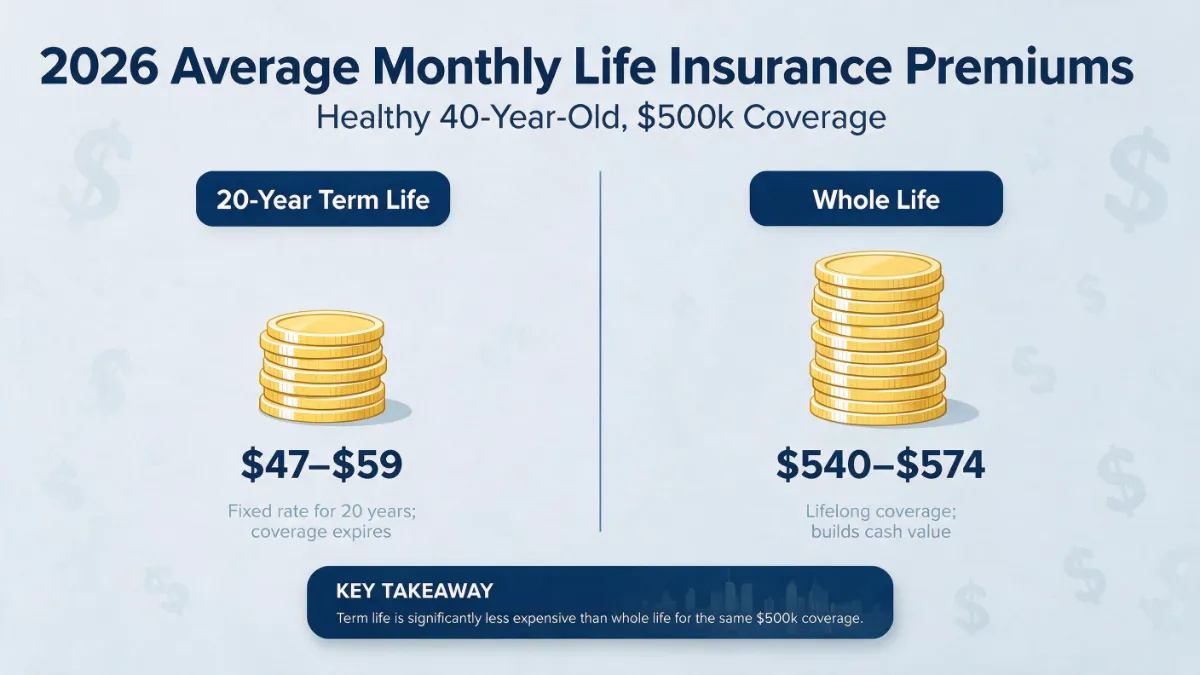
Here’s the number that changes how people think about this decision. A healthy 40-year-old woman can buy $500,000 of 20-year term coverage for around $47 a month. The same $500,000 of whole life coverage costs roughly $540 a month. That $493 monthly gap — nearly $6,000 a year — is what drives one of the most studied debates in personal finance.
I went through the IRS guidance on life insurance taxation and researched how cash value actually accumulates inside these products. The structural mechanics clarify why the price gap is so large — and why that gap is the central question for most families.
Term vs. Whole Life Insurance: The Basics
What is the difference between term and whole life insurance? Choosing life insurance is one of the largest financial commitments a household will make. The decision always comes down to two variables: duration and cost.
Term life pays a death benefit only if the insured dies during a fixed timeframe — usually 10, 20, or 30 years. It carries zero cash value. The policy simply ends when the term expires. Whole life delivers permanent, lifelong coverage alongside a built-in cash-value account. As long as you pay the premiums, the policy stays active until death.
Table 1 — Term vs. Whole Life Core Features at a Glance
| Feature | Term Life | Whole Life |
|---|---|---|
| Coverage Duration | Fixed term (10–30 years) | Permanent / lifetime |
| Death Benefit | Pays only if death occurs during the active term | Pays whenever death occurs (subject to terms) |
| Cash Value | None | Accumulates over time |
| Premium Cost | Highly affordable | 5x to 15x higher |
| Premium Structure | Level for the selected term | Level for life |
| Policy Loans | No | Yes — interest applies |
Source: SaveXpert structural comparison. Tax treatment of policy proceeds: IRS — Life insurance & disability insurance proceeds.
The 2026 Premium Gap: Why Whole Life Costs 5x to 15x More
Why is whole life insurance so much more expensive? Insurers charge roughly 10 times as much for whole life compared to an equivalent term policy. The 2026 market average for a healthy 40-year-old nonsmoker purchasing $500,000 of coverage shows this gap in hard numbers.
Table 2 — 2026 Monthly Premium Benchmarks (40-Year-Old, $500k Coverage)
| Policy Type | Women | Men | Annual Cost Range |
|---|---|---|---|
| 20-Year Term | ~$47/month | ~$59/month | ~$564–$708 |
| Whole Life | ~$540/month | ~$574/month | ~$6,480–$6,888 |
Source: 2026 industry market averages for illustrative comparison. Actual premiums vary by underwriting class, health history, and carrier. These figures represent illustrative market benchmarks — always obtain quotes directly from licensed insurers for your specific profile.
Why the Massive Markup?
The premium gap isn’t a random markup. It funds three specific structural guarantees that term life never provides:
- Permanent death benefit: The insurer knows they will eventually pay a claim. Most term policies expire without a payout because the insured outlives the term.
- Cash value accumulation: A portion of every whole life premium funds the savings component inside the policy.
- Administrative costs and commissions: Insurers bake significant agent commission payouts and ongoing administrative expenses into whole life premiums, particularly in the early years.
How Whole Life Cash Value Actually Works
How does whole life cash value accumulate? Cash value doesn’t accumulate from your full premium payment. Insurance regulators note that cash value only builds from the premium dollars remaining after the insurer deducts mortality costs and administrative fees. Your paid premiums do not equal your available cash value — especially in the early years of the policy.
Insurance agents sometimes pitch whole life as a savings or investment vehicle. It isn’t a bank account and shouldn’t be evaluated as one. Some mutual insurers pay dividends to participating whole life policyholders, but these aren’t guaranteed — and an optimistic sales illustration is not a guaranteed financial forecast.
⚠️ Important caveat: Cash value growth projections in insurance sales illustrations are often based on non-guaranteed dividend assumptions. The IRS confirms that if you surrender a whole life policy and receive more than your total premium investment, the excess is taxable income. See IRS guidance on life insurance cash surrender tax treatment.
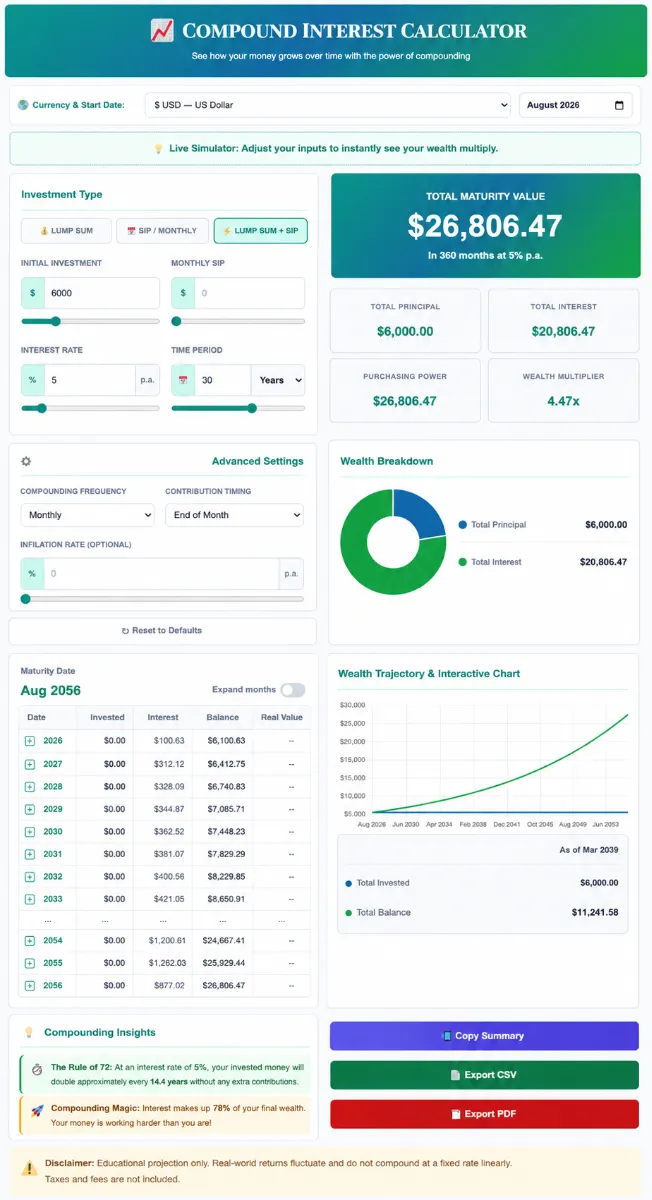
See how your money grows with the power of compounding.
Policy Loans and Early Surrender Charges
What are whole life surrender charges and policy loans? Whole life policies often carry steep surrender charges if you cancel in the early years. These fees can completely wipe out your accumulated cash value, leaving you with nothing if you walk away in the first few years of the policy.
You can borrow against a whole life policy’s cash value, but the insurer charges interest on that loan. If you die before repaying the balance, the insurer deducts the outstanding loan — plus accrued interest — directly from the death benefit your family receives.
Also, the IRS treats surrendered policy payouts as taxable income if the cash you receive exceeds the total premiums you paid in. Agents often promote “tax-free access” to cash value, but the reality includes strict limits and potential tax obligations that depend on how and when you access the funds.
💡 Research note: The IRS rule is clear: death benefits paid to a beneficiary are generally not taxable income. But surrendering a policy for cash while alive is a different transaction — if cash received exceeds your cost basis (total premiums paid minus any dividends or loans previously excluded from income), the difference is taxable. Source: IRS — Life Insurance & Disability Insurance Proceeds.

Buy Term and Invest the Difference (BTID) Explained
What is the Buy Term and Invest the Difference strategy? The BTID strategy works like this: buy the cheapest term policy that covers your income-replacement need, then take the dollars you saved on premiums and invest them systematically into the market. The data behind this approach is striking.
Using the 2026 premium data above, a 40-year-old man saves approximately $6,180 a year by choosing a 20-year term policy over a comparable whole life policy. Invested consistently at a 7% average annual return, that difference compounds substantially over time.
Table 3 — BTID 30-Year Compounding Growth Projections ($6,000/year at 7%)
| Investment Period | Total Contributions | Approximate Future Value |
|---|---|---|
| 10 Years | $60,000 | ~$83,000 |
| 20 Years | $120,000 | ~$246,000 |
| 30 Years | $180,000 | ~$567,000 |
Source: SaveXpert calculation — simplified $6,000 annual end-of-year investment, 7% average return. Investment returns fluctuate, and actual results will vary. This is a hypothetical illustration, not a guaranteed outcome.
⚠️ BTID requires discipline: This strategy only works if you actually invest the savings. Buying cheap term coverage and spending the difference on discretionary purchases completely defeats the purpose. The math above assumes consistent, monthly investing — not occasional lump sums.
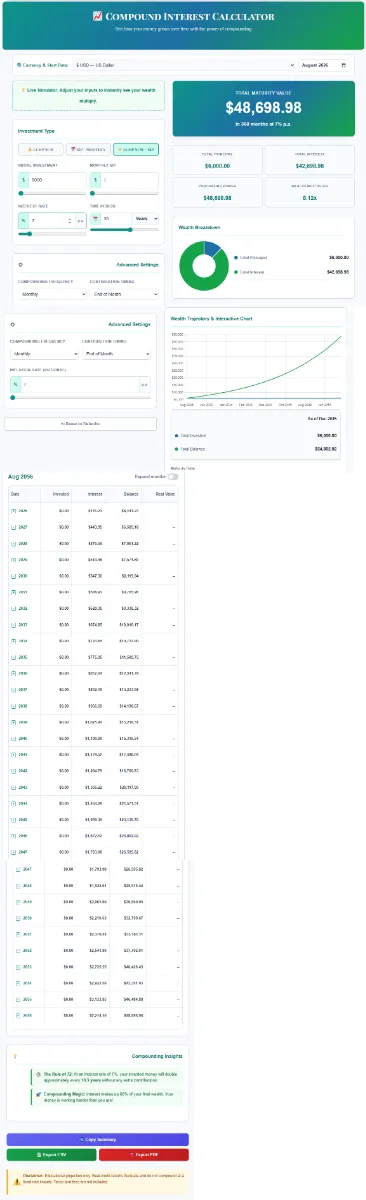
💰 Try the SaveXpert Compound Interest Calculator
I ran the $6,000 annual savings scenario through SaveXpert’s Compound Interest Calculator at 5%, 7%, and 9% return assumptions to see how much the range shifts over 30 years. The 7% base case is the commonly cited long-run stock market average — but testing the 5% pessimistic case and the 9% optimistic case shows how sensitive the outcome is to your actual return. Enter your own premium difference, time horizon, and return estimate to model your specific scenario.
Educational note: This calculator provides hypothetical illustrations only. Real-world investment returns are never guaranteed and will vary. This tool does not constitute investment or insurance advice.
Who Needs Term Life Insurance?
Who should buy term life insurance? Most working families experience temporary financial risks — not permanent ones. You need maximum death benefit coverage when your children are young, your mortgage balance is high, and your household income is the primary safety net.
Term life solves these time-limited needs precisely. A 20- or 30-year term protects your family during the years you’re building retirement assets and paying down your mortgage. Once the term expires, your children are grown, your home is paid off, and your investment accounts have compounded. The temporary need is gone.
💡 Research note: A common coverage rule of thumb: multiply your gross annual income by 10 to 12 to estimate a baseline death benefit. Adjust upward for remaining mortgage debt and future education costs. Match the term length to your longest financial obligation — if you plan to retire in 20 years, a 20-year term aligns the policy expiration with your projected financial independence date.
Who Needs Whole Life Insurance?
Who should buy whole life insurance? Whole life solves specific, permanent financial problems — not general income-replacement needs. Research on who actually benefits from whole life points to three narrow categories.
High-net-worth households use permanent policies to generate guaranteed estate liquidity — specifically, to cover inheritance taxes without forcing heirs to sell illiquid assets. Families caring for special-needs dependents use whole life to guarantee lifelong financial support after the parents pass, because the coverage need never ends. Business owners use permanent policies to fund buy-sell agreements, ensuring a surviving partner can purchase a deceased partner’s share at a predetermined price.
If none of these specific profiles fit your situation, term life is almost certainly the more cost-effective choice for your household’s income-replacement goal.
Cash Value Life Insurance vs. Index Funds
How does whole life cash value compare to investing in index funds? These two products can’t be compared using the same metrics — they serve fundamentally different purposes. But when someone is deciding how to allocate the premium difference, the cost structure of each matters.
Table 4 — Whole Life Cash Value vs. Broad-Market Index Fund
| Factor | Whole Life Cash Value | Broad-Market Index Fund |
|---|---|---|
| Primary Purpose | Insurance protection + cash value | Wealth generation and investment |
| Costs | Heavy insurance and agent commission fees | Ultra-low expense ratios and trading costs |
| Liquidity | Restricted by surrender charges and policy terms | Highly liquid in taxable brokerage accounts |
| Market Risk | Insurer guarantees baseline values | Investor assumes all market volatility |
Source: SaveXpert comparative framework. Investment cost guidance: SEC — Mutual Fund Fees and Expenses. Tax treatment of life insurance surrender: IRS.
Investing directly in low-cost index funds strips away the insurance wrapper and the associated cost layers. Whether that trade-off is worth it depends entirely on whether the buyer has a genuine permanent insurance need — or just an income-replacement need that a term policy covers at a fraction of the cost.
Is Whole Life Insurance Worth It in 2026?
Is whole life insurance worth the cost? For most working families focused on income replacement, research consistently shows whole life is not the most cost-effective product. Term provides far more death benefit per premium dollar. However, whole life holds real value for households with genuine permanent financial needs — estate liquidity, special-needs planning, or business succession.
One important caution: don’t cancel an existing whole life policy just because you read an article. Before surrendering coverage, evaluate your net surrender value after any outstanding loans, check whether you can qualify medically for a replacement term policy, and model the tax consequences using IRS guidance on cash-surrender income. Surrendering a policy that has significant gains above your premium cost basis creates a taxable event.
The Bottom Line: Your 5-Step Action Plan
How do I choose between term and whole life insurance? Here’s a research-based 5-step sequence for evaluating your coverage need and executing the right strategy:
1. Calculate your exact income-replacement need:
Multiply gross annual income by 10 to 12 as a starting point. Adjust for remaining mortgage debt, future education costs, and existing savings that would offset the need.
2. Match the term to your longest financial obligation:
If retirement is 20 years out, a 20-year term aligns the coverage window with your projected financial independence. Don’t pay for coverage you won’t need.
3. Compare quotes across multiple carriers:
Always use identical coverage parameters — same term length, same death benefit — across at least three different insurers. Pricing can vary significantly for the same underwriting profile.
4. Automate premium payments:
Link your policy directly to your checking account. A missed payment can lapse the policy instantly — destroying your family’s protection with no warning.
5. Invest the premium savings deliberately:
Calculate the monthly difference between your term premium and a whole life quote. Automate that exact amount into an index fund or retirement account every month — the BTID strategy only works through consistent execution, not intention.
The term vs. whole life decision comes down to one question: is your coverage need temporary or permanent? For most households, it’s temporary — and matching a temporary need with a permanent, high-cost product is where most insurance mistakes happen.
“When I looked at IRS guidance on cash-surrender tax treatment and how insurance regulators describe cash-value accumulation mechanics, the pattern that stood out is this: the premium markup on whole life isn’t random — it funds three specific structural guarantees. For most households with temporary income-replacement needs rather than permanent estate obligations, the research on the premium gap is consistent and striking.”
— Kevin Brown, Lead Researcher at SaveXpert.com
Frequently Asked Questions
Ans: Insurers charge 5x to 15x higher premiums for whole life because they guarantee a permanent death benefit payout — meaning they know they will eventually pay a claim. The premium also funds the built-in cash-value account and covers significant administrative fees and agent commissions, particularly in the early policy years.
Ans: When the term expires, the policy generally ends with no cash value payout. Some carriers allow annual renewal after the term, but typically at sharply higher premiums reflecting the insured’s older age. Most policyholders either let the policy lapse or purchase a new term policy if coverage is still needed.
Ans: Yes — but only from a whole life policy with accumulated cash value. The insurer charges interest on the loan. If you die before repaying the balance, the outstanding loan amount plus accrued interest is deducted directly from the death benefit paid to your beneficiaries.
Ans: Whole life serves as a functional tool for specific needs: estate planning, business buy-sell agreements, and ensuring lifelong financial support for special-needs dependents. For families simply seeking income replacement or long-term wealth accumulation, broad-market index funds generally provide significantly more growth potential at far lower cost.
Ans: BTID means buying the most affordable term policy that covers your income-replacement need, then systematically investing the annual premium savings — typically $5,000–$7,000 per year versus a comparable whole life policy — into low-cost index funds or a retirement account. The strategy’s math is compelling over long time horizons, but it requires the discipline to actually invest the savings rather than spend them.
Ans: Surrender charges are fees insurers assess if you cancel a whole life policy before a set period — often the first 10 to 15 years. During that window, these charges can equal or exceed your accumulated cash value, leaving you with little or nothing if you walk away. Also note that if the cash surrender value exceeds your total premium cost basis, the IRS treats the gain as taxable income.