

ⓘ Educational Disclosure:
This article is for educational and informational purposes only. It does not constitute financial, legal, tax, lending, or investment advice. SaveXpert and its authors are not licensed financial advisors, CPAs, attorneys, or tax advisors. All data comes from publicly available government and institutional sources. Tax treatment depends on individual holding periods, taxable income, filing status, and transaction details. State capital gains taxes are excluded from this research. Always verify figures at IRS.gov and consult a qualified tax professional before making investment or tax decisions. Always consult a qualified professional before making investment decisions.
What are the capital gains tax rates for 2026, short-term vs long-term? According to IRS Topic No. 409 and IRS Revenue Procedure 2025-32: short-term gains (assets held one year or less) are taxed at ordinary income rates of 10% to 37%. Long-term gains (assets held more than one year) are taxed at 0%, 15%, or 20%, depending on taxable income and filing status. For 2026, single filers qualify for the 0% long-term rate on taxable income up to $49,450; the 15% rate applies from $49,451 through $545,500; the 20% rate applies above $545,500. Holding exactly one year counts as short-term, not long-term, under the IRS’s general counting rule.
Key Takeaways
- Problem: Many investors don’t know whether ordinary income rates or the preferential capital-gains schedule applies to their profits — because the answer depends on one specific date calculation that’s often misunderstood.
- Solution: IRS Topic No. 409 establishes the rule precisely: assets held one year or less = short-term (ordinary income rates, 10%–37%). Assets held more than one year = long-term (0%, 15%, or 20%, based on taxable income and filing status). “Exactly one year” counts as short-term — not long-term. The IRS published the official 2026 thresholds in Revenue Procedure 2025-32 on October 9, 2025.
- Result: The holding period, taxable income, filing status, capital-loss netting, and potential 3.8% NIIT exposure all affect the final federal tax on any sale. The rates are published; the inputs are specific to each transaction.
- Source: IRS Topic No. 409 · IRS Revenue Procedure 2025-32 · IRS Publication 550
- Time To Read: 6 Minutes
Table of Contents
1. Why the 2026 Capital Gains Tax Rules Matter
2. What Are the Capital Gains Tax Rates for 2026?
3. Short-Term vs Long-Term: The Holding Period Rule
4. How Taxable Income Changes the 0%, 15%, or 20% Rate
5. Special Capital Gains Rates and the 3.8% NIIT
6. Running the Numbers: Tax Bracket Calculator Example
7. Capital Losses Also Change the Tax Picture
9. Realistic Expectations for 2026
The IRS published the 2026 capital gains tax thresholds on October 9, 2025, in Revenue Procedure 2025-32. The framework has two parts — and confusing them is one of the most common tax mistakes the research identifies. Assets held one year or less face ordinary income rates: 10% to 37%. Assets held more than one year generally face preferential rates: 0%, 15%, or 20%, depending on taxable income and filing status. The one-year boundary isn’t a rough guideline. It’s an exact classification that determines which tax schedule applies to the entire gain.
Why the 2026 Capital Gains Tax Rules Matter
I found something easy to miss while reviewing the 2026 IRS figures. The distinction between short-term and long-term treatment isn’t just about rates — it’s about which tax system applies to the gain at all. Short-term gains enter the ordinary income system. Long-term gains enter a separate, parallel federal schedule with its own brackets and thresholds.
The One Big Beautiful Bill Act (Public Law 119-21) made the individual ordinary-income rate structure permanent beginning in 2026 — removing the sunset uncertainty that previously applied to TCJA rates. The 2026 thresholds for both ordinary income and long-term capital gains were published on October 9, 2025, in IRS Revenue Procedure 2025-32. These are official, inflation-adjusted figures — not projections.
I went through IRS Topic No. 409, Revenue Procedure 2025-32, and IRS Publication 550. The same two-system structure runs through all of them: short-term or long-term classification first; then rates applied within that system based on holding period, taxable income, and filing status.

What Are the Capital Gains Tax Rates for 2026?
What Are the Capital Gains Tax Rates for 2026?
The IRS taxes short-term capital gains at the same rates as ordinary income. For 2026, those rates run from 10% to 37% under IRS Revenue Procedure 2025-32.
| Tax Rate | 2026 Single Filer Taxable Income Range (Ordinary Income) |
|---|---|
| 10% | $0 – $12,400 |
| 12% | $12,401 – $50,400 |
| 22% | $50,401 – $105,700 |
| 24% | $105,701 – $205,000 (approx.) |
| 32% | Above $205,000 to $258,800 (approx.) |
| 35% | Above $258,800 to $645,900 (approx.) |
| 37% | Above $645,900 |
⚠️ Source: Research brief based on IRS Revenue Procedure 2025-32. The lower bracket figures in the research brief ($12,400 / $50,400 / $105,700) may differ slightly from the official Rev. Proc. 2025-32 published thresholds — verify at IRS.gov before filing. All figures are federal only; state income taxes apply separately.
What Are the Capital Gains Tax Rates for 2026?
Long-term capital gains use a separate rate schedule. For 2026, IRS Revenue Procedure 2025-32 Section 4.03 establishes the following thresholds:
| Filing Status | 0% Rate (Taxable Income Up To) | 15% Rate Range | 20% Rate Begins Above |
|---|---|---|---|
| Single | $49,450 | $49,451 – $545,500 | $545,500 |
| Married Filing Jointly | $98,900 | $98,901 – $613,700 | $613,700 |
| Head of Household | $66,200 | $66,201 – $579,600 | $579,600 |
| Married Filing Separately | $49,450 | $49,451 – $306,850 | $306,850 |
| Estates and Trusts | $3,300 | $3,301 – $16,250 | $16,250 |
Source: IRS Revenue Procedure 2025-32 § 4.03 — published October 9, 2025. These are official inflation-adjusted figures.
Short-Term vs Long-Term: The Holding Period Rule
The IRS holding-period rules look simple. The exact wording matters more than most coverage suggests.
| Classification | Holding Period | Tax Treatment | IRS Source |
|---|---|---|---|
| Short-term | One year or less | Ordinary income rates (10%–37%) | IRS Topic No. 409 |
| Long-term | More than one year | 0%, 15%, or 20% depending on taxable income | |
| Counting method | Day after acquisition through disposal date | — |
Source: IRS Topic No. 409 — Capital Gains and Losses
⚠️ Exactly one year = SHORT-TERM: An asset held for exactly 365 days from the day after purchase counts as short-term under the IRS’s general holding-period rule. Long-term treatment requires more than one year — day 366 and beyond. The research brief specifically flags this as a common source of misclassification. One extra day is the difference between ordinary income rates and the preferential long-term schedule.
For example: an investor buys an asset on January 15, 2025. The day after acquisition is January 16, 2025. Long-term classification generally requires holding the asset past January 15, 2026 — to January 16, 2026 or later. Selling on exactly January 15, 2026 produces a short-term gain. The math changes the applicable tax framework, not just the rate.
How Taxable Income Changes the 0%, 15%, or 20% Rate
The 0%, 15%, and 20% long-term rates don’t apply to every long-term investor in the same way. The IRS ties those rates to taxable income and filing status — meaning the gain amount itself isn’t the only input.
Here’s the practical implication: the phrase “0% capital gains tax rate” needs context. It doesn’t mean every dollar of a long-term gain automatically faces 0% federal tax. It means qualifying long-term gains that, when added to other taxable income, keep the total below the applicable threshold face that rate. Once total taxable income (including the long-term gain) exceeds the threshold for the filing status, the portion above the threshold moves to the 15% rate.
The same logic applies at the 15% level. A single filer with taxable income between $49,451 and $545,500 doesn’t pay 15% on all income. They pay 15% on the long-term capital gain portion that falls within that range — with the ordinary income portions taxed under the separate ordinary income schedule. The two systems operate in parallel, and long-term gains “stack” on top of ordinary income for threshold-testing purposes.
Practical example — single filer at the 0% threshold
A single filer has $45,000 in taxable income from wages and a $5,000 long-term capital gain. Total taxable income = $50,000. That exceeds the $49,450 threshold for the 0% long-term rate. The first $4,450 of the long-term gain falls in the 0% bracket. The remaining $550 moves into the 15% bracket. The applicable federal long-term rate isn’t uniformly 0% or 15% for this investor — it’s split at the threshold. The Tax Bracket Calculator below models this for your specific numbers.

Find your marginal bracket, income tax, and take-home.
Running the Numbers: Tax Bracket Calculator Example
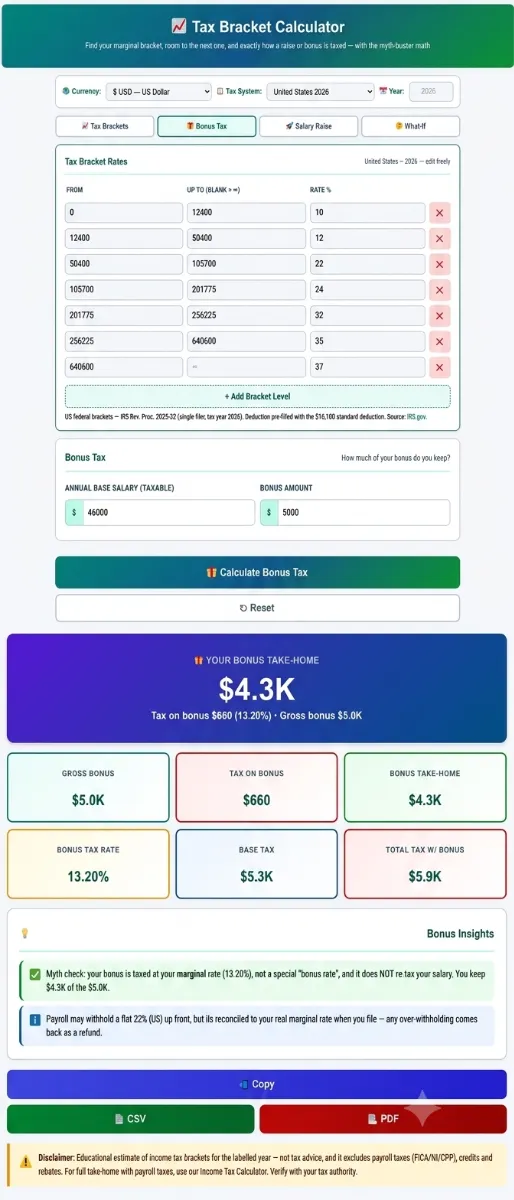
I ran an example from the research brief through SaveXpert’s Tax Bracket Calculator: a single filer with $40,000 in taxable income and a $5,000 long-term capital gain.
The combined taxable amount is $45,000. That stays below the $49,450 single-filer threshold for the 2026 0% long-term rate — meaning the $5,000 long-term gain falls entirely within the 0% bracket in this specific scenario. The capital gain produces no federal income tax on the gain itself, while the $40,000 in ordinary income is taxed under the regular 10%/12%/22% bracket schedule.
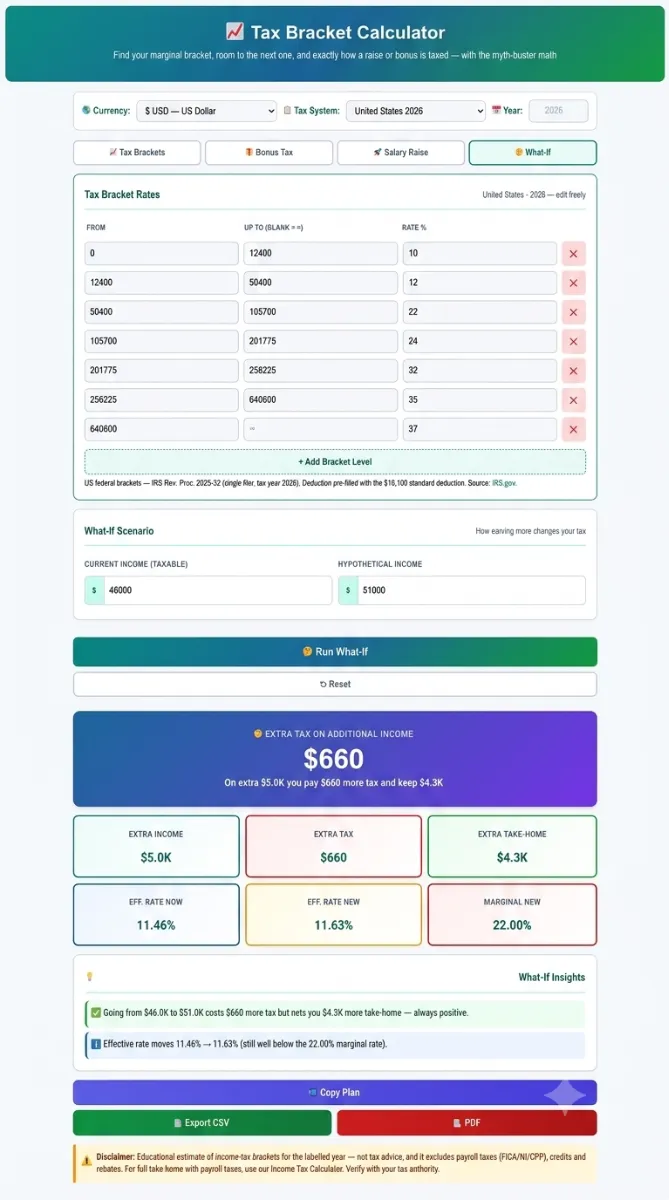
Change the scenario to $46,000 in ordinary income with the same $5,000 long-term gain ($51,000 total), and the picture shifts. Total taxable income now exceeds the $49,450 threshold. The first $3,450 of the long-term gain falls in the 0% bracket; the remaining $1,550 moves into the 15% bracket. The same $5,000 long-term gain now generates a different federal tax outcome — not because the gain amount changed, but because the income context changed.
🧮 SaveXpert Tax Bracket Calculators — Free & No Signup
The Tax Bracket Calculator identifies which bracket your taxable income falls in — and shows how a long-term capital gain interacts with the ordinary income brackets. Because short-term gains use the ordinary-income schedule while long-term gains use a separate set of thresholds, the calculator shows both marginal rate and effective rate for your specific input. The Investment Return Calculator estimates a gain or loss before applying the relevant tax treatment, giving you the gain amount to run through the Tax Bracket Calculator.
Educational note: Calculators model federal tax scenarios for informational purposes only. State taxes not included. Source: IRS Revenue Procedure 2025-32 · IRS Topic No. 409
Capital Losses Also Change the Tax Picture
Capital gains don’t exist in isolation when the IRS calculates net capital gain. The IRS nets relevant gains and losses before applying the applicable rate — and the annual loss limit against other income is a specific statutory number worth knowing.
| Capital Loss Rule | IRS Position | Source |
|---|---|---|
| Netting requirement | The IRS nets capital gains and losses before calculating net capital gain — gains aren’t calculated in isolation | IRS Topic No. 409 |
| Annual deduction against other income | Up to $3,000 per year for individuals; $1,500 for married filing separately | |
| Excess losses | Generally carry forward to later years — no expiration under current rules | |
| Common misconception | A capital loss does NOT create an unlimited deduction against wages or other ordinary income |
Source: IRS Topic No. 409
The research brief specifically identifies the unlimited-loss misconception as a problem worth naming. A $20,000 capital loss in a year when a taxpayer has $60,000 in wages doesn’t produce a $20,000 deduction against that wage income. It produces a $3,000 deduction in the current year, with the remaining $17,000 carrying forward to offset future capital gains (or produce a further $3,000 annual deduction against other income).
Reporting follows a two-step process: Form 8949 covers most sales and exchanges of capital assets; Schedule D on Form 1040 summarises the net capital gains and deductible losses. An unrealised increase in value doesn’t trigger the reporting or tax rules — the IRS focuses on the disposition event and the amount realised.
What the Research Shows Works
Accurate holding-period tracking from the day after acquisition.
The holding-period rule’s precision — “more than one year” rather than “one year or more” — means the classification turns on the exact disposal date. An investment diary or brokerage statement that tracks acquisition date and disposal date for every position is the most direct way to apply the IRS rule correctly before calculating any tax.
Matching taxable income to the correct filing-status column in the long-term table.
The 0%, 15%, and 20% rates are filing-status-specific. A married couple filing jointly has a $98,900 threshold for the 0% rate — exactly double the single-filer $49,450 threshold. Using the wrong column produces an incorrect rate calculation for the same income level.
Netting gains and losses before calculating the applicable rate.
The IRS calculates net capital gain after netting. A portfolio with both gains and losses in the same year doesn’t produce separate tax events for each — the net position determines the applicable calculation. This benefits taxpayers with losses in the same year as gains, within the statutory limits.
Checking for special-rate asset categories before applying the standard framework.
Collectibles, qualifying small-business stock, and unrecaptured §1250 gain from real property each carry rates outside the 0%/15%/20% schedule. Applying the standard long-term rates to a collectibles gain produces an understatement of the applicable federal rate.
What the research doesn’t establish:
any universal investment strategy that consistently produces better after-tax returns. The IRS rules describe how gains are classified and taxed. They don’t recommend a particular investment approach, trading method, or asset allocation. The tax framework is the same for every investor at the same income level — the investment decisions within that framework are individual.

Realistic Expectations for 2026
The 2026 thresholds are official and published — not projections. IRS Revenue Procedure 2025-32 sets the long-term capital-gains thresholds, and Public Law 119-21 locked in the permanent ordinary-income rate structure. For planning purposes, these figures will apply to the 2026 tax year filed in 2027.
The final federal tax on any sale still depends on the facts of the specific transaction: holding period, taxable income for the year, filing status, netting of all capital gains and losses for that year, and potential NIIT exposure. Two investors with the same long-term gain in the same tax bracket can face different effective rates if one has offsetting capital losses that the other doesn’t.
One important scope limitation: this research covers US federal capital gains tax only. State capital-gains tax rules vary significantly and are excluded from this article’s scope. Investors in states with income taxes — including some that tax capital gains at full ordinary income rates — need separate state-level analysis.
Bottom Line: 5 Steps to Classify and Calculate Your 2026 Capital Gain
1. Establish short-term or long-term classification before calculating anything else — and verify the exact disposal date:
Under IRS Topic No. 409, the count starts the day after acquisition and ends on the disposal date. One year or less = short-term (ordinary income rates). More than one year = long-term (0%, 15%, or 20%). Exactly 365 days from the day after purchase counts as short-term under the general rule. The classification determines which tax system applies — and the two systems can produce dramatically different federal tax outcomes on the same dollar gain.
2. Match your taxable income to the correct filing-status column in the official 2026 long-term rate table:
A single filer qualifies for the 0% rate up to $49,450 in taxable income. A married couple filing jointly qualifies up to $98,900. Using the wrong column or the wrong threshold produces an incorrect calculation. The long-term rate table in IRS Revenue Procedure 2025-32 Section 4.03 is the authoritative source. Long-term gains “stack” on top of ordinary income for threshold purposes — which is why the Tax Bracket Calculator needs your total taxable income, not just the gain amount.
3. Check whether the asset type requires a special rate before applying the standard 0%/15%/20% framework:
Collectibles (coins, art) and qualifying small-business stock under §1202 carry a maximum 28% rate. Unrecaptured §1250 gain from certain depreciated real property faces a maximum 25% rate. Both are per IRS Topic No. 409. These rates apply regardless of where the investor’s income falls within the standard long-term thresholds — they operate outside the 0%/15%/20% schedule entirely.
4. Net all capital gains and losses for the year before calculating the final rate — and know the $3,000 annual limit against other income:
The IRS calculates net capital gain after netting all gains and losses in the same year. Capital losses can reduce other income by up to $3,000 per year ($1,500 for married filing separately). Excess losses carry forward. A capital loss doesn’t create an unlimited deduction against wages or ordinary income in the same year — the research brief identifies this as a common misconception. Report through Form 8949 and Schedule D.
5. Check whether your MAGI exceeds the NIIT threshold — the 3.8% tax stacks on top of the regular capital gains rate:
Under IRS Topic No. 559 and IRS Publication 550, the 3.8% NIIT applies when MAGI exceeds $200,000 (single), $250,000 (MFJ), or $125,000 (MFS). A long-term gain in the 15% bracket with NIIT exposure faces an 18.8% effective federal rate; a gain in the 20% bracket faces 23.8%. The Tax Bracket Calculator shows the marginal bracket; verify NIIT applicability separately against your MAGI before finalising the total federal estimate.
“The detail that most changes how I read the capital gains tax rules is the difference between ‘one year or less’ and ‘more than one year.’ The IRS isn’t describing the same line twice from different angles — those are two different categories with different federal treatment. An asset held exactly 365 days from the day after purchase counts as short-term under the general holding-period rule. An asset held 366 days counts as long-term. The research brief specifically warns against treating exactly one year as an automatic long-term classification — and that distinction can shift the applicable tax rate by double digits for the same gain from the same investor in the same income bracket.”
— Kevin Brown, Lead Researcher at SaveXpert.com
Frequently Asked Questions
Ans: According to IRS Revenue Procedure 2025-32: short-term gains (assets held one year or less) are taxed at ordinary income rates of 10%–37%. Long-term gains (assets held more than one year) are taxed at 0%, 15%, or 20%, depending on taxable income and filing status. For 2026, single filers qualify for the 0% long-term rate on taxable income up to $49,450, the 15% rate from $49,451 through $545,500, and the 20% rate above $545,500. The IRS published these official figures on October 9, 2025.
Ans: The difference is the holding period and the resulting tax treatment. Short-term gains come from assets held one year or less — they’re taxed as ordinary income at the same rates as wages (10%–37%). Long-term gains come from assets held more than one year — they qualify for the preferential 0%, 15%, or 20% rates based on taxable income. The two systems are completely separate; a long-term gain doesn’t “blend” into ordinary income. Per IRS Topic No. 409, long-term gains are reported and taxed under their own rate schedule.
Ans: More than one year — not exactly one year. The IRS counting rule generally starts the day after acquisition and ends on the disposal date. An asset held for exactly one year from the day after purchase counts as short-term. Holding to one day beyond that one-year mark — day 366 from the acquisition date — generally qualifies the gain as long-term. The research brief specifically identifies this as a common source of misclassification. Per IRS Topic No. 409, “one year or less” is short-term; “more than one year” is long-term. Those are two different categories, not two phrasings of the same rule.
Ans: For 2026, under IRS Revenue Procedure 2025-32: single filers with taxable income up to $49,450 qualify for the 0% long-term rate; married couples filing jointly qualify up to $98,900. The 0% rate applies specifically to qualifying long-term gains — not short-term gains. The rate also depends on where total taxable income (including the long-term gain) falls. If a long-term gain pushes total taxable income above the threshold, only the portion below the threshold qualifies for 0%; the rest moves to 15%.
Ans: Yes. Under the Internal Revenue Code and IRS Topic No. 409, short-term capital gains receive no special tax brackets. They’re added to the taxpayer’s other ordinary income and taxed at the applicable ordinary income rate — the same rates that apply to wages, salaries, and most other earned income. For 2026, those rates run from 10% to 37% under IRS Revenue Procedure 2025-32.
Ans: The 3.8% NIIT applies on top of the regular capital gains rate when modified adjusted gross income exceeds the applicable threshold. Under IRS Publication 550 and IRS Topic No. 559, the thresholds are $200,000 for single filers, $250,000 for married filing jointly, and $125,000 for married filing separately. The NIIT applies to the lesser of net investment income or the excess of MAGI above the threshold. A long-term gain in the 15% bracket with NIIT exposure carries an 18.8% effective federal rate (15% + 3.8%); a gain in the 20% bracket carries 23.8%. The NIIT covers both short-term and long-term capital gains, as well as dividends and other investment income.