
ⓘ Educational Disclosure:
This article is for educational and informational purposes only. It does not constitute financial, legal, tax, lending, or investment advice. SaveXpert and its authors are not licensed financial advisors, CPAs, attorneys, or tax advisors. All data comes from publicly available government and institutional sources. Always consult a qualified professional before making investment decisions.
When is the Q4 2026 estimated tax deadline? The standard fourth quarter estimated tax payment deadline for the 2026 tax year is January 15, 2027. This payment covers income earned from September 1 through December 31, 2026 — a four-month period, not three. According to IRS Form 1040-ES, taxpayers who expect to owe $1,000 or more after withholding and credits must make quarterly estimated payments. An alternative exists: filing your complete 2026 tax return and paying any balance by February 1, 2027 eliminates the January 15 requirement.
Key Takeaways
- Problem: Self-employed taxpayers and those with variable income often don’t realise the Q4 estimated tax period covers four months — not three — and that the January 15 deadline is firm.
- Solution: The Q4 2026 estimated tax deadline is January 15, 2027, covering income earned September 1 through December 31. IRS safe harbor rules — paying 90% of current-year tax or 100%/110% of prior-year tax — protect against underpayment penalties.
- Result: Taxpayers who meet the deadline using a qualifying safe harbor method avoid the IRS underpayment penalty, which ran between 6% and 7% (compounded daily) during 2026.
- Source: IRS Form 1040-ES, IRS Form 2210
- Time To Read: 6 Minutes
Table of Contents
1. The Q4 2026 Estimated Tax Deadline Is January 15, 2027
2. The Full 2026 Estimated Tax Calendar — All Four Quarters
3. Who Needs to Make Estimated Tax Payments?
4. How to Calculate Your Q4 Estimated Tax Payment
5. Self-Employment Tax: The Second Calculation Many Miss
6. What Happens If You Miss the January 15 Deadline?
7. The February 1 Exception: How to Skip the January Payment Legally
8. How to Send Your Q4 Estimated Tax Payment
9. What the Research Shows Works (and What Doesn’t)
The IRS Q4 estimated tax period covers four months. Most people assume it covers three. September 1 through December 31, 2026 — that’s the income window your January 15 payment addresses. Miss it, and the underpayment penalty for 2026 ran between 6% and 7%, compounding daily. The fourth quarter estimated tax payment 2026 deadline isn’t complicated once you understand why the calendar looks the way it does.
The Q4 2026 Estimated Tax Deadline Is January 15, 2027
IRS Form 1040-ES sets the standard Q4 deadline at January 15 of the following year. For the 2026 tax year, that’s January 15, 2027. This date applies to income earned from September 1 through December 31, 2026.
January 15 falls on a Thursday in 2027 — no weekend shift or federal holiday adjustment needed. The deadline is January 15, 2027.
⚠️ The four-month Q4 period is not a mistake: The IRS estimated tax schedule deliberately creates unequal periods. Q2 covers only two months (April–May). Q4 covers four months (September–December). This means more income accrues in Q4 than in Q2 — and the January payment often ends up being the largest of the four for taxpayers with steady income throughout the year.

The Full 2026 Estimated Tax Calendar — All Four Quarters
Understanding the Q4 deadline requires seeing all four payment dates together. The periods are unequal — and the due dates don’t fall at the end of each quarter.
| Payment | Income Period Covered | Due Date | Months Covered |
|---|---|---|---|
| Q1 2026 | January 1 – March 31, 2026 | April 15, 2026 | 3 months |
| Q2 2026 | April 1 – May 31, 2026 | June 16, 2026 | 2 months |
| Q3 2026 | June 1 – August 31, 2026 | September 15, 2026 | 3 months |
| Q4 2026 | September 1 – December 31, 2026 | January 15, 2027 | 4 months |
The Q3 due date falls on September 15 rather than the last day of September. Q2 ends on May 31, but the payment isn’t due until June 16. These aren’t rounding errors — this is how the IRS designed the estimated tax schedule, and understanding it prevents both underpayments and missed deadlines.
💡 Research note: If any due date falls on a Saturday, Sunday, or federal holiday, the deadline shifts to the next business day. January 15, 2027 is a Thursday — no shift needed. Always verify the specific calendar year when planning payments.
Who Needs to Make Estimated Tax Payments?
According to the IRS Taxpayer Advocate Service and Form 1040-ES guidance, individuals generally must make quarterly estimated payments if they expect to owe $1,000 or more in federal income tax after accounting for withholding and refundable credits.
This threshold catches more people than just the fully self-employed. The following income types typically require estimated payments when they produce $1,000+ of net tax liability:
| Income Type | Why Estimated Payments Apply |
|---|---|
| Self-employment income (freelance, consulting, gig work) | No employer withholding; both income tax and self-employment tax owed |
| Side income not covered by W-2 withholding | Employer withholding on primary job may not cover additional earnings |
| Investment income (capital gains, dividends, interest) | Taxable distributions not typically subject to withholding at source |
| Rental income | Landlords generally receive no withholding on rent payments |
| Pension and retirement distributions | Withholding on distributions is optional — many recipients elect out |
| Alimony (under pre-2019 divorce agreements) | Recipient may have no withholding on alimony income |
Workers with a W-2 job who also have significant side income are a common example. The W-2 employer withholds for the primary salary — but nothing covers the side income’s tax liability. If that side income produces $1,000+ of net tax owed, estimated payments are required.
How to Calculate Your Q4 Estimated Tax Payment
The IRS provides three acceptable methods for calculating estimated tax payments. Two are safe-harbor methods — meaning they protect you from underpayment penalties even if your actual 2026 liability turns out higher. The third handles highly variable income.
| Method | How It Works | Who It Suits | Penalty Protection |
|---|---|---|---|
| 90% of current-year tax | Pay at least 90% of your total 2026 estimated tax liability through withholding and estimated payments combined | Taxpayers who can estimate 2026 income with reasonable accuracy | Yes — safe harbor |
| 100% of prior-year tax | Pay the same total as your 2025 final tax liability (from Form 1040, line 24) | Taxpayers with prior-year AGI of $150,000 or less | Yes — safe harbor |
| 110% of prior-year tax | Pay 110% of your 2025 final tax liability | High earners with prior-year AGI above $150,000 | Yes — safe harbor |
| Annualized income method (Form 2210) | Calculate actual income earned each period and pay tax on that specific amount | Highly variable or seasonal income — business with slow early quarters | Yes — if calculated correctly |
Source: IRS Form 1040-ES · IRS Form 2210 — Underpayment of Estimated Tax
The prior-year safe harbor is the simplest approach
For many taxpayers, the prior-year safe harbor is the most straightforward path. Pull up your 2025 Form 1040 and find your total tax on line 24. Divide by four — or by the remaining number of payments if you’re catching up — and pay that amount each quarter. If your prior-year AGI was $150,000 or below, paying 100% of last year’s total tax keeps you penalty-safe regardless of how your 2026 income grows.
If your prior-year AGI exceeded $150,000, the IRS requires 110% — not 100% — of your 2025 tax to qualify for safe-harbor protection. This higher threshold applies regardless of filing status.
💡 Research note: Safe harbor doesn’t mean you won’t owe additional tax in April — it means you won’t owe a penalty on any shortfall. A taxpayer who paid 100% of prior-year tax but had a much higher 2026 income will owe the difference at filing. The penalty protection is separate from the final balance owed.
Self-Employment Tax: The Second Calculation Many Miss
Self-employed taxpayers face a tax that W-2 employees don’t see directly: the self-employment (SE) tax. Employers cover half of Social Security and Medicare taxes for regular employees — but the self-employed pay both halves.
The SE tax rate is 15.3% on net self-employment income up to the Social Security wage base, plus 2.9% Medicare on income above it. For 2026, any income above $168,600 (the approximate 2026 Social Security wage base) is subject only to the 2.9% Medicare portion — not the full 15.3%.
Two important offsets apply:
Deductible half of SE tax:
The IRS allows self-employed taxpayers to deduct half of their SE tax as an above-the-line adjustment to income (Schedule 1, Part II). This reduces the income figure used to calculate federal income tax — but not the SE tax itself.
QBI deduction:
Many self-employed taxpayers may qualify for the qualified business income (QBI) deduction, which can reduce taxable income by up to 20% of net self-employment income, subject to income thresholds and trade-or-business qualifications.
⚠️ Common underpayment cause: A freelancer who estimates only income tax and forgets to include SE tax in their estimated payment typically ends up significantly underpaid. SE tax is often larger than federal income tax for lower-to-middle-income self-employed workers. Include both in every estimated payment calculation.

What Happens If You Miss the January 15 Deadline?
Missing the fourth quarter estimated tax payment deadline triggers an IRS underpayment penalty — not technically a “fine,” but a charge calculated as interest on the underpaid amount for the period it remained unpaid.
The penalty rate is set each quarter at the federal short-term interest rate plus 3 percentage points. For 2026, this produced rates fluctuating between 6% and 7%, compounding daily. If you delay the January 15 payment until April 15 when you file your return, the penalty accrues daily for those three months.
How the penalty is calculated
The IRS uses Form 2210 to calculate the underpayment penalty. The form applies the daily rate to the underpaid amount for each day the payment was late. On a $5,000 underpayment at a 7% annual rate, 90 days of daily compounding adds approximately $86 in penalty charges — relatively small in isolation, but scaling directly with the underpayment amount and delay period.
The penalty is calculated separately for each quarter. A taxpayer who underpaid Q1 but fully paid Q2, Q3, and Q4 faces a penalty only on the Q1 shortfall — the other payments don’t offset the earlier underpayment when calculating the penalty amount.
| Penalty Factor | Detail |
|---|---|
| Rate for 2026 | 6%–7% (federal short-term rate + 3 points; changes quarterly) |
| Compounding method | Daily — not monthly or annually |
| Calculated on | The shortfall amount × days late × daily rate |
| IRS form used | Form 2210 — filed with the annual return if applicable |
| Automatic waiver conditions | Total liability under $1,000; or paid ≥90% current / 100%-110% prior-year safe harbor |
Source: IRS Form 2210 · IRS Internal Revenue Bulletins (2026 quarterly rates)
Estimate your tax, effective rate, and take-home pay.
The February 1 Exception: How to Skip the January Payment Legally
This is one of the clearest and most useful findings in the IRS estimated tax research.
IRS rules specifically state that if you file your complete 2026 tax return and pay any remaining balance by February 1, 2027, you don’t need to make the January 15 estimated payment. The January 15 deadline is waived entirely when that condition is met.
For taxpayers who can project their 2026 total liability accurately and gather their documentation early, this path lets them skip a separate January payment and handle everything in one February filing. The tax owed is the same — the timing is what changes.
💡 Research note: The February 1 exception requires filing the full return — not just an extension. A taxpayer who files an extension and pays in April has not met the February 1 condition and faces the standard Q4 underpayment assessment if January 15 was missed.
How to Send Your Q4 Estimated Tax Payment
The IRS offers several payment methods — all equally valid for estimated tax payments, with different levels of convenience and confirmation.
| Payment Method | How to Access | Cost | Confirmation |
|---|---|---|---|
| IRS Direct Pay | IRS Direct Pay (bank account draft) | Free | Immediate online confirmation |
| EFTPS (Electronic Federal Tax Payment System) | eftps.gov (must enroll in advance) | Free | Immediate; allows scheduling |
| IRS2Go app | Mobile — same Direct Pay system | Free | Immediate confirmation |
| Credit or debit card | IRS-authorized payment processors (see irs.gov) | Processing fee (1.82%–1.98% typical) | Immediate confirmation from processor |
| Check or money order | Mail with Form 1040-ES voucher to IRS address for your state | Postage only | Delivery — retain USPS proof of mailing |
Source: IRS.gov — Payment Options · IRS Form 1040-ES
Checks and money orders should be made payable to “United States Treasury” — not “IRS.” Include your Social Security number, the tax year (2026), and the payment type (“1040-ES”) on the memo line. If mailing, always retain certified mail or USPS tracking as proof of submission date.
EFTPS requires advance enrollment — typically 5–7 business days for PIN delivery by mail. If you haven’t enrolled yet, start now rather than waiting until January. Direct Pay requires no prior enrollment and accepts payments up to 8 p.m. ET on the day the payment is due.
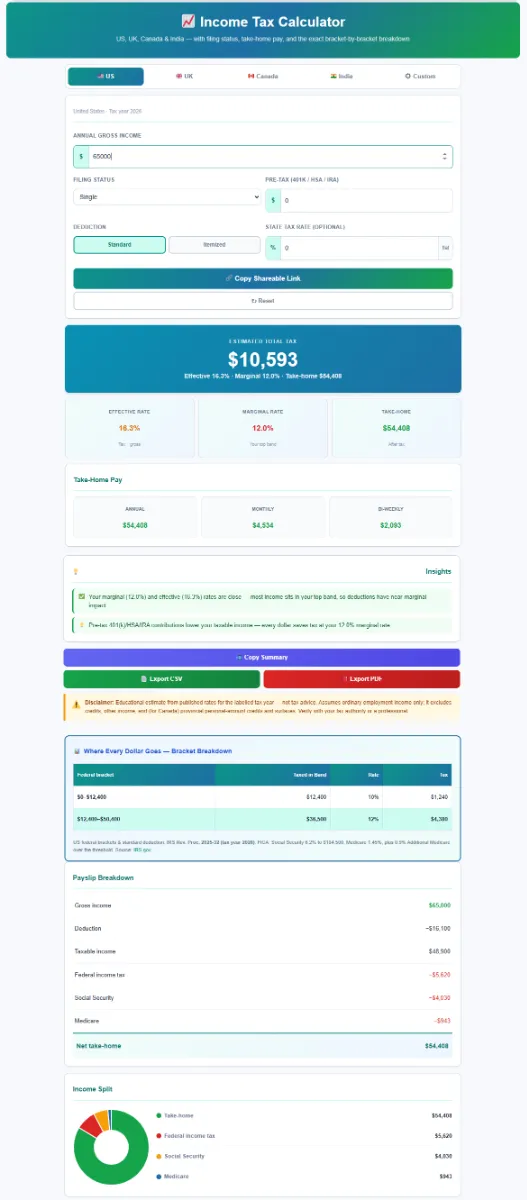
🧮 Estimate Your 2026 Tax Liability: SaveXpert Income Tax Calculator
I ran a self-employed income scenario through the Income Tax Calculator — projecting $65,000 of net self-employment income — and compared the safe-harbor approaches side by side. At a 22% marginal federal rate plus SE tax, the estimated total liability came in well above what income tax alone would suggest. Knowing your approximate bracket and likely total liability before calculating the safe-harbor amount makes the payment decision much more concrete. Put your own figures in.
Educational note: This calculator models federal income tax scenarios for informational purposes only and does not provide personalized tax advice. Source: IRS Form 1040-ES
What the Research Shows Works (and What Doesn’t)
What the IRS data consistently supports
Choosing one safe-harbor method and applying it consistently through all four quarters.
The prior-year safe harbor (100% or 110% depending on AGI) is the most straightforward: pull the prior year’s total tax, divide by four, pay that amount each quarter. You may owe more in April — but you won’t owe a penalty. The current-year 90% method requires more estimation but can reduce overpayment if income falls below prior-year levels.
Separating self-employment tax from federal income tax in the calculation.
The SE tax adds 15.3% on the first ~$168,600 of net self-employment income — on top of income tax. Taxpayers who calculate only income tax routinely underpay and face penalties. Every estimated tax worksheet for self-employed workers needs to include both.
Using IRS Direct Pay or EFTPS and retaining the confirmation number.
Electronic payments create an immediate timestamped record. If there’s ever a question about whether a payment was received on time, a Direct Pay or EFTPS confirmation number resolves it instantly. A mailed check without tracking creates avoidable uncertainty.
What the data says doesn’t work
Assuming a projected refund eliminates estimated payment requirements.
Expecting a refund at year-end doesn’t waive the quarterly payment obligation if the IRS calculates that you owed more than safe-harbor thresholds at any earlier point in the year. Form 2210 applies the penalty quarterly — not just at filing. A refund expected in April doesn’t retroactively eliminate an underpayment that accrued in June.
Skipping Q4 with the plan to catch up at April filing without using the February 1 option.
Delaying Q4 from January 15 to April 15 means 90 days of daily compounding penalty on the underpaid amount. The February 1 exception is the one clean way to legally skip the January payment — but it requires filing the complete return, not an extension.
Treating all four quarters as equal.
Q4 covers four months of income. A flat even-quarters approach can lead to underpayment in Q4 specifically — the largest income-period quarter — even when Q1, Q2, and Q3 were sufficient for their shorter periods.

Bottom Line: 5 Steps Before January 15, 2027
1. Mark the date — January 15, 2027 — or decide on the February 1 alternative now:
The Q4 deadline is January 15. If you can file your complete return and pay any balance by February 1, you can skip the January 15 payment entirely. Decide which path you’re taking before mid-December so you’re not scrambling in January.
2. Pick your safe-harbor method and calculate the Q4 amount:
If your 2025 AGI was $150,000 or below, paying 100% of last year’s total tax (divided evenly across four payments) qualifies. Above $150,000, use 110%. Alternatively, estimate 90% of your projected 2026 total liability and apply that. Either method protects against the underpayment penalty regardless of your actual 2026 final liability.
3. Include SE tax in your calculation — not just income tax:
Self-employed taxpayers owe 15.3% SE tax on the first ~$168,600 of net self-employment income on top of income tax. This is the most common source of estimated tax underpayment. Every quarterly calculation needs to account for both components.
4. Pay via IRS Direct Pay or EFTPS and save the confirmation number:
Both are free. Both are immediate. Both create a timestamped record that proves the payment date. If you’re enrolling in EFTPS for the first time, the PIN arrives by mail — start the enrollment process now, not in January.
5. Run your 2026 income estimate through the Income Tax Calculator before you write the check:
Knowing your approximate total federal liability — including the SE tax component — makes the safe-harbor calculation concrete rather than theoretical. The calculator shows how the income figure, bracket, and deductions interact before you commit to a payment amount.
“When I went through Form 1040-ES guidance and the IRS estimated tax schedule, the most common misunderstanding wasn’t the math — it was the calendar. The IRS calls these ‘quarterly’ payments, but the periods aren’t equal. Q4 covers four months while Q2 covers only two. That asymmetry matters when you’re deciding how much to set aside each month of the year.”
— Kevin Brown, Lead Researcher at SaveXpert.com
Frequently Asked Questions
Ans: The standard Q4 2026 estimated tax deadline is January 15, 2027. This covers income earned from September 1 through December 31, 2026 — a four-month period. IRS Form 1040-ES confirms the January 15 date. One alternative exists: taxpayers who file their complete 2026 return and pay any remaining balance by February 1, 2027 don’t need to make the January 15 payment. That February 1 option requires a full return filing — not an extension.
Ans: Individuals who expect to owe $1,000 or more in federal income tax after accounting for withholding and refundable credits generally must make quarterly estimated payments. This applies to self-employed workers and freelancers, people with significant side income not covered by W-2 withholding, investors with capital gains and dividends, landlords, and pensioners who chose not to have tax withheld from distributions. W-2 employees whose employer withholding is sufficient to meet the safe-harbor threshold typically don’t need separate estimated payments.
Ans: The IRS provides three main methods. The prior-year safe harbor is simplest: pay 100% of your 2025 total tax liability (110% if your 2025 AGI exceeded $150,000), divided across four quarterly payments. The current-year 90% method works better when 2026 income is lower than 2025 — pay at least 90% of projected 2026 total tax. The annualized income method (Form 2210, Schedule AI) handles highly variable or seasonal income by calculating actual income earned each period separately. Self-employed taxpayers must include both income tax and self-employment tax (15.3% on the first ~$168,600 of net SE income) in every calculation.
Ans: Missing the January 15 deadline triggers an IRS underpayment penalty on the shortfall. The rate for 2026 fluctuated between 6% and 7% (the federal short-term rate plus 3 percentage points), compounding daily. The penalty is calculated on the underpaid amount from January 15 through the date payment is made — so delaying until April 15 means approximately 90 days of daily compounding. Form 2210 calculates the penalty when filed with the annual return. Taxpayers who meet a safe-harbor threshold automatically avoid the penalty regardless of their actual 2026 liability.
Ans: Expecting an April refund doesn’t automatically eliminate the Q4 payment requirement. The underpayment penalty is calculated quarterly — not just at filing. A taxpayer who underpaid in Q1, Q2, and Q3 but expects a refund at year-end still owes quarterly penalties on those earlier shortfalls. The one clean exception: filing the complete return and paying any balance by February 1, 2027 eliminates the January 15 requirement specifically. That’s a filing decision — not a refund expectation.
Ans: The Q4 estimated payment on January 15 covers taxes on income earned September through December. It’s a prepayment toward your total 2026 liability. The April 15 tax return reconciles your complete 2026 liability against everything paid throughout the year — withholding, all four estimated payments, and any other credits. After filing, you either owe any remaining difference or receive a refund of any overpayment. The January payment reduces the April balance — but the April filing is still required even when all four quarterly payments were made in full.