

ⓘ Educational Disclosure:
This article is for educational and informational purposes only. It does not constitute financial, legal, tax, lending, or investment advice. SaveXpert and its authors are not licensed financial advisors, CPAs, attorneys, or tax advisors. All data comes from publicly available government and institutional sources. Tax treatment depends on individual facts — your holding period, adjusted basis, income level, filing status, and whether any special rules or adjustments apply. Always verify figures at IRS.gov and consult a qualified tax professional before preparing your return. Always consult a qualified professional before making investment decisions.
Do I owe capital gains tax on stocks I sold this year? You generally do if you sold them for a net profit. According to IRS Topic No. 409, selling stock for more than its adjusted cost basis creates a taxable capital gain. Whether that gain is taxed at short-term rates (ordinary income, up to 37%) or long-term rates (0%, 15%, or 20%) depends on your holding period — one year or less is short-term; more than one year is long-term. If you sold at a loss, no tax is owed on that sale, but the loss can offset other gains and may reduce ordinary income by up to $3,000 per year. The reportable amount is the gain (proceeds minus adjusted basis), not the total proceeds shown on your Form 1099-B.
Key Takeaways
- Problem: Many investors who sold stocks this year aren’t sure what they actually owe — because the 1099-B from their broker shows gross sale proceeds, not taxable profit. That number and your actual capital gain are two different things.
- Solution: According to IRS Topic No. 409, a taxable capital gain equals your sale proceeds minus your adjusted cost basis. Whether you owe — and how much — depends on that gain (or loss), the holding period, and where your total taxable income lands relative to the 0%, 15%, or 20% long-term rate thresholds.
- Result: Tracking your adjusted basis and holding period accurately lets you calculate the actual gain, apply the correct rate, check for the wash-sale rule and NIIT, and report correctly on Form 8949 and Schedule D.
- Source: IRS Topic No. 409 · IRS Topic No. 703 · IRS Publication 550
- Time To Read: 7 Minutes
Table of Contents
1. Why Stock Sales Create So Much Tax Confusion
2. Do I Owe Capital Gains Tax on Stocks I Sold This Year? — The IRS Answer
3. What If the Stock Sale Produced a Loss?
4. How Adjusted Basis and Holding Period Determine Your Gain
5. What Happens After You Sell — 1099-B, Form 8949, Schedule D
6. Could a Stock Sale Create an Estimated-Tax Obligation?
7. What About Reinvesting the Proceeds?
8. High-Income Investors: The 3.8% Net Investment Income Tax
9. I Ran a Stock-Sale Example Through SaveXpert’s Investment Return Calculator
11. What Can You Realistically Expect After Selling Stocks?
12. Bottom Line: 5 Steps to Answer the Capital Gains Question
A stock sale doesn’t automatically mean a 15% capital gains tax bill. The IRS can tax short-term gains at ordinary income rates that run up to 37%, while some qualifying long-term gains fall into the 0% category entirely. The difference comes down to four things: your sale proceeds, your adjusted basis, your holding period, and where your total taxable income lands. I went through the IRS material — Topic No. 409, Publication 550, Form 8949 guidance, and estimated-tax guidance — because the rules are much clearer once you separate those four elements and stop treating the cash that hit your account as the taxable figure.
Why Stock Sales Create So Much Tax Confusion
Most investors look at the cash that landed in their taxable brokerage account and treat that as their profit. The IRS uses a different calculation. It compares the amount you received against your adjusted cost basis — and those two numbers can differ significantly.
The research brief also identifies a second problem: reporting the gross sale proceeds shown on Form 1099-B as taxable profit. Gross proceeds and taxable gain are not the same figure. A broker’s Form 1099-B reports what the stock sold for. Your actual taxable gain — what the IRS cares about — is proceeds minus adjusted basis.
That mismatch is why people end up either overpaying or under-reporting. The IRS framework doesn’t start with the cash in your account. It starts with the gain or loss calculation, then applies a rate based on holding period, taxable income, and filing status.

Do I Owe Capital Gains Tax on Stocks I Sold This Year? — The IRS Answer
The starting point from IRS Topic No. 409 is this: a gain generally occurs when your sale proceeds exceed the stock’s adjusted basis. A loss generally occurs when proceeds fall below that basis.
A profitable sale creates a taxable capital gain — but the gain doesn’t automatically face one flat rate. The holding period determines the rate category:
| Holding Period | IRS Classification | Federal Tax Rate |
|---|---|---|
| One year or less | Short-term capital gain | Ordinary income rates: 10%, 12%, 22%, 24%, 32%, 35%, or 37% |
| More than one year | Long-term capital gain | 0%, 15%, or 20% — based on taxable income and filing status |
Source: IRS Topic No. 409 · IRS Form 8949 Instructions
Here’s the basic example from the IRS material: you bought stock for $8,000 and later sold it for $11,000. Assuming your adjusted basis stays at $8,000 after applicable adjustments, your capital gain is $3,000. The $11,000 sale proceeds are not the same thing as the $3,000 gain. That distinction is one of the most important findings in the IRS material reviewed for this article — and it’s the one most likely to cause a reporting error.
💡 The holding-period count starts the day after acquisition.
Holding exactly 365 days = short-term. Holding 366 days = long-term. For investors who would land in the 0% long-term bracket, one extra day can be the difference between paying 22%+ and paying 0% on the same gain. This is documented in the IRS Form 8949 Instructions.
What If the Stock Sale Produced a Loss?
The IRS also recognises capital losses. Under IRS Topic No. 409, capital losses offset capital gains — and the offset within the capital category carries no annual dollar cap.
The $3,000 annual limit works differently from what many people assume. It doesn’t cap the offset of losses against gains. It caps something separate: the deduction of excess net capital losses against other ordinary income (wages, salary, interest). Here’s how the distinction breaks down:
| Situation | IRS Treatment | Annual Dollar Cap? |
|---|---|---|
| Capital losses offset capital gains (losses ≤ total gains) | Direct offset — reduces net capital gain before any rate applies | No limit on this offset |
| Excess net capital losses deducted against ordinary income | Deductible against wages, salary, and other ordinary income | $3,000/year for most taxpayers; $1,500 for MFS |
| Unused excess losses beyond the annual deduction | Carry forward to future tax years under IRS rules | Same $3,000 limit applies each year going forward |
Source: IRS Topic No. 409
A stock sold at a loss doesn’t make the transaction irrelevant. The loss can meaningfully affect your return — but the rules don’t let most taxpayers deduct the entire net loss against ordinary income in one year if losses significantly outweigh gains.
How Adjusted Basis and Holding Period Determine Your Gain
IRS Topic No. 703 places adjusted basis near the centre of the calculation. Basis generally starts with your purchase price plus purchase-related costs such as commissions and transfer fees. That’s your starting point for measuring the economic gain or loss — not what the stock is worth today, and not what your brokerage account shows as a “return.”
A practical example: you bought a stock for $10,000 and paid $100 in commissions. Your adjusted basis is $10,100. A later sale at $12,000 produces a $1,900 gain — not $2,000. That $100 matters because the IRS doesn’t treat every dollar received from a sale as profit.
The Long-Term Capital Gains Thresholds for 2025 and 2026
The rate that applies to a long-term gain depends on your total taxable income and filing status. Here are the official thresholds for both years:
| Filing Status | 2025 — 0% Up To | 2025 — 15% Up To | 2026 — 0% Up To | 2026 — 15% Up To |
|---|---|---|---|---|
| Single | $48,350 | $533,400 | $49,450 | $545,500 |
| Married Filing Jointly | $96,700 | $600,050 | $98,900 | $613,700 |
| Head of Household | $64,750 | $566,700 | $66,200 | $579,600 |
| Married Filing Separately | $48,350 | $300,000 | $49,450 | $306,850 |
2025 source: IRS Revenue Procedure 2024-40 · IRS Topic No. 409. 2026 source: IRS Revenue Procedure 2025-32 §4.03 (published October 9, 2025). 20% rate applies above the applicable 15% upper threshold for each filing status.
Special Rates — the 28% and 25% Figures
IRS Topic No. 409 also identifies a 28% maximum rate for certain qualified small-business stock (§1202 QSBS) and collectibles gains, and a 25% maximum rate for unrecaptured Section 1250 gain from real property. These are not the standard rate structure for ordinary taxable stock sales. The research brief also lists a 24% backup-withholding rate in specified situations — specifically noting that 24% is not a normal capital gains tax rate. If your stock sale is a straightforward purchase-and-sale of publicly traded shares, these special figures generally don’t apply.
Find your marginal bracket, income tax, and take-home.
What Happens After You Sell — 1099-B, Form 8949, Schedule D
This is where a lot of investors assume their broker has handled everything — and that assumption is partly right and partly wrong.
The IRS says most stock sales get reported on IRS Form 8949 and summarised on Schedule D, regardless of whether a broker sends a Form 1099-B. The three documents play different roles:
| Document | Role | Who Generates It |
|---|---|---|
| Form 1099-B | Information statement — reports proceeds and (for covered securities) basis to the taxpayer and the IRS | Your broker |
| Form 8949 | Reconciles reportable transactions — where you report each sale, basis, gain/loss, and any adjustments | You (the taxpayer) |
| Schedule D | Summarises all capital gains and losses from Form 8949 | You (the taxpayer) |
Source: IRS Form 8949 Instructions · Schedule D Instructions
One documented deadline worth noting: the general deadline for brokers to furnish 2025 Forms 1099-B, 1099-DA, and certain 1099-MISC forms to recipients was February 17, 2026. That applies specifically to the 2025 reporting cycle — not automatically to future years.
Why Basis Information Still Needs Your Attention
The IRS distinguishes between covered and noncovered securities. For covered securities, brokers are generally required to report cost basis information to both you and the IRS on Form 1099-B. For noncovered securities — generally those acquired before certain effective dates — brokers report gross proceeds but are not required to report basis to the IRS. That means you carry full responsibility for tracking and providing the correct adjusted basis on Form 8949 for noncovered positions.
A mismatch between your own records and your brokerage statement can affect the reported gain or loss. The IRS reporting framework expects taxpayers to reconcile proceeds, basis, and adjustments — not simply report the net cash that reached the account. Relying solely on the 1099-B without independently verifying noncovered security basis is a documented source of reporting errors.
The Wash-Sale Rule Can Disallow a Stock Loss
There’s another layer that can hide behind an apparently simple stock loss. Under IRS rules cited in the 2025 Schedule D Instructions and supported by IRC §1091, a loss may become disallowed when you acquire substantially identical stock or securities within 30 days before or after the loss sale. The disallowed loss doesn’t disappear — it gets added to the basis of the replacement shares. But it can’t be claimed as a current-year deduction the way an unaffected loss can.
⚠️ The wash-sale 30-day window runs in both directions: 30 days before the sale AND 30 days after. Selling a position at a loss on Monday and repurchasing the same stock on Wednesday produces a disallowed loss. The loss isn’t gone permanently — it shifts to the basis of the new shares — but it won’t reduce this year’s taxable gain as planned. The Schedule D Instructions also address IRA and Roth IRA acquisitions specifically in the wash-sale context — verify the treatment for each account type if cross-account activity applies to your situation.
Someone can look at a brokerage statement, see a loss, assume that loss belongs fully on their current return — and produce an incorrect deduction. Checking for wash-sale exposure before claiming any loss is a required step, not an optional one.
Estimate your lump-sum investment growth over time.
Could a Stock Sale Create an Estimated-Tax Obligation?
A taxable gain can affect estimated-tax requirements when withholding and credits aren’t sufficient to cover the liability. The IRS Estimated Tax FAQ says taxpayers may annualise income and make an estimated payment in the quarter when the gain is realised — meaning the timing of the sale matters for quarterly payment planning, not just for the annual return.
Not every profitable stock sale automatically creates an estimated payment requirement. The research brief is specific: a taxable capital gain may create an estimated-tax obligation depending on whether withholding and credits are sufficient. The trigger is whether total tax owed exceeds what’s been withheld and credited, not the mere fact of a gain. But for taxpayers with significant gains and no withholding to offset them, the quarter of the sale is when this needs to be evaluated.
What About Reinvesting the Proceeds?
The short answer from the IRS research: reinvesting stock-sale proceeds does not remove or defer the taxable gain. The IRS taxes the original transaction — the one where you sold the shares — based on proceeds, adjusted basis, and the resulting gain or loss. What you do with the cash afterward doesn’t change what happened on the sale date.
This is worth noting because the idea that “reinvesting means no tax” comes up frequently in online discussions. The documented IRS rule focuses on the taxable transaction itself. There’s no official provision that defers a stock-sale gain simply because the proceeds were immediately moved into another investment in a taxable brokerage account.
High-Income Investors: The 3.8% Net Investment Income Tax
According to IRS Topic No. 559 and IRS Publication 550, the 3.8% Net Investment Income Tax (NIIT) can apply to the lesser of net investment income or the amount by which modified adjusted gross income (MAGI) exceeds the applicable threshold:
| Filing Status | MAGI Threshold | NIIT Rate | Effective Rate on a 15% LT Gain |
|---|---|---|---|
| Single / Head of Household | $200,000 | 3.8% | 18.8% (15% + 3.8%); 23.8% if in 20% bracket |
| Married Filing Jointly | $250,000 | ||
| Married Filing Separately | $125,000 |
Source: IRS Topic No. 559 · IRS Publication 550 · IRC §1411. These thresholds are not inflation-adjusted.
The NIIT is a reason why a simple “I made X dollars on the stock, so I owe 15%” calculation can miss part of the federal tax picture. For taxpayers above these MAGI thresholds, the NIIT applies on top of the capital gains rate — including on short-term gains — and stacks with whatever ordinary income or long-term rate applies to the gain. A 20% long-term rate plus 3.8% NIIT produces an effective 23.8% federal rate on that gain.
I Ran a Stock-Sale Example Through SaveXpert’s Investment Return Calculator
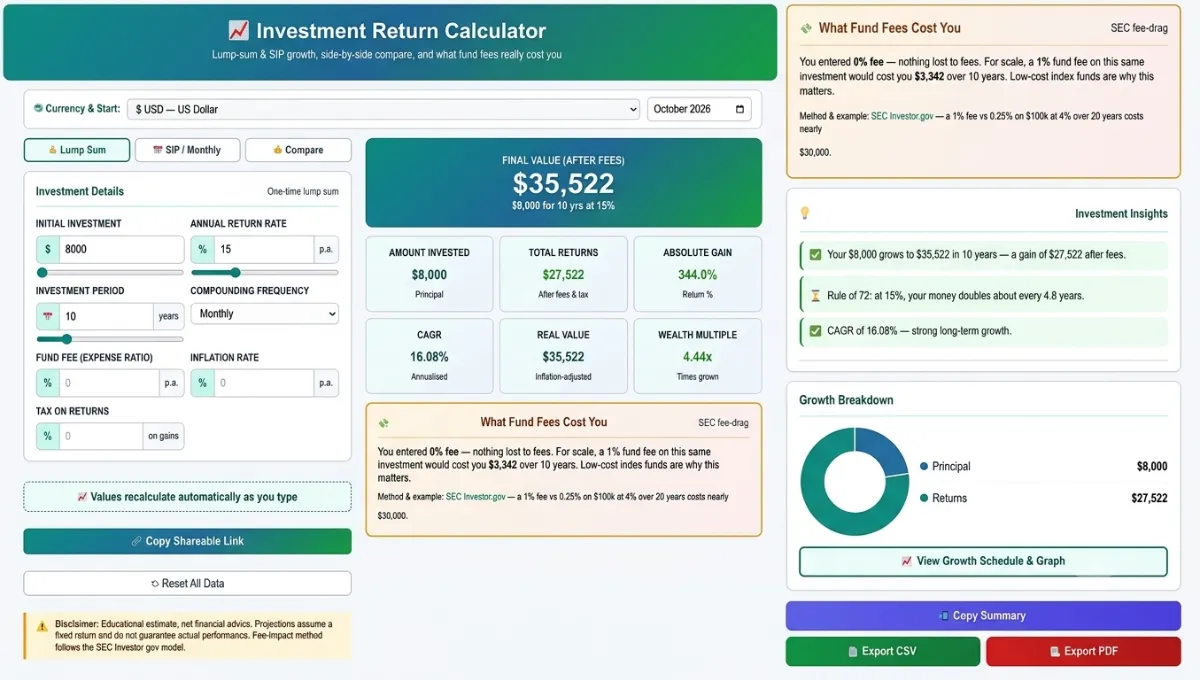
I used the same example from the IRS material: an $8,000 investment sold for $11,000. The calculator produced a $3,000 gain before any tax rules apply. That’s the number to bring into the tax-rate analysis — not the $11,000 in proceeds.
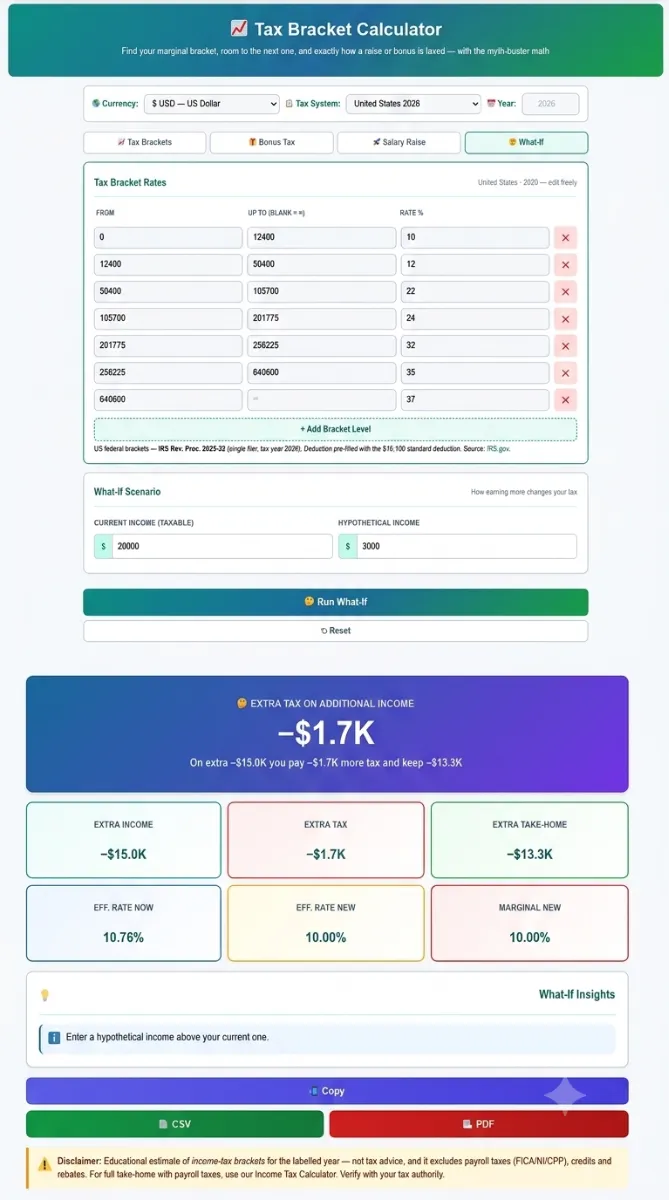
The exercise made one thing very clear visually: the taxable calculation starts with the gain or loss, not the sale amount. Once you have the gain, the Tax Bracket Calculator shows where it lands relative to the long-term 0%, 15%, and 20% thresholds based on your total taxable income and filing status. The two calculators work in sequence — Investment Return first, then Tax Bracket with your full taxable income including the gain.
🧮 SaveXpert Calculators — Free & No Signup Required
Use the Investment Return Calculator first to find the actual gain or loss from your stock sale. Then bring that figure into the Tax Bracket Calculator with your total taxable income to see which long-term rate bracket applies — and where the NIIT threshold sits relative to your MAGI.
Educational note: Federal tax only — state capital gains taxes are excluded. Source: IRS Topic No. 409 · IRS Rev. Proc. 2025-32

What the Research Shows Works
Calculating adjusted basis before anything else.
The IRS does not treat every dollar received from a sale as profit. Purchase price plus commissions and fees per IRS Topic No. 703 is the starting point. Getting that figure right determines everything downstream.
Classifying every transaction as short-term or long-term.
The rate difference between short-term (up to 37%) and long-term (as low as 0%) is large enough that even an approximation can produce a significant under- or over-estimate of the tax owed. The holding-period count starts the day after acquisition, and one day’s difference in either direction changes the classification.
Using capital losses to offset capital gains before applying any rate.
Losses offset gains directly within the capital category with no annual cap on that specific offset. Planning which gains and losses fall in the same tax year is where the practical value sits — losses realised in a different tax year don’t automatically offset gains from an earlier or later year.
Reconciling Form 1099-B against Form 8949.
The broker’s information statement and the taxpayer’s Form 8949 can legitimately differ for covered adjustments, disallowed losses, and corrections. The IRS expects Form 8949 to reconcile the reportable transactions — not to simply copy the 1099-B totals onto Schedule D.
What the data also shows can go wrong: claiming a loss without checking for substantially identical purchases in the wash-sale window; assuming every 1099-B has complete basis information for noncovered securities; treating every gain as long-term without verifying the holding period; and ignoring the NIIT for high-income years.
What Can You Realistically Expect After Selling Stocks?
For a typical taxable brokerage sale, the IRS framework produces a process rather than a single flat tax bill. The transaction creates a gain or loss based on proceeds and adjusted basis. The IRS classification depends on the holding period. The resulting federal rate depends on the applicable short-term or long-term structure, your total taxable income, and your filing status.
Brokerage reporting plays a role but doesn’t handle everything on your behalf. Form 1099-B provides proceeds and (for covered securities) basis. Form 8949 is where you reconcile and report. Schedule D is where the net result feeds into your return. If the sale happened in a year when withholding isn’t sufficient to cover the resulting tax, the IRS Estimated Tax FAQ notes that an estimated payment in the quarter of the gain may be appropriate.
For high-income years, the NIIT calculation runs parallel to — and stacks on top of — the standard capital gains rate. And for investors who harvested losses, the wash-sale rule check is required before any loss is reported on the return.

Bottom Line: 5 Steps to Answer the Capital Gains Question
1. Calculate proceeds minus adjusted basis — that figure, not the cash in your account, is what the IRS uses:
Per IRS Topic No. 409, a capital gain occurs when proceeds exceed adjusted basis. Per IRS Topic No. 703, adjusted basis starts with purchase price plus purchase-related costs (commissions, transfer fees). The gross proceeds shown on your Form 1099-B are the starting point of the calculation — not the end result. Run the Investment Return Calculator to confirm the gain or loss figure before looking at any tax rate.
2. Verify the exact holding period — the count starts the day after acquisition, and one day’s difference changes the applicable rate:
Assets held one year or less from the day after purchase are short-term (ordinary income rates, 10%–37%). Assets held more than one year are long-term (0%, 15%, or 20% per IRS Rev. Proc. 2025-32). For 2026, a single filer with total taxable income up to $49,450 faces a 0% federal rate on qualifying long-term gains. The same gain taxed as short-term at the 22% bracket produces a very different result.
3. Apply capital losses against capital gains in the same tax year — and check for wash-sale exposure before claiming any loss:
Under IRS Topic No. 409, losses offset gains directly within the capital category with no annual cap. The $3,000 annual limit applies only to excess net losses deducted against other ordinary income. Before reporting any loss, confirm no substantially identical securities were purchased within 30 days before or after the sale date — the wash-sale rule under IRC §1091 disallows the loss if that window was violated, regardless of whether the trade looked clean on the brokerage statement.
4. Reconcile Form 1099-B against Form 8949 — and independently verify basis for any noncovered securities:
Form 1099-B is an information statement; Form 8949 is where you reconcile it. For covered securities, the broker reports basis to both you and the IRS. For noncovered securities, the broker reports proceeds only — the IRS doesn’t receive basis data, and you must provide the correct figure from your own records on Form 8949. A mismatch or missing adjustment on Form 8949 feeds directly into Schedule D and changes the taxable amount the IRS sees on the return.
5. Check the quarter of the sale for estimated-tax exposure, and check MAGI separately for the 3.8% NIIT:
Per the IRS Estimated Tax FAQ, a taxable capital gain may require an estimated payment in the quarter it’s realised when withholding and credits aren’t sufficient. Separately, if MAGI exceeds $200,000 (single/HoH), $250,000 (MFJ), or $125,000 (MFS), the 3.8% NIIT under IRS Topic No. 559 stacks on top of the regular rate. The Tax Bracket Calculator shows which long-term bracket applies to the gain — run it with total taxable income including the gain, then verify the NIIT threshold against MAGI separately.
“The single most common mistake I found when reading through the IRS reporting framework for stock sales is treating total cash received as the taxable amount. If you sold $11,000 worth of stock that you bought for $8,000, you don’t owe tax on $11,000 — you owe tax on $3,000. That seems obvious until you see the 1099-B, which reports gross proceeds. The proceeds figure on Form 1099-B is not your taxable gain. It’s the starting point of the calculation. Your adjusted basis — purchase price plus commissions and related costs — comes off the top before any rate applies. Getting that number wrong in either direction produces an incorrect tax return.”
— Kevin Brown, Lead Researcher at SaveXpert.com
Frequently Asked Questions
Ans: According to IRS Topic No. 409, if you sold stock for more than its adjusted cost basis, you generally owe capital gains tax on the difference. Your exact liability depends on the holding period (short-term at ordinary income rates, or long-term at 0%, 15%, or 20%), your total taxable income, and your filing status. The gain — not the total proceeds — is the taxable amount, and the sale must be reported to the IRS on Form 8949 and Schedule D.
Ans: A sale at a loss generally doesn’t create a tax liability for that transaction. Instead, it creates a capital loss under IRS Topic No. 409. That loss can offset other capital gains dollar-for-dollar. If losses exceed gains, the excess can be deducted against ordinary income up to $3,000 per year for most taxpayers ($1,500 for MFS), with unused losses carrying forward. The wash-sale rule under IRC §1091 can disallow the loss if substantially identical securities were purchased within 30 days before or after the sale — a check that must happen before reporting the loss.
Ans: Under IRS Topic No. 703, cost basis generally starts with your purchase price plus purchase-related costs such as commissions and transfer fees. For covered securities (generally those acquired after applicable effective dates), brokers typically report this figure on Form 1099-B. For noncovered securities, brokers report gross proceeds only — basis is not reported to the IRS, and you are responsible for providing the correct adjusted basis on Form 8949 from your own records.
Ans: Brokers generally issue Form 1099-B for reportable securities sales. For covered securities, this information statement includes both proceeds and basis. But Form 1099-B is not your tax return — it’s the source document you reconcile against Form 8949. The general deadline for brokers to furnish 2025 Forms 1099-B to recipients was February 17, 2026. That applies to the 2025 tax reporting cycle specifically.
Ans: No. According to the IRS rules in the research, reinvesting stock-sale proceeds in a standard taxable brokerage account does not remove or defer the taxable gain. The IRS taxes the original sale transaction based on proceeds, adjusted basis, and the resulting gain or loss — regardless of what you do with the cash afterward. The gain is recognised on the date of the sale, not when the cash is spent or reinvested. Deferral mechanisms (such as Section 1031 exchanges) apply to qualifying real property under different rules and don’t extend to ordinary stock sales.
Ans: For covered securities, brokers are required to report cost basis information to both the taxpayer and the IRS on Form 1099-B — meaning the IRS can match the basis figure you report on Form 8949 against what the broker reported. For noncovered securities, brokers report gross proceeds but are not required to report basis to the IRS. The full responsibility for providing the correct adjusted basis on Form 8949 rests with the taxpayer. Using only the 1099-B proceeds for a noncovered position — without independently verifying and supplying the basis — can result in the IRS treating the entire proceeds amount as a taxable gain if the basis isn’t reconciled on the return.