
ⓘ Educational Disclosure:
This article is for educational and informational purposes only. It does not constitute financial, legal, tax, lending, or investment advice. SaveXpert and its authors are not licensed financial advisors, CPAs, attorneys, or tax advisors. All data comes from publicly available government and institutional sources. Always consult a qualified professional before making investment decisions.
How do you adjust W-4 withholding for 2027? Use the final 2026 IRS Form W-4 and the IRS Tax Withholding Estimator (updated March 2026) for 2027 planning. A draft 2027 W-4 exists but is marked “DRAFT — DO NOT FILE” — the final version is expected around December 2026. The 2026 form already reflects new One Big Beautiful Bill Act deductions including qualified tips (up to $25,000), qualified overtime ($12,500 single / $25,000 MFJ), passenger vehicle loan interest ($10,000), and the senior deduction ($6,000 per qualifying taxpayer age 65+). Workers with these deductions can bring them into paychecks now by updating Step 4 on their current W-4.
Key Takeaways
- Problem: Workers unsure how to adjust W-4 withholding for 2027 are caught between a draft 2027 form marked “DO NOT FILE” and a 2026 framework that already reflects significant new deductions from the One Big Beautiful Bill Act.
- Solution: Use the final 2026 W-4 and the IRS Tax Withholding Estimator — updated in March 2026 — for planning until the IRS releases the final 2027 form, expected around December 2026.
- Result: The IRS estimator produces more accurate withholding calculations than manual math, especially for multiple-job households and workers with eligible OBBBA deductions. Workers who update Step 4 of their W-4 bring those deductions into paychecks now rather than waiting for April.
- Source: IRS Tax Withholding Estimator, IRS Publication 15-T
- Time To Read: 6 Minutes
Table of Contents
1. The 2027 W-4 Exists as a Draft — Here’s What That Means
2. The OBBBA Deductions Already Built Into the 2026 W-4
3. What Each W-4 Step Does — and Where OBBBA Changes Live
4. Why the IRS Withholding Estimator Matters More Than Manual Math
5. What Happens When Income Changes or You Add a Second Job
6. How New Deductions Can Change Your Paycheck Now — Not Just at Filing
7. What About Exemptions? The Two Conditions That Must Both Be True
8. What the Research Shows Works (and What Doesn’t)
9. Realistic Expectations When Adjusting Your W-4
The 2027 W-4 exists. The IRS released a draft in July 2026. But as of September 2026, it’s stamped “DRAFT — DO NOT FILE.” Workers who need to adjust W-4 withholding for 2027 can’t use it yet. The IRS says to use the 2026 framework and the updated Tax Withholding Estimator in the meantime — and that estimator was significantly updated in March 2026 to reflect new deductions from the One Big Beautiful Bill Act.
The 2027 W-4 Exists as a Draft — Here’s What That Means
The IRS released a draft 2027 Form W-4 in July 2026. Experian’s employer services analysis of that draft notes it doesn’t appear to make major structural changes from the 2026 form — but the IRS explicitly warns it’s not for filing. It contains placeholder dollar amounts, and those provisional figures shouldn’t be treated as final IRS guidance.
The final 2027 W-4 is expected around December 2026. Until then, the research supports a straightforward approach: use the final 2026 W-4 and the IRS Tax Withholding Estimator. That combination covers the OBBBA provisions already enacted and lets workers plan 2027 withholding before the official form arrives.
⚠️ Don’t file the draft 2027 W-4: The IRS’s “DRAFT — DO NOT FILE” designation is explicit. Submitting a draft form to an employer creates an invalid withholding election. The 2027 SALT cap in the draft ($40,804 vs. 2026’s $40,400) and other placeholder figures are provisional — not confirmed IRS amounts. Use the final 2026 form until the IRS publishes the 2027 final version.

The OBBBA Deductions Already Built Into the 2026 W-4
The One Big Beautiful Bill Act added several new deductions that are already reflected in the 2026 W-4 and the updated IRS Tax Withholding Estimator. Workers who qualify for any of these can adjust their withholding now — they don’t need to wait for the 2027 form.
| OBBBA Deduction | 2026 Limit | Who Qualifies |
|---|---|---|
| Qualified tips | Up to $25,000 | Workers in tipped industries during the applicable period |
| Qualified overtime compensation | $12,500 (single) / $25,000 (MFJ) | Eligible overtime earners |
| Passenger vehicle loan interest | Up to $10,000 | Taxpayers with qualifying auto loan interest |
| Senior deduction (age 65+) | $6,000 per qualifying taxpayer | Taxpayers age 65 or older |
| Child Tax Credit | $2,200 per qualifying child under 17 | Parents with children under 17 |
| Other dependents credit | $500 per dependent | Non-child qualifying dependents |
Source: IRS Form W-4 (2026) · IRS Newsroom — Estimator Update March 2026
The research also confirms the 2026 standard deductions and the SALT cap, both of which affect W-4 planning:
| Figure | 2026 Amount | Notes |
|---|---|---|
| Standard deduction — Married Filing Jointly | $32,200 | — |
| Standard deduction — Head of Household | $24,150 | — |
| Standard deduction — Single / MFS | $16,100 | — |
| SALT cap (itemizers) | $40,400 | MFS: $20,200 |
| 37% bracket threshold — Single | $640,600+ | — |
| 37% bracket threshold — MFJ | $768,700+ | — |
Source: IRS Form W-4 (2026) · IRS Publication 15-T
Find your marginal bracket, income tax, and take-home.
What Each W-4 Step Does — and Where OBBBA Changes Live
The W-4 has five steps. Understanding which step to update prevents errors and tells workers exactly where the OBBBA deductions get entered.
| Step | What It Covers | When to Complete / Update |
|---|---|---|
| Step 1 | Personal information and filing status | Always — review when filing status changes (marriage, divorce) |
| Step 2 | Multiple jobs or working spouse | Complete on the highest-paying job’s W-4 when multiple income sources exist |
| Step 3 | Dependents and credits (Child Tax Credit, other dependents) | Complete on highest-paying job’s W-4; don’t duplicate across employers |
| Step 4 | Other income, deductions, and extra withholding — includes OBBBA deductions | Update when claiming tips, overtime, auto loan interest, or senior deduction |
| Step 5 | Signature | Always — required for submission |
Source: IRS Form W-4 (2026)
💡 Research note: The OBBBA deductions (tips, overtime, auto loan interest, senior deduction) are entered in Step 4b — “Deductions other than the standard deduction.” This is where taxpayers who itemize also enter their itemized deduction estimate. Workers taking these new deductions can add them to Step 4b even when taking the standard deduction for other purposes.
Estimate your tax, effective rate, and take-home pay.
Why the IRS Withholding Estimator Matters More Than Manual Math
The IRS updated its Tax Withholding Estimator — also called W4App — in March 2026 specifically to incorporate the OBBBA provisions. Before that update, the tool didn’t account for the new deductions. Now it does.
According to the IRS newsroom announcement, the estimator takes about 25 minutes on average. That’s more time than most workers spend on withholding decisions — but the research shows it produces more accurate results than manual calculations, particularly in these situations:
| Situation | Why the Estimator Helps |
|---|---|
| Multiple jobs in the household | Calculates combined household withholding rather than each job in isolation |
| Self-employment income alongside W-2 wages | Accounts for SE tax and identifies whether additional withholding on the W-2 job can cover the SE tax liability |
| Claiming multiple OBBBA deductions | Adds each deduction to the withholding calculation correctly — manual math errors are common when stacking deductions |
| Recent life change (marriage, new dependent, second job) | Recalculates the full household picture rather than adjusting one variable in isolation |
Source: IRS Tax Withholding Estimator · IRS Newsroom — March 2026
The estimator also walks users through exactly what to enter on a new W-4. So the output isn’t just a number — it’s a guided set of instructions for the actual form.
🧮 Put Your Numbers Into Context: SaveXpert Tax Bracket Calculator
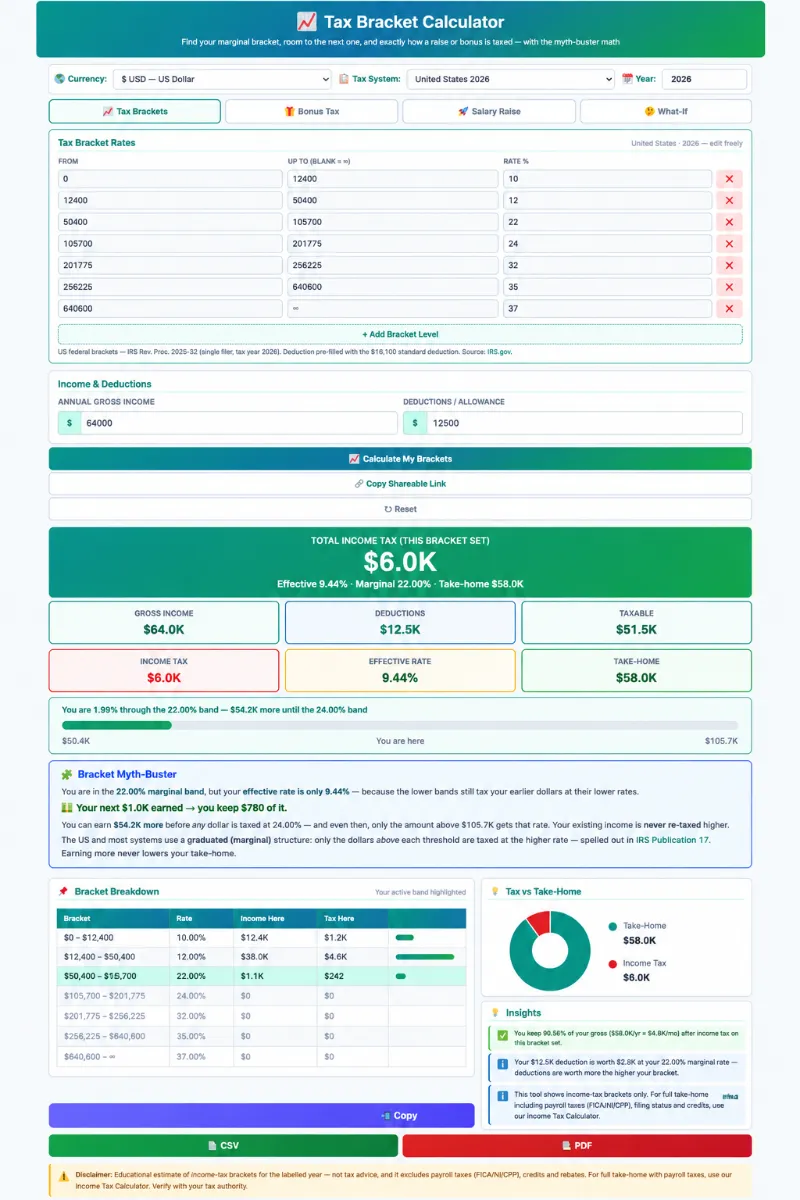
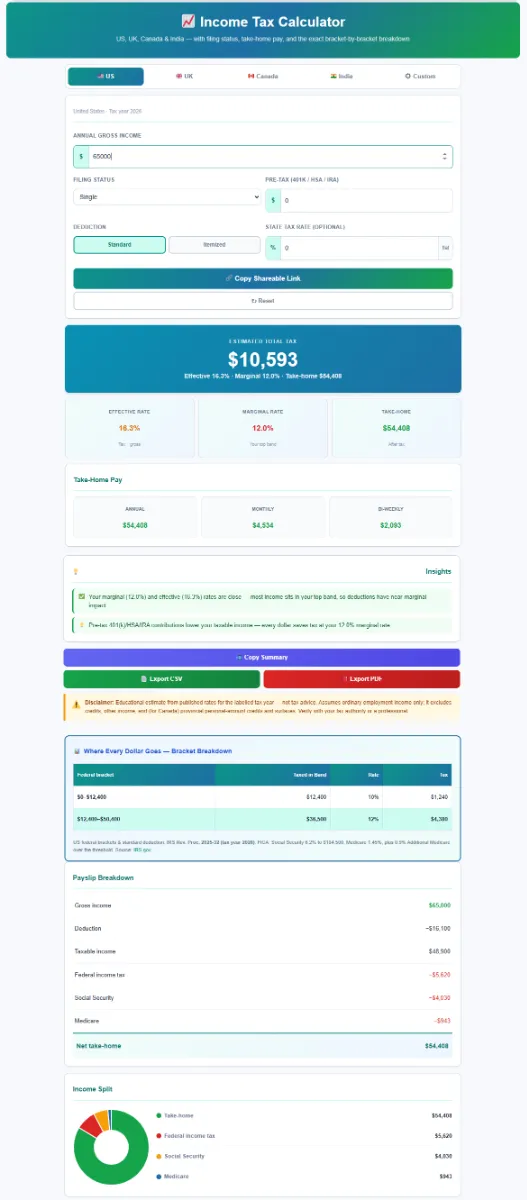
I ran a single-filer scenario through the Tax Bracket Calculator — income around the upper-bracket threshold, then comparing how an additional $12,500 overtime deduction shifts the income subject to the higher rate. The bracket shift matters because it determines the value of each dollar of deduction. A $12,500 deduction saves more in federal tax for a 22% bracket worker than a 12% bracket worker. Before updating Step 4 on your W-4, knowing which bracket your income lands in makes the deduction calculation concrete.
Educational note: These calculators model federal income tax scenarios for informational purposes only and do not provide personalized tax advice. Source: IRS Publication 15-T
What Happens When Income Changes or You Add a Second Job
This is one of the clearest findings in the research. Life changes that affect income create withholding mismatches — and those mismatches don’t fix themselves automatically. They require a new W-4.
Multiple-job households
The research gives specific guidance for households with multiple W-2 jobs. Complete Steps 2 through 4 on the highest-paying job’s W-4. Leave the other jobs at Steps 1 and 5 only. This approach avoids the most common multiple-job withholding error: claiming deductions and credits on more than one job, which typically results in underwithholding.
Consider a practical example. One spouse starts a second job during 2027. Leaving the original withholding untouched means the new combined household income may not have enough withheld — even if each individual job’s withholding looked fine on its own. The estimator recalculates the full picture.
The pre-2020 W-4 problem
Some workers haven’t updated their W-4 since before 2020, when the IRS redesigned the form and eliminated the allowances system. The old allowances-based approach doesn’t translate directly into the new form. IRS Publication 15-T contains a computational bridge that employers use to convert old allowance elections into the new withholding tables — but that bridge can produce different results from a freshly completed 2026 W-4.
Workers who filed an allowances-based W-4 in 2019 or earlier and haven’t updated since may be over- or underwithholding without realizing it. The IRS estimator identifies this when users input their current paycheck withholding against their expected tax liability.
⚠️ The old allowances don’t apply directly: If you still have a pre-2020 W-4 on file, your withholding is calculated through Publication 15-T’s computational bridge — not the old allowance dollar amounts themselves. The IRS recommends submitting a new W-4 whenever a significant life change occurs, regardless of how old the previous form is.

How New Deductions Can Change Your Paycheck Now — Not Just at Filing
Here’s the part of the research that I think gets missed most often.
Withholding and final tax liability are two different things. If you’re eligible for the overtime deduction, the tips deduction, the car loan interest deduction, or the senior deduction — and you don’t update your W-4 — your paychecks are still withheld at the old rate. You’ll capture the tax benefit when you file in April. But you get nothing in your weekly or biweekly paychecks during the year.
Updating Step 4b of the W-4 to reflect those deductions changes the calculation. Your employer withholds less because the deductions reduce your estimated taxable income. You see the benefit in every paycheck through the year instead of waiting for a refund.
The research explicitly confirms this for qualified tips, qualified overtime compensation, passenger vehicle loan interest, and the senior deduction. The tax benefit is the same either way — it’s the timing that changes when you update the W-4.
💡 Research note: The IRS position on overtime withholding is specific: overtime pay itself is still subject to withholding at regular rates. The deduction can reduce tax liability — but only if the W-4 is updated to reflect the expected deduction. Without the W-4 update, the deduction produces a refund at filing rather than higher paychecks throughout the year.
What About Exemptions? The Two Conditions That Must Both Be True
Claiming “exempt” on a W-4 tells the employer to withhold nothing from paychecks. The research is direct about when this applies — and when it doesn’t.
Two conditions must both be met to claim exemption:
1. The taxpayer had no federal income tax liability in the prior year.
2. The taxpayer expects no federal income tax liability in the current year.
Both conditions must be true. If either fails, the exemption claim is invalid — and the result is an underwithholding situation that can trigger a tax bill and potentially penalties when the return is filed.
The exemption also isn’t permanent. It expires annually. Workers claiming exemption for 2027 must renew it by February 15, 2028. If the renewal deadline passes without a new W-4, the employer reverts to single filing status with no other adjustments — which may produce different withholding than the employee expects.
⚠️ Exempt ≠ a way to increase take-home pay: The research doesn’t support treating exemption as a general paycheck-boost strategy. The eligibility conditions are strict. A worker who claims exempt but owes federal income tax for the year faces the full liability at filing — often without having set anything aside to cover it.
What the Research Shows Works (and What Doesn’t)
What the data consistently supports
Running the IRS Tax Withholding Estimator before updating a W-4.
The estimator accounts for OBBBA deductions, multiple jobs, and complex income situations that manual math tends to get wrong. It takes about 25 minutes and produces a guided instruction set for the actual form — not just a number.
Updating Step 4b to capture OBBBA deductions during the year.
Workers eligible for the tips deduction, overtime deduction, auto loan interest deduction, or senior deduction who don’t update their W-4 receive those benefits only at April filing. An updated W-4 moves those benefits into paychecks during the year.
Completing Steps 2-4 only on the highest-paying job’s W-4 in multi-job households.
Duplicating credits and deductions across multiple employers’ W-4 forms produces underwithholding. The research supports the single-form approach for multi-job households.
Reviewing withholding when life changes occur — not just at year-end.
Marriage, new dependents, and a second job all change the relationship between income and withholding mid-year. Waiting until December to adjust means months of incorrect withholding have already occurred.
What the data says doesn’t work
Filing the draft 2027 W-4.
The IRS explicitly prohibits this. The form has placeholder amounts and hasn’t been finalized. Submit the 2026 final form instead.
Claiming exemption without meeting both conditions.
Workers who claim exempt without having zero prior-year liability and zero current-year expected liability face a tax bill at filing — often with insufficient funds set aside to cover it.
Relying on a pre-2020 allowances-based W-4 without updating it.
The allowances system is no longer directly applicable. Employers translate old allowances through Publication 15-T’s computational bridge, which can produce different withholding than a freshly completed 2026 W-4 would for the same taxpayer.

Realistic Expectations When Adjusting Your W-4
Updating a W-4 doesn’t produce an automatically larger paycheck or a guaranteed refund. What it does is align withholding with the taxpayer’s actual expected tax liability — which can result in either direction depending on whether previous withholding was too high or too low.
The research doesn’t provide a universal timeframe for W-4 changes to appear in a paycheck. That depends on the employer’s payroll cycle — most changes take effect within one or two pay periods after the employer processes the new form.
The final 2027 W-4 remains pending as of September 2026. When it arrives (expected December 2026), workers should compare its figures against the 2026 amounts used for planning. The research found the draft doesn’t appear to introduce major structural changes from 2026 — but provisional draft figures like the $40,804 SALT cap should be treated as estimates until the IRS confirms the final amounts.
💡 Research note: Withholding accuracy doesn’t require a perfect prediction of annual income. The IRS safe-harbor rules for estimated taxes (90% of current-year liability or 100%/110% of prior-year liability) also apply to W-2 withholding. Workers whose total withholding meets those thresholds avoid underpayment penalties even if the final tax bill differs from what was withheld.
Bottom Line: 5 Steps to Adjust Your W-4 for 2027
1. Don’t file the draft 2027 W-4 — use the final 2026 form for now:
The draft is marked “DRAFT — DO NOT FILE.” It has placeholder amounts and no IRS-confirmed figures. The final 2027 form is expected around December 2026. Until it’s published, the 2026 final W-4 paired with the updated IRS estimator is the research-backed planning tool.
2. Run the IRS Tax Withholding Estimator before touching your W-4:
The estimator accounts for OBBBA deductions, multiple-job households, and complex income situations. It takes about 25 minutes and produces specific W-4 instructions — not just a ballpark. Access it at irs.gov/individuals/tax-withholding-estimator.
3. If you have eligible OBBBA deductions, update Step 4b to bring them into paychecks now:
Tips (up to $25,000), overtime ($12,500 single / $25,000 MFJ), car loan interest ($10,000), and senior deduction ($6,000) can all be entered in Step 4b. Without updating, you capture those deductions at April filing instead of in each paycheck through the year.
4. For multi-job households: complete Steps 2-4 on the highest-paying job’s W-4 only:
Entering credits and deductions on multiple W-4 forms causes underwithholding. Keep the other jobs at Steps 1 and 5 only. The estimator walks through this calculation for the combined household picture.
5. Revisit withholding when life changes — don’t wait until December:
Marriage, a new dependent, or a second job changes the withholding picture mid-year. The IRS recommends a mid-year review in those situations. Waiting until year-end means months of incorrect withholding have already accumulated.
“When I went through the IRS estimator update announcement and the 2026 W-4 documentation, the biggest withholding issue for 2027 wasn’t about tax brackets. It was about the OBBBA deductions already built into the form. Workers eligible for the tips deduction, overtime deduction, or senior deduction can bring those benefits into their paychecks now — but only if they update Step 4. Without that update, the savings stay locked until April.”
— Kevin Brown, Lead Researcher at SaveXpert.com
Frequently Asked Questions
Ans: The IRS recommends updating your W-4 whenever you experience a significant life change — marriage, divorce, having a dependent, a new job, or a significant change in income. These events change the relationship between income and withholding. Mid-year adjustments ensure federal income tax withholding stays accurate throughout the year rather than producing a large bill or a large refund at filing.
Ans: Accurately claiming eligible deductions in Step 4b of the W-4 reduces the amount withheld from each paycheck. The OBBBA deductions built into the 2026 form — including qualified tips (up to $25,000), qualified overtime ($12,500 single / $25,000 MFJ), passenger vehicle loan interest ($10,000), and the senior deduction ($6,000 for eligible taxpayers age 65+) — can all be entered there. The tax benefit is the same whether captured in paychecks or at April filing. Updating the W-4 moves the timing into paychecks during the year.
Ans: The IRS Tax Withholding Estimator is an official online tool at irs.gov/individuals/tax-withholding-estimator that calculates whether your current withholding will cover your expected tax liability. Updated in March 2026 to incorporate OBBBA provisions, it takes about 25 minutes on average and produces specific instructions for completing a new W-4. The research finds it more accurate than manual calculations, particularly for multiple-job households, self-employed taxpayers with W-2 income, and workers claiming multiple new deductions.
Ans: Marriage, divorce, the birth or adoption of a child, gaining or losing another dependent, starting or ending a second job, a significant change in income, and eligibility for new deductions all warrant a W-4 review. The IRS recommends mid-year adjustments for these situations — not waiting until the next year’s open enrollment or tax filing season. Each of these changes shifts the relationship between income and withholding in ways that can produce unexpected bills or over-refunds.
Ans: Yes. Withholding and final tax liability are connected directly. If you reduce withholding by claiming OBBBA deductions in Step 4b, your paychecks increase during the year — but your April refund will be smaller because less was withheld. Your total tax liability doesn’t change. What changes is the timing: money either comes to you in paychecks throughout the year or as a refund in April. Neither is better or worse in isolation — it depends on whether you prefer larger paychecks or a larger annual refund.
Ans: The Form W-4 is the employee form submitted to an employer to communicate withholding preferences. Publication 15-T is the IRS employer guide containing the federal withholding tables and computational bridges. Employers use Publication 15-T to translate W-4 elections into actual dollar amounts withheld from each paycheck. Employees who haven’t updated a pre-2020 W-4 may have their old allowances translated through Publication 15-T’s computational bridge — producing different withholding than a freshly completed 2026 form would for the same income and situation.