

ⓘ Educational Disclosure:
This article is for educational and informational purposes only. It does not constitute financial, legal, tax, lending, or investment advice. SaveXpert and its authors are not licensed financial advisors, CPAs, attorneys, or tax advisors. All data comes from publicly available government and institutional sources. Always consult a qualified professional before making investment decisions.
What is the FSA contribution limit for 2027? As of September 2026, the IRS has not officially published the 2027 Health FSA contribution limit. The confirmed 2026 limit is $3,400, set by IRS Revenue Procedure 2025-32 on October 9, 2025. One industry projection (BenefitsUSA) estimates a possible $3,500 for 2027 — but that figure is an estimate, not a confirmed IRS figure. The official 2027 limit is typically released in an IRS Revenue Procedure in October or November 2026. Until that publication, $3,400 is the reliable planning baseline.
Key Takeaways
- Problem: Many workers must make open enrollment FSA elections before the official 2027 FSA limit is published — creating a gap between the decision deadline and the confirmed IRS figure.
- Solution: Plan around the confirmed 2026 limit of $3,400, watch for the IRS Revenue Procedure announcement in October or November 2026, and estimate expenses conservatively to avoid forfeiting funds under the use-it-or-lose-it rule.
- Result: Accurate expense estimation lets workers capture the pre-tax FSA benefit without the forfeiture risk that comes with overcontributing — particularly when the plan’s carryover cap limits what rolls over.
- Source: IRS Publication 969 — FSAs and HDHPs, IRS Revenue Procedure 2025-32
- Time To Read: 6 Minutes
Table of Contents
1. The 2027 FSA Limit Is Not Official Yet — and That Creates a Problem
2. What the 2026 FSA Limit History Tells Us About 2027
3. The Carryover and Use-It-or-Lose-It Rules: How They Actually Work
4. Why the HSA Limit Being Published Doesn’t Set the FSA Limit
5. The Dependent Care FSA Just Got Its First Increase in 40 Years
6. What the Tax Planning Data Shows About FSA Elections
7. What Happens to FSA Money at Year-End
8. What the Published Limits Don’t Tell You
9. What the Research Shows Works (and What Doesn’t)
The IRS published the 2027 HSA limits in May 2026. The 2027 FSA limit? Still not confirmed as of September 2026. That timing gap matters because many employers run open enrollment in October or November — the same window when the IRS typically publishes the following year’s FSA limit through a Revenue Procedure. Workers making FSA elections right now are doing so without the official 2027 number in hand.
The 2027 FSA Limit Is Not Official Yet — and That Creates a Problem
Health FSA contribution limits are set by the IRS each year through a Revenue Procedure. For 2026, that announcement came on October 9, 2025 — IRS Revenue Procedure 2025-32. The statutory authority comes from Internal Revenue Code Section 125(i).
The same process will produce the 2027 figure. But as of September 2026, that Revenue Procedure hasn’t been published. The IRS has already set 2027 HSA and HDHP limits — those came through a separate Revenue Procedure (2026-24) in May 2026. The FSA announcement follows its own timeline.
That creates a specific open enrollment problem. An employee who needs to elect an FSA for the 2027 plan year — and whose open enrollment window closes before the IRS announcement — has to make a binding decision based on the 2026 confirmed figure.
⚠️ Industry projections are not IRS figures: One industry source (BenefitsUSA) projects a $3,500 Health FSA limit and a $700 carryover for 2027. Those estimates are clearly labeled as projections — not official IRS numbers. Treat them as directionally useful context, not confirmed planning figures. The official limit may be $3,500, more, or less. Only the IRS Revenue Procedure confirms it.

What the 2026 FSA Limit History Tells Us About 2027
The historical pattern is consistent. Health FSA limits have risen in $100 increments in recent years, adjusted annually for inflation through the IRS Revenue Procedure process.
| Plan Year | Health FSA Employee Limit | Annual Change | IRS Authority |
|---|---|---|---|
| 2024 | $3,200 | — | Prior Revenue Procedure |
| 2025 | $3,300 | +$100 | Prior Revenue Procedure |
| 2026 | $3,400 | +$100 | Rev. Proc. 2025-32 (Oct. 9, 2025) |
| 2027 | TBD — est. $3,500* | +$100 projected* | Pending — expected Oct/Nov 2026 |
* Industry estimate only (BenefitsUSA). Not an IRS-confirmed figure. Source: IRS Publication 969 · IRS Revenue Procedure 2025-32
The pattern of $100 annual increases is a useful historical reference — not a guarantee. The IRS determines the adjustment based on inflation calculations each year. A different inflation environment could produce a different increase, a flat figure, or (in unusual circumstances) no change.
💡 Research note: A projection that follows the $100 trend is reasonable context for planning purposes. But using $3,500 as a confirmed election amount before the IRS publishes the official figure means making a binding financial commitment based on an estimate. If the confirmed limit turns out lower, you may have elected more than the legal maximum allows.
The Carryover and Use-It-or-Lose-It Rules: How They Actually Work
This is where the most common FSA mistakes happen. The use-it-or-lose-it rule is real — but the exceptions are equally real, and confusing one for the other can be costly.
IRS Publication 969 describes the general rule: Health FSA funds that aren’t spent by the end of the plan year are forfeited. The IRS allows employers to offer one of two exceptions. They cannot offer both simultaneously.
| Feature | Grace Period | Carryover |
|---|---|---|
| What it allows | Up to 2.5 extra months after plan year end to spend remaining funds | Up to $680 (2026) rolled into the next plan year balance |
| When must funds be used? | Within the grace period window; unused funds then forfeit | Rolled balance available at start of new plan year |
| Can be combined with the other? | No — employer chooses one or neither | No — employer chooses one or neither |
| Is the employer required to offer it? | No — employer’s choice | No — employer’s choice |
| If the employer offers neither? | Unused funds are forfeited at plan year-end with no exception | |
Source: IRS Publication 969 · IRS Notice 2020-33 (carryover rule)
The 2026 maximum carryover is $680 — equivalent to 20% of the $3,400 annual limit. If the 2027 limit increases to $3,500, the carryover maximum would likely change accordingly, but that calculation depends on the confirmed figures. BenefitsUSA projected a $700 carryover for 2027, following the same 20% relationship.
What this means in practice: an employee who elects $3,400 but only spends $2,500 during the plan year faces a $900 shortfall. With a $680 carryover, $680 rolls forward — and $220 is forfeited. With no carryover provision at all, $900 is forfeited. Accurate expense estimation before making the election is the only reliable way to avoid that outcome.
⚠️ Don’t assume your plan has a carryover: The carryover and grace period are employer options — not IRS requirements. Your plan may have neither. Contact your HR department or FSA administrator before open enrollment closes to confirm which exception (if any) your specific plan offers. That answer changes the risk profile of your election amount significantly.
Why the HSA Limit Being Published Doesn’t Set the FSA Limit
I want to address a specific source of confusion head-on. The IRS published the 2027 HSA contribution limits in May 2026 — $4,500 for self-only coverage, $9,000 for family — through Revenue Procedure 2026-24. That announcement has nothing to do with the Health FSA limit.
The two accounts follow separate legal frameworks, separate IRS processes, and separate publication timelines. An HSA announcement in May does not trigger or establish the Health FSA announcement.
What the academic research found
A field experiment involving 3,858 technology job seekers — associated with researchers at Harvard, Brown, and UCLA — found that salary negotiators improved compensation by an average of 12.45%, or roughly $27,000 per year. This isn’t official government research, but it’s a peer-reviewed finding, and the scale of the study makes the result meaningful.
Pew survey data found that 28% of workers received the full amount they requested when they negotiated, and another 38% received a partial increase. That’s roughly a 66% success rate among people who asked. Fidelity’s research from the same period found 85% of Americans who negotiated received at least part of the increase they requested.
| Feature | Health FSA | HSA |
|---|---|---|
| 2027 limit | Not yet published (est. $3,500) | $4,500 (self-only) / $9,000 (family) — confirmed |
| 2026 limit | $3,400 | $4,400 (self-only) / $8,750 (family) |
| When published? | Oct/Nov 2026 (expected) | May 2026 (already published) |
| Rollover treatment | Use-it-or-lose-it (limited carryover) | Indefinite — no forfeiture |
| Eligibility requirement | Employer cafeteria plan (IRC §125) | HDHP required |
| IRS legal authority | IRC §125(i) · Rev. Proc. 2025-32 | IRC §223 · Rev. Proc. 2026-24 |
Source: IRS Publication 969 · IRS Revenue Procedure 2026-24 · IRS Revenue Procedure 2025-32
The practical implication: employees who are HSA-eligible and planning open enrollment have confirmed 2027 HSA numbers to work with. Employees electing a Health FSA are working with the 2026 confirmed number until the IRS publishes the 2027 figure. Neither situation affects the other.
Find your marginal bracket, income tax, and take-home.
The Dependent Care FSA Just Got Its First Increase in 40 Years
If you’ve been reflexively entering $5,000 in your Dependent Care FSA election because that’s always been the limit — stop. That number changed in 2026 for the first time since 1986.
The One Big Beautiful Bill Act (Public Law 119-21) raised the Dependent Care FSA exclusion limit to $7,500 per household for plan years beginning after December 31, 2025. The married filing separately limit rose to $3,750.
| Filing Status | 2025 DC FSA Limit | 2026 DC FSA Limit | Change |
|---|---|---|---|
| Single filer or Married Filing Jointly | $5,000 | $7,500 | +$2,500 (+50%) |
| Married Filing Separately | $2,500 | $3,750 | +$1,250 (+50%) |
Source: One Big Beautiful Bill Act, Public Law 119-21 · IRS Publication 969
This is a significant change that many workers may not have incorporated into their elections yet. Parents with qualifying childcare, after-school care, or other dependent care expenses should review whether their current election captures the new $7,500 limit before enrollment closes.
💡 Research note: The Dependent Care FSA and Health FSA are separate accounts with separate limits. A $7,500 Dependent Care FSA election doesn’t reduce how much you can put into a Health FSA — and vice versa. Workers with qualifying dependents should review both independently during open enrollment.

What the Tax Planning Data Shows About FSA Elections
Pre-tax Health FSA contributions reduce the amount of income subject to federal income tax, Social Security tax, and Medicare tax. That triple reduction is the core financial case for using an FSA when you have qualifying medical expenses.
The actual dollar savings depends entirely on the worker’s marginal tax rate — there’s no single “you save X%” answer that applies to everyone. A worker in the 22% federal bracket captures a different benefit from the same $3,400 contribution than a worker in the 12% or 32% bracket.
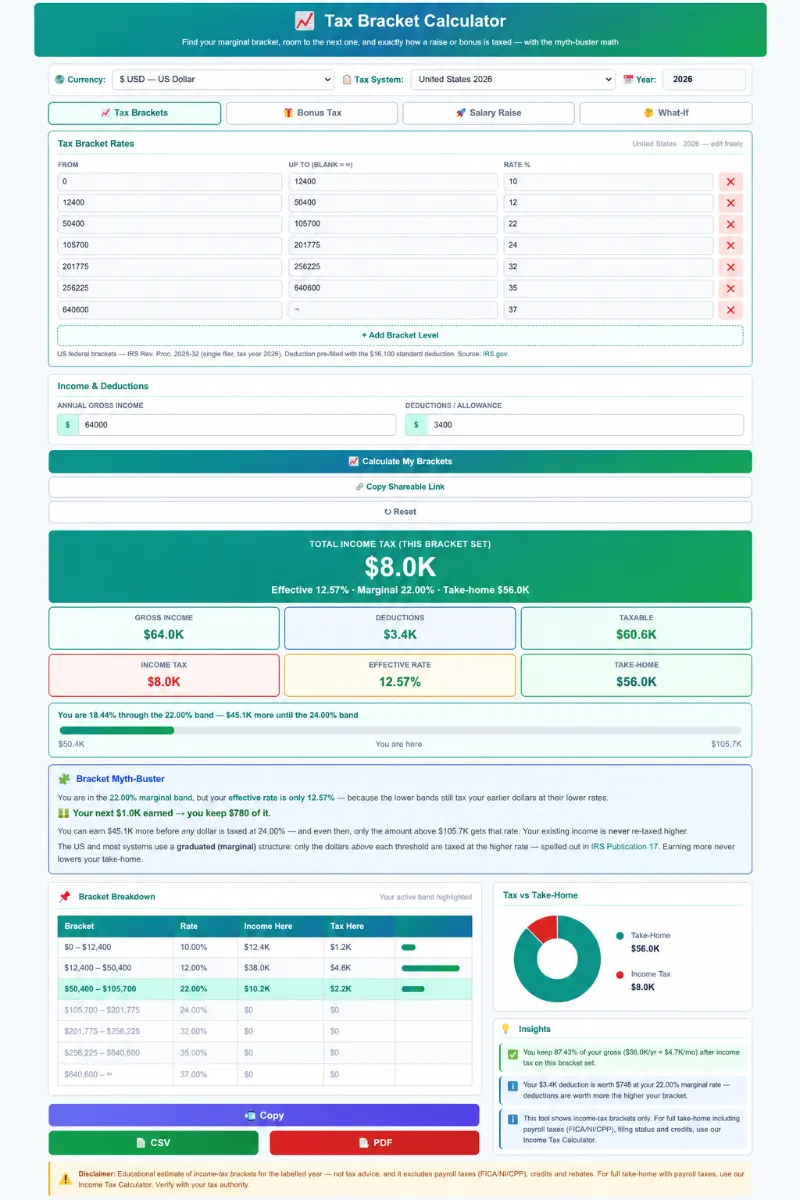
🧮 Model Your FSA Tax Savings: SaveXpert Tax Bracket Calculator
I ran a $3,400 Health FSA contribution scenario through the Tax Bracket Calculator. The contribution reduces taxable income by $3,400 in the model — but what that saves in actual tax depends on the worker’s bracket, filing status, and other deductions. A 22% bracket worker saves approximately $748 in federal income tax alone. A 12% bracket worker saves approximately $408. Put your own income and FSA election in to see where the math lands for your situation.
Educational note: This calculator models federal income tax scenarios for informational purposes only and does not provide personalized tax or benefits advice. Source: IRS Publication 969
What Happens to FSA Money at Year-End
The answer isn’t simply “it expires.” It depends on three variables: what your employer’s plan offers, whether you have remaining funds, and how much those funds are.
Scenario 1: Plan offers a carryover provision
Up to $680 (2026 maximum) rolls into the next plan year. Funds above $680 that remain unspent at year-end are forfeited. Example: a $3,400 election, $2,400 spent, $1,000 remaining → $680 carries over, $320 forfeited.
Scenario 2: Plan offers a grace period
You have up to 2.5 extra months after the plan year ends to spend remaining funds. Any unused funds after the grace period expires are forfeited. The plan year plus grace period creates a longer spending window — but there’s no carryover into the new year’s balance.
Scenario 3: Plan offers neither provision
All unused funds forfeit at year-end with no exceptions. This is the default position when the employer hasn’t adopted either exception — and the research shows this situation is more common than many workers realize.
💡 Research note: Two workers at the same company with identical FSA elections and identical unspent balances can face completely different year-end outcomes if they’re on different benefit plan designs. The employer’s plan document controls. If you’ve changed jobs or your employer changed benefit vendors, the rules you experienced last year may not apply this year.
Married couples and separate FSAs
One more clarification the research highlights: married couples don’t share one Health FSA limit. Each employed spouse has their own employee-level FSA limit under their respective employer’s plan. A married couple where both spouses have access to a Health FSA through their individual employers can each elect up to the applicable limit — potentially $3,400 each in 2026.
What the Published Limits Don’t Tell You
The IRS Revenue Procedure establishes the annual contribution ceiling — it doesn’t answer every FSA question that arises during open enrollment. A few of the common gaps are worth naming directly.
Changing your election during the year
Under standard IRS cafeteria plan rules, you generally can’t change your FSA election amount after open enrollment closes — unless you experience a qualifying life event (QLE). Marriage, divorce, the birth or adoption of a child, or a change in employment status typically qualify. A change in anticipated medical expenses alone isn’t a qualifying event. If you realize mid-year that you over-elected or under-elected, the fix has to wait for the next open enrollment unless a QLE occurs.
Which specific expenses qualify
Both Health FSAs and HSAs cover the same universe of qualified medical expenses under IRS Publication 502. That publication provides the authoritative expense list — it’s the source to check for specific questions about whether a particular cost qualifies. The annual contribution limits don’t expand or narrow that list.
Reimbursement timing from the FSA administrator
How quickly claims are processed and reimbursed depends on the FSA administrator, not federal law. The IRS sets contribution rules and plan design requirements — it doesn’t establish a required reimbursement turnaround time. Contact your FSA administrator directly for claim timing expectations.

What the Research Shows Works (and What Doesn’t)
What the data consistently supports
Estimating annual medical expenses accurately before electing.
This is the most important single action in FSA planning. The use-it-or-lose-it rule makes overcontributing a real financial loss — not a hypothetical one. The carryover cap of $680 limits how much of an overcontribution can be salvaged. Conservative estimation based on known, scheduled expenses (prescriptions, planned procedures, regular copays) reduces forfeiture risk.
Using $3,400 as the planning baseline for 2027 elections made before the IRS announcement.
It’s the confirmed 2026 limit and the most reliable available figure. If the confirmed 2027 limit turns out to be $3,500, the difference is $100 — small enough that planning around $3,400 doesn’t create a meaningful undercontribution for most workers.
Check your employer’s plan before assuming a carryover applies.
The $680 carryover maximum exists in IRS rules — but only for plans that specifically adopt it. A plan that doesn’t adopt the carryover provision defaults to full forfeiture. Verifying before the enrollment deadline takes one conversation with HR or the FSA administrator.
Reviewing the Dependent Care FSA election separately.
The $7,500 limit (up from $5,000) is the first change in four decades. Workers with qualifying childcare expenses who haven’t adjusted their elections are leaving pre-tax savings potential unused.
What the data says doesn’t work
Treating an industry projection as a confirmed IRS figure.
The $3,500 estimate is useful directional context. It’s not an official limit until the IRS Revenue Procedure confirms it. Making a binding election based on an unconfirmed projection creates unnecessary risk.
Assuming the carryover and grace period can both apply.
They can’t. IRS rules require plans to choose one or neither. A worker who believes both protections apply to unused funds may face unexpected forfeiture at year-end.
Assuming that because your spouse has an FSA you can’t contribute to yours.
Married couples with access to separate employer FSAs can each contribute independently, up to their individual employer plan limits.
Bottom Line: 5 Steps Before Open Enrollment Closes
1. Use $3,400 as your Health FSA planning baseline:
That’s the confirmed 2026 IRS figure and the most reliable reference for 2027 elections made before the October/November Revenue Procedure. The 2027 official limit will likely arrive in that window — update your plan if enrollment is still open when it’s published.
2. Estimate expenses conservatively — the use-it-or-lose-it rule is real:
Base your election on known, scheduled medical expenses (recurring prescriptions, planned appointments, anticipated procedures). The $680 carryover cap limits how much of an overcontribution you can recover — and only if your plan offers the carryover at all.
3. Confirm which year-end provision your plan offers — before enrollment closes:
Call HR or the FSA administrator and ask directly: does your plan offer a carryover, a grace period, or neither? That single answer changes the risk profile of your election. Don’t assume carryover — verify it.
4. Review your Dependent Care FSA election separately — the limit jumped 50% in 2026:
The DC FSA limit rose from $5,000 to $7,500 per household for plan years beginning after December 31, 2025. If you have qualifying childcare or dependent care expenses and haven’t updated your election, you may be leaving significant pre-tax savings on the table.
5. Run your planned election through the Tax Bracket Calculator:
The pre-tax FSA contribution reduces taxable income — but the dollar value of that reduction depends on your tax bracket. Seeing the actual projected tax savings (not just the gross contribution amount) gives you a more accurate picture of the benefit before you commit.
“When I went through the IRS Revenue Procedures for this article, the clearest finding isn’t the dollar figure — it’s the timing mismatch. The IRS publishes the following year’s FSA limit in October or November. Most employers run open enrollment in October or November. That means a significant share of open enrollment decisions happen before the official limit even exists. Knowing that isn’t a reason to panic — it’s a reason to understand what the confirmed 2026 number means as a planning baseline.”
— Kevin Brown, Lead Researcher at SaveXpert.com
Frequently Asked Questions
Ans: As of September 2026, the IRS has not published the official 2027 Health FSA contribution limit. The confirmed 2026 limit is $3,400, set by IRS Revenue Procedure 2025-32 on October 9, 2025. One industry source (BenefitsUSA) projects a possible $3,500 for 2027, following the pattern of $100 annual increases — but that figure is an estimate, not an official IRS number. The IRS typically announces next-year FSA limits in October or November via a Revenue Procedure. Until that publication, $3,400 is the confirmed planning baseline.
Ans: Under the general rule in IRS Publication 969, unused Health FSA funds forfeit at plan year-end. The IRS allows employers to offer one of two exceptions: a grace period of up to 2.5 months to spend remaining funds, or a carryover of up to $680 (2026) into the next plan year. A plan cannot offer both simultaneously. Neither exception is required — employers choose to adopt them. If your plan offers neither, all unused funds forfeit at year-end without exception.
Ans: The grace period gives workers up to 2.5 extra months after the plan year ends to spend remaining FSA funds. The carryover allows up to $680 (2026) of unused funds to roll into the following plan year’s balance. A plan cannot offer both — the IRS requires employers to choose one or the other, or neither. The carryover generally provides more flexibility for workers who tend to have some remaining balance, because the funds roll forward rather than requiring additional spending within a fixed window.
Ans: A Health FSA covers qualified medical expenses as defined in IRS Publication 502 — copays, prescriptions, dental, vision, and similar costs. Its 2026 limit is $3,400 per employee. A Dependent Care FSA covers qualifying childcare and dependent care expenses. Its 2026 limit is $7,500 per household (up from $5,000, which hadn’t changed since 1986). The two accounts have different limits, different eligible expense lists, and separate elections — they don’t combine or affect each other’s limits.
Ans: Generally no. Under IRS cafeteria plan rules, FSA elections are binding for the plan year and can’t be changed based on changing medical expense estimates alone. The IRS allows mid-year changes only when a qualifying life event (QLE) occurs — marriage, divorce, birth or adoption of a child, a dependent’s loss of eligibility, or a change in employment status for the worker or their spouse. If you realize mid-year that you over-elected or under-elected, the correction typically has to wait until the next open enrollment period unless a QLE applies.
Ans: Yes. Married couples with access to separate employer-sponsored Health FSAs can each contribute independently, up to the applicable employee limit under their respective employer’s plans. They don’t share a combined household limit the way they do for a Dependent Care FSA. If both spouses have employer FSA access and both elect the full 2026 limit of $3,400, the household’s combined Health FSA contributions could reach $6,800. Each account’s carryover and grace period provisions are governed by the individual employer’s plan, not a shared rule.