
ⓘ Educational Disclosure:
This article is for educational and informational purposes only. It does not constitute financial, legal, tax, lending, or investment advice. SaveXpert and its authors are not licensed financial advisors, CPAs, attorneys, or tax advisors. All data comes from publicly available government and institutional sources. Tax rules, eligibility requirements, and income thresholds may change. Always verify current rules at IRS.gov and consult a qualified tax professional before making decisions about your deductions. Always consult a qualified professional before making investment decisions.
Can you deduct charitable donations without itemizing in 2026? Yes. Starting with tax years beginning after December 31, 2025, non-itemizers can claim a charitable deduction under Public Law 119-21, Section 70424. The maximum is $1,000 for taxpayers who don’t file jointly and $2,000 for married couples filing jointly. The deduction applies to qualifying cash contributions made to eligible tax-exempt organisations. IRS Topic 506 and the 2026 Form 1040-ES confirm both the amounts and the cash-only requirement. This provision is permanent — not a temporary pandemic-era measure. It’s a deduction that reduces taxable income, not a tax credit that reduces your tax bill dollar-for-dollar.
Key Takeaways
- Problem: For years, taxpayers who took the standard deduction got no federal deduction for charitable giving — because charitable deductions required itemizing. Roughly 90% of filers chose the standard deduction and lost the benefit entirely.
- Solution: Starting with tax years beginning after December 31, 2025, Congress permanently created a charitable deduction for non-itemizers. Under Public Law 119-21, Section 70424, non-itemizers can deduct qualifying cash donations up to $1,000 (single) or $2,000 (married filing jointly). At the same time, a separate provision — Section 70425 — introduced a new 0.5% AGI floor for taxpayers who do itemize.
- Result: The deduction reduces taxable income — not the tax bill dollar-for-dollar. It’s a deduction, not a credit. The actual tax savings depend on the taxpayer’s marginal rate. Documentation rules still apply: cash contributions need a bank record or written acknowledgment, and contributions of $250 or more need a contemporaneous written acknowledgment from the organisation.
- Source: IRS Topic 506 · IRS Publication 526 · Public Law 119-21 (One Big Beautiful Bill Act)
- Time To Read: 8 Minutes
Table of Contents
1. Why the 2026 Charitable Deduction Rules Changed
2. Charitable Deduction Without Itemizing 2026: Who Qualifies?
3. How the 0.5% AGI Floor Affects Itemizers in 2026
4. What Records You Need for a Charitable Donation Deduction
5. Do GoFundMe Donations Count as Tax Deductible?
6. Are Non-Cash Donations Tax Deductible?
7. I Ran a $1,000 Donation Through SaveXpert’s Income Tax Calculator
9. Realistic Expectations for the 2026 Charitable Deduction
10. Bottom Line: 5 Steps to Claim the 2026 Charitable Deduction Correctly
A $1,000 number changed the charitable deduction rules for 2026. Taxpayers who take the standard deduction — roughly 90% of filers in recent years — previously got no federal deduction for charitable giving because they weren’t itemizing. Congress changed that in Public Law 119-21 (the One Big Beautiful Bill Act). Starting with tax years beginning after December 31, 2025, non-itemizers can deduct qualifying cash donations up to $1,000 as single filers or $2,000 as married couples filing jointly. Simultaneously, a new 0.5% AGI floor changed how itemizers calculate their charitable deduction. Both changes apply to 2026 returns — and they work differently depending on whether you itemize or don’t.
I went through IRS Topic 506, IRS Publication 526, the 2026 Form 1040-ES, and the statutory text of Public Law 119-21 to put together the clearest picture I could find of what changed, who it applies to, and what you need to document. Here’s what the research shows.
Why the 2026 Charitable Deduction Rules Changed
The older framework was straightforward — and limiting. Before Public Law 119-21, charitable contributions only produced a federal deduction when the taxpayer itemized. A taxpayer who took the standard deduction gave up any tax benefit for charitable giving. That tradeoff was implicit in every giving decision for non-itemizers.
Congress had created a temporary COVID-era above-the-line deduction — $300 for single filers, $600 for joint filers — but it expired. Public Law 119-21 creates a permanent replacement that’s substantially higher: $1,000 for single/non-joint filers, $2,000 for married couples filing jointly.
| Provision | Who It Applies To | Amount | Statutory Basis |
|---|---|---|---|
| Non-itemizer charitable deduction (new, permanent) | Taxpayers taking the standard deduction | $1,000 (single) / $2,000 (MFJ) | Public Law 119-21 §70424 |
| 0.5% AGI floor (new) | Taxpayers who itemize charitable contributions | First 0.5% of contribution base doesn’t count | Public Law 119-21 §70425 |
| General charitable contribution limit (unchanged) | Itemizers — applies on top of the 0.5% floor | 60% of AGI (general); 20%, 30%, or 50% for certain contribution/org types | IRS Publication 526 |
| Effective date — both provisions | Both filer types | Tax years beginning after December 31, 2025 (i.e., 2026 tax year filed in 2027) | Public Law 119-21 |
Source: IRS Topic 506 · Public Law 119-21 (Congress.gov) · IRS Publication 526
One clarification worth stating upfront: this isn’t a QCD. Qualified Charitable Distributions from IRAs follow an entirely separate set of rules. The $1,000/$2,000 non-itemizer deduction applies to direct cash contributions — not IRA distributions routed to charities. The research brief specifically flags this distinction. If you’re over 70½ and considering a charitable distribution from an IRA, that’s a separate analysis.

Charitable Deduction Without Itemizing 2026: Who Qualifies?
Two tests determine whether a contribution qualifies for the non-itemizer deduction: the type of contribution and the type of recipient.
The contribution must be cash
The non-itemizer provision covers qualifying cash contributions. Non-cash property donations — clothing, household items, vehicles, stock — don’t qualify for this specific deduction. Those contributions may still qualify under a different framework if the taxpayer itemizes, but they don’t count toward the $1,000/$2,000 non-itemizer cap.
The recipient must be a qualifying organisation
| Qualifying Recipients | Non-Qualifying Recipients | IRS Source |
|---|---|---|
| Religious organisations | Individuals | IRS Topic 506 · IRS Publication 526 |
| Nonprofit schools and hospitals | Political candidates | |
| Certain veterans’ organisations | Political organisations | |
| Certain government entities | Civic leagues | |
| Other qualifying § 501(c)(3) organisations | Social clubs · Personal fundraising accounts |
Source: IRS Topic 506 · IRS Publication 526
Verify qualifying status before you donate — don’t assume:
Use the IRS Tax Exempt Organisation Search to confirm that a specific charity holds qualifying status. A charity looking legitimate and being IRS-qualifying are not the same thing — and the deduction depends on the recipient’s actual status, not the donor’s intention.
Simple examples
A single taxpayer who gives $1,000 in qualifying cash donations during 2026 can potentially claim the full $1,000 deduction without itemizing — assuming the contributions meet all applicable rules and are properly documented.
A taxpayer who gives $1,500 in qualifying cash donations doesn’t get a $1,500 non-itemizer deduction. The cap stays at $1,000 for single/non-joint filers. The additional $500 doesn’t carry over or combine with another provision to produce a larger deduction under the non-itemizer framework. Married filing jointly raises the cap to $2,000 — not to the full donation amount beyond that.
The deduction is not a tax credit. A $1,000 deduction reduces taxable income by $1,000. It doesn’t reduce the tax bill by $1,000. At a 22% marginal rate, a $1,000 deduction produces approximately $220 in tax savings. That distinction matters before building expectations around the benefit.
How the 0.5% AGI Floor Affects Itemizers in 2026
Taxpayers who itemize don’t use the $1,000/$2,000 non-itemizer framework at all. They face a different new rule: a 0.5% AGI floor on charitable contributions, created in Public Law 119-21, Section 70425.
The floor works like this: itemizers can only deduct charitable contributions that exceed 0.5% of their contribution base. The research brief describes the contribution base generally through adjusted gross income. The first 0.5% of AGI in charitable giving doesn’t produce an itemized charitable deduction in 2026.
| AGI | 0.5% Floor | What Happens | Contributions Above Floor |
|---|---|---|---|
| $60,000 | $300 | First $300 in charitable giving doesn’t count for the itemized deduction | Giving above $300 can qualify — subject to other limits |
| $80,000 | $400 | First $400 in charitable giving doesn’t count for the itemized deduction | Giving above $400 can qualify — subject to other limits |
| $150,000 | $750 | First $750 in charitable giving doesn’t count for the itemized deduction | Giving above $750 can qualify — subject to other limits |
| $300,000 | $1,500 | First $1,500 in charitable giving doesn’t count for the itemized deduction | Giving above $1,500 can qualify — subject to other limits |
Source: Public Law 119-21 §70425 · IRS Publication 526 · Illustrative calculations based on statutory 0.5% floor
The 0.5% floor doesn’t replace the general AGI-based percentage limits — it adds another layer beneath them. A taxpayer still faces the 60% of AGI general limit, and potentially the lower 20%, 30%, or 50% limits that apply based on the type of contribution and recipient organisation. The floor just means that a portion of giving at the bottom never produces a current-year itemized deduction, regardless of those other limits.
⚠️ Non-itemizers and itemizers can’t use both frameworks on the same return: The $1,000/$2,000 non-itemizer deduction applies specifically to taxpayers who take the standard deduction. Itemizers use the 0.5% AGI floor framework instead. The research brief is specific about this: the two provisions apply to different filer types. You can’t claim the $1,000 non-itemizer cap as an additional deduction while also itemizing charitable contributions — they’re mutually exclusive frameworks for the same tax year.

What Records You Need for a Charitable Donation Deduction
Documentation matters as much as the donation itself. A qualifying contribution that isn’t properly documented can be denied even when the recipient qualifies, and the amount falls within the cap. I found this clearly in IRS Topic 506 — the substantiation rules aren’t suggestions.
| Contribution Type | Threshold | Documentation Required | Source |
|---|---|---|---|
| Cash (any amount) | Any amount | Bank record or written communication from the organisation showing: organisation name, contribution date, amount | IRS Topic 506 |
| Cash or non-cash | $250 or more | Contemporaneous written acknowledgment from the organisation — describes the contribution and states whether goods or services were provided in return; if goods/services were provided, must state their estimated FMV | IRS Topic 506 |
| Mixed payment (partly gift, partly for goods/services) | $75 or more | Organisation generally provides written disclosure showing deductible vs. non-deductible portion | IRS Publication 526 |
| Noncash contributions | Above $500 | Form 8283 generally required | IRS Form 8283 Instructions |
| Noncash contributions | Above $5,000 per item or similar-item group | Form 8283 Section B plus qualified appraisal (subject to exceptions) | IRS Topic 506 |
| Noncash property | Above $500,000 | Qualified appraisal must be attached to the return | IRS Topic 506 |
Source: IRS Topic 506 · IRS Publication 526 · IRS Form 8283 Instructions
When you receive something back from the charity
If a donation comes with goods or services from the organisation — a tote bag, a gala dinner ticket, a magazine subscription — only the amount exceeding the fair market value of those benefits can qualify as a deductible charitable contribution. IRS Publication 526 is clear on this: the deductible portion is the excess over FMV, not the full payment.
The value of donated time or personal services is never a deductible charitable contribution — the IRS rules don’t allow it. Certain unreimbursed out-of-pocket expenses connected with volunteer activity can qualify under separate rules. The standard mileage rate for qualifying volunteer driving is 14 cents per mile, per IRS Publication 526. “I gave free time” and “I paid qualifying expenses while volunteering” don’t receive identical treatment.
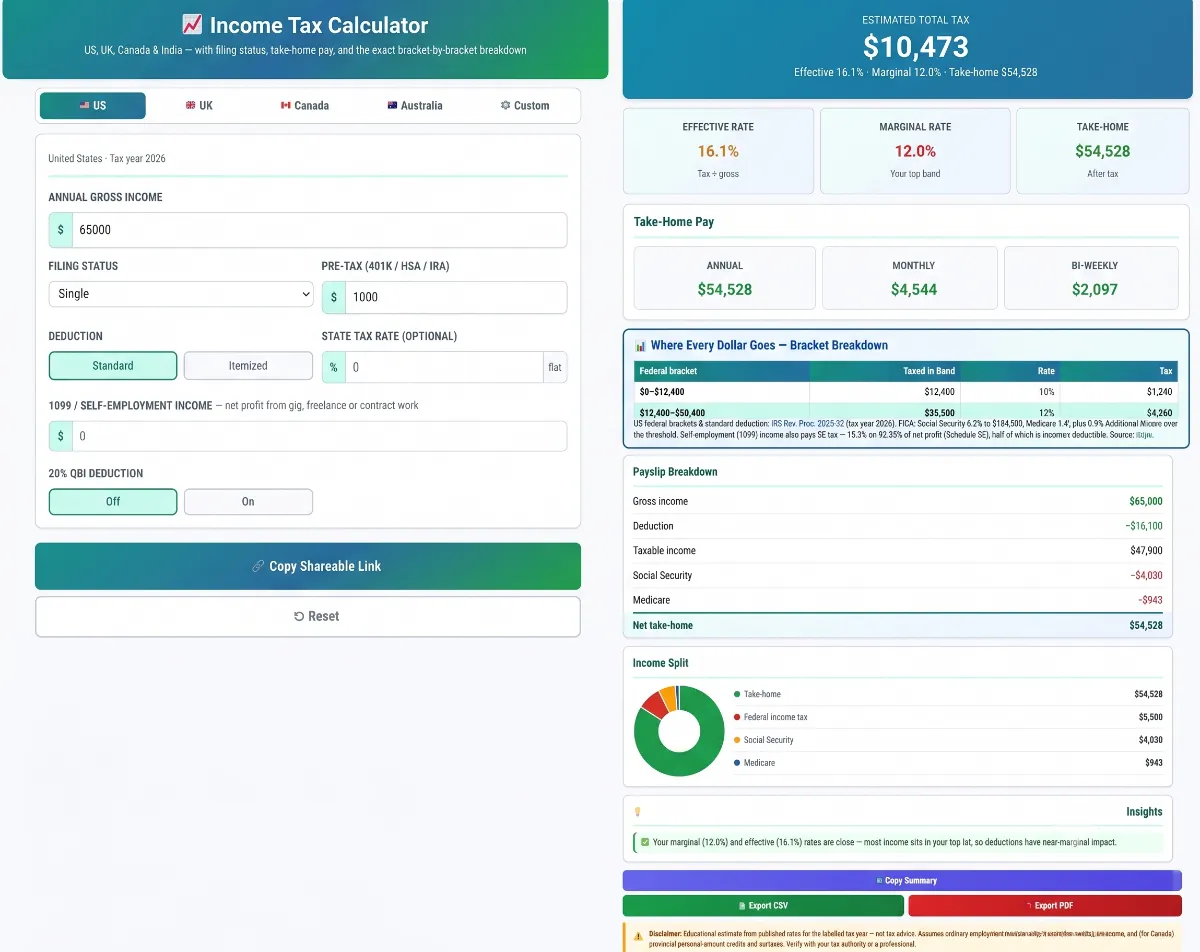
Estimate your tax, effective rate, and take-home pay.
Do GoFundMe Donations Count as Tax Deductible?
This comes up constantly, and the research gives a clear answer. The IRS doesn’t care about the platform. It cares about the recipient.
Gifts to individuals are not deductible charitable contributions under IRS rules. IRS Topic 506 and IRS Publication 526 both establish this. The research brief specifically identifies individual fundraising accounts — the kind most commonly used on crowdfunding platforms — as payments that don’t qualify for the charitable deduction.
That creates a specific problem with crowdfunding: a payment can look like a charitable donation — you’re giving money to help someone — while failing every federal charitable-contribution requirement. The platform’s name doesn’t change the analysis. What matters is whether the recipient is a qualifying tax-exempt organisation under the IRS rules, or an individual.
Some GoFundMe campaigns are set up by or for qualifying nonprofit organisations rather than individuals. Those might qualify — but the test is the same: use the IRS Tax Exempt Organisation Search to confirm the recipient’s status before assuming deductibility. The IRS classification of the recipient governs the result, not the donor’s intention or the platform used.
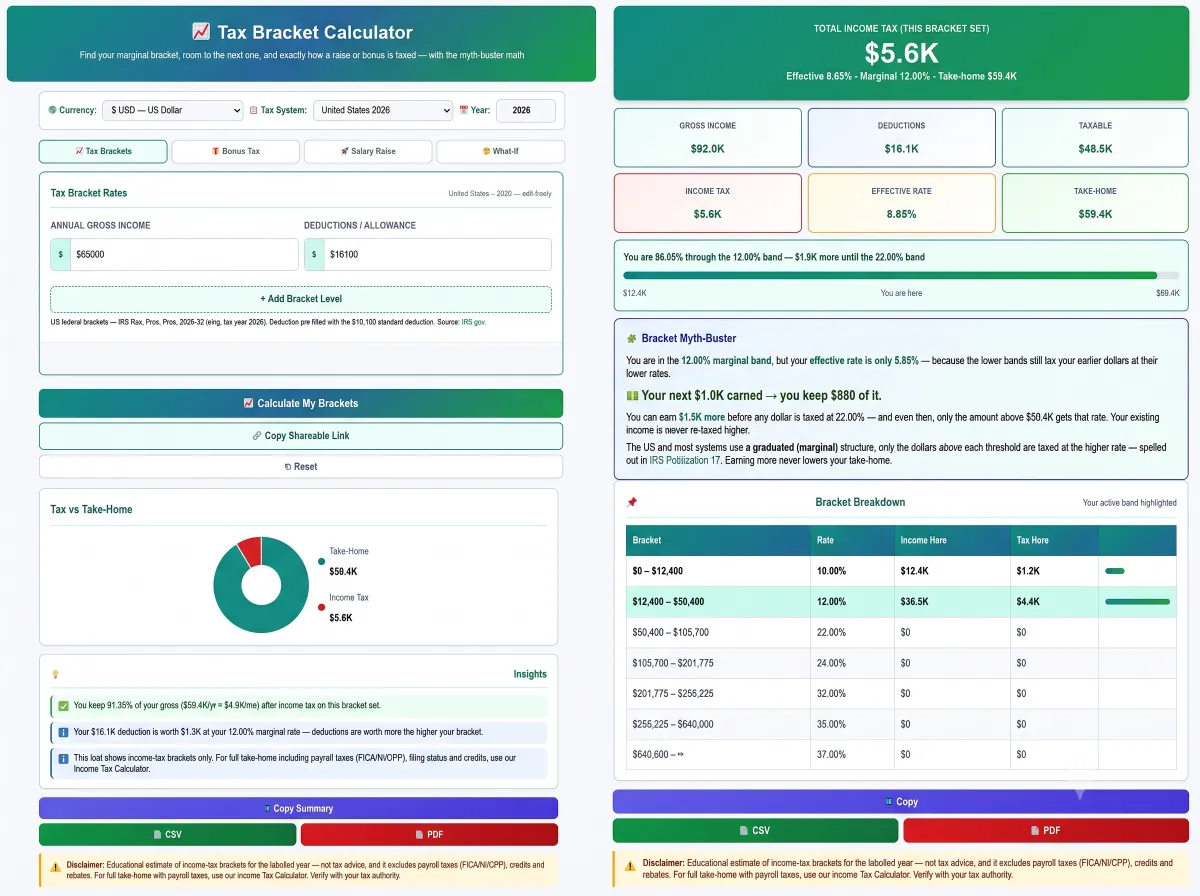
Find your marginal bracket, income tax, and take-home.
Are Non-Cash Donations Tax Deductible?
Property donations can qualify for a charitable deduction when two conditions are met: the recipient organisation qualifies, and the taxpayer follows the substantiation rules. But non-cash contributions come with more paperwork than cash; the valuation rules are different, and the non-itemizer $1,000/$2,000 provision doesn’t apply to them at all.
Valuation and limits for donated property
IRS Publication 526 generally uses fair market value as the starting point for donated property — the price a willing buyer would pay a willing seller when neither is under pressure to complete the transaction. But FMV isn’t always the right measure. Certain property types use different valuation methods under IRS rules:
Vehicles donated to charity often use the charity’s actual sale price rather than FMV (subject to IRS conditions)
Inventory and certain business property follow separate rules
Appreciated capital gain property held long-term may qualify at FMV, but different limits can apply based on the organisation type
The documentation escalation for non-cash contributions
The Form 8283 threshold — $500 in noncash contributions — is where the paperwork significantly increases. At $5,000 per item or similar-item group, a qualified appraisal from a qualified appraiser is generally required alongside Section B of Form 8283. At $500,000, the appraisal attaches directly to the return. Missing any of these documentation steps can result in a denied deduction even when the organisation qualifies, and the FMV is genuine.
The research brief makes the hierarchy clear: documentation requirements escalate with contribution value, and the failure point for most non-cash deductions is the paper trail — not the underlying gift.
I Ran a $1,000 Donation Through SaveXpert’s Income Tax Calculator
I used a simple 2026 example: a single taxpayer taking the standard deduction who makes a $1,000 qualifying cash contribution to an eligible nonprofit. Here’s the structure of what that shows.
The $1,000 contribution qualifies for the full non-itemizer deduction under Public Law 119-21, Section 70424 — assuming it’s cash, it goes to a qualifying organisation, and the bank record exists. That $1,000 reduces taxable income by $1,000. The actual tax saving from that deduction depends on which bracket the taxpayer’s taxable income falls in.
| Marginal Tax Rate | $1,000 Deduction Produces | Applies When Taxable Income Falls In… |
|---|---|---|
| 10% | ~$100 in tax savings | Single filer: up to projected ~$12,800 (2026 tax year) |
| 12% | ~$120 in tax savings | Single filer: projected ~$12,801–$52,025 |
| 22% | ~$220 in tax savings | Single filer: projected ~$52,026–$109,125 |
| 24% | ~$240 in tax savings | Single filer: projected ~$109,126–$208,325 |
Illustrative model only. Tax savings = deduction amount × marginal rate. 2026 bracket thresholds from IRS Revenue Procedure 2025-32. Actual savings depend on your specific tax situation.
The point of running this model is to show the deduction-vs-credit distinction visibly. A $1,000 tax credit would save $1,000 in tax regardless of bracket. A $1,000 deduction saves between $100 and $240 depending on where taxable income sits. The research brief is clear that the 2026 non-itemizer provision creates a deduction — not a credit. Building planning assumptions around the wrong calculation type produces the wrong expected savings.
🧮 SaveXpert Tax Calculators — Free & No Signup
The Income Tax Calculator estimates total federal tax liability using your taxable income, filing status, and applicable deductions — so you can see what a $1,000 or $2,000 charitable deduction actually does to your tax bill in your specific bracket. The Tax Bracket Calculator identifies which bracket your taxable income falls in, which directly determines how much a deduction saves you.
Educational note: Calculators model scenarios for informational purposes only. Source: IRS Topic 506 · IRS Publication 526
What the Research Shows Works
Identify which framework applies to you before calculating anything.
The $1,000/$2,000 non-itemizer deduction and the 0.5% AGI floor for itemizers aren’t two options you choose between — they’re two different systems that apply to two different filer types. Non-itemizers use the cap. Itemizers use the floor plus the existing percentage limits. Getting this wrong at the start produces a deduction calculation that doesn’t match IRS rules.
Check the recipient before the donation, not after.
The deduction depends entirely on the recipient’s qualifying status. A well-intentioned cash donation to a non-qualifying recipient produces zero charitable deduction. The IRS Tax Exempt Organisation Search takes about 30 seconds to confirm status before you give. Checking after is harder — and doesn’t change the result.
Cash-only for the non-itemizer provision.
The $1,000/$2,000 non-itemizer deduction applies to qualifying cash contributions. Non-cash property donations don’t count toward the cap, and the non-itemizer provision doesn’t create a deduction for them at all. Clothing, household items, vehicles, and stock donations follow a different set of rules — and can only produce a deduction for itemizers who meet the substantiation requirements.
The documentation requirement is binary — you either have it or the deduction is at risk.
IRS Topic 506 establishes specific record requirements for every contribution level. A bank record or written communication from the organisation for cash donations of any amount. A contemporaneous written acknowledgment for $250 and above. Form 8283 for noncash contributions above $500. These aren’t bureaucratic suggestions — they’re the substantiation that makes a claimed deduction defensible. Missing records at filing time doesn’t get reconstructed after a review.
The deduction reduces taxable income — calculate savings using your marginal rate.
The research brief warns against claiming a specific tax-saving strategy without running the calculation. A $1,000 deduction saves $220 at 22% and $120 at 12%. A taxpayer in the 10% bracket saves $100 on a $1,000 donation — real money, but not the same as a $1,000 credit.

Realistic Expectations for the 2026 Charitable Deduction
The 2026 rule creates a genuine new federal benefit for non-itemizers. It’s permanent. It’s substantially higher than the expired COVID-era deduction. And it’s straightforward to claim for taxpayers who make qualifying cash donations to eligible organisations and keep the right records.
What the research doesn’t establish: a guaranteed tax outcome for any donation amount, or a study showing how much individual taxpayers will save. The IRS materials set out the rules and limits, not a promised dollar-for-dollar result. The actual benefit depends on the taxpayer’s marginal rate, the specific contribution, the recipient’s qualifying status, and the documentation in hand at filing.
For itemizers, the 0.5% AGI floor is a new layer to calculate — not a reason to change giving behaviour, but a real change to how the itemized deduction is computed. A taxpayer who previously itemized $3,000 in charitable contributions on a $100,000 AGI now has a $500 floor — meaning $2,500 of those contributions feeds the itemized deduction, not the full $3,000.
The 2026 tax year gets filed in 2027. Contributions made between January 1 and December 31, 2026 are eligible for the 2026 tax return. The research brief doesn’t establish a special contribution deadline beyond the standard December 31 year-end cutoff.
Bottom Line: 5 Steps to Claim the 2026 Charitable Deduction Correctly
1. Confirm you’re taking the standard deduction — the $1,000/$2,000 cap only applies to non-itemizers:
The Public Law 119-21 non-itemizer provision and the 0.5% AGI floor for itemizers are mutually exclusive frameworks on the same return. If you itemize, the $1,000/$2,000 cap doesn’t apply to you — you’re in the floor framework instead, and your charitable deduction calculation starts with 0.5% of AGI before any contribution counts. If you take the standard deduction, the cap applies, and the floor doesn’t. Establishing which situation you’re in is the first step, not an afterthought.
2. Verify the recipient’s qualifying status using the IRS search tool — before donating, not after:
A cash contribution to a non-qualifying recipient produces no deduction, regardless of the donor’s intent or the amount. Use the IRS Tax Exempt Organisation Search to confirm eligibility before you give. Individual crowdfunding accounts, political organisations, civic leagues, and social clubs don’t qualify. Once you’ve confirmed the recipient, the recipient’s IRS status doesn’t change between the gift and the filing — but if it was wrong at the time of the donation, no documentation fixes that retroactively.
3. Gather the documentation before the filing deadline — not during a review:
IRS Topic 506 requires a bank record or written communication from the organisation for all cash donations — showing name, date, and amount. Contributions of $250 or more require a contemporaneous written acknowledgment, including a statement on whether goods or services were provided in exchange. For noncash contributions above $500, Form 8283 is generally required. These records need to exist at filing time. Requesting acknowledgments months after a contribution creates risk if the organisation has changed status or can’t provide the documentation retroactively.
4. If you itemize, calculate the 0.5% AGI floor before estimating your charitable deduction:
Public Law 119-21, Section 70425 means your first 0.5% of AGI in charitable contributions doesn’t produce an itemized deduction. On $80,000 AGI, that’s a $400 floor. On $150,000 AGI, that’s $750. This applies on top of — not instead of — the existing 60% of AGI general limit and the lower percentage limits for certain organisation types and contribution types. If your total charitable giving is small relative to your AGI, the floor may eliminate a meaningful portion of what you expected to deduct.
5. Run the Income Tax Calculator using your marginal rate before treating any deduction as a specific savings amount:
The non-itemizer charitable deduction is a deduction — not a credit. The tax savings equal the deduction amount multiplied by your marginal tax rate. At 12%, $1,000 saves $120. At 22%, $1,000 saves $220. At 10%, $1,000 saves $100. The Income Tax Calculator and Tax Bracket Calculator both help visualise this accurately before you incorporate a specific number into your planning. A $1,000 deduction is a real and meaningful benefit — it just isn’t a $1,000 reduction in your tax bill.
“The number that most changes how I read the 2026 charitable deduction story isn’t the $1,000 non-itemizer cap — it’s the 0.5% AGI floor that applies to itemizers at the same time. Most coverage focuses on the new deduction for standard-deduction filers, which is a real and meaningful change. But the AGI floor is the quieter structural shift that affects donors giving larger amounts. A taxpayer with $150,000 in AGI who itemizes now has to clear a $750 floor before any of their charitable contributions count toward the itemized deduction. The two provisions came from the same law — Public Law 119-21 — and they work in opposite directions for different filer types. Understanding which one applies to you is the only way to calculate your actual 2026 charitable deduction correctly.”
— Kevin Brown, Lead Researcher at SaveXpert.com
Frequently Asked Questions
Ans: Yes. Starting with tax years beginning after December 31, 2025, non-itemizers can claim a charitable deduction under Public Law 119-21, Section 70424. The maximum is $1,000 for taxpayers who don’t file jointly and $2,000 for married couples filing jointly. The provision applies to qualifying cash contributions made to eligible tax-exempt organisations. IRS Topic 506 and the 2026 Form 1040-ES both confirm the amounts and the cash-only requirement. This provision is permanent, not temporary.
Ans: It depends on whether you itemize. Non-itemizers can deduct up to $1,000 in qualifying cash contributions (single filers) or $2,000 (married filing jointly) under Public Law 119-21. Itemizers don’t use the cap — instead, they face a new 0.5% AGI floor that reduces the deductible portion of their charitable giving, on top of the general 60% of AGI limit and the lower limits (20%, 30%, or 50%) that apply to certain contribution types and organisation types per IRS Publication 526.
Ans: Per IRS Topic 506: cash donations of any amount require a bank record or written communication from the qualifying organisation showing its name, the contribution date, and the amount. Contributions of $250 or more require a contemporaneous written acknowledgment that also states whether the organisation provided goods or services in exchange — and if so, their estimated fair market value. Noncash contributions above $500 generally require Form 8283. Above $5,000 per item, Section B of Form 8283 plus a qualified appraisal is generally required.
Ans: Generally not — because most GoFundMe campaigns raise money for individuals, and the IRS doesn’t allow deductions for gifts to individuals. IRS Topic 506 and IRS Publication 526 both establish the recipient test: only contributions to qualifying tax-exempt organisations qualify. Some campaigns raise money for a qualifying nonprofit rather than an individual — those might qualify, but the test is the recipient’s IRS status, not the platform or the donor’s intention. Use the IRS Tax Exempt Organisation Search to check.
Ans: Contributions must generally be made by December 31, 2026 to count on a 2026 tax return — the standard IRS year-end cutoff. Public Law 119-21 establishes that the non-itemizer provision applies to tax years beginning after December 31, 2025, meaning the 2026 tax year. Those returns are generally filed in 2027. The research brief doesn’t establish a separate special deadline beyond this standard rule. Check IRS charitable contributions guidance for any specific contribution type that may have different timing rules.
Ans: A deduction reduces taxable income — the tax savings depend on the taxpayer’s marginal rate. A tax credit reduces the tax bill dollar-for-dollar. The 2026 non-itemizer provision under IRS Topic 506 and Public Law 119-21 is a deduction, not a credit. A $1,000 charitable deduction at a 22% marginal rate saves approximately $220 in federal income tax. At 12%, the same $1,000 deduction saves approximately $120. A $1,000 tax credit would save $1,000 regardless of marginal rate — a very different benefit. The Tax Bracket Calculator shows which bracket your taxable income falls in, which determines how much a $1,000 deduction actually saves in your specific case.