
ⓘ Educational Disclosure:
This article is for educational and informational purposes only. It does not constitute financial, legal, tax, lending, or investment advice. SaveXpert and its authors are not licensed financial advisors, CPAs, attorneys, or tax advisors. All data comes from publicly available government and institutional sources. Always consult a qualified professional before making investment decisions.
Are Black Friday deals really worth it? According to the FTC, a Black Friday discount is only genuine when the comparison price was a bona fide price offered regularly for a reasonably substantial period. Federal data from BLS, CFPB, and FTC sources do not establish that Black Friday produces the lowest annual prices across all product categories. What the research does establish: the total purchase cost (including fees), the former price history, product condition, and financing terms all determine whether a specific deal represents real value. CFPB research shows that financing methods — particularly deferred-interest credit and Buy Now Pay Later — can raise the effective cost of a Black Friday purchase above the advertised sale price
Key Takeaways
- Problem: Heavily advertised Black Friday discounts can look like automatic savings — but a percentage markdown only means something when the price it’s measured from was real to begin with.
- Solution: The FTC is clear: a former price is only a legitimate comparison when it represents an actual price offered regularly for a reasonably substantial period. And the full cost — including shipping, fees, taxes, and financing — determines the real price, not the headline number.
- Result: Federal data doesn’t establish that Black Friday produces the lowest annual prices across all products. What it does establish is a framework for checking whether a specific deal is genuine — and CFPB research shows that financing methods can convert a good sale price into a more expensive purchase than it first appears.
- Source: FTC Deceptive Pricing Guidelines · CFPB Consumer Research
- Time To Read: 7 Minutes
Table of Contents
1. The Advertised Percentage Doesn’t Prove Savings
2. When a Black Friday Discount Is Real and When It’s Deceptive
3. Are Black Friday Prices Actually the Lowest of the Year?
4. Which Product Categories Show Stronger Black Friday Pricing
5. How Financing Turns a Good Sticker Price Into a Different Calculation
6. What to Check Before Calling a Black Friday Price a Deal
7. What the FTC’s 2025 Fee Rule Changed — and What It Didn’t
8. What the Research Shows Works
The FTC draws a clear line. A Black Friday discount is only a genuine saving when the comparison price represents an actual price offered regularly for a reasonably substantial period. What the FTC doesn’t do is verify every Black Friday tag before it goes up. That means the $200 saving on the TV, the 50% off on the laptop, and the slashed-down appliance price all need to clear a test the shopper has to run themselves — before checkout.
The Advertised Percentage Doesn’t Prove Savings
A large Black Friday markdown can look compelling on a tag. The FTC’s position is that the percentage only tells you what the retailer claims — not whether the saving is real.
The FTC guidance that governs former-price comparisons sets a specific standard: a former price must represent an actual price offered regularly for a reasonably substantial period before the discount is advertised. A percentage calculated from an inflated reference price is measuring something other than what the shopper saved off a genuine market value.
Consider the standard television example. A set priced at $1,000 before Black Friday and advertised at $500 looks like a 50% discount. That calculation is only meaningful if $1,000 was a genuine regular price. If the $1,000 was set artificially high in the weeks before the promotion, the actual saving off a fair market price is something the percentage alone can’t establish.
That’s not an edge case — it’s the core issue the FTC’s guidance exists to address. The agency doesn’t say every large discount represents deception. It sets conditions for when a former-price comparison is legitimate. Those conditions require a shopper to do independent work: find the price history, not just accept the tag.

When a Black Friday Discount Is Real and When It’s Deceptive
The FTC’s framework gives a clear structure for separating genuine deals from misleading ones. Both can carry identical-looking percentage tags.
| Scenario | What It Looks Like | What FTC Guidance Says |
|---|---|---|
| Genuine discount | Price reduced from a reference price that was regularly charged to the public for a substantial period | Former-price comparison is legitimate — the percentage represents real savings off a real price |
| Inflated reference price | A “was” price set above the item’s actual regular selling price to produce a larger-looking discount | FTC says an artificially inflated former price can make the advertised bargain false or deceptive |
| Hidden total cost | Sale price looks favourable, but shipping, handling, taxes, or fees raise the real cost | FTC guidance tells consumers to compare the full total cost — not just the headline price |
| Scam pricing | Unusually low price on an expensive item from an unfamiliar seller | FTC warns that unusually low prices can signal fake shopping sites; recommends investigating the seller |
Source: FTC — Deceptive Pricing Guidance · FTC — Online Shopping
The FTC also makes a separate point about payment method. Credit cards generally provide stronger dispute protections than gift cards, wire transfers, payment apps, or cryptocurrency for online-shopping problems. That distinction matters specifically when a deal turns out to be a scam or the product doesn’t arrive as described — the payment method affects what recourse is available after the transaction.
Are Black Friday Prices Actually the Lowest of the Year?
This is where the federal data draws an honest limitation — and the research brief is clear about it.
No federal source publishes an all-retailer average Black Friday discount for any year. The available government datasets don’t establish that Black Friday prices represent the lowest annual price for typical products. That means the research can’t support a blanket statement that Black Friday always beats other shopping periods — and it can’t support the reverse either.
What the BLS data does show is the spending and price-movement context around the season.
| BLS Data Point | Figure | What It Measures |
|---|---|---|
| Average annual consumer unit expenditure (2024) | $78,535 | Total spending — not Black Friday pricing specifically |
| Year-over-year expenditure increase (2023→2024) | $1,377 / 1.8% | Broader consumer spending trend |
| Average monthly expenditure equivalent (2024) | $6,545 | Monthly spending context |
| Average income before taxes per consumer unit (2024) | $104,207 | Income context for spending capacity |
| All-items CPI (December 2023 → December 2024) | +2.9% | Broad price movement — not retail discounts |
| All-items CPI (December 2024 → December 2025) | +2.7% | Broad price movement — not retail discounts |
Source: BLS — Consumer Expenditures in 2024 · BLS — Consumer Price Index 2024 in Review
Those CPI figures show that broad consumer prices were moving between 2024 and 2025. When prices shift over time, a dollar-amount saving depends entirely on the item’s actual price history — not on the calendar date of the promotion. The advertised percentage doesn’t provide that context.
Private retail analysis adds one relevant finding: dynamic pricing allows retailers to adjust prices constantly based on demand, competitor actions, and location. That finding from private-source analysis (not federal data) helps explain why timing alone can’t prove whether a deal represents the year’s lowest price. An item’s price on Black Friday is one snapshot in an ongoing dynamic — not necessarily the bottom of its annual price range.
Which Product Categories Show Stronger Black Friday Pricing
The research brief draws a clear distinction between what federal sources can verify and what private price-tracking analysis suggests — and it’s worth preserving that distinction explicitly.
| Source Type | What It Says About Black Friday Categories | How to Weight It |
|---|---|---|
| Federal sources (FTC, BLS, CFPB) | No all-retailer Black Friday discount rate established; no federal data identifies specific product categories as reaching lowest annual prices on Black Friday | Authoritative on rules and spending data — not on category pricing patterns |
| Private price-tracking analysis | Technology devices and kitchen gadgets frequently show strong Black Friday pricing; expert opinion suggests discounts around 30% can represent a good deal | Useful category-level context — not a federal benchmark or universal rule |
Source: FTC · BLS · CFPB | Private-source category analysis: NerdWallet deal research (not a government source)
The 30% expert-opinion figure from private deal analysis isn’t a federal threshold. The research brief is explicit about that. What it offers is a rough benchmark for comparing against a specific item’s price history — not a standard that applies across all products or all retailers.
The honest research position is: if you’re looking at tech or kitchen products on Black Friday and the discount is 30% or more off a verified genuine former price, that aligns with what private analysis has described as a strong deal. For other product categories, the data is thinner. The BLS data confirms people spend heavily in the final months of the year — it doesn’t confirm they’re getting the year’s best prices while doing it.

Find out how long it takes to clear your card — and the interest cost.
How Financing Turns a Good Sticker Price Into a Different Calculation
The sticker price is one number. The total financial cost of the purchase — after the financing arrangement plays out — can be a different number. CFPB research shows how that gap opens up.
Buy Now Pay Later (BNPL)
| BNPL Feature | What CFPB Research Shows |
|---|---|
| Scale of use | 21% of consumers with a credit record financed at least one purchase through BNPL during the period analysed |
| Black Friday BNPL borrowing | Consumers borrowed nearly $150 million per day through BNPL from Black Friday through the period analysed |
| Typical structure | Four or fewer instalments; CFPB’s 2021 inquiry found many products required a 25% down payment at checkout |
| Interest rate | Typically 0% for the pay-in-four structure — but 0% interest doesn’t mean no debt |
| Legal classification | CFPB defines pay-in-four BNPL as closed-end instalment loans — debt obligations regardless of the interest rate |
Deferred-interest promotional credit
This is the more consequential risk for large Black Friday purchases. “No interest if paid in full” is not the same as “no interest.” The CFPB explains the difference directly: if the promotional balance isn’t paid off by the deadline, interest charges dating back to the original purchase date can apply to the remaining balance. A $600 appliance bought in November under a 12-month “no interest if paid in full” offer can become significantly more expensive if there’s still a balance on the account in month 13.
⚠️ “No interest if paid in full” ≠ “no interest”: According to CFPB guidance, deferred-interest financing applies retroactive interest dating back to the purchase date if the balance isn’t cleared before the promotional deadline. A purchase that looks like it benefited from a sale price and 0% financing can end up costing substantially more — all charged at once at the end of the promotional period.
The research brief also notes a 48% revolving rate in the CFPB’s retail credit-card analysis (2023 data, general-purpose cards). That figure provides context: a substantial share of credit-card balances aren’t paid in full each month, which means deferred-interest promotions carry real default risk for a meaningful proportion of card users.
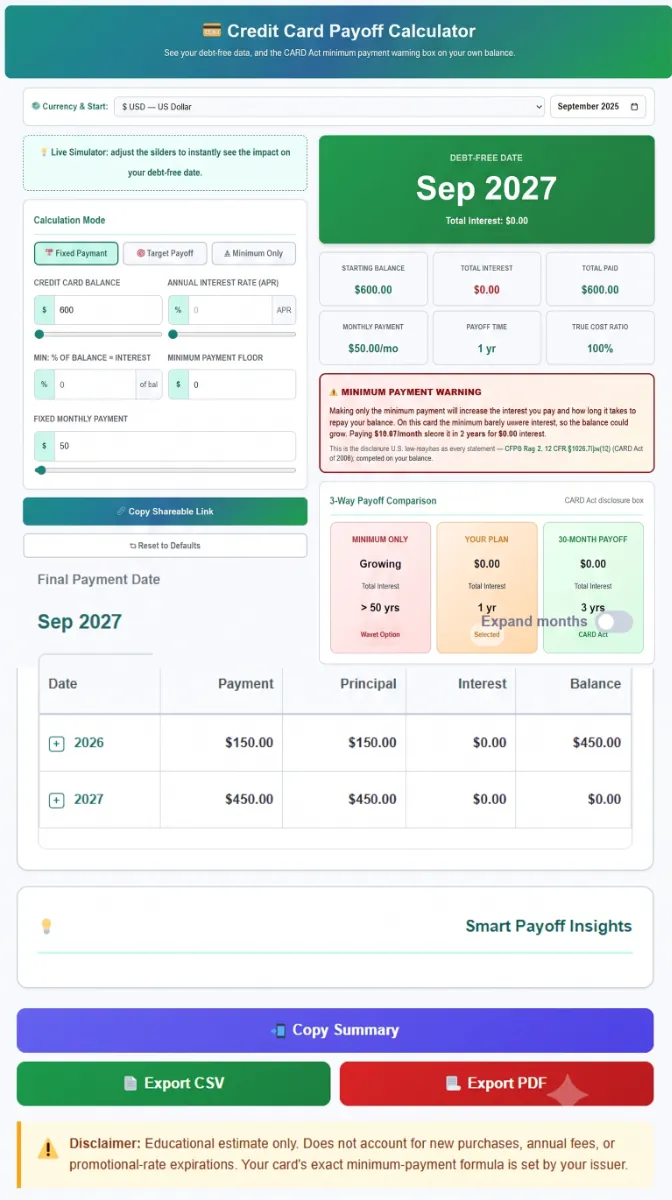
💳 Run the Financing Numbers: SaveXpert Credit Card Payoff Calculator
CFPB research points to the purchase amount, promotional period, APR, and repayment schedule as the relevant variables in any “no interest” offer. I ran a $600 Black Friday appliance through the Credit Card Calculator using a 12-month deferred-interest period and a standard retail APR to show what the cost looks like if the balance isn’t cleared before the deadline. The difference between the sale price and the total cost with retroactive interest is the number that matters — not the headline markdown on the tag.
Educational note: Calculator models scenarios for informational purposes only. Source: CFPB — Deferred Interest Guidance
What to Check Before Calling a Black Friday Price a Deal
FTC guidance provides four concrete checks that apply to any online purchase — and Black Friday shopping raises the stakes on all four because of the time pressure retailers deliberately create.
Step 1 — Compare the full price, not the headline number
Shipping, handling, delivery, taxes, and other fees are part of the real price. A $150 saving on a product can disappear when the advertised retailer charges $40 in shipping and a competing retailer offers a higher price but free delivery. Calculate the total checkout cost before comparing.
Step 2 — Check the former price independently
The FTC’s former-price standard requires a genuine prior price offered regularly for a substantial period. The shopper has to verify that independently. Price-tracking browser extensions and price-history tools let you see what an item actually sold for over the past 60–90 days — the most useful tool for testing the validity of a “was” price on a Black Friday tag.
Step 3 — Read the product condition and terms
FTC guidance specifically flags terms like “refurbished,” “vintage,” and “close-out” as descriptions that change what the buyer receives. A Black Friday “new” price comparison applied to a refurbished unit is a different purchase than the markdown implies. Read the full product description and return/refund terms before treating a sale price as comparable to the regular new-product price.
Step 4 — Evaluate financing as a separate decision
The sale price and the financing arrangement are two separate questions. Evaluate them separately. CFPB research shows that deferred-interest credit and BNPL can raise the effective total cost of a purchase even when the original sale price was favourable. If you can’t pay in full before the promotional period ends, calculate the total cost with interest before counting the sale price as your final number.
💡 One more FTC warning for Black Friday specifically: The FTC says an unusually low price on an expensive product can signal a fake shopping site or scam — not an exceptional deal. Verify the seller’s legitimacy, check shipping and refund terms, and use a credit card rather than gift cards, wire transfers, payment apps, or cryptocurrency. Credit cards carry stronger dispute protections when a purchase goes wrong.
What the FTC’s 2025 Fee Rule Changed — and What It Didn’t
This needs a direct correction because the 2025 FTC rule gets misrepresented in Black Friday content fairly regularly.
The FTC’s Rule on Unfair or Deceptive Fees took effect on May 12, 2025. The rule requires covered businesses to disclose total prices upfront and prohibits misrepresentations about fees.
The critical qualifier: the rule specifically covers live-event tickets and short-term lodging. It does not cover ordinary retail merchandise.
| Product or Service Type | Covered by the 2025 FTC Fee Rule? | Governing Standard |
|---|---|---|
| Concert and sporting event tickets | ✅ Yes | FTC Rule on Unfair or Deceptive Fees (16 C.F.R. Part 464) |
| Short-term lodging (hotels, vacation rentals) | ✅ Yes | FTC Rule on Unfair or Deceptive Fees (16 C.F.R. Part 464) |
| Televisions, appliances, electronics | ❌ No | FTC’s broader deceptive advertising rules and former-price comparison guidance |
| Clothing, toys, kitchen gadgets | ❌ No | FTC’s broader deceptive advertising rules and former-price comparison guidance |
| Any ordinary Black Friday retail merchandise | ❌ No | FTC’s broader deceptive advertising rules and former-price comparison guidance |
Source: FTC — Rule on Unfair or Deceptive Fees FAQ · 16 C.F.R. Part 464
The research found no verified federal law or court decision as of September 2026 that establishes a universal Black Friday discount percentage, mandatory sale duration, or requirement that any product reach its lowest annual price during the Black Friday period. The protections that exist for retail shoppers are the FTC’s longstanding deceptive advertising rules — not a new 2025 Black Friday regulation.
What the Research Shows Works
Running the former-price test independently, not trusting the tag.
The FTC’s framework doesn’t enforce itself — the shopper has to check. Price-history tools exist precisely because the former-price test requires knowing what the item actually sold for before the promotional markup. Without that check, the advertised percentage is unverifiable.
Calculating the total purchase cost before comparing prices.
The FTC’s guidance on comparing total costs — including shipping, handling, delivery, taxes, and fees — is the most practical single check available. A price comparison that only covers the headline number is incomplete.
Reading product condition and terms before purchasing.
FTC guidance specifically calls out “refurbished,” “vintage,” and “close-out” as terms that change the purchase. A sale price that’s legitimately lower because it refers to a refurbished unit — compared against a “new” former price — is a different calculation than it appears.
Separating the financing decision from the sale-price decision.
CFPB findings on deferred-interest credit and BNPL show that the two decisions affect the total cost differently. A good sale price paired with financing that doesn’t get paid off before a deadline can cost more in total than a higher regular price paid outright.
Applying more scrutiny, not less, to unusually aggressive discounts.
The FTC’s warning about unusually low prices functioning as scam signals runs counter to how most people approach a big markdown. The biggest-looking discounts during high-pressure shopping periods carry specific risks the FTC has flagged — and credit cards provide the most recoverable option if something goes wrong.
The data does not support treating the calendar date of Black Friday as proof of the year’s lowest price for any product. The BLS data shows broad consumer price movement. The CFPB data shows financing risks. The FTC data shows the conditions for legitimate discounts. None of those datasets confirm that Black Friday produces universally lower prices than other shopping periods across all product categories.

Bottom Line: 5 Steps to Evaluate a Black Friday Deal
1. Run the former-price test before trusting the discount percentage:
Per FTC guidance, a former price is only a legitimate comparison when it represents an actual price offered regularly for a reasonably substantial period. Use a price-tracking tool to check what the item actually sold for in the 60–90 days before Black Friday. A 50% discount from a fabricated reference price is not a 50% saving — and the tag won’t tell you which one it is.
2. Calculate the total purchase cost — not just the sale price:
FTC guidance is explicit: shipping, handling, delivery, taxes, and other fees are part of the real price. A $100 saving on a product at one retailer can disappear when that retailer’s shipping and handling costs more than a competitor’s. Compare total checkout costs, not headline numbers.
3. Check the product condition and return terms before buying:
The FTC specifically flags “refurbished,” “vintage,” and “close-out” as descriptions that change what you’re receiving. A new-product price comparison applied to a refurbished item is a different purchase than the markdown implies. Read the full product description and refund policy — not just the price tag.
4. Treat financing as a separate decision — and model the worst case:
CFPB research shows that “no interest if paid in full” means deferred interest — retroactive charges back to the purchase date if the balance isn’t cleared by the deadline. BNPL creates instalment debt even at 0%. If you can’t pay in full before the promotional period ends, run the Credit Card Calculator with the item’s price and your card’s APR to see the real total cost before the sale price counts as a saving.
5. Apply more scrutiny to unusually low prices — not less:
The FTC warns that unusually low prices on expensive products can signal fake shopping sites or scams, not exceptional deals. Verify the seller’s legitimacy, check shipping and refund terms, and pay by credit card rather than gift card, wire transfer, or payment app — credit cards carry stronger dispute protections when a purchase goes wrong. The most aggressively discounted offer during a high-pressure shopping period is sometimes the one that needs the most checking.
“The finding from the FTC guidance that most changes how I read a Black Friday tag is the former-price standard. Retailers don’t have to prove what they claim about a comparison price before putting it on a sign. But the FTC’s position is clear: an artificially inflated former price can make the whole discount false or deceptive. A ‘60% off’ sign is only meaningful when the number it’s cutting from was a real price offered regularly to the public. Price-tracking history is the only way an individual shopper can run that test independently — and most people never run it.”
— Kevin Brown, Lead Researcher at SaveXpert.com
Frequently Asked Questions
Ans: The federal data doesn’t establish that Black Friday produces the lowest annual prices across all product categories. According to the FTC, a deal is only genuine when the comparison price represents a legitimate former price offered regularly for a substantial period. Whether a specific Black Friday deal beats prices available at other times of year depends entirely on that item’s price history — not on the calendar date of the promotion. The BLS data shows consumers spend heavily in the November–December period; it doesn’t confirm they’re getting the year’s lowest prices while doing so.
Ans: The FTC’s former-price standard is the test: if the “was” price wasn’t genuinely offered to the public regularly for a substantial period, the discount calculated from it isn’t legitimate. The practical check is a price-history tool that shows what the item actually sold for in the weeks and months before the Black Friday promotion. An item that was priced at $400 for ten months and then raised to $700 two weeks before Black Friday to support a “50% off” claim is not offering a real 50% saving — and the tag won’t tell you that. The price history does.
Ans: Private price-tracking analysis — not federal data — has found that technology devices and kitchen gadgets frequently show strong Black Friday pricing. The research brief specifically notes this is private category-level analysis, not a government-confirmed pattern. Federal sources from the FTC, BLS, and CFPB don’t establish a universal discount rule for any product category. For those specific categories, private analysis suggests the Black Friday period often produces competitive pricing — but that finding doesn’t mean every product reaches its lowest annual price that weekend.
Ans: The FTC monitors deceptive former-price inflation but federal economic data doesn’t prove a universal pattern of retailers raising prices immediately before Black Friday. Private retail analysis describes dynamic pricing — retailers adjusting costs based on demand, competitors, and location — which means prices can move in either direction at any time. The FTC’s deceptive pricing guidance exists precisely because inflated former prices are a documented pattern in retail advertising. Running a price-history check before a major purchase is the most reliable way to detect whether a specific product’s “before” price was genuine.
Ans: According to CFPB research, the answer depends entirely on the specific financing terms and whether the balance gets paid off before the promotional deadline. “No interest if paid in full” can mean deferred interest — retroactive charges dating back to the purchase if the balance remains at the deadline. BNPL creates instalment debt even at 0% interest. The CFPB found 21% of consumers with a credit record used BNPL during the analysed period. A Black Friday sale price that gets partially funded through deferred-interest credit isn’t a net saving if the promotional period expires with a balance remaining.
Ans: The FTC’s Rule on Unfair or Deceptive Fees, which took effect May 12, 2025, requires covered businesses to disclose total prices upfront and prohibits hidden fee misrepresentations. The rule specifically covers live-event tickets and short-term lodging. It does not cover ordinary retail merchandise — televisions, appliances, clothing, toys, kitchen gadgets, and similar Black Friday products are not covered by the 2025 rule. Those products remain under the FTC’s longstanding deceptive advertising guidelines and former-price comparison standards, which have existed for decades. As of September 2026, no verified federal law establishes a universal Black Friday discount requirement or mandates that products reach their lowest annual price during the holiday weekend.