

ⓘ Educational Disclosure:
This article is for educational and informational purposes only. It does not constitute financial, legal, tax, lending, or investment advice. SaveXpert and its authors are not licensed financial advisors, CPAs, attorneys, or tax advisors. All data comes from publicly available government and institutional sources. Always consult a qualified professional before making investment decisions.
How much should you spend on gifts per person? According to the CFPB, there is no universal dollar amount. Federal agencies don’t publish a recommended per-person gift amount. The CFPB instead advises setting a total seasonal budget based on household finances first, then dividing that total across recipients. The Federal Reserve’s 2025 household data shows why a single number can’t apply to all households: financial capacity — from emergency savings to month-end cash flow — varies sharply across income groups. A per-person gift amount is only meaningful when it comes from a total that your household can actually sustain.
Key Takeaways
- Problem: People search for a per-person gift amount to budget by — $50 per friend, $100 per family member — but no federal source publishes one. Using private survey averages as a personal target ignores wide income and savings differences across households.
- Solution: The CFPB’s holiday guidance runs in a specific order: set a total seasonal budget from available funds first, list every recipient, assign an amount to each person second. That sequence — total before per-person — is the only version that can’t produce unplanned debt
- Result: The Federal Reserve’s household data shows that financial capacity varies sharply by income group — 75% of adults earning $100,000+ have three months of emergency savings, versus 21% of adults earning below $25,000. A fixed per-person gift target treats those households identically. The research doesn’t support that.
- Source: CFPB Holiday Spending Guidance · Federal Reserve Household Report 2025
- Time To Read: 6 Minutes
Table of Contents
1. There Is No Federal Benchmark for How Much to Spend Per Gift
2. The CFPB Framework: Total Budget First, Per-Person Allocation Second
3. Why BLS Data Can’t Tell Us the Average Gift Amount Per Person
4. How Financial Capacity Makes a Universal Number Meaningless
5. How to Split a Gift Budget Across Recipients
6. What Private Surveys Show (and Why They’re Context, Not Benchmarks)
7. Lower-Cost Options the CFPB Identifies
8. What the Research Shows Works
There is no federal figure for how much you should spend on each gift recipient. The IRS hasn’t published one. The CFPB hasn’t published one. The Federal Reserve and BLS haven’t published one. Common numbers like “$50 per friend” or “$100 per family member” appear in personal finance content and private surveys — they don’t exist in government data. What the CFPB has published is a framework: set a total seasonal budget from available funds, list your recipients, assign amounts to each, and track spending against the plan. The research supports that sequence. It doesn’t support any specific per-person dollar figure.
There Is No Federal Benchmark for How Much to Spend Per Gift
The research brief reviewed IRS, CFPB, Federal Reserve, and BLS publications. None publishes a recommended per-person gift amount — not for family members, friends, coworkers, or any other recipient category.
| Source | What It Publishes on Gift Spending | What It Doesn’t Publish |
|---|---|---|
| IRS | Annual standard deductions, tax inflation adjustments | No recommended per-person gift amount; no holiday spending allowance |
| CFPB | A holiday budgeting framework: set total → list recipients → allocate → track | No national per-person dollar figure for gifts |
| Federal Reserve | Household financial capacity data (emergency savings, income breakdowns, credit) | No recommended gift spending amount by income group or household type |
| BLS | Annual consumer-unit expenditure totals ($78,535 average in 2024) | No average gift-per-person figure — gifts outside the consumer unit excluded from tables since 2020 |
Source: CFPB Holiday Spending Plan · BLS Consumer Expenditures 2024 · Federal Reserve Household Report 2025
Common figures like “$50 per person” or “$100 per person” don’t come from these sources. They appear in personal budgeting guides and private surveys. The distinction matters because household finances vary widely — what fits one budget creates hardship in another.

The CFPB Framework: Total Budget First, Per-Person Allocation Second
The CFPB’s holiday spending guidance runs in a specific order that the research brief identifies as the core framework for gift budgeting. The order matters.
| Step | What the CFPB Framework Says | Why the Order Matters |
|---|---|---|
| 1. Set a total seasonal budget | Based on available household funds — not a national average or a per-person starting point | The total is the constraint; everything else divides inside it |
| 2. List all recipients and seasonal expenses | Gifts are one category; travel, food, decorations, charitable giving, activities also belong in the total | Gifts-only planning underestimates the season |
| 3. Assign an amount to each recipient | Per-person amounts come from dividing the gift category total across recipients | Starting from per-person amounts and multiplying up to a total reverses the logic |
| 4. Track actual spending against the plan | Impulse purchases and financing costs can push spending beyond the planned amount | Tracking is how overruns appear on paper rather than in January credit statements |
Source: CFPB — Plan Your Spending to Avoid Holiday Debt · CFPB — Three Ways to Enjoy the Holidays Without Going Into Debt
The sequence is the point. Starting from “I want to spend $100 per person” and multiplying by ten recipients produces $1,000 — which may or may not fit the household’s available funds. Starting from available funds and allocating down to per-person amounts produces a gift limit that can’t exceed what the household has. The arithmetic is the same; the financial outcome is different.
The CFPB also warns specifically that credit-card interest, fees, and store-financing costs can add to the final cost of purchases made beyond the planned amount. Impulse spending during high-pressure shopping periods is explicitly named as a mechanism that pushes actual spending above plan.
Why BLS Data Can’t Tell Us the Average Gift Amount Per Person
This is the most important data integrity point in the article — and the one most commonly ignored in gift-spending content.
⚠️BLS data limitation — gifts outside the consumer unit excluded since 2020: The Bureau of Labor Statistics excludes gifts given to people outside the consumer unit from its published Consumer Expenditure tables since the 2020 midyear tables. That means BLS data doesn’t capture what consumers spend on gifts for others in the way most gift-budget articles imply. Any source that cites the BLS $78,535 annual consumer-unit figure to derive an “average gift amount” is working with a dataset that explicitly doesn’t count external gift spending. Source: BLS Consumer Expenditure Surveys
| BLS Figure | What It Measures | What It Can’t Be Used For |
|---|---|---|
| $78,535 — average annual consumer-unit expenditures (2024) | Total annual spending by a household on itself across all categories | Not a gift budget — and doesn’t include gifts given outside the household |
| $1,377 — expenditure increase 2023→2024 (1.8% nominal) | Year-over-year change in total household spending | Not specific to gifts; not a gift-budget adjustment figure |
| 83.7% — spending on housing, transport, food, healthcare, insurance/pensions | Share of household spending going to major non-discretionary categories | Shows how little is left for discretionary including gifts — not a gift benchmark |
| 2.4 — average consumer unit size (2024) | Average number of people per household | Dividing $78,535 by 2.4 does not produce a per-person gift figure |
Source: BLS — Consumer Expenditures 2024
The 83.7% figure is worth pausing on: housing (33.4%), transportation, food (12.9%), healthcare, and personal insurance/pensions collectively consume more than four-fifths of average consumer-unit spending. What remains for discretionary spending — including gifts — varies enormously by income, household size, and location. That’s the context in which any gift budget sits, and it makes a universal per-person gift figure even less meaningful.
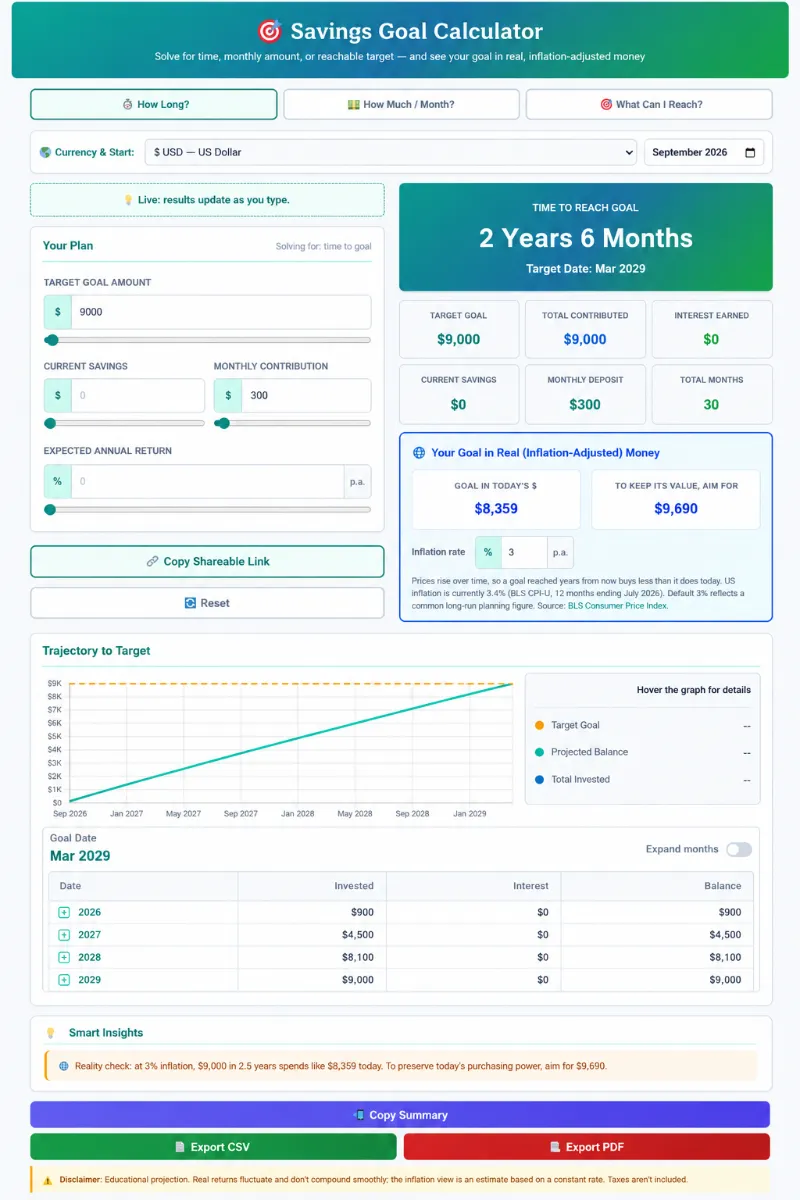
See how long it takes to reach your target.
How Financial Capacity Makes a Universal Number Meaningless
The Federal Reserve’s 2025 household report (published May 26, 2026, using 2025 data) provides the clearest picture of why one gift amount can’t apply to all households.
| Financial Capacity Measure | Percentage of Adults | Gift Budget Implication |
|---|---|---|
| Have 3 months of emergency savings (all adults) | 55% | Nearly half of adults start the holiday season without a full emergency buffer |
| Cannot cover 3 months of expenses by any means | 30% | Nearly one-third have limited financial flexibility before seasonal spending begins |
| Have 3 months emergency savings — income $100,000+ | 75% | Higher-income households have more room to set per-person gift amounts |
| Have 3 months emergency savings — income below $25,000 | 21% | Lower-income households face much tighter constraints for seasonal spending |
| Could cover a $400 emergency with cash or equivalent | 63% | 37% of adults face difficulty covering a $400 expense — less than many gift budgets |
| Could not cover a $400 emergency at all | 12% | For these households, any gift spending competes with financial stability |
| Would put a $400 emergency on credit and pay over time | 15% | Credit-financed emergency expenses and gift spending create compounding debt risk |
Source: Federal Reserve — Economic Well-Being of U.S. Households in 2025 (published May 26, 2026)
The income-savings gap is the critical number. The difference between 75% (income $100,000+) and 21% (income below $25,000) having three months of emergency savings means those two groups face completely different gift-budget constraints. A $100/person figure that works comfortably for the first group could genuinely compete with emergency reserves for the second.
The Federal Reserve also found that 86% of adults who always had money left over at month-end had three months of emergency savings — compared to 13% of adults who never had money left over at month-end. The research brief correctly notes this shows association, not causation. But it illustrates that the gap between households is not small.
How retirement savings adds another layer
The same Federal Reserve report found that 14% of non-retirees had borrowed from, cashed out, or reduced retirement contributions during the previous year. Among those who cashed out retirement funds, only 24% viewed their retirement plan as on track. The research doesn’t connect those actions specifically to gift purchases. It shows that current spending pressures — of which holiday giving is one — can intersect with long-term financial decisions in ways that a per-person gift target doesn’t account for.
How to Split a Gift Budget Across Recipients
Once a total gift budget is set, the CFPB framework calls for assigning amounts to each recipient. Here’s how the arithmetic works across different pool sizes and recipient counts.
| Total Gift Budget | 2 Recipients | 4 Recipients | 6 Recipients | 10 Recipients |
|---|---|---|---|---|
| $300 | $150 each | $75 each | $50 each | $30 each |
| $600 | $300 each | $150 each | $100 each | $60 each |
| $900 | $450 each | $225 each | $150 each | $90 each |
| $1,200 | $600 each | $300 each | $200 each | $120 each |
Equal-split calculation for illustration. Allocation can vary per recipient — the constraint is the total, not the per-person amount.
The table shows why recipient count matters as much as budget size. A household with $600 to spend on gifts and six recipients has $100 per person on an equal split — a manageable figure. Adding four more recipients with the same budget drops that to $60 each. Neither number is inherently right or wrong; what changes is the pool each number comes from.
The CFPB framework allows unequal allocation — assigning more to some recipients and less to others — as long as the total stays within the available amount. A $600 gift budget might assign $200 to a partner, $100 each to two parents, $75 each to two siblings, and $50 to a coworker gift exchange. The six-recipient total still comes to $600. The per-person amounts vary, but the total is fixed by what’s available, not by what each relationship “deserves.”
🎁 Run Your Own Numbers: SaveXpert Budget & Savings Goal Calculators
The CFPB treats gifts as one category inside a broader seasonal spending plan. The Budget Calculator is the right first tool — enter your income, regular monthly expenses, and savings to see what’s available for the holiday season before a gift pool number is set. The Savings Goal Calculator converts that gift total into a monthly savings target based on how many months remain before spending starts.
Educational note: Calculators model scenarios for informational purposes only. Source: CFPB Holiday Spending Plan Guidance
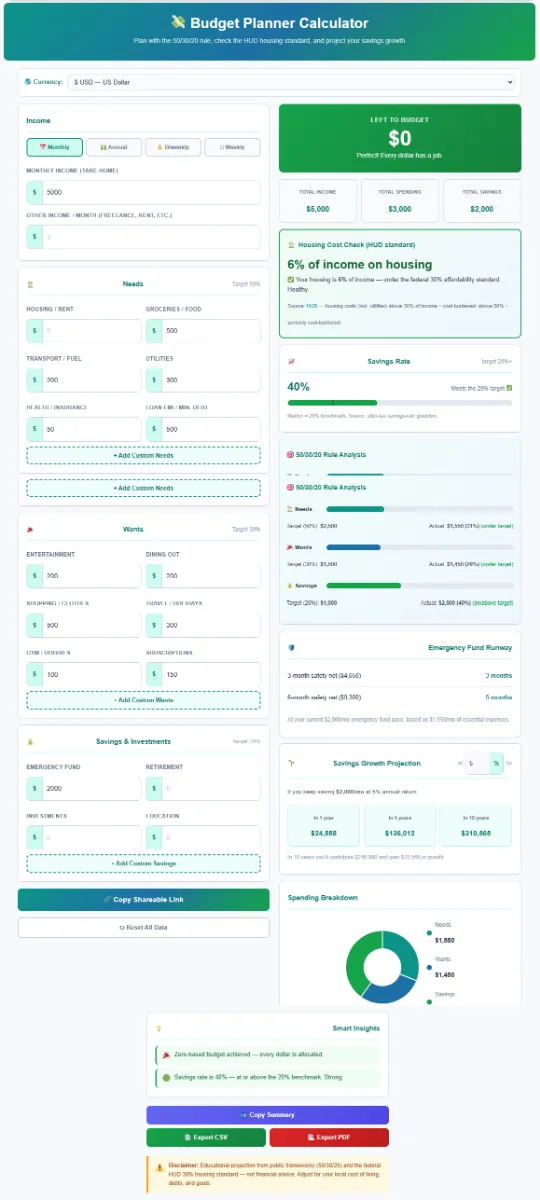
Enter your income and top expenses to see where you stand.
What Private Surveys Show (and Why They’re Context, Not Benchmarks)
Private survey data on holiday gift spending appears in a lot of coverage. The research brief includes several figures — with important caveats about what each measures.
Assigning a payment method to each category
| Survey & Year | Figure Reported | What It Covers | Research Brief Flag |
|---|---|---|---|
| NerdWallet 2024 Holiday Spending Report | $925 average planned gift spend; 83% planned to purchase gifts | Self-reported expected gift spending — gifts only | Private survey; describes survey respondents’ plans, not federal data |
| Bankrate 2024 winter-holiday spending | $902 average winter-holiday spending | Gifts, food, decorations, and other seasonal spending combined — not gifts alone | Not comparable to gift-only surveys; methodology and scope differ |
| Deloitte (via Investopedia) | $1,778 average winter-holiday budget | Broader seasonal spending — not gifts alone | Different scope than gift-only figures; don’t compare directly |
| National Retail Federation (via Investopedia) | $875 holiday spending figure | Broader seasonal spending definition | Scope differs from gift-only surveys; not directly comparable |
| NerdWallet 2025 | $1,107 for presents | Gifts only (survey) | Verification flag in research brief — not treated as confirmed figure in this article |
Private survey sources — none constitute federal benchmarks. Research brief flags NerdWallet 2025 figure for verification before use.
The Bankrate/Deloitte/NRF figures are especially important to separate from gift-specific surveys. A $902 figure covering gifts, food, decorations, and other seasonal spending can’t be compared to a $925 figure covering gifts only — they measure different scopes. Articles that cite multiple survey figures without flagging the scope difference are combining numbers that don’t compare.
The research brief also notes that Canadian NerdWallet sources appear in the broader research set. Those studies measure Canadian consumers and don’t provide U.S. benchmarks — they’re excluded from this article.
The underlying question is what these private survey figures are useful for. They describe what survey respondents planned to spend in a given year, in a given sample. They provide directional context about where household gift spending sits — not a target that any individual household should match regardless of their own financial situation.

Lower-Cost Options the CFPB Identifies
The CFPB specifically names three approaches that can reduce the cash requirement of holiday giving without eliminating the experience of giving. These appear in the same guidance as the budgeting framework — meaning the CFPB treats them as legitimate budget tools, not consolation prizes.
| Option | How It Reduces Cash Requirement | CFPB Context |
|---|---|---|
| Gift exchanges (e.g. Secret Santa) | One gift per person rather than one gift per recipient in a group; reduces the number of gift pool draws on the budget | Named in CFPB holiday guidance as a lower-cost option |
| Homemade gifts | Replaces purchased items with time and materials; can significantly lower cash cost per recipient | Named in CFPB “Three Ways to Enjoy the Holidays Without Going Into Debt” |
| Gifts of time | Offers a service, skill, or shared experience rather than a purchased product; cash cost can be zero or minimal | Named in CFPB holiday guidance alongside homemade gifts |
Source: CFPB — Three Ways to Enjoy the Holidays Without Going Into Debt
A note on gift cards
The CFPB’s holiday guidance also addresses gift cards specifically. Fees and expiration terms must be disclosed. Dormancy, inactivity, and service fees generally can’t apply unless the card has gone unused for at least one year. If gift cards are part of a per-person gift plan, check the specific card’s fee and expiration terms — a $50 gift card with applicable dormancy fees after six months of non-use isn’t the same $50 value as a direct cash equivalent.
What the Research Shows Works
Starting from the available total, not from a per-person target.
The CFPB framework runs in one direction: total → allocation. Running it in reverse (per-person × recipients = total) doesn’t check whether the total is available. That’s the mechanism that produces unplanned debt — not a specific dollar figure, but the direction of the calculation.
Writing the recipient list before shopping begins.
The CFPB identifies the purchase list as a pre-shopping step. Family expectations can expand quickly. Coworkers get added. Friends who weren’t on the original list appear. A written list with pre-assigned amounts is the tool that keeps a manageable total from expanding by default.
Using the CFPB’s lower-cost alternatives to reduce per-person cash requirements.
Gift exchanges, homemade gifts, and gifts of time reduce the cash demand without removing recipients from the list. For households that have more recipients than their gift budget supports at a per-person amount that feels appropriate, these options are the research-supported approach — not spending beyond the plan.
Keeping emergency savings outside the gift budget calculation.
The Federal Reserve data on savings capacity is the clearest reason this matters. The gap between households earning $100,000+ (75% with three months of emergency savings) and those below $25,000 (21%) shows that matching a national survey average when your savings situation is below average creates real risk. The gift budget should come from what’s available after emergency reserves are protected.
Communicating budget limits before the season rather than after it.
The CFPB framework supports setting per-person amounts and communicating them — the research treats family budget conversations as a planning tool, not a social failure. A gift exchange agreement reached in October is more comfortable than a debt conversation in January.
The research does not support treating any private survey average as a personal gift target. The BLS exclusion of external gifts from published tables, the wide income-savings gap in Federal Reserve data, and the CFPB’s household-specific framing all point in the same direction: the right gift amount is the one that comes from your household’s total, not from a national number.

Bottom Line: 5-Step Gift Budget Framework
1. Run the CFPB framework in order — total budget first, per-person amounts second, never the reverse:
Starting from “how much per person” and multiplying up to a total doesn’t check whether that total is available. The CFPB sequence — available funds → seasonal total → gift category → per-person allocation — is the only version that can’t produce unplanned debt. Use the Budget Calculator to establish what’s available before setting any per-person number.
2. Write out every recipient before setting any per-person amount:
The CFPB treats the recipient list as a pre-shopping step. Family members, friends, coworkers, and gift exchanges all need to appear on the list before the budget is divided — because the total changes significantly when someone is added after amounts are already assigned. A written list with pre-assigned amounts is the tool that keeps the total stable as the season progresses.
3. Don’t use private survey averages as a per-person spending target:
NerdWallet’s $925 planned-gift-spend figure (2024) and Bankrate’s $902 winter-holiday figure (2024, covering all seasonal spending) describe survey respondents’ plans — not a universally appropriate amount. The Federal Reserve data shows that 37% of adults couldn’t cover a $400 emergency from cash or savings. Matching a national survey average when your financial situation differs from the average isn’t a budgeting decision — it’s social comparison with financial consequences.
4. Protect emergency savings from the gift calculation — the Fed’s income-savings gap shows why the boundary matters:
The difference between 75% (income $100,000+) and 21% (income below $25,000) of adults having three months of emergency savings means gift budgets operate against very different financial backdrops. A gift budget that draws down emergency reserves to match a per-person target trades financial protection for social expectations. The CFPB framework treats gifts as one category inside a plan that doesn’t consume emergency funds.
5. Tell family and friends your gift budget limit — CFPB guidance identifies this as a planning step, not a social failure:
Setting per-person amounts and communicating them is part of the CFPB holiday framework. The CFPB also names gift exchanges, homemade gifts, and gifts of time as budget tools — not workarounds. For households with more recipients than the gift budget supports at a comfortable per-person amount, those CFPB-identified options are the research-supported approach. Budget conversations in October are more comfortable than debt conversations in January.
“The finding from the BLS methodology that most changed how I read gift-spending advice was the post-2020 exclusion. Since the 2020 midyear tables, the BLS has excluded gifts given to people outside the consumer unit from its published expenditure tables. That means every article citing BLS data to establish an ‘average gift amount’ is working with a dataset that specifically doesn’t count what it sounds like it counts. The BLS figure of $78,535 in average annual consumer-unit spending tells you what households spend on themselves — not what they give away.”
— Kevin Brown, Lead Researcher at SaveXpert.com
Frequently Asked Questions
Ans: According to the CFPB, there is no universal dollar amount. No federal agency publishes a recommended per-person gift figure. The CFPB’s framework is to set a total seasonal budget from available funds first, then divide that total across recipients. The right per-person amount is one that comes from a total your household can sustain — not from matching a national survey average.
Ans: The CFPB doesn’t publish separate benchmarks for parents, siblings, partners, or other family categories. The framework applies regardless of recipient type: set the total gift budget, list all recipients, and assign amounts. An unequal allocation — more to some family members, less to others — is consistent with the CFPB approach as long as the total assigned across all recipients stays within the available budget. The Federal Reserve’s household data shows that financial capacity varies widely by income group — which is why a family spending “rule” that works in one income bracket can create real hardship in another.
Ans: The CFPB’s framework defines reasonable as whatever fits within a pre-planned seasonal budget without requiring debt. The Federal Reserve found that 37% of adults couldn’t cover a $400 emergency with cash or equivalent — which means for many households, a “$100 per person” rule creates a gift total that competes directly with financial stability. A reasonable per-person amount is the quotient of your actual available gift total divided by your actual recipient count — not a number borrowed from a private survey or a personal finance rule of thumb.
Ans: The CFPB framework starts with the total pool and divides down. List all recipients first — family, friends, coworkers, gift exchanges — then assign an amount to each. An equal split (total ÷ recipients) is one approach. An unequal split is equally valid: assign amounts based on relationship, reciprocal expectations, or personal preference, then verify the assigned amounts sum to the total. If they exceed the total, reduce some allocations — don’t raise the total.
Ans: Yes — and the CFPB identifies this as part of the planning process. Communicating budget limits before the shopping season, proposing gift exchanges to reduce individual spending requirements, suggesting homemade gifts or gifts of time as alternatives — all of these appear in CFPB holiday guidance as practical tools. The research treats family budget conversations as planning steps, not as social failures. The discomfort of setting a $50-per-person limit in October is considerably smaller than the discomfort of carrying a $500 credit balance into February.
Ans: According to CFPB guidance, fees and expiration terms for gift cards must be disclosed. Dormancy, inactivity, and service fees generally can’t apply unless the card has gone unused for at least one year. If gift cards are part of a per-person gift allocation, check the specific card’s fee and expiration structure before treating the face value as a full cash equivalent — applicable fees reduce the recipient’s effective value below the purchase price.