
ⓘ Educational Disclosure:
This article is for educational and informational purposes only. It does not constitute financial, legal, tax, lending, or investment advice. SaveXpert and its authors are not licensed financial advisors, CPAs, attorneys, or tax advisors. All data comes from publicly available government and institutional sources. Always consult a qualified professional before making investment decisions.
Is Black Friday or Cyber Monday better for deals in 2026? According to Federal Reserve, BLS, CFPB, and FTC data, neither day is universally better. Black Friday 2026 is November 27; Cyber Monday is November 30. No official US federal source establishes a consistent price advantage for either shopping day across all product categories. The Federal Reserve’s Beige Book reported promotional pricing coinciding with strong holiday sales in 2024 — but that describes the season as a whole, not one specific day. The research supports comparing the price history of a specific item before both days rather than relying on the calendar to choose.
Key Takeaways
- Problem: Most Black Friday vs Cyber Monday comparisons treat the calendar date as the deciding factor — as if shopping on November 27 rather than November 30 automatically produces lower prices.
- Solution: Official US federal data doesn’t establish either day as a universal winner. The Federal Reserve, BLS, CFPB, and FTC data point to the same answer: the lowest price depends on the specific product, specific retailer, and specific price history — not the shopping-day calendar.
- Result: Tracking the price history of a specific item before both days is the only check the research supports. BLS CPI measures broad economy-wide inflation — it doesn’t tell you whether a specific TV is cheaper on Black Friday or Cyber Monday. CFPB BNPL data shows financing risk applies to both days equally.
- Source: Federal Reserve Beige Book · BLS Consumer Price Index · CFPB BNPL Research
- Time To Read: 7 Minutes
Table of Contents
1. Black Friday and Cyber Monday 2026: The Dates and What They Don’t Tell You
2. Why Official Data Doesn’t Establish a Universal Winner
3. What the Federal Reserve’s Holiday Data Shows
4. Separating Broad Inflation Data from Promotional Pricing
5. What CFPB Research Shows About BNPL and Holiday Shopping
6. Online vs. In-Store: What the Official Evidence Shows
7. Shopping Scams: FTC Guidance for the Holiday Season
8. Credit Card Protections That Matter After a Holiday Purchase
9. What the Research Shows Works
10. Bottom Line: 5 Steps for Black Friday vs Cyber Monday Decisions
Black Friday 2026 falls on November 27. Cyber Monday falls on November 30. The three-day gap between them drives half the holiday shopping advice published every year — shop here, wait there, hold off until Monday. What the Federal Reserve, BLS, CFPB, and FTC data shows is more specific and less calendar-dependent than most of that advice: no official federal source establishes that either day consistently produces lower prices across all product categories. The research points to a different question entirely — not which day wins, but which specific item’s price history you tracked before either one arrived.
Black Friday and Cyber Monday 2026: The Dates and What They Don’t Tell You
Black Friday falls on the day after Thanksgiving — in 2026, that’s November 27. Cyber Monday follows the first Monday after Thanksgiving — in 2026, November 30. Both dates are Thanksgiving-calendar derivations, not announcements from a federal financial agency.
⚠️An important research transparency note: As of September 2026, neither shopping event had occurred. No verified 2026 sale-performance data was available at the time of research. This article uses data from prior seasons (Federal Reserve Beige Book, BLS CPI, CFPB consumer credit research) to establish the analytical framework — not confirmed 2026 promotional figures.
The dates themselves are only the starting point of the comparison. What the research brief finds — and what most calendar-based comparisons miss — is that a shopping date doesn’t carry pricing information. A date tells you when promotional windows open. It doesn’t tell you which retailer, which product, or which price history underlies a specific “deal” on that day.
| Event | 2026 Date | Basis for the Date | What the Date Determines |
|---|---|---|---|
| Black Friday | November 27, 2026 | Day after Thanksgiving (4th Thursday of November) | When promotional windows typically open — not which prices are lowest |
| Cyber Monday | November 30, 2026 | First Monday after Thanksgiving | When online promotional windows typically open — not which prices are lowest |
| Extended holiday sales period | November–December 2026 | Industry promotional practice | Pricing can be competitive throughout; neither single day is a guaranteed floor |
Source: Federal Reserve Beige Book — 2024 holiday season reporting; dates from Thanksgiving calendar

Why Official Data Doesn’t Establish a Universal Winner
The research brief reviewed Federal Reserve, BLS, CFPB, and FTC publications. None establishes a consistent price advantage for Black Friday over Cyber Monday — or the reverse — across all product categories.
| Federal Source | What It Covers on Holiday Pricing | What It Doesn’t Establish |
|---|---|---|
| Federal Reserve Beige Book | Anecdotal economic conditions by regional district; reported promotional pricing coinciding with strong 2024 holiday sales | No per-day, per-product price comparison between Black Friday and Cyber Monday |
| BLS Consumer Price Index | Broad economy-wide price movement (2.9% Dec 2023→Dec 2024; 2.7% Dec 2024→Dec 2025) | No breakdown of which specific items are cheaper on which specific shopping day |
| CFPB | Consumer credit patterns, BNPL research, credit-card disclosure rules | No per-day pricing comparison; no national dataset proving online beats in-store or vice versa |
| FTC | Deceptive pricing guidance, former-price standards, shopping scam warnings | No ruling that Black Friday or Cyber Monday prices are more or less deceptive than the other |
Source: Federal Reserve Beige Book Dec 2024 · BLS CPI · FTC Deceptive Pricing
Common claims — “Cyber Monday is better for electronics,” “Black Friday wins on appliances,” “one day always beats the other” — don’t originate from these federal sources. They come from private retailer analysis and survey data that changes year to year. The absence of a federal benchmark means the shopper has to run the check themselves on each specific item.
What the Federal Reserve’s Holiday Data Shows
The Federal Reserve’s Beige Book is a collection of anecdotal reports from the Fed’s twelve regional districts, published eight times per year. The December 2024 edition reported on the 2024 holiday shopping season.
What it showed: promotional pricing and strong retail sales occurred together during the 2024 holiday period. That’s a meaningful data point about the seasonal dynamic — not a Black Friday vs. Cyber Monday comparison.
| Beige Book Finding (2024 Holiday Season) | What This Means for 2026 Planning | What It Doesn’t Mean |
|---|---|---|
| Promotional pricing coincided with strong holiday sales | The season as a whole featured genuine promotional activity — discounts weren’t uniformly inflated | Doesn’t establish that Black Friday or Cyber Monday prices are lower than other days in the season |
| Anecdotal reporting from 12 regional districts | Regional variation matters — conditions in one district may differ from another | Not a per-product analysis; Beige Book reports economic conditions, not retail price comparisons |
| Strong retail sales through the holiday period | Consumer demand was high throughout November–December 2024 — not concentrated on two days | High sales volume doesn’t confirm the deepest discounts fell on specific calendar days |
The Federal Reserve also raised the federal-funds target range to 3.75%–4.00% on September 16, 2026. That decision sets a broad borrowing-cost environment, not a holiday pricing outcome. It matters if you’re financing a holiday purchase — higher borrowing costs mean interest on any carried credit balance is higher than it was during the lower-rate period.
Separating Broad Inflation Data from Promotional Pricing
BLS Consumer Price Index data appears in a lot of Black Friday coverage as context for whether deals are “real.” It’s worth being precise about what CPI measures and what it doesn’t.
| BLS CPI Data Point | What It Actually Measures | What It Cannot Determine |
|---|---|---|
| All-items CPI: +2.9% (Dec 2023 → Dec 2024) | Broad average price change across the economy — a basket of goods and services | Whether a specific TV, laptop, or appliance is priced lower on Black Friday or Cyber Monday |
| All-items CPI: +2.7% (Dec 2024 → Dec 2025) | Continued broad price movement through 2025 | Whether holiday promotional pricing offsets inflation for any specific product category |
| Category-level CPI (apparel, electronics, etc.) | Price trends in broad product categories over time | Individual retailer promotional pricing decisions for specific models or SKUs |
The distinction matters in a specific way. If broad CPI rose 2.9% in 2024, that doesn’t mean every product at every retailer cost 2.9% more. Individual products can move more or less than the basket average — and promotional pricing in specific categories can move in the opposite direction of the general trend.
BLS data is useful for understanding the general price environment around the holiday season. It isn’t a tool for predicting whether a specific product is cheaper on Black Friday or Cyber Monday. For that, only the item’s own price history provides the check.
The FTC’s former-price standard is the relevant test for any specific promotional offer: a discount is only legitimate when the comparison price represents an actual price offered regularly for a reasonably substantial period. That standard applies identically on Black Friday and Cyber Monday — neither day creates an exception to the FTC’s deceptive pricing rules.
What CFPB Research Shows About BNPL and Holiday Shopping
Buy Now Pay Later offers appear prominently during both Black Friday and Cyber Monday. The CFPB’s research on BNPL usage applies to both days equally — the financing risk doesn’t change based on the calendar.
| CFPB BNPL Finding | Black Friday Application | Cyber Monday Application |
|---|---|---|
| $150M/day borrowed through BNPL from Black Friday through the holiday period | Black Friday is the entry point for the heaviest BNPL borrowing of the year | Cyber Monday borrowing continues the pattern established over Black Friday weekend |
| 21%+ of consumers with credit records used BNPL (2022) | BNPL is common on both days — not specific to one shopping event | Same usage pattern; in-store vs. online channel doesn’t change the debt obligation |
| Many BNPL users held simultaneous loans from multiple lenders | Black Friday BNPL purchases add to existing obligations | Cyber Monday purchases three days later can overlap with Black Friday BNPL schedules |
| Pay-in-four classified as closed-end instalment loans | 0% interest doesn’t mean no debt — applies on both days | 0% interest doesn’t mean no debt — the same classification applies regardless of the date |
Source: CFPB — Consumer Use of BNPL and Other Unsecured Debt
⚠️Black Friday + Cyber Monday BNPL overlap: A shopper who uses BNPL on November 27 (Black Friday) and again on November 30 (Cyber Monday) creates two overlapping instalment schedules running simultaneously into January, February, and March. The CFPB’s finding that many BNPL users hold simultaneous loans from multiple lenders is most directly applicable to this three-day gap. Each transaction looks manageable individually. The aggregate repayment picture — across four instalments from each — is the number that matters.
The CFPB also notes that BNPL carries different dispute-protection terms than credit cards. A product bought with BNPL on either day — that arrives damaged, doesn’t match the description, or comes from a fraudulent seller — may have fewer formal dispute options than the same product bought with a credit card. That distinction applies equally on Black Friday and Cyber Monday.
Online vs. In-Store: What the Official Evidence Shows
One version of the Black Friday vs. Cyber Monday comparison is really a channel comparison: in-store prices on the Friday versus online prices on the Monday. The federal data on this is straightforward.
No national dataset from the Federal Reserve, BLS, CFPB, or FTC establishes that online deals are inherently better than in-store promotions, or vice versa. The CFPB’s consumer data shows consumers use both channels for holiday shopping — without establishing a consistent price advantage for either.
| Shopping Channel | What Federal Data Shows | Shopper Check to Run |
|---|---|---|
| In-store (typically Black Friday focus) | No federal dataset proves in-store prices are lower on Black Friday specifically | FTC former-price check: was the “was” price genuinely offered regularly before the promotional markdown? |
| Online (typically Cyber Monday focus) | No federal dataset proves online prices are lower on Cyber Monday specifically | Same FTC former-price check: price-tracking history of the specific item at the specific online retailer |
| Both channels throughout the holiday period | Federal Reserve Beige Book: promotional pricing was active throughout the 2024 holiday season — not concentrated on two days | Compare total purchase cost (shipping, fees, taxes) — FTC says total cost determines the real price |
Source: FTC — Online Shopping · Federal Reserve Beige Book Dec 2024
The FTC’s guidance on online shopping carries one specific warning that applies more on Cyber Monday than Black Friday: online-only purchases from unfamiliar sellers warrant extra scrutiny. The FTC says unusually low prices on expensive items can signal fake shopping sites — not exceptional deals. The urgency of a Cyber Monday countdown timer is a pressure mechanism, not a quality signal.
Enter your income and top expenses to see where you stand.
Shopping Scams: FTC Guidance for the Holiday Season
The FTC is the principal US agency for consumer shopping scam guidance. The same warnings apply to both Black Friday and Cyber Monday — the risk doesn’t shift based on the day.
| FTC Warning | Black Friday Context | Cyber Monday Context |
|---|---|---|
| Unusually low prices on expensive items can signal fake shopping sites | In-store: fake retail storefronts are less common but promotional confusion can obscure terms | Online: fake shopping sites replicate legitimate retailers; urgency countdown timers add pressure |
| Verify the seller before purchasing | Check the physical store’s return and refund terms; know who you’re buying from | Check the URL, reviews, and return policy of any unfamiliar online seller before entering payment details |
| Credit cards provide stronger dispute protections than gift cards, wire transfers, or payment apps | Applies to in-store and online purchases on both days | Cyber Monday emphasis: pressure to act quickly can push buyers toward less-protected payment methods |
| Former-price standard: the “was” price must have been offered regularly for a substantial period | Markdown tags on physical shelves are subject to the same FTC standard as digital price displays | Online “was” and “list” price comparisons are subject to the same standard — check price history independently |
Source: FTC — Online Shopping · FTC — Deceptive Pricing
For both days, the FTC’s recommendation to use a credit card as the payment method of choice — rather than gift cards, wire transfers, payment apps, or cryptocurrency — is the most actionable single protection available. It applies whether the purchase is in-store on Black Friday or online on Cyber Monday.
Credit Card Protections That Matter After a Holiday Purchase
The post-purchase protections available to a shopper depend on how the purchase was paid for — not which day it happened. The CFPB’s framework for credit-card protections is the same on November 27 and November 30.
| Payment Method | Dispute Protection Level | Holiday Shopping Implication |
|---|---|---|
| Credit card | Strongest — governed by Regulation Z and CFPB credit-card rules; formal dispute process for billing errors and fraudulent charges | Use for both Black Friday and Cyber Monday purchases to retain maximum recourse |
| BNPL (pay-in-four) | Varies by provider — CFPB has noted different dispute protections than credit cards; CFPB’s 2024 BNPL Interpretive Rule was withdrawn May 12, 2025 | Know your specific BNPL provider’s dispute terms before using for holiday purchases |
| Gift cards | Limited — once used, protections are minimal; FTC says gift card fees and expiration terms must be disclosed | Scammers often request gift cards; legitimate retailers don’t require gift card payment for promotions |
| Wire transfer/payment apps/cryptocurrency | Very limited — FTC warns these carry weak recourse when a purchase goes wrong | Avoid for unfamiliar sellers on either day; the urgency of promotional windows doesn’t override the risk |
Source: CFPB — Credit Cards · Regulation Z — 12 CFR Part 1026 · FTC — Online Shopping
Regulation Z governs credit-card disclosures including APR, finance charges, minimum-payment requirements, and the billing due date rule (generally at least 21 days after the statement is issued). Those protections are the same on Black Friday and Cyber Monday — and they’re the strongest consumer protections available after a holiday purchase goes wrong.
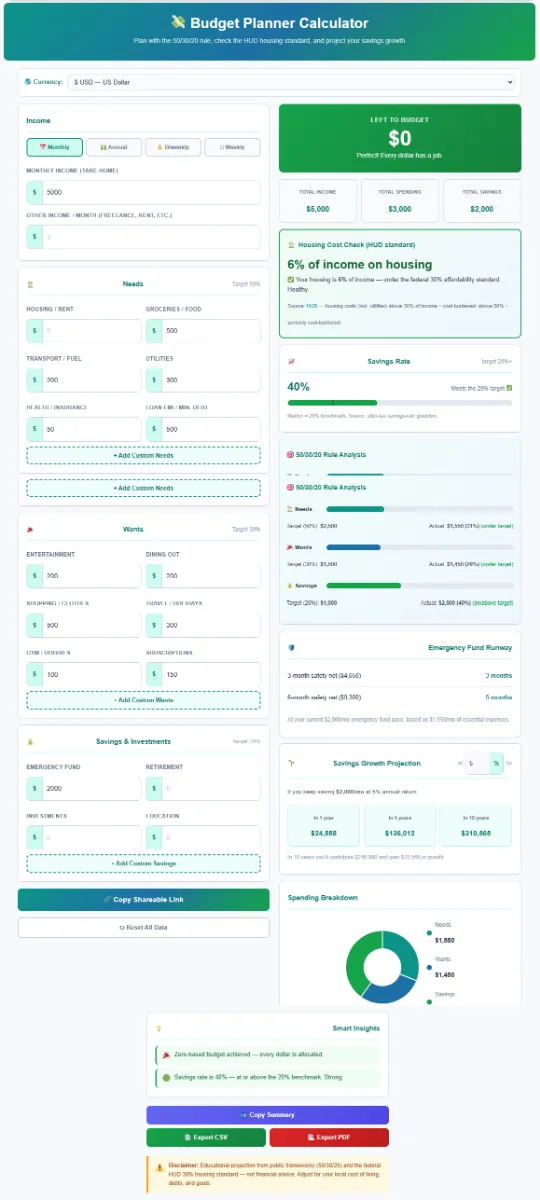
💰 Put the Purchase in Context: SaveXpert Budget Planner Calculator
Neither Black Friday nor Cyber Monday changes what a purchase actually costs relative to your household’s cash flow. I ran a holiday-purchase scenario through the Budget Calculator — comparing available income, regular monthly expenses, savings, and the specific purchase amount — to show whether a “deal” that looks good on a promotional tag fits the household’s actual financial picture before checkout. A discounted price that exceeds your planned holiday allocation isn’t a saving.
Educational note: Calculator models scenarios for informational purposes only. Source: CFPB Holiday Spending Plan Guidance
What the Research Shows Works
Checking the item’s price history before either shopping day — not during it.
The FTC’s former-price standard requires that a comparison price was genuinely offered regularly for a substantial period. The only way to verify that is through a price-tracking history checked before the promotional window opens. A “60% off” on Black Friday that’s measured from a price inflated two weeks earlier is no different from the same claim on Cyber Monday.
Treating the Federal Reserve Beige Book data as seasonal context, not a day-by-day guide.
The Beige Book’s finding that promotional pricing coincided with strong 2024 holiday sales describes the season’s overall character. It doesn’t establish that prices peaked or troughed on a specific day. The research treats this as useful macro context — not a signal to shop on Black Friday rather than Cyber Monday, or vice versa.
Separating BLS CPI from item-level pricing.
Broad economy-wide inflation running at 2.7%–2.9% describes how prices moved across the economy as a whole. A specific category — electronics, apparel, appliances — can move differently. And a specific item within a category can move differently still. The research supports using CPI as background and price-tracking tools as foreground.
Counting BNPL obligations from both days before committing to either.
A shopper who creates BNPL obligations on Black Friday and additional ones on Cyber Monday three days later holds overlapping repayment schedules running into Q1 2027. The CFPB’s $150M/day borrowing figure around Black Friday weekend reflects how common this accumulation is. Evaluating the combined repayment picture — both sets of instalments together — before either purchase is the research-supported approach.
Comparing total purchase cost, not headline price.
The FTC says the real price includes shipping, handling, delivery, taxes, and other fees. A product that’s $20 cheaper on Cyber Monday but ships at $30 isn’t $20 cheaper. The total checkout cost on both days is the comparison that matters — not the promotional tag.

Bottom Line: 5 Steps for Black Friday vs Cyber Monday Decisions
1. Check the specific item’s price history before either day — not on the day:
The FTC former-price standard requires the comparison price to have been genuine. A price-tracking tool that shows 60–90 days of history is the only way to run that test independently before a promotional window opens. Neither Black Friday (Nov 27) nor Cyber Monday (Nov 30) creates an exception to the FTC’s deceptive pricing rules — and both days carry the same risk of inflated reference prices.
2. Compare the total checkout cost — not the headline price:
The FTC’s guidance on total-cost comparison applies to both days. Shipping, handling, delivery fees, and taxes are part of the real price. A product that’s $30 cheaper on Cyber Monday from a retailer charging $40 in shipping costs more in total. Calculate the full checkout amount at both retailers — in-store and online — before the calendar date influences the decision.
3. Count the combined BNPL repayment schedule from both days before either purchase:
A Black Friday BNPL purchase on November 27 and a Cyber Monday BNPL purchase on November 30 create two overlapping instalment schedules. The CFPB found consumers borrowed nearly $150M/day through BNPL from Black Friday onward — and that many users held simultaneous loans. Calculate what both sets of instalments cost per month in Q1 2027 before committing to either. The combined obligation is the real number.
4. Pay with a credit card on both days if at all possible:
Credit cards provide the strongest formal dispute protections of any holiday payment method — governed by Regulation Z and CFPB rules. BNPL carries different (and often weaker) dispute terms. Gift cards, wire transfers, payment apps, and cryptocurrency carry minimal protections after a purchase goes wrong. The FTC’s recommendation to use a credit card applies whether the purchase is in-store on Black Friday or online on Cyber Monday.
5. Run the Budget Calculator before buying on either day — a real deal that doesn’t fit your cash flow isn’t a saving:
The Federal Reserve Beige Book showed promotional pricing coinciding with strong holiday sales in 2024. Strong promotional pricing doesn’t change whether a purchase fits your household’s planned holiday budget. Use the Budget Calculator to check whether the specific purchase sits within your allocated category amount — before the promotional countdown timer decides for you.
“The finding in the Federal Reserve’s Beige Book data that most changed how I read Black Friday vs Cyber Monday comparisons was the framing around promotional pricing. The Beige Book tracks anecdotal regional economic conditions — not per-product discount rates. What it showed for the 2024 holiday season was that promotional pricing and strong retail sales happened together. That’s useful context about the season. It isn’t a comparison tool between two specific days. The calendar date of a sale doesn’t determine whether a specific product’s reference price was genuine. Only the price history of that specific item does — and that check has to happen before either day, not on the day.”
— Kevin Brown, Lead Researcher at SaveXpert.com
Frequently Asked Questions
Ans: No official US federal source establishes either day as a universal winner. The Federal Reserve Beige Book reported promotional pricing throughout the 2024 holiday season — not concentrated on one specific day. BLS CPI measures broad economy-wide prices, not per-product holiday discounts. The research supports comparing the price history of each specific item before both days, rather than relying on the calendar date to determine which is cheaper.
Ans: Official BLS consumer price data doesn’t break down which specific items are cheaper on Cyber Monday. General inflation metrics measure broad price movement across the economy — they can’t forecast individual promotional discounts for specific electronics, apparel, or appliance models during the Cyber Monday sales period. Private retail analysis (not federal data) has associated Cyber Monday with online electronics and software deals, but those findings change year to year and don’t constitute a federal pricing benchmark.
Ans: Black Friday 2026 is November 27 (the day after Thanksgiving). Cyber Monday 2026 is November 30 (the first Monday after Thanksgiving). These dates follow from the Thanksgiving calendar — they’re not announcements from a federal financial agency. As of September 2026, neither event had occurred and no verified 2026 promotional-performance data was available at the time of research.
Ans: No national federal dataset establishes that online deals on Cyber Monday are inherently better than in-store promotions on Black Friday. The CFPB’s consumer data shows households use both channels for holiday shopping without establishing a consistent price advantage for either. The FTC’s former-price standard applies equally to both — a reference price displayed on a physical shelf tag and a reference price displayed in an online product listing are subject to the same deceptive pricing rules.
Ans: The FTC is the principal US agency for shopping scam guidance. The FTC warns that unusually low prices on expensive products can signal fake shopping sites — not exceptional deals. Practical steps: verify the seller’s legitimacy before entering payment details, check the URL and return policy of any unfamiliar retailer, and pay with a credit card rather than gift cards, wire transfers, or payment apps — credit cards provide the strongest formal dispute protections if a purchase goes wrong. Countdown timers and “limited stock” warnings are pressure mechanisms; they’re not quality signals.
Ans: No. Official federal data doesn’t establish that Cyber Monday consistently produces lower prices than Black Friday across product categories. BLS CPI tracks broad price movement — it doesn’t forecast which specific products are cheaper on which specific day. The Federal Reserve Beige Book noted that promotional pricing and strong sales happened together throughout the 2024 holiday season — not on one specific day. For any specific item, the price may be lower on Black Friday, higher on Cyber Monday, or the same — depending on the retailer’s pricing strategy. Only a price-tracking history for that specific item, checked before both days, provides an answer.