
ⓘ Educational Disclosure:
This article is for educational and informational purposes only. It does not constitute financial, legal, tax, lending, or investment advice. SaveXpert and its authors are not licensed financial or tax advisors. Always consult a qualified professional before making investment decisions.
How do you build an emergency fund on a low income? Start with a target that fits your actual cash flow — not the standard three-to-six-month recommendation. The CFPB’s emergency-savings research supports a tiered approach: build a first cushion of $100 to $500, then work toward one essential bill, then one month of essential expenses. Small recurring automatic transfers — even $5 to $10 per paycheck — show the most consistent results in the research. The goal is a realistic amount that can stay saved, not an ambitious figure that drains back out immediately.
Key Takeaways
- Problem: On a low income, even a $300 car repair can force a choice between high-cost borrowing and missing work — when no savings buffer exists.
- Solution: The CFPB and FDIC support a tiered approach — starting with $100 to $500, building toward one month of essential expenses, then growing from there — rather than trying to save three months at once.
- Result: The CFPB and FDIC support a tiered approach — starting with $100 to $500, building toward one month of essential expenses, then growing from there — rather than trying to save three months at once.
- Source: CFPB Emergency Savings Research, FDIC Money Smart
- Time To Read: 10 Minutes
Table of Contents
1. Why Savings Matter More When Money Is Already Tight
2. The Four-Tier Approach — Start Smaller Than You Think
3. Map Your Monthly Cash Flow Before Setting a Target
4. Save Small, Save Automatically
5. Finding Extra Savings Without a Raise
6. Where to Keep Emergency Savings
7. Should You Save or Pay Down Debt First?
8. Keep Emergencies and Planned Expenses Separate
9. What to Do After Using the Fund
10. Risks and Limits the Research Doesn’t Gloss Over
Here’s a scenario I found in the CFPB and Federal Reserve research — and it resonated. A household has $75 left after paying rent, utilities, food, transportation, and the bare minimum on debt. Then a $400 car repair lands. That $75 doesn’t cover it. So the choice becomes: delay a bill, use a credit card, borrow from family, take out a payday loan, or miss work. Every option costs something. (Federal Reserve SHED 2025)
That’s not a failure of planning. That’s what a thin margin looks like. And the research on emergency savings specifically addresses this — not by saying “save more,” but by showing that even a small, accessible cushion can change which options are available when the unexpected arrives.

Why Savings Matter More When Money Is Already Tight
Households with limited margin between income and expenses face a compounding risk. A car repair, a medical bill, a reduced paycheck, or a broken appliance doesn’t just cost money — it can start a chain. One unpaid bill generates a late fee. A payday loan generates interest. A missed shift generates lost income. (CFPB Consumer Resources)
The CFPB’s research found that people who reported not saving were nearly three times more likely to report difficulty paying bills than those who did save. The research doesn’t prove that saving causes better outcomes — it shows a meaningful association. But the direction is clear: even small savings appear to reduce exposure to the cascade that starts with a single unexpected cost.
The Federal Reserve’s 2025 SHED report found that 63% of adults could cover a hypothetical $400 emergency with cash or its equivalent. That means roughly 37% couldn’t. For low-income households, the share without that buffer is substantially higher. (Federal Reserve SHED 2025)
An emergency fund on a low income isn’t a luxury savings goal. It’s the financial equivalent of a spare tire. You don’t need a full garage of spares. You need one that fits and that you can reach.
The Four-Tier Approach — Start Smaller Than You Think
The three-to-six-month target is a reasonable long-run destination for many households. But for someone with $75 left at month-end, it can feel like being told to run a marathon when you’re still learning to walk. The research supports starting where you actually are.
Tier 1: A starter cushion ($100–$500)
The first target should cover one smaller emergency — a prescription copay, a utility reconnection fee, a tire repair, a basic insurance deductible. The exact amount varies by household. For one person, it might be $100. For another, it might be $300 or $500. The point is picking a number that represents your most likely first emergency, not a round number that sounds responsible. Getting to Tier 1 is more important than choosing the perfect amount.
Tier 2: One essential bill
After the starter fund is solid, the next target is one month of a single essential expense — groceries, transportation, utilities, or a portion of rent. This gives the household breathing room when income arrives late, or a bill hits at the wrong moment. It also makes the fund feel real and purposeful, which matters for keeping it intact.
Tier 3: One month of essential expenses
This means the essential costs — housing, food, transportation, utilities, insurance, minimum debt payments — for one full month. Not total income. Not total spending. Just the costs that must be covered to keep the household running. This target is achievable for many households over time and provides meaningful protection against a short-term income disruption.
Tier 4: A larger reserve over time
A larger reserve — eventually toward three months of essential expenses — reflects the Federal Reserve’s common resilience benchmark. The appropriate longer-term target depends on factors specific to the household: job stability, number of income earners, health conditions, access to paid leave, and whether family support is realistically available in a crisis. (Federal Reserve SHED 2025)
💡 Research note: The most useful emergency-fund target is one that is realistic enough to maintain. A $200 fund that stays saved protects more than a $2,000 target that gets depleted regularly. Build the habit before building the balance.
Enter your income and top expenses to see where you stand.
Map Your Monthly Cash Flow Before Setting a Target
Before deciding how much to save per paycheck, it helps to see where money actually goes. Here’s a simple monthly cash-flow table to work from:
| Category | Monthly Amount (Example) |
|---|---|
| Take-home income (wages, benefits, other) | $2,400 |
| Housing and utilities | $1,150 |
| Food | $400 |
| Transportation | $300 |
| Insurance and medical costs | $200 |
| Minimum debt payments | $150 |
| Other essential expenses | $125 |
| Amount remaining | $75 |
Illustrative example based on CFPB cash-flow framework. Your numbers will differ. Source: CFPB Consumer Resources
When only $75 remains, a $300 monthly savings goal isn’t realistic — and committing to it will likely cause the plan to fail. A $10 or $20 per paycheck contribution that actually happens every time is worth far more than a plan that doesn’t survive the first month.
The cash-flow review also surfaces timing problems. A household might have enough income for the month in total but still experience a shortfall if bills are due before the paycheck arrives. Mapping the specific dates of income and bills — not just the monthly totals — can reveal that problem before it triggers an overdraft or a late fee.
There’s also a category worth reviewing carefully: irregular expenses. Car registration, school costs, annual insurance premiums, seasonal utilities, and medical out-of-pocket costs can feel like emergencies when they arrive — but they’re predictable. Identifying them in advance and setting a small amount aside each month separates genuine emergencies from anticipated costs.
💰 Map Your Real Cash Flow — Budget Planner Calculator
I ran the example above through SaveXpert’s Budget Calculator to find the realistic savings margin in the household — not a target, but the actual amount left after essential expenses. Enter your own income and expense categories to find yours. The gap between what’s left and what a savings plan requires is where the real plan starts.
Educational note: This calculator models budgeting scenarios using user inputs and does not provide personalized financial advice. Source: CFPB Consumer Tools
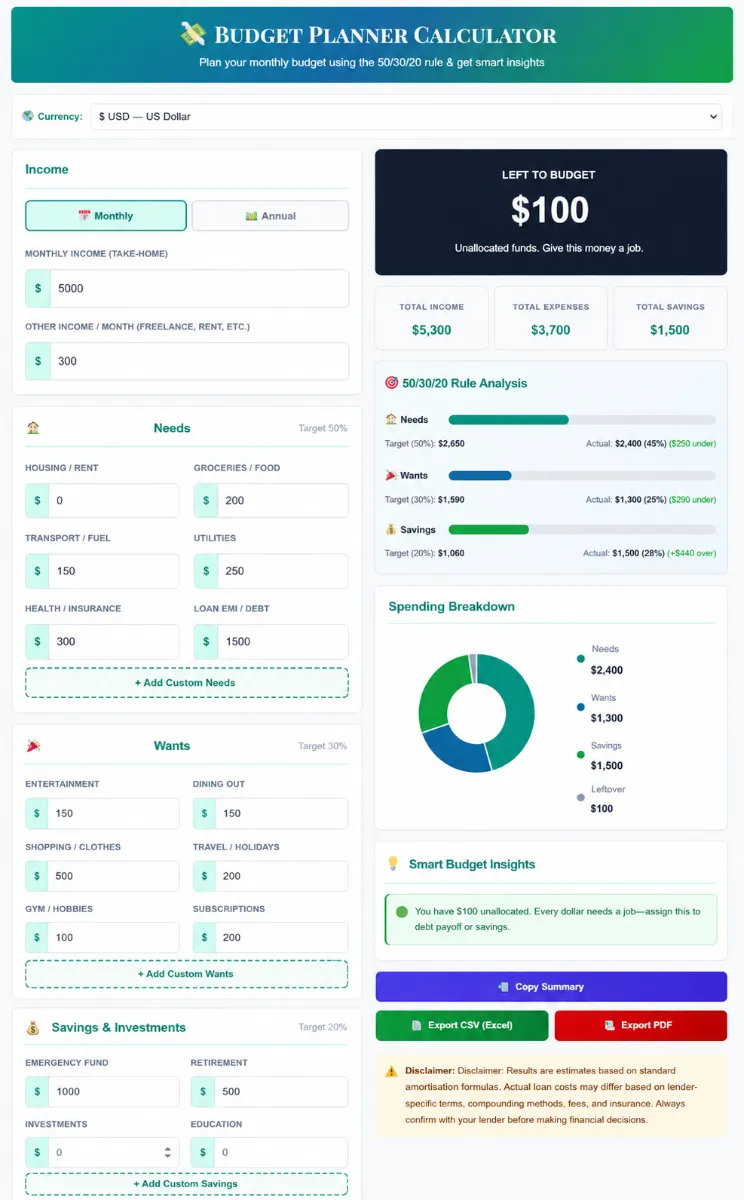
See your target safety net and how close you are.
Save Small, Save Automatically
The CFPB and FDIC both discuss automatic saving as one of the most consistent mechanisms for building emergency savings. A recurring transfer that happens right after payday doesn’t require a decision every pay period — which is where many manual savings plans break down. (CFPB: Evidence-Based Strategies to Build Emergency Savings)
The weekly and biweekly math
Small amounts add up. The research doesn’t require a dramatic contribution to make progress:
| Pay Frequency | $5/paycheck | $10/paycheck | $25/paycheck |
|---|---|---|---|
| Weekly (52 paychecks) | ~$260/year | ~$520/year | ~$1,300/year |
| Biweekly (26 paychecks) | ~$130/year | ~$260/year | ~$650/year |
| Twice monthly (24 paychecks) | ~$120/year | ~$240/year | ~$600/year |
Illustrative calculations before interest or withdrawals. The point: consistent small contributions reach Tier 1 and Tier 2 targets in realistic timeframes.
At $10 per week, a household reaches a $250 Tier 1 cushion in 25 weeks. At $5 per week, it takes a year. Neither timeline involves financial heroics — both reach a meaningful first goal.
When automation carries overdraft risk
⚠️ Automated transfers can cause overdrafts — check first: If a checking account regularly runs low before payday, a scheduled automatic transfer on the wrong day can trigger an overdraft fee that erases weeks of savings. The CFPB has taken enforcement action (including against Hello Digit LLC) specifically because automated savings tools caused overdrafts that harmed the consumers they were designed to help. Before setting up any automatic transfer, review the account’s typical low-balance timing and consider starting with a manual transfer on payday instead. (CFPB: Hello Digit LLC Enforcement Action)
Other approaches to automate or systematize saving include splitting a direct deposit between checking and savings, using a separate savings account at the same bank, or saving a fixed amount from each paycheck manually — immediately after the deposit clears, before anything else is paid
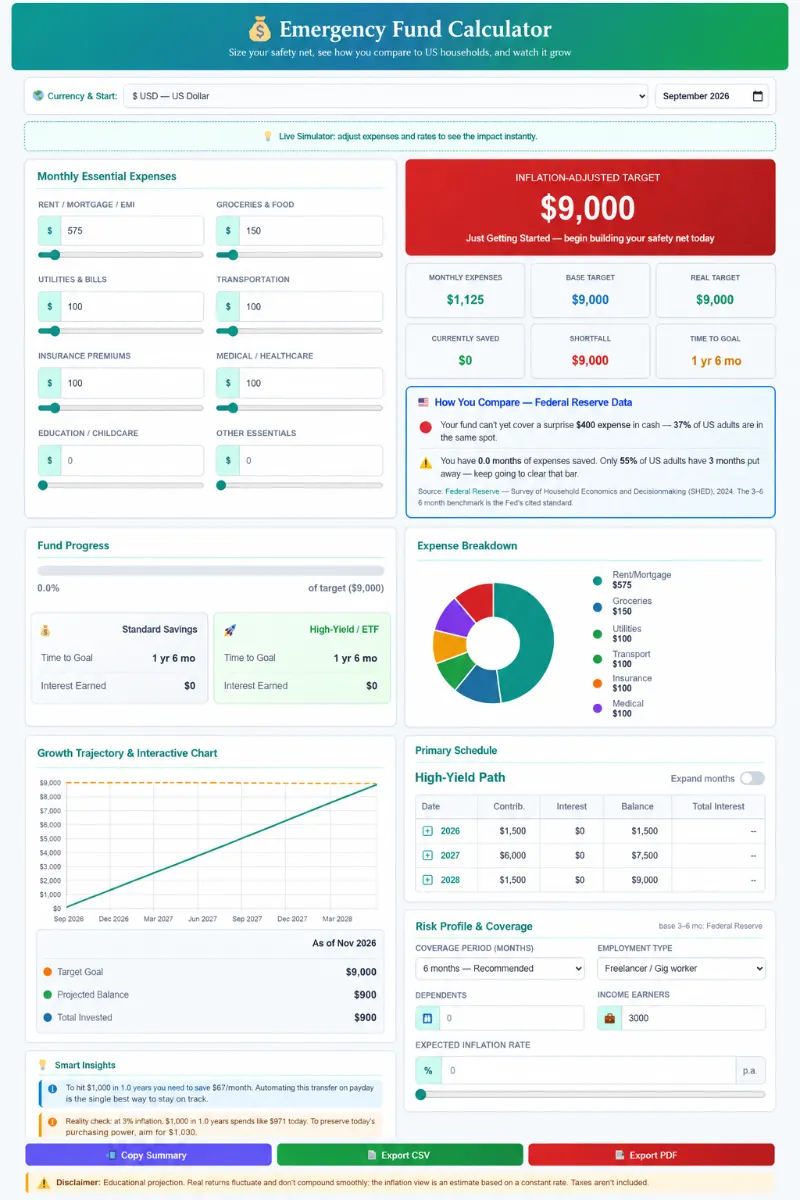
🛡️ Find Your Tier 1 Target — Emergency Fund Calculator
Enter your monthly essential expenses and the calculator applies the Federal Reserve’s three-month benchmark to show your household-specific full target. More useful here: work backward from Tier 1 — enter just your most likely single emergency cost to see a starter goal. I ran a $3,000/month expense scenario and worked back to a $500 Tier 1 target to start.
Educational note: This calculator illustrates savings targets based on user inputs and does not constitute financial advice. Source: CFPB Evidence-Based Emergency Savings Research
Finding Extra Savings Without a Raise
For some households, the regular paycheck doesn’t leave room for savings at all. Irregular income sources can fill part of that gap — and reducing necessary expenses can free up cash that’s already coming in.
Tax refunds and free filing
Tax refunds are among the most accessible lump sums available to low-income households — especially for those who qualify for the Earned Income Tax Credit (EITC). Directing even a portion of a refund toward a starter emergency fund can jump-start what paycheck-by-paycheck contributions would take months to accumulate.
Free tax preparation is available through the IRS’s Volunteer Income Tax Assistance (VITA) program, generally for households earning $67,000 or less. The IRS also offers Tax Counseling for the Elderly (TCE) for taxpayers age 60 and older. These programs use IRS-certified volunteers and file electronically — which means faster refunds than paper returns. (IRS: Free Tax Return Preparation)
Benefits and assistance programs
Reducing a necessary expense can free up cash for savings without requiring a pay increase. Depending on household income, size, and state of residence, programs may be available for food assistance, health insurance, utility support, housing, childcare, broadband, and transportation. USA.gov’s benefit finder is the federal starting point — it connects to state and local programs by entering basic household details. (USA.gov: Benefit Finder
Employer benefits are worth reviewing too. Some employers offer health savings accounts, transportation benefits, emergency savings programs, earned wage access, or employee assistance programs. Not all employers offer these, and those that do may have restrictions or fees — reading the terms before enrolling matters.
💡 Research note: Other irregular income worth considering: overtime pay, work bonuses, rebates, cash gifts, money from selling unused items, or a temporary reduction in a bill. The research doesn’t establish one right use for any of these — but directing even a portion toward a Tier 1 starter fund can accelerate progress that paycheck contributions alone would take much longer to produce.
Where to Keep Emergency Savings
Emergency savings needs to be accessible quickly — that rules out investment accounts, certificates with penalties, or anything that takes more than a few days to reach. It also needs to be safe. The most common options that check both boxes:
| Account Type | Key Consideration | Insurance |
|---|---|---|
| Savings account at an FDIC-insured bank | Check for monthly fees and minimum balances | FDIC up to $250,000 per depositor per institution |
| Credit union savings account | Often lower fees; verify federal or state insurance | NCUA for federally insured credit unions |
| A separate savings account at your existing bank | Easy to open; keeps emergency money distinct from checking | Same as above |
| No-fee online savings account | May offer better interest; confirm ATM access if needed | FDIC if bank is federally insured |
The FDIC insures eligible deposits at FDIC-insured banks up to $250,000 per depositor, per institution, per ownership category. The National Credit Union Administration provides comparable federal insurance for eligible deposits at federally insured credit unions. Checking that any account used for emergency savings is federally insured is a basic step the FDIC recommends.
A separate account from everyday checking is useful because it reduces the temptation to spend the money — but it shouldn’t be so difficult to access that reaching it in a real emergency requires a two-day wait. That gap could push someone back toward high-cost borrowing in an urgent situation.
⚠️ Watch for fees that erode small balances: Some accounts charge monthly maintenance fees that can consume a significant share of a small emergency fund. An account that charges $5 per month against a $100 balance loses 60% of the balance in fees alone over a year. Look for accounts with no minimum balance requirement and no monthly fee before opening. (FDIC Money Smart)
Should You Save or Pay Down Debt First?
The research doesn’t give one universal answer — and any source claiming it does is oversimplifying. The right balance depends on specific household circumstances: the interest rate on the debt, the availability of other resources, the likelihood of a near-term financial shock, and how much cash flow exists for either purpose.
That said, the CFPB’s research supports a specific argument for building a small starter cushion before aggressively attacking high-interest debt: without a savings buffer, any unexpected expense gets paid with new high-interest borrowing anyway. Paying down a credit card while having zero cash reserves can mean taking the same card back out the moment the car breaks down — with new interest charges on top.
A practical sequence the research supports:
- Build a small starter reserve (Tier 1).
- Keep making required minimum debt payments.
- Assess the cost of high-interest debt.
- Consider whether additional savings or debt repayment improves stability more.
- Rebuild savings after any emergency withdrawal.
This is an area where individualized guidance from a nonprofit credit counselor or a qualified fiduciary professional can genuinely help. The FTC’s consumer information pages cover how to find legitimate credit counseling versus scams. (FTC Consumer Advice)
Keep Emergencies and Planned Expenses Separate
Emergency funds disappear quickly when predictable costs get treated as emergencies. Car maintenance, annual insurance renewals, school supplies, holiday gifts, and pet care all arrive on a schedule — even if not every month. They’re not truly unpredictable.
When these anticipated costs pull from the emergency fund, that fund isn’t available for the genuinely unexpected expense that follows. A simple approach: identify recurring irregular expenses at the start of each year, divide the annual cost by 12, and set aside that fraction each month in the budget — separately tracked from the emergency fund.
These categories don’t necessarily need separate bank accounts. Tracking them in a budget spreadsheet, a notebook, or a budgeting app achieves the same separation. The point is that the emergency fund should be for emergencies — not for the car registration that arrives in October the same way it did last October.
What to Do After Using the Fund
Using emergency savings doesn’t mean the plan failed. It means it worked. That’s the purpose of the money — to be available when something unexpected happens.
After a withdrawal, a few steps help:
Record what happened.
Was this a one-time event or a recurring risk? A car breakdown might suggest the emergency fund target should account for regular transportation-related costs.
Check whether something could have helped prevent the expense.
Insurance coverage, an assistance program, or a payment plan the household didn’t know about might reduce similar future costs.
Restart contributions at any amount.
Getting back to zero is normal. Starting a $5-per-paycheck contribution the day after using the fund is better than waiting until the household “feels ready” to save again.
Adjust the target if needed.
The emergency that just occurred may reveal that the original Tier 1 or Tier 2 target was too low — or that a specific risk category (medical, transportation, housing) deserves its own sub-fund over time.
Risks and Limits the Research Doesn’t Gloss Over
The official sources are careful about what they claim. Here’s what the research explicitly acknowledges:
Saving may not be possible when income doesn’t cover essentials.
No savings plan should require skipping food, housing, medication, utilities, or insurance. When those costs aren’t covered, the priority is addressing the shortfall — through assistance programs, income changes, or professional guidance — not forcing a savings contribution.
Bank fees can erase small balances.
A $5 monthly fee on a $50 balance is a 10% monthly charge. Finding a no-fee federally insured account before opening one is the first step, not an afterthought. (FDIC Money Smart)
Savings may affect eligibility for means-tested programs.
Some assistance programs have asset limits. Emergency savings held in a bank account may count as an asset depending on the program’s rules. Households enrolled in or applying for means-tested benefits should verify how savings balances are treated by those specific programs before setting money aside. Eligibility rules vary widely by program and state. (USA.gov: Benefit Finder)
Financial scams target people in emergencies.
The FTC and CFPB both document scams that specifically target people facing financial stress. Government agencies never demand payment by gift card, cryptocurrency, or wire transfer to release benefits or prevent arrest. (FTC Consumer Advice)
Savings interest may not keep up with inflation.
A standard savings account’s interest rate may be lower than the inflation rate. The point of an emergency fund is stability and access, not growth. Investment accounts, stocks, or cryptocurrency are generally not appropriate places for emergency savings — they can lose value or take days to liquidate.

Your 5-Step Emergency Fund Plan for a Low Income
1. Choose a Tier 1 target, not a full three-month goal:
Pick a modest first target — $100, $250, or $500 — that reflects your most likely single emergency. Use the Emergency Fund Calculator above to find your household-specific Tier 1 starting point. Don’t let the long-run target stop you from starting today.
2. Open a no-fee, federally insured savings account:
Find an account with no monthly maintenance fee, no minimum balance requirement, and federal insurance (FDIC or NCUA). Keep the emergency fund separate from everyday checking — but accessible within one business day.
3. Set a contribution that fits your real cash flow:
Use the Budget Calculator to find your realistic monthly margin, then set a contribution per paycheck — even $5 or $10 — that can happen every time. Consistency beats size. A $5 weekly transfer that never fails reaches Tier 1 in under a year.
4. Check assistance programs and free tax filing:
Review USA.gov’s benefit finder for programs that may reduce essential expenses. File through VITA (free for households earning $67,000 or less) to capture the EITC and other credits — and consider directing part of any tax refund toward the emergency fund.
5. Rebuild immediately after any withdrawal:
When you use the fund, restart contributions the same pay period — even at a reduced amount. The research supports this: returning to savings behavior after a setback matters more than how quickly you replace the amount.
“What I found going through the CFPB and FDIC research is that the standard advice — ‘save three to six months of expenses’ — isn’t wrong. It’s just a long-term destination, not a starting point. The more useful finding is that people who save any amount, at any income level, report meaningfully better financial outcomes than those who don’t save at all. The amount matters less than the habit and the mechanism.”
— Kevin Brown, Lead Researcher at SaveXpert.com
Frequently Asked Questions
Ans: An emergency fund is money set aside for unexpected, necessary expenses — a car repair, medical bill, urgent home repair, or temporary income loss. For low-income households, the CFPB and FDIC research supports starting with a realistic first target of $100 to $500, rather than the standard three-to-six-month recommendation. The Federal Reserve’s three-month benchmark is a long-run resilience measure — not a starting point — and the research shows that even a small accessible fund reduces exposure to high-cost borrowing when a financial shock arrives.
Ans: According to CFPB and FDIC guidance, small recurring contributions can make meaningful progress over time. Saving $5 per week produces approximately $260 per year. Saving $10 per week produces approximately $520 per year. For a household paid biweekly, $10 per paycheck produces about $260 annually. These amounts reach a Tier 1 starter target of $250 to $500 within roughly one to two years — without requiring any change to essential spending. Consistency matters more than the amount.
Ans: According to FDIC and NCUA guidance, emergency savings should be kept in a federally insured deposit account — either at an FDIC-insured bank or a federally insured credit union — with no monthly maintenance fee and convenient access. The FDIC insures eligible deposits up to $250,000 per depositor, per institution, per ownership category. Investment accounts, stocks, and cryptocurrency are generally not appropriate for emergency savings because they can lose value quickly or take days to access. The account should be reachable within one business day — close enough for a real emergency, separate enough to avoid routine spending.
Ans: The CFPB’s research supports building a small starter cushion before aggressively paying down high-interest debt — because without savings, any unexpected expense gets covered with new high-interest borrowing anyway, undoing the debt-reduction progress. A reasonable approach: build a Tier 1 cushion while making required minimum debt payments, then evaluate whether additional cash flow goes further toward savings or debt repayment based on the interest rates involved. Individual circumstances vary significantly. Nonprofit credit counselors can provide guidance specific to a household’s debt situation.
Ans: According to CFPB and FTC consumer guidance, several lower-cost options may be worth exploring before turning to payday loans or high-interest credit: asking a service provider for a payment plan, contacting a utility company about hardship programs, speaking with a medical billing office about financial assistance, checking whether insurance covers the expense, or researching local nonprofit assistance programs. None of these options is guaranteed to be available, and each may have eligibility requirements or consequences — but they may reduce the cost of bridging a gap compared to payday or title loans.
Ans: Several federal and state programs may reduce necessary monthly expenses for qualifying households. USA.gov’s benefit finder connects households to programs related to food assistance (SNAP), health insurance (Medicaid, CHIP), utility support (LIHEAP), housing, childcare, broadband, and transportation. The IRS Earned Income Tax Credit is available to qualifying low-income working households and can produce a meaningful refund even for households that owe little or no tax. Free tax filing is available through the IRS VITA program for households earning $67,000 or less. Eligibility rules vary by program, state, household size, and income — verify current requirements at the relevant agency before applying.