
ⓘ Educational Disclosure:
This article is for educational and informational purposes only. It does not constitute financial, legal, tax, lending, or investment advice. SaveXpert and its authors are not licensed financial advisors, CPAs, attorneys, or tax advisors. All data comes from publicly available government and institutional sources. Always consult a qualified professional before making investment decisions.
How does a 0% APR credit card work for holiday spending? According to CFPB guidance, a 0% introductory APR offer allows qualifying purchases to avoid interest during a stated promotional period. Once that period ends, the card’s regular APR applies to any remaining balance. The Federal Reserve’s September 8, 2026 G.19 release shows a 20.94% all-account average and a 22.15% rate for accounts assessed interest in Q2 2026 — the rates that apply after the 0% window closes. The CFPB also establishes a distinction most holiday shoppers miss: a 0% purchase APR doesn’t eliminate annual fees, late fees, or other account charges, and there’s a critical difference between true 0% APR and deferred-interest offers — two structures that look identical in marketing but work differently when a balance remains at the promotional deadline.
Key Takeaways
- Problem: Holiday shoppers treat “0% APR” as a simple free-money label — without reading the promotional end date, the post-promotion rate, or whether the offer is true 0% APR or deferred interest, which can produce completely different outcomes when any balance remains at the deadline.
- Solution: The CFPB’s promotional financing guidance and Regulation Z materials establish what matters beyond the headline rate: the promotional period, post-promotion APR, fees, minimum-payment formula, qualifying transaction types, and the deferred-interest vs. true 0% APR distinction.
- Result: Federal Reserve G.19 data shows credit-card accounts assessed interest averaged 22.15% in Q2 2026. That’s the rate waiting on the other side of any 0% promotional period. Understanding the terms before applying is the decision that determines whether the promotion saves money or creates more expensive holiday debt.
- Source: CFPB Consumer Credit Card Guidance · Federal Reserve G.19 — September 8, 2026
- Time To Read: 7 Minutes
Table of Contents
1. How a 0% APR Credit Card Actually Works for Holiday Purchases
2. What Happens When the 0% Promotional Period Ends
3. The Critical Difference Between 0% APR and Deferred Interest
4. Is a 0% APR Card Better Than Using Savings for Holiday Spending?
5. Does Applying for a 0% APR Card Affect Your Credit Score?
6. What the Federal Reserve Data Shows About 2026 Credit Card Rates
7. What the Research Shows Works (and What Doesn’t)
8. Bottom Line: 5 Things to Verify Before Using a 0% APR Card for the Holidays
The Federal Reserve’s September 2026 G.19 data shows a 22.15% rate for credit card accounts that actually incurred interest in Q2 2026. That’s the number waiting on the other side of every 0% promotional credit card offer marketed to holiday shoppers. The 0% period is real. What matters — and what the CFPB’s guidance spells out clearly — is what happens to any balance still on the card when it ends, and whether the offer is true 0% APR or deferred interest. Those two structures use the same “no interest” marketing language and can produce completely different outcomes.
How a 0% APR Credit Card Actually Works for Holiday Purchases
The CFPB’s explanation of promotional financing starts with a distinction that often gets lost in holiday marketing. An ordinary 0% introductory APR offer charges no interest on qualifying purchases during a stated promotional period. Once that period ends, the regular APR can apply to the remaining balance.
That’s the complete structure in one sentence. Everything else in the card agreement fills in what that means in practice.
What the promotional period actually covers — and what it doesn’t
| Term | What It Covers | What It Doesn’t Cover |
|---|---|---|
| 0% purchase APR | Interest on qualifying purchases during the promotional window | Annual fees, late fees, cash-advance APR, balance-transfer fees, penalty APR |
| Promotional period | The stated number of months from account opening (or first purchase, depending on agreement) | Does not extend automatically; does not reset with new purchases |
| Qualifying transactions | Purchases that meet the card’s definition — set in the agreement, not the marketing banner | May exclude cash advances, balance transfers, or certain transaction types |
Source: CFPB Consumer Credit Card Guidance · CFPB Regulation Z
The CFPB’s “Know Before You Owe” materials and Regulation Z rules make the same point about fees. A 0% purchase APR answers exactly one question: what interest rate applies during the promotional period on qualifying purchases? The annual fee, late-payment fee, balance-transfer fee, and other charges are governed by separate disclosures in the same agreement.
Promotional periods in CFPB credit card agreement examples range from six months to 12 months and other specified periods. The card agreement — not the promotional banner — controls the actual terms. A promotional end date printed in a summary table in the agreement is the date that matters, not the number of months implied in the advertisement.
💡 Research note: Regulation Z requires specific disclosures for APR, fees, penalty-rate conditions, and qualifying transaction types. The CFPB’s examination materials identify promotional-financing disclosures as an area where consumers frequently misread the terms — often because the headline 0% language is larger and more prominent than the expiration date, fee table, and post-promotion APR.

Find out how long it takes to clear your card — and the interest cost.
What Happens When the 0% Promotional Period Ends
When an ordinary 0% promotional APR ends, interest can begin on the balance that remains after the promotional period. This isn’t a penalty or a hidden term — it’s the basic structure of promotional pricing.
What makes the end date consequential is the rate waiting on the other side. The Federal Reserve’s September 8, 2026 G.19 data shows:
| Federal Reserve G.19 Series | Rate | Observation Period |
|---|---|---|
| All credit-card accounts (all commercial banks) | 20.94% | Latest 2026 observation (Sept 8, 2026 release) |
| Accounts assessed interest | 22.15% | Q2 2026 |
| All accounts — Q1 2026 | 21.00% | Q1 2026 |
| All accounts — Q4 2025 | 20.97% | Q4 2025 |
| All accounts — Q1 2025 | 21.37% | Q1 2025 |
| Assessed interest — Q3 2025 | 22.83% | Q3 2025 |
| Assessed interest — Q2 2025 | 22.25% | Q2 2025 |
Source: Federal Reserve G.19 Consumer Credit — September 8, 2026 release
The “assessed interest” series excludes accounts that didn’t incur interest during the measurement period. That distinction is why the assessed-interest rate (22.15%) is higher than the all-account rate (20.94%) — the all-account figure includes pay-in-full cardholders who paid no interest. When comparing “the average credit card rate” against a specific card’s post-promotion APR, the series you use matters.
The minimum payment trap
The research brief identifies one specific misconception worth naming: the assumption that making minimum payments automatically clears the promotional balance before the deadline. Minimum-payment formulas vary by agreement. One CFPB-published agreement example calculates the promotional payment as the promotional purchase divided by the number of months in the promotional period — a formula that would clear the balance in time. Other agreements use different formulas that can leave a residual balance at expiration.
⚠️ The minimum payment on your statement may not clear the promotional balance in time: Calculate the required monthly payment yourself — promotional balance divided by number of months in the promotional period. Compare that figure to the minimum payment shown on your statement. If the statement minimum is lower, you’ll carry a balance into the post-promotion rate. Only the calculation-based figure guarantees the promotional balance clears on time.
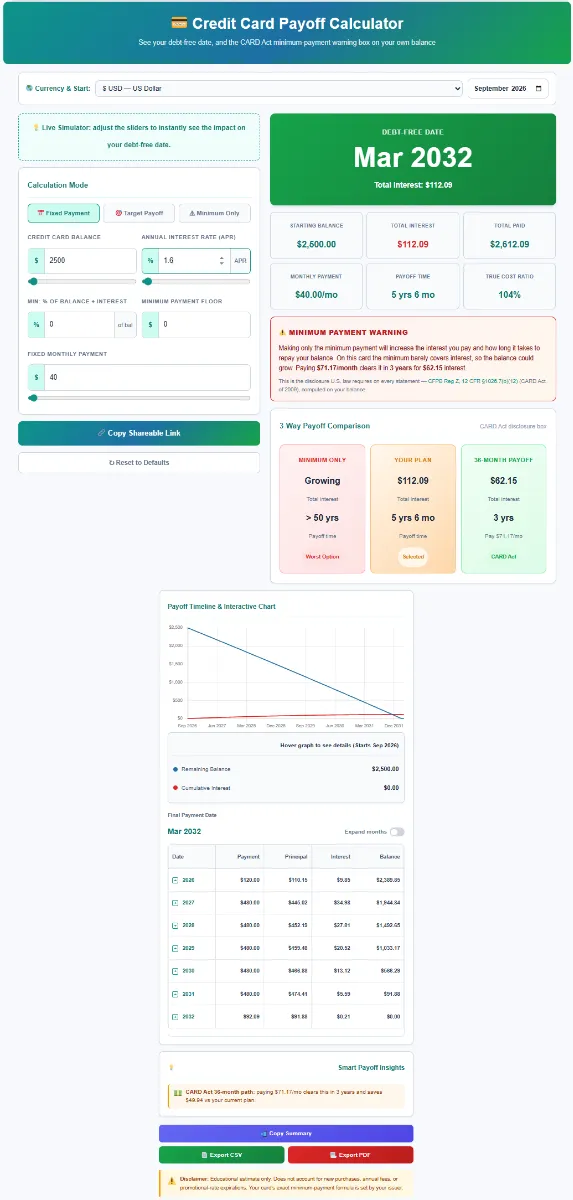
💳 See the Real Numbers: SaveXpert Credit Card Payoff Calculator
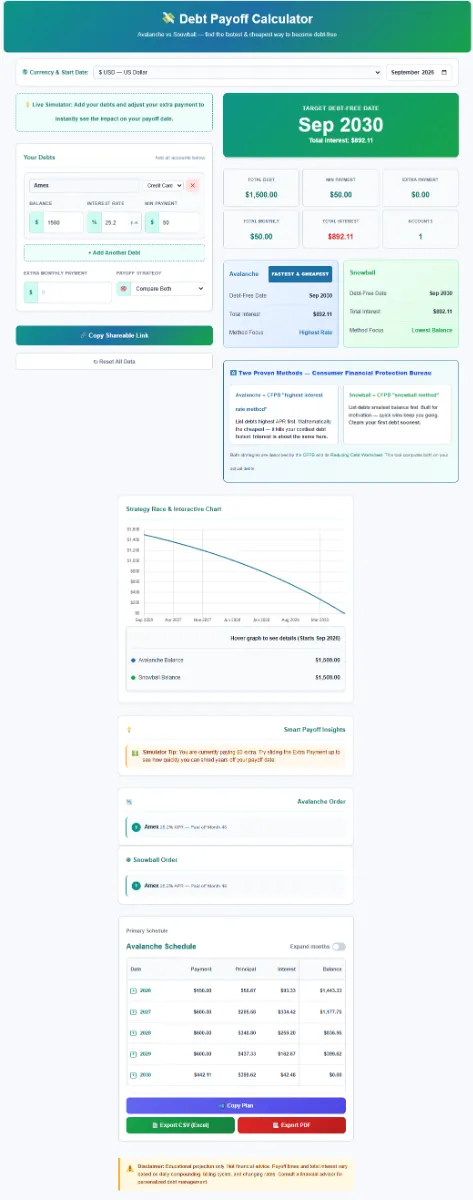
I ran a $2,500 holiday balance through the Credit Card Calculator using a 12-month promotional period at a 1.6% average rewards figure. About $40 per month, or roughly $480 per year before annual fees and interest. Then I entered a $2,500 carried balance at 20% APR. The Debt Payoff Calculator also helps model different payoff timelines side by side.
Educational note: These calculators model scenarios for informational purposes only. Source: Federal Reserve G.19 — September 8, 2026
Find out exactly how long it takes to become debt-free.
The Critical Difference Between 0% APR and Deferred Interest
This was the most important distinction in the CFPB research — and the one most likely to produce an unexpected outcome for a holiday shopper who didn’t read the agreement carefully.
Both offer types can appear in marketing with identical “no interest” language. The mechanics differ significantly when a balance remains at the promotional deadline.
| Feature | True 0% APR | Deferred-Interest Plan |
|---|---|---|
| Interest during promotional period | Does not accrue | Accrues throughout — but is waived if conditions are met |
| If balance fully paid by deadline | No interest owed | No interest owed (accrued interest waived) |
| If any balance remains at deadline | Regular APR applies to the remaining balance going forward | All accrued interest from original purchase date may be charged retroactively |
| If more than 60 days late on required payment | May trigger penalty APR per Regulation Z terms | May also trigger the accrued-interest charge per agreement terms |
| Marketing language | Often: “No interest for [X months]” | Often: “No interest if paid in full by [date].” |
The CFPB states that deferred-interest structures can apply interest under the agreement when the promotional purchase isn’t paid in full by the deadline. The brief also notes a qualifying condition involving being more than 60 days late on a required minimum payment.
⚠️ Deferred interest in plain terms — with a holiday example: A shopper puts $1,500 of holiday purchases on a deferred-interest card with a 12-month promotional offer. Over the year, they pay $1,400 — leaving $100 at the promotional deadline. Under a deferred-interest structure, the agreement may allow the issuer to charge the full year’s worth of interest that accrued on the original $1,500 balance — potentially hundreds of dollars retroactively added to the account. One unpaid dollar can trigger interest on the full original promotional balance, calculated from the original purchase date.
Under true 0% APR, the same situation would add the standard post-promotion APR only to the $100 remaining balance going forward — no retroactive calculation.
The CFPB treats this distinction as material, not cosmetic. Both offers use “no interest” language in marketing. The agreement’s specific wording — particularly “if paid in full” language — controls which structure applies.
Is a 0% APR Card Better Than Using Savings for Holiday Spending?
The CFPB and Federal Reserve sources don’t establish that one approach is universally better. That determination depends on facts outside the research: the individual’s savings position, the exact card agreement, and the ability to maintain the monthly payment required to clear the balance before expiration.
What the research does establish is the framework for comparing the two options honestly.
| Approach | Known Benefits | Known Costs or Risks |
|---|---|---|
| 0% APR promotional card | Keeps cash available during promotional period; no interest cost if balance cleared on time | Hard inquiry on credit report; annual fee (if applicable); post-promotion APR of 20%+ if balance remains; deferred-interest risk if offer structure isn’t true 0% APR |
| Using savings | No interest, no hard inquiry, no fee; eliminates debt entirely | Reduces available cash; opportunity cost of spending savings vs. keeping them invested or available |
A household that puts $2,000 of holiday purchases on a 0% APR card and keeps the cash available earns nothing on that cash in a checking account — and faces a monthly payment requirement to clear the balance before the promotion expires. A household that spends the savings avoids any interest or fees, but depletes the cash reserve.
The research finding isn’t which option is “better.” It’s that the 0% APR card introduces several variables — hard inquiry, fee structure, post-promotion rate, minimum-payment formula, deferred-interest risk — that require evaluation before the comparison is complete. The headline 0% describes only one term of a multi-term agreement.
Does Applying for a 0% APR Card Affect Your Credit Score?
The CFPB’s credit-inquiry guidance gives a clear answer on one part of the application process. When a lender checks a credit report in response to a credit application, the resulting hard inquiry can affect credit scores. Scoring models consider how recently and how frequently a consumer has applied for credit.
| Credit Application Element | What the CFPB Research Establishes |
|---|---|
| Hard inquiry from a single application | Can affect credit score; amount not universal — depends on the applicant’s full credit profile |
| Multiple applications in a short period | Can create more hard-inquiry activity than a single application; scoring models consider recency and frequency |
| Universal point deduction per application | Not established — the research doesn’t provide a fixed number of points per inquiry |
| FCRA framework | Governs consumer reporting, credit-report access, disputes, and adverse-action disclosures |
The research brief identifies hard inquiries as relevant because scoring models can consider application frequency and recency. A single application for a 0% promotional card creates one hard inquiry. Multiple applications in a short window can create a pattern that scoring models weigh more heavily. The research doesn’t establish a universal score impact — the actual effect depends on the applicant’s full credit history and the scoring model used.
This is one of several places where the headline 0% APR doesn’t tell the whole story. The promotional pricing applies to interest charges. A hard inquiry relates to the application process — a separate credit event that occurs before the card is even opened.

What the Federal Reserve Data Shows About 2026 Credit Card Rates
The Federal Reserve’s G.19 release provides the most current federal benchmark for credit card interest rates. The September 8, 2026 release reports these figures:
The all-account rate of 20.94% covers all commercial-bank credit card plans — including cardholders who pay in full each month and incur no interest. The assessed-interest rate of 22.15% (Q2 2026) covers only accounts that actually incurred interest during the measurement period — a population that more closely resembles someone carrying a balance after a promotional period expires.
The rate trend across recent periods also provides context:
| Period | All-Account Rate | Assessed-Interest Rate |
|---|---|---|
| Q2 2026 (latest assessed) | — | 22.15% |
| Latest 2026 obs. (Sept 8 release) | 20.94% | — |
| Q1 2026 | 21.00% | — |
| Q4 2025 | 20.97% | — |
| Q3 2025 | — | 22.83% |
| Q2 2025 | — | 22.25% |
| Q1 2025 | 21.37% | — |
The G.19 release also reported that total consumer credit grew at a 4.2% seasonally adjusted annual rate in July 2026, with revolving consumer credit growing at 2.5%. These figures don’t tell us what any individual cardholder pays — but they establish that the borrowing environment a holiday balance enters after a promotional period expires is one where market-average rates have stayed persistently above 20%.
What the Research Shows Works (and What Doesn’t)
What the CFPB and Federal Reserve data consistently supports
Comparing the post-promotion APR to the Federal Reserve benchmark before applying.
The 20.94%–22.15% range in the G.19 data gives a reference point. A card’s post-promotion APR above that range is more expensive than the market average for accounts that carry balances. One below it is more competitive. The comparison requires knowing the post-promotion APR, which Regulation Z disclosures must include.
Calculating the required monthly payment before treating the promotion as manageable.
Promotional balance divided by number of months in the promotional period gives the monthly payment needed to clear the balance on time. Comparing that figure to the statement minimum shows whether minimum payments keep you on track — or leave a residual balance into the post-promotion rate.
Identifying whether the offer is true 0% APR or deferred interest before applying.
The CFPB treats this as a material distinction. “No interest if paid in full” signals deferred interest. “No interest for [period]” more commonly signals true 0% APR. The agreement’s actual language controls — not the marketing headline.
Accounting for fees in the total cost calculation.
The 0% APR headline answers only the interest question. An annual fee, a late-payment fee, or a balance-transfer fee can offset the promotional benefit for lower spending levels. The full cost structure — all disclosed fees plus post-promotion APR — provides the complete picture.
What the data says doesn’t work
Relying on minimum payments to clear the promotional balance.
Minimum-payment formulas vary by agreement. A formula that charges interest-based minimums may not accelerate the balance toward zero. Only the promotional-balance ÷ promotional-period calculation guarantees clearance on time.
Treating a 0% promotional offer as permanent interest-free financing.
The CFPB’s guidance is explicit: the promotional rate lasts for the stated period. A holiday purchase placed on a promotional card in November isn’t exempt from interest indefinitely — it’s exempt for the number of months disclosed in the agreement, after which the balance enters standard interest-rate treatment.
Applying for multiple promotional cards in a short window to maximise 0% capacity.
Each application creates a hard inquiry. Scoring models consider the recency and frequency of credit applications. Multiple applications may weigh more heavily than a single one, and the CFPB identifies this as relevant to credit-score outcomes.
Bottom Line: 5 Things to Verify Before Using a 0% APR Card for the Holidays
1. Find the exact promotional end date in the card agreement and enter it in your calendar before making any purchase:
Not the promotional period length — the actual expiration date. A 12-month promotion on a card opened November 15, 2026 may expire October 15 or November 15, 2027, depending on the agreement’s calculation method. The difference of one month is the difference between clearing the balance and entering the post-promotion rate with an outstanding balance.
2. Identify whether the offer is true 0% APR or deferred interest before applying:
Look for “if paid in full” language — that signals deferred interest, where the full promotional period’s accrued interest can be charged retroactively if even one dollar remains at the deadline. “No interest for [X months]” more commonly signals true 0% APR. The card agreement’s specific language controls, not the marketing banner. Under deferred interest, $1 left unpaid can mean hundreds of dollars in retroactive charges.
3. Calculate the required monthly payment yourself — don’t rely on the statement minimum:
Divide the total promotional balance by the number of months in the promotional period. That’s the monthly payment required to clear the balance on time. Compare it to the minimum payment shown on your statement. If the statement minimum is lower, the minimum payment schedule will leave a residual balance that enters the post-promotion rate. Run the Credit Card Calculator to model both scenarios in dollar terms.
4. List every fee in the card agreement before deciding the promotion is free:
A 0% purchase APR doesn’t eliminate annual fees, late-payment fees, balance-transfer fees, or cash-advance charges. These are governed by separate disclosures per Regulation Z. For low holiday spending levels, an annual fee can consume a significant share of the savings the 0% period provides. Add up all fees in the first year and compare to the interest cost the promotion avoids.
5. Check the post-promotion APR against the Federal Reserve’s current benchmark before committing to the card:
The Fed G.19 shows 20.94% for all accounts and 22.15% for accounts assessed interest in Q2 2026. If the card’s post-promotion APR is above those figures and you carry any balance after the promotion, you’re paying above-market interest on the holiday spending you deferred. A card with a lower post-promotion APR provides more protection against the cost of any balance that doesn’t clear on time.
“When I went through the CFPB’s promotional financing guidance and the Federal Reserve’s G.19 data, the most important finding wasn’t the 22.15% rate waiting at the end of a 0% promotional period. It was the deferred-interest distinction. Two offers can use the same ‘no interest’ marketing language and produce completely different outcomes when one dollar remains unpaid at the deadline. The CFPB treats that distinction as material — and the research bears that out.”
— Kevin Brown, Lead Researcher at SaveXpert.com
Frequently Asked Questions
Ans: According to CFPB guidance, a 0% introductory APR offer lets qualifying purchases avoid interest during a stated promotional period. Once the period ends, the card’s regular APR applies to any remaining balance. The Federal Reserve G.19 shows that the rate averaged 20.94% for all accounts and 22.15% for accounts assessed interest in Q2 2026. The 0% pricing applies only to qualifying purchases during the promotional window — not to annual fees, cash advances, balance transfers, or charges in other categories.
Ans: When the promotional period expires, interest begins accruing on any remaining balance at the card’s standard APR. The CFPB research also identifies a common misconception: making only minimum payments doesn’t automatically clear the promotional balance in time. Minimum-payment formulas vary by agreement. The research brief notes that one CFPB-published agreement example calculates the promotional payment as the balance divided by the number of months — but other formulas may produce lower payments that leave a residual balance at expiration. Calculate the required monthly payment yourself rather than relying on the statement minimum.
Ans: The CFPB and Federal Reserve sources don’t establish that one method is universally better. A 0% APR promotional card keeps cash available during the promotional period without incurring interest — if the balance is cleared before expiration. But it also involves a hard inquiry on the credit report, potential fees, a post-promotion APR above 20%, and deferred-interest risk if the offer structure isn’t true 0% APR. Using savings avoids debt, interest, and fees entirely — but depletes available cash. The research supports evaluating the full cost structure of both options, not just the headline 0%.
Ans: The CFPB’s credit-inquiry guidance states that a hard inquiry from a credit application can affect credit scores. Scoring models consider how recently and how frequently a consumer has applied for credit. The research doesn’t establish a fixed point deduction per application — the actual effect depends on the applicant’s full credit profile and the scoring model in use. Multiple applications in a short window create more hard-inquiry activity than a single application, which scoring models can weigh more heavily.
Ans: With true 0% APR, interest doesn’t accrue during the promotional period. After the period ends, the regular APR applies to the remaining balance going forward. With deferred interest, interest accrues throughout the promotional period but is waived if the full balance is paid before the deadline. Leave even one dollar unpaid at the deadline and the full period’s accrued interest — calculated from the original purchase date — may be charged retroactively. The CFPB treats this as a material distinction, not a cosmetic one. Both offer types can appear in marketing with identical “no interest” language; the agreement’s specific wording controls which structure applies.
Ans: The calculation is straightforward: divide the total promotional balance by the number of months in the promotional period. For a $1,200 balance on a 12-month promotional offer, that’s $100/month. This is different from the minimum payment shown on your billing statement — the statement minimum is calculated by the issuer’s formula, which the CFPB notes varies by agreement and may leave a residual balance at expiration. Only the balance ÷ months calculation guarantees the promotional balance clears on schedule. The Credit Card Calculator can model the full payoff scenario, including projected interest if any balance remains after the promotion ends.