
ⓘ Educational Disclosure:
This article is for educational and informational purposes only. It does not constitute financial, legal, tax, lending, or investment advice. SaveXpert and its authors are not licensed financial advisors, CPAs, attorneys, or tax advisors. All data comes from publicly available government and institutional sources. Always consult a qualified professional before making investment decisions.
What is the best credit card strategy for holiday shopping in 2026? According to the CFPB’s Consumer Credit Card Market Report, the approach that minimises total cost depends on your repayment behaviour. If you’ll pay the balance in full each month, a rewards card that earns the highest return on holiday spending categories makes sense. If you’ll carry any portion of the balance, the card with the lowest APR — or a genuine 0% APR promotional period long enough to cover full repayment — is the better option. The CFPB’s 2024 data shows average general-purpose card APRs at 25.2%, which erases the value of most reward structures when a balance carries. The research also identifies a critical distinction between true 0% APR offers and deferred-interest plans — two structures that look identical on a promotional banner but work very differently if the balance isn’t cleared before the period ends.
Key Takeaways
- Problem: Holiday shoppers are comparing credit card reward rates without comparing the interest costs that erase those rewards — at CFPB-reported average APRs of 25.2% for general-purpose cards, a carried balance costs more in interest than most reward structures return.
- Solution: The smartest holiday credit card approach compares total repayment cost — APR, promotional terms, and fees together — against the value of any reward or promotion. The Credit Card Calculator converts those abstract percentages into actual dollar differences before you commit to a purchase.
- Result: Prioritising the lowest available APR over the highest reward rate when carrying a balance minimises total holiday debt cost. And understanding the critical difference between a true 0% APR offer and a deferred-interest plan prevents one of the most expensive surprises in consumer credit.
- Source: CFPB Consumer Credit Card Market Report 2025 · Federal Reserve G.19 Consumer Credit
- Time To Read: 7 Minutes
Table of Contents
1. The APR Numbers That Change the Holiday Math
2. Rewards Cards vs. 0% APR Cards for Holiday Shopping
3. The Deferred-Interest Trap: How 0% Offers Can Backfire
4. How Holiday Spending Affects Your FICO Score
5. When Holiday Payments Matter Most
6. The September 2026 Fed Rate Cut: What It Doesn’t Mean for Your Card
7. What the Research Shows Works (and What Doesn’t)
8. Bottom Line: 5 Steps for the Best Holiday Credit Card Strategy
The question most holiday shoppers ask about credit cards is the wrong one. “Which card earns the most rewards?” is useful — but only when you’re paying the balance in full. The CFPB’s 2025 Consumer Credit Card Market Report shows average APRs of 25.2% for general-purpose cards and 31.3% for private-label store cards in 2024. At those rates, a 2% cash-back reward earns $20 on a $1,000 balance while interest charges on that same balance run approximately $252 annually. The math changes which card is actually the best one for your holiday shopping.
The APR Numbers That Change the Holiday Math
The research found two sets of credit card interest-rate figures from federal sources — and they don’t show the same number. Understanding why matters before using either as a reference point.
| Source | Measure | 2024/2026 Figure | Methodology Note |
|---|---|---|---|
| CFPB Market Report 2025 | General-purpose card APR (2024 avg) | 25.2% | Covers all accounts, including those near penalty rates |
| CFPB Market Report 2025 | Private-label card APR (2024 avg) | 31.3% | Store-branded cards; higher average than general-purpose |
| Federal Reserve G.19 | Credit card interest rates (2026) | 20.90%–21.58% | Different statistical methodology; not directly comparable to CFPB figures |
Source: CFPB Consumer Credit Card Market Report 2025 · Federal Reserve G.19 Consumer Credit
The CFPB explicitly notes in its report that its APR figures use a different statistical approach from the Federal Reserve’s G.19 interest-rate measures. Both sets of numbers come from official federal sources — but they’re not measuring the same thing in the same way. Neither figure is simply “wrong.” They reflect different sample constructions and calculation approaches, which is why the CFPB’s 25.2% and the Fed’s 20.90%–21.58% coexist without contradiction in the same research brief.
For holiday planning purposes, the CFPB’s figure — which includes accounts at or near penalty rates — gives a more conservative benchmark. The practical question isn’t which number is right. It’s what APR is printed on your specific card agreement.
Separately, the Federal Reserve reported that revolving consumer credit grew at a 2.5% seasonally adjusted annual rate in July 2026. Holiday borrowing lands in a market where revolving balances are already rising across the household sector.

Rewards Cards vs. 0% APR Cards for Holiday Shopping
The research points to a decision that hinges entirely on one question: will you carry any portion of the balance after the statement closes?
| Card Type | Best When | Risk When Carrying a Balance | Key Regulation |
|---|---|---|---|
| Rewards card (cash back, points, miles) | You pay in full every month | Interest at 25.2%+ avg APR erases reward value quickly | Regulation Z §1026.7 — minimum-payment warnings required on statements |
| 0% APR promotional card (true) | You can pay the full balance before the promo period ends | Residual balance after period ends reverts to standard APR | CFPB promotional plan terms disclosure |
| Deferred-interest plan (“no interest if paid in full”) | You are certain you can pay in full before the period ends | All accrued interest retroactively charged on missed payoff | CFPB Regulation Z deferred-interest definition |
| Lowest-APR card available | You know you’ll carry a balance | Minimises, but doesn’t eliminate, interest cost | Regulation Z §1026.7 — minimum-payment disclosures |
Source: CFPB Regulation Z §1026.7 · CFPB Consumer Credit Card Market Report 2025
The research brief also reviewed third-party card data from NerdWallet and Bankrate for market context. Bankrate reported that issuers often increase welcome offers between October and December — a seasonal pattern that can make Q4 a useful window for new card applications. But welcome offers and reward rates are not the primary research finding here. The CFPB’s data is clear: when a balance carries, the APR is the number that controls total cost — not the reward rate on the front face of the card.
The minimum-payment warning the CFPB requires on every statement
Regulation Z §1026.7 requires credit card statements to warn consumers about the cost of making only minimum payments. The warning states that paying only the minimum leads to more interest paid and a longer payoff period. That’s not editorial commentary — it’s a federally mandated disclosure that issuers are required to include on every billing statement. The CFPB put it there precisely because the impact of carrying a balance at 25%-plus APRs is that severe.
The Deferred-Interest Trap: How 0% Offers Can Backfire
This is the most important distinction in the research — and the one most holiday shoppers miss entirely when they see a “no interest for 12 months” promotion at the retail checkout.
The CFPB’s regulatory materials define a deferred-interest plan as one where accrued interest isn’t owed when the consumer pays the balance in full before the promotional period expires. That definition contains the critical word: accrued.
Under a deferred-interest plan, interest does accrue during the promotional period — it just doesn’t appear on your statement while you’re in the promotion. If you pay the full balance before the period ends, the accrued interest is waived. If you leave even $1 unpaid at the promotional deadline, the full retroactively accumulated interest from the entire promotional period can be added to your account at once.
⚠️ Deferred-interest vs. true 0% APR — the difference in plain terms:
- True 0% APR: No interest accrues during the promotional period. Residual balance after the period reverts to the standard APR — but only going forward.
- Deferred-interest plan: Interest accrues throughout the promotional period but is waived if the full balance is paid before the period ends. Miss the payoff deadline by even one dollar and the full amount of accrued interest is retroactively charged — potentially months of interest, in one billing cycle.
Retail store card promotions are almost always deferred-interest, not true 0% APR. General-purpose balance-transfer or new-purchase promotions from major issuers are more commonly true 0% APR. Read the promotional terms carefully — not just the banner.
How Holiday Spending Affects Your FICO Score
The research identifies two specific FICO scoring components that holiday credit card spending can affect.
| FICO Component | Approximate Weight | Holiday Spending Impact |
|---|---|---|
| Payment history | ~35% | A missed or late holiday payment is recorded and affects this component; Regulation Z §1026.10 governs payment-crediting rules |
| Amounts owed (incl. revolving utilization) | ~30% | A large holiday balance that raises revolving utilization can suppress this component until the balance is paid down |
Source: FICO — Key Factors in FICO Scores · CFPB Regulation Z §1026.10
The research is careful on one point: it doesn’t establish a single “safe” utilization percentage that guarantees a particular FICO outcome. FICO’s guidance indicates that lower revolving utilization is better across the scoring model — but a specific threshold that produces a specific score change isn’t something the research brief supports claiming.
What the data does support: a holiday spending pattern that significantly raises revolving utilization can suppress the amounts-owed component of your FICO score in the near term. That suppression typically reverses as balances are paid down — but it can affect your score during a window when it matters for other financial decisions like refinancing or a January loan application.
💡 Research note: Revolving utilization is calculated per card and in aggregate. A single card pushed close to its credit limit contributes more to utilization impact than the same total balance spread across multiple cards with available capacity. If holiday spending concentrates on one card, the utilization effect on that card can be disproportionate even if your total balance looks moderate.

When Holiday Payments Matter Most
The research doesn’t establish a single universal payment date that guarantees no interest across all cards. Payment deadlines, statement cycles, and promotional cutoffs are all set by individual card agreements — not by federal law.
What the research does establish is the framework for payment timing across two scenarios:
For regular monthly balances:
Regulation Z §1026.10 governs payment crediting. Issuers must credit a payment on the day it’s received if it meets the card’s payment requirements. The CFPB also addresses what happens when an issuer materially changes its payment address or handling process — if such a change creates a processing delay, federal rules restrict certain late fees and finance charges during a 60-day transition period.
For promotional 0% or deferred-interest periods:
The promotional deadline is the date that determines whether accrued interest applies. For deferred-interest plans, clearing the entire balance by that deadline is the single most important payment timing event in the promotional period. Missing it by one day — or one dollar — can trigger retroactive interest charges on the full promotional balance.
The practical takeaway: don’t rely on a general “pay before the due date” heuristic for promotional balances. Read the promotional agreement for the specific payoff deadline, and set a payment that clears the full balance several days in advance to account for processing time.
Find out how long it takes to clear your card — and the interest cost.
The September 2026 Fed Rate Cut: What It Doesn’t Mean for Your Card
On September 16, 2026, the Federal Reserve changed its federal funds target range by 0.25 percentage point, bringing the range to 3.75%–4.00%.
The research brief is specific about what this does and doesn’t mean for credit card holders: the rate change doesn’t establish an immediate or universal change in every credit card’s APR.
Variable-rate credit card APRs are typically tied to an index — most commonly the U.S. Prime Rate, which generally moves in parallel with the federal funds rate. A Fed rate cut can eventually flow through to variable-rate cards as the Prime Rate adjusts. But:
Timing varies.
Issuers may not adjust rates immediately. Some do; some wait for a billing cycle.
The amount may differ.
A 0.25% Fed funds reduction that flows through to the Prime Rate produces a 0.25% potential reduction in a variable-rate card’s APR — which would reduce a 25.2% average APR to approximately 24.95%. Meaningful over time, not transformative in a single holiday season.
Check your agreement.
Not all cards are variable-rate. Some have fixed rates. The terms of your specific card agreement determine how — and whether — a Fed rate change affects your APR.
⚠️ Don’t assume the rate cut lowered your card’s APR: The September 2026 Fed rate cut is real — but the research brief explicitly notes it doesn’t produce an automatic, universal, or immediate APR reduction for every cardholder. Check your card’s current APR in your account portal or most recent statement, not against the Fed announcement.
💳 Run the Real Numbers: SaveXpert Credit Card Payoff Calculator
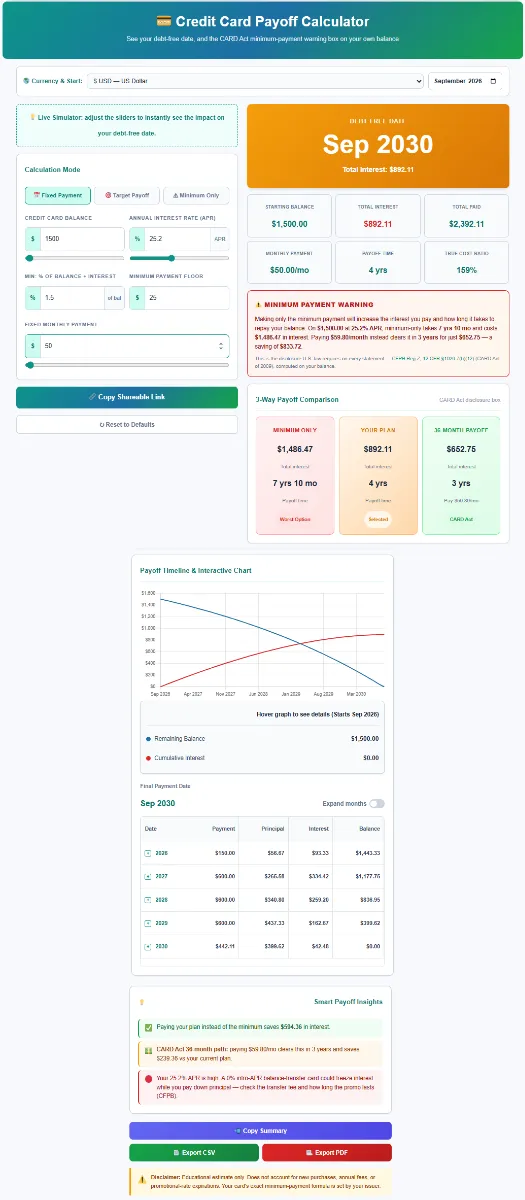
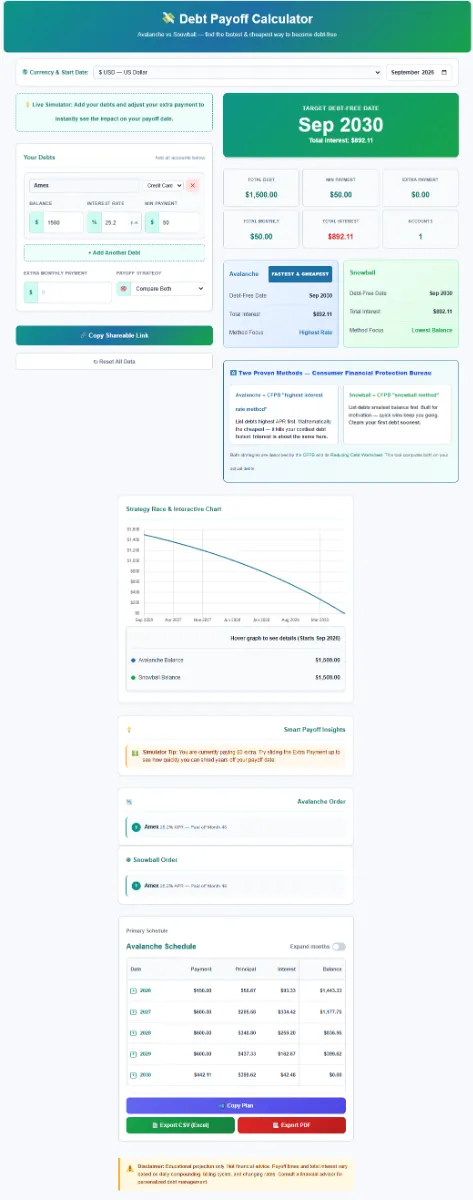
I ran a holiday scenario through the Credit Card Calculator: $1,500 balance, 25.2% APR, minimum payments only. The output showed the full interest cost and payoff timeline — and the gap between that number and a 1.5% or 2% cash-back reward made the APR-over-rewards argument concrete rather than theoretical. The Debt Payoff Calculator also helps compare payment amounts and timelines side by side when you’re managing multiple holiday balances across more than one card.
Educational note: These calculators model scenarios for informational purposes only and do not constitute financial advice. Source: CFPB Consumer Credit Card Market Report 2025
Find out exactly how long it takes to become debt-free.
What the Research Shows Works (and What Doesn’t)
What the CFPB, Regulation Z, and FICO data consistently supports
Comparing total repayment cost before choosing a card for holiday spending.
The CFPB’s 25.2% general-purpose APR and 31.3% private-label APR averages show that interest at these levels outpaces most reward structures within a single billing cycle of carrying a balance. The comparison that matters isn’t reward rate vs. reward rate — it’s total cost including interest vs. reward value received.
Understanding the deferred-interest vs. true 0% distinction before accepting a promotional offer.
The CFPB’s regulatory definition makes this distinction formal and consequential. Retail store card promotions are frequently deferred-interest structures. Missing the payoff deadline by even one billing cycle can produce a retroactive interest charge that exceeds the original purchase discount that made the retail card attractive.
Keeping revolving utilization in check during the holiday season.
FICO’s scoring framework puts amounts owed — including revolving utilization — at approximately 30% of the score. Holiday balances that push utilization significantly higher can suppress this component. If other financial decisions depend on your credit score in Q1 (a loan application, a lease renewal, a refinance), the timing of holiday balance paydown matters.
Running the Credit Card Calculator before committing to a holiday purchase on credit.
Abstract percentages become specific dollar amounts when you enter the actual balance, APR, and payment amount. The calculation converts “25.2% sounds high” into “$378 in interest on $1,500 over 12 months of minimum payments.” That specificity changes the decision.
What the data says doesn’t work
Treating rewards rate as the primary holiday card metric when carrying a balance.
The math is simple, and the CFPB data supports it without ambiguity. A 3% cash-back reward earns $45 on a $1,500 balance. Interest at 25.2% APR on that same balance costs $378 annually. Choosing the card with the highest reward rate when you expect to carry a balance is choosing to optimise the smaller number.
Assuming a “no interest for 12 months” banner means true 0% APR.
The promotional language is identical between deferred-interest and true 0% APR offers in many retail contexts. The distinction lives in the promotional terms document — specifically whether the language says “no interest if paid in full” (deferred-interest) or “no interest for [period]” (true 0% APR). The CFPB’s Regulation Z addresses this distinction in its deferred-interest plan definitions.
Assuming the September 2026 Fed rate cut immediately reduced your card’s APR.
The research brief flags this explicitly. The Fed’s 0.25% rate change on September 16, 2026 doesn’t produce automatic, universal, or immediate credit card APR reductions. Variable-rate cards may eventually reflect the change — but the timeline, the amount, and whether your specific card is variable-rate depend on your card agreement, not the Fed announcement.

Bottom Line: 5 Steps for the Best Holiday Credit Card Strategy
1. Calculate the true cost of carrying a balance before choosing a rewards card for holiday purchases:
At 25.2% average APR (CFPB 2024 general-purpose figure), a $1,000 carried balance costs approximately $252 in annual interest. A 2% cash-back reward on that purchase earns $20. Run the Credit Card Calculator with your actual card’s APR and expected balance before assuming rewards provide net value. If you’ll pay in full, the rewards card wins. If you’ll carry, the lowest-APR card wins.
2. Read the promotional terms before accepting any “no interest” offer — specifically whether it’s true 0% APR or a deferred-interest plan:
The banner language looks identical. The regulatory distinction is consequential. Under a deferred-interest plan, interest accrues throughout the promotional period and is retroactively charged in full if the balance isn’t completely cleared by the deadline. “No interest if paid in full” = deferred-interest. “No interest for [period]” = more likely true 0% APR. Verify in the promotional terms document, not the marketing banner.
3. Monitor revolving utilization during the holiday season — especially if a Q1 financial decision depends on your credit score:
FICO’s scoring framework puts amounts owed at approximately 30% of the score, with revolving utilization as a component. A large holiday balance can suppress this portion until paid down. If you’re planning a loan application, lease renewal, or refinance in January or February, pay down holiday balances before those applications — not after.
4. Set a calendar reminder to pay off any promotional balance at least five business days before the promotional deadline:
The research doesn’t establish a single universal payment date that eliminates interest risk. What it does establish is that promotional deadlines are exact, and processing times vary. Setting a payoff at least five business days before the promotional expiration date provides a buffer against payment processing delays. For deferred-interest plans, missing the deadline by even one day can mean the full retroactive interest charge.
5. Check your card’s actual current APR — don’t assume the September 2026 Fed rate cut already reduced it:
The Federal Reserve cut its target rate on September 16, 2026 to 3.75%–4.00%. The research brief explicitly notes this doesn’t establish an automatic, immediate, or universal reduction in every credit card’s APR. Log into your card account portal or check your most recent statement for your current APR. If your card is variable-rate, any rate change will appear in your account terms — typically with advance notice per Regulation Z change-in-terms requirements.
“When I went through the CFPB’s 2024 credit card market data and the Regulation Z minimum-payment disclosures, the finding that stood out wasn’t the 25.2% average APR itself. It was the reward math underneath it. A 2% cash-back reward on a $1,000 holiday purchase earns $20. Carrying that same balance for a year at 25.2% costs $252 in interest. Holiday rewards don’t work as a benefit when interest carries — they work as a fraction of the true cost. The CFPB data makes that calculation unavoidable.”
— Kevin Brown, Lead Researcher at SaveXpert.com
Frequently Asked Questions
Ans: According to CFPB data, the smartest approach depends on your repayment plan. If you’ll pay in full each month, a card that earns the highest return on holiday spending categories makes financial sense. If you’ll carry any portion of the balance, the CFPB’s average APR data — 25.2% for general-purpose cards, 31.3% for private-label cards in 2024 — shows that interest costs erase the value of reward structures quickly. In a carry scenario, the card with the lowest available APR or a genuine 0% promotional period long enough to cover full repayment is the better option.
Ans: The CFPB’s regulatory materials support prioritising a 0% APR promotional card if you’ll carry a balance — provided the promotional offer is a true 0% APR and not a deferred-interest plan. With a deferred-interest plan, interest accrues throughout the period and is charged retroactively if the balance isn’t paid in full before the promotional deadline. Retail store card promotions are frequently deferred-interest structures, not true 0% APR. A rewards card is the better choice only when the full balance will be paid before interest charges apply.
Ans: FICO’s scoring framework identifies two components directly relevant to holiday spending. Payment history accounts for approximately 35% of the score — a missed or late holiday payment affects this portion. Amounts owed, including revolving credit utilization, account for approximately 30%. A large holiday balance that pushes revolving utilization significantly higher can suppress the amounts-owed component until balances are paid down. The research doesn’t establish a single safe utilization threshold, but FICO’s guidance indicates that lower revolving utilization is better across all scoring ranges.
Ans: The research brief doesn’t establish a single universal safe utilization rate that guarantees a specific FICO outcome. FICO’s guidance consistently indicates that lower revolving utilization is better — but a specific percentage tied to a specific score change isn’t something the research supports claiming. The practical guidance from the data: if other financial decisions (loan applications, lease renewals) depend on your credit score in Q1 2027, pay down holiday balances before those applications. The utilization suppression from a large holiday balance typically reverses as balances are paid down.
Ans: The CFPB’s Consumer Credit Card Market Report doesn’t establish specific rules for holiday spending — but its 2024 average APR data (25.2% general-purpose, 31.3% private-label) and Regulation Z’s minimum-payment disclosure requirements both point toward the same finding: when a balance carries, minimising interest cost outperforms chasing reward rates. The CFPB’s regulatory framework for deferred-interest plans is also relevant — the distinction between deferred-interest and true 0% APR is a federal regulatory category, not just fine print.
Ans: Not necessarily. The Federal Reserve changed its federal-funds target range by 0.25 percentage point on September 16, 2026, to 3.75%–4.00%. The research brief explicitly notes that this change doesn’t establish an immediate or universal effect on every credit card’s APR. Variable-rate cards are typically tied to the Prime Rate, which generally tracks the federal funds rate — so a rate cut may eventually pass through. But timing, amount, and applicability depend on each card’s agreement. Check your current APR in your account portal or on your most recent statement rather than assuming the Fed announcement automatically reduced your rate.