ⓘ Educational Disclosure:
This article is for educational and informational purposes only. It does not constitute financial, legal, tax, lending, or investment advice. SaveXpert and its authors are not licensed financial advisors, CPAs, attorneys, or tax advisors. All data comes from publicly available government and institutional sources. Always consult a qualified professional before making investment decisions.
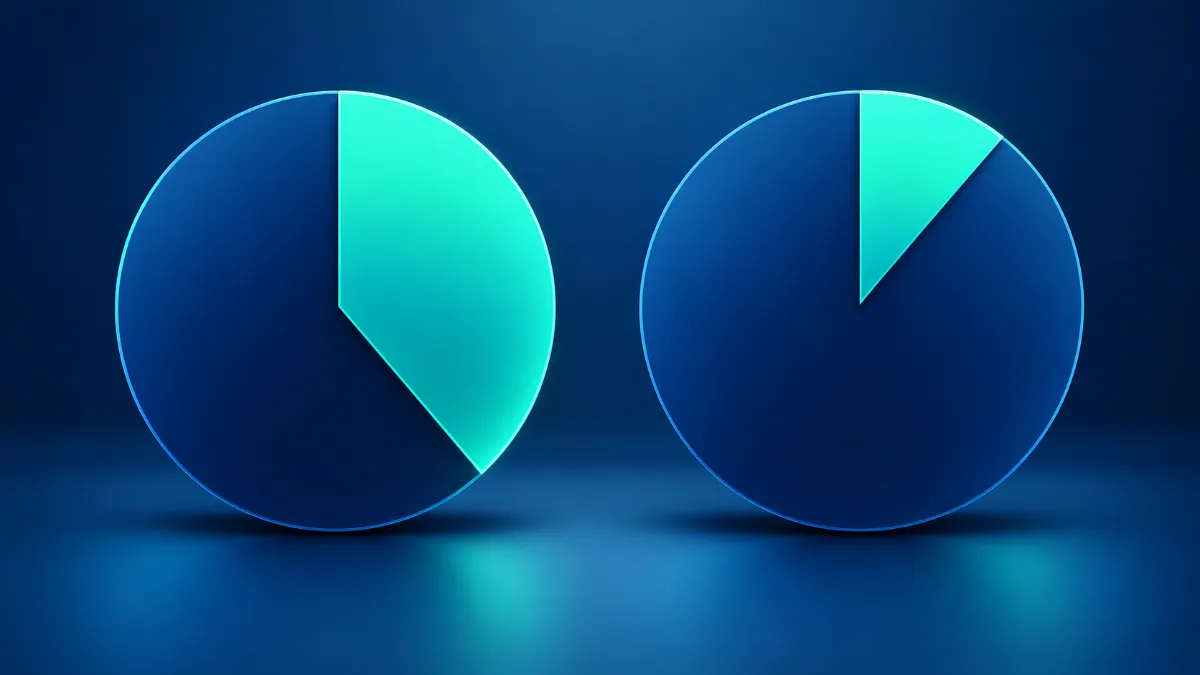
How do you improve your credit score before applying for a credit card? According to FICO and CFPB data, focus on the two factors that make up 65% of your FICO Score: payment history (35%) and credit utilization (30%). Credit utilization is the fastest-moving factor — reducing revolving balances below 30% of your credit limit can show up in your score within 30–45 days after the creditor reports the new balance. Payment history has the largest weight but is the slowest to repair — missed payments remain on credit reports for seven years. Check your free credit report at AnnualCreditReport.com for errors before applying, and stop opening new credit in the 3–6 months before your target application date.
Key Takeaways
- Problem: Many consumers approaching holiday card applications don’t know which credit factors actually move quickly and which take years — so they focus energy on things that won’t change their score before the application window.
- Solution: FICO and CFPB data show that payment history (35%) and credit utilization (30%) together make up 65% of a FICO Score. Of those two, utilization is the fastest-moving — changes can appear within 30–45 days after the creditor reports the new balance. Payment history is the most impactful but the slowest to repair.
- Result: The research also shows that Bankrate data found only 38% of applicants with “good” credit (670–739) received approval through their platform — meaning a score in the right range doesn’t guarantee the card. Improvement changes the odds; understanding what the score measures is where the process starts.
- Source: FICO Credit Education · CFPB — Understand Your Credit Score
- Time To Read: 6 Minutes
Table of Contents
1. The Two FICO Factors That Control 65% of Your Score
2. Credit Utilization: The Fastest Lever Before Applying
3. Payment History: The Largest Factor and the Slowest to Repair
4. How Long Does It Take for Changes to Appear on Your Score?
5. Check Your Credit Report Before Applying — It’s Free
6. What a Hard Inquiry Actually Costs
7. Three Misconceptions the Research Corrects
8. Score Ranges and What Approval Data Actually Shows
9. What the Research Shows Works (and What Doesn’t)
10. Bottom Line: 5 Steps Before Applying for a Holiday Credit Card
The average U.S. FICO Score reached 714 in fall 2026. A single hard inquiry from a new credit card application typically lowers that score by fewer than five points. Neither number — the average score or the inquiry cost — tells you whether you’ll be approved for the card you want. Bankrate’s data found that only 38% of applicants with “good” credit (670–739) received approval through their platform. Improving your score before applying changes the odds. Understanding which factors move quickly and which take years tells you where to focus your time between now and the application.
The Two FICO Factors That Control 65% of Your Score
The research starts with one finding that clears away most of the noise around credit improvement advice. Two factors — payment history and credit utilization — account for 65% of a FICO Score. Everything else (length of credit history, credit mix, new credit) makes up the remaining 35%.
| FICO Factor | Weight | What It Measures | Speed of Change |
|---|---|---|---|
| Payment history | 35% | Whether you pay bills on time; missed/late payments and their recency | Slow — missed payments stay 7 years; positive history builds over time |
| Credit utilization | 30% | Revolving balances as a percentage of total credit limits | Fastest — updates within 30–45 days of creditor reporting |
| Length of credit history | 15% | Age of oldest/newest accounts, average account age | Very slow — improves with time only |
| Credit mix | 10% | Variety of credit types (cards, loans, mortgage) | Slow — changes with new account types |
| New credit | 10% | Recent applications and hard inquiries | Moderate — hard inquiries affect score for 12 months |
Source: FICO Credit Education · CFPB — Understand Your Credit Score
For a consumer approaching a holiday credit card application with a defined timeline, the implication is clear. The 65% that moves fastest consists of utilization (actionable within one billing cycle) and payment history (built through consistent on-time payments over months and years). The remaining 35% either moves slowly or isn’t significantly controllable in a short window.
Credit Utilization: The Fastest Lever Before Applying
The research identifies credit utilization as the factor most actionable before a planned application. FICO assigns it 30% of the score, and changes appear faster than any other scoring component because utilization is recalculated each time a creditor reports a new balance — which typically happens at the end of each billing cycle.
What the research says about the target percentage
| Utilization Level | On a $5,000 Limit Card | Scoring Signal |
|---|---|---|
| 40% (above common ceiling) | $2,000 balance | Above the 30% threshold the CFPB commonly references; stronger negative signal |
| 30% (common ceiling) | $1,500 balance | At or near the threshold the CFPB recommends not exceeding |
| 10% (lower target) | $500 balance | Stronger positive signal; research cites some data at 1%–3% showing slightly higher scores |
| 0% statement balance | $0 balance | Does not damage your score — see Misconceptions section |
Source: CFPB — Understand Your Credit Score · FICO scoring data
The research doesn’t promise a specific number of score points for a specific utilization reduction. It establishes that lower utilization produces a stronger scoring signal, with the sharpest benefit typically appearing when balances cross below the 30% threshold.
One more useful point: utilization is calculated both per card and in aggregate across all revolving accounts. A single maxed-out card can raise that card’s individual utilization to 100% even when the overall utilization across all cards looks low. Spreading balances or reducing the highest-utilization card first addresses both dimensions.
Payment History: The Largest Factor and the Slowest to Repair
Payment history carries the largest single weight in FICO scoring at 35%. The CFPB describes on-time payment behaviour as having the greatest impact on your score.
The difficulty for someone approaching a holiday application: missed payments remain on credit reports for seven years. Chapter 7 bankruptcy stays for ten. These are CFPB-confirmed timelines — not ranges that can be shortened through legitimate credit strategies.
What the research does support is the forward-looking impact of building a clean payment history. A consumer with a 12-month window of on-time payments builds a strong positive signal in this category, even when older missed payments are still technically present on the report. The negative weight of older marks diminishes over time; the positive weight of recent consistent payments accumulates.
⚠️ A missed payment can cost more than a hard inquiry: A single new hard inquiry from a credit card application typically costs fewer than five FICO points. A single missed or late payment can have a much larger negative effect — and that record stays for seven years. If the choice is between applying now (with a hard inquiry) or missing a payment to free up cash, the research supports prioritising the payment every time.
How Long Does It Take for Changes to Appear on Your Score?
The research provides specific timeframes for each type of credit change. Not all improvements appear at the same speed.
| Change Type | Typical Timeframe to Appear | Source |
|---|---|---|
| Paid/reduced revolving balance | 30–45 days (after creditor reports new balance at end of billing cycle) | Experian data cited in research brief |
| Credit report error dispute | Up to 30 days (FCRA investigation window for bureaus) | FCRA / CFPB |
| Hard inquiry (scoring effect) | Affects FICO Score for 12 months; visible on report for 24 months | CFPB / FICO |
| Missed payment (negative) | Remains on report for 7 years | CFPB |
| Chapter 7 bankruptcy (negative) | Remains on report for 10 years | CFPB |
Source: CFPB — How to Rebuild Your Credit · Experian billing-cycle data · FCRA
For a consumer planning a holiday card application in October or November, the 30–45-day reporting window matters significantly. A balance reduction made in late September may not appear in scoring data until late October or early November — potentially after an application has already been submitted. Planning a balance paydown 6–8 weeks before the target application date builds in the reporting cycle buffer.
Check Your Credit Report Before Applying — It’s Free
The research identifies a step that costs nothing and carries no scoring risk: reviewing your credit report before applying.
The CFPB classifies personal credit checks as soft inquiries, which do not affect credit scores. Consumers can check reports for free weekly at AnnualCreditReport.com. The research brief also notes additional Equifax free-report availability through December 31, 2026.
The reason to check before applying isn’t just to watch a number. It’s to find inaccurate negative information before a lender sees it. An incorrect late-payment entry, a duplicate account, or an account showing an old balance that was already paid can suppress a score unnecessarily.
Under the Fair Credit Reporting Act, credit bureaus generally have 30 days to investigate disputes. Consumers can dispute errors directly with the bureau and with the information furnisher (the lender who reported the item). The research doesn’t promise every dispute resolves before an application — but starting the dispute process at least 6 weeks before the target date gives the investigation time to complete and the correction time to appear.
💡 Research note: The CFPB and FTC research explicitly warns against paying credit repair companies to remove accurate negative information. Accurate items cannot be legitimately removed from a credit report regardless of what a company charges to attempt it. The FTC issued alerts about credit repair scams in 2026 pointing to this practice. The only legitimate path to removing negative information is the passage of time (for accurate items) or a successful dispute (for inaccurate items).
What a Hard Inquiry Actually Costs
When you apply for a new credit card, the lender performs a hard inquiry — a check of your credit report that is visible to other lenders and counted by scoring models. The research gives specific data on what hard inquiries cost and how long that cost lasts.
| Hard Inquiry Element | Research Finding | Source |
|---|---|---|
| Typical score impact per inquiry | Fewer than 5 FICO points | FICO / CFPB |
| Scoring effect duration | 12 months | CFPB / FICO |
| Visible on credit report | 24 months | CFPB / Experian |
| 6+ inquiries correlation | 8x higher bankruptcy risk than 0 inquiries (correlation, not causation) | FICO data cited in research |
| Soft inquiry (personal check) | No score impact | CFPB |
Source: FICO — Does Checking Your Credit Score Lower It? · CFPB Credit Score Inquiry Guidance
A single hard inquiry from a holiday card application costs fewer than 5 FICO points — a modest, temporary effect. The research-supported concern is accumulation. The 8x bankruptcy correlation associated with 6+ inquiries isn’t a causal claim; it reflects a pattern that scoring models have observed in credit-profile data. The practical implication is that lenders reading a credit report see inquiry frequency as a signal about risk behaviour — even when each individual inquiry had a small individual impact.
The research brief specifically identifies the 3-to-6-month period before applying as the window when no new credit should be opened. This isn’t because one more inquiry is catastrophic — it’s because a clean application window signals to the lender that you’re not in a pattern of rapid credit-seeking before the card review.
Three Misconceptions the Research Corrects
Misconception 1: Carrying a balance helps build credit
FICO data cited in the research is direct on this point: a 0% statement balance does not damage your score. Carrying a balance is not required to build good credit. A credit card used regularly and paid in full each month demonstrates active credit use — which benefits payment history — without generating interest charges. With the Federal Reserve reporting average card rates above 20% in 2026, carrying a balance to “build credit” produces real interest costs with no scoring benefit.
Misconception 2: Paying off a balance immediately raises your score
Payment-to-score-update is not instantaneous. A paid balance typically takes 30–45 days to appear in scoring data — the creditor must first report the new balance to the bureaus, usually at the end of the billing cycle. A consumer who pays a large balance two days before submitting a card application may not see that lower utilization reflected in the score the lender checks.
Misconception 3: A credit score in the “good” range guarantees card approval
Bankrate’s data found that only 38% of applicants with “good” credit (670–739) who applied through its platform received approval. Credit score is one input in the lender’s decision. Income, debt-to-income ratio, account history at that specific lender, and recent application activity all factor into the outcome. A score in the good range improves odds — it doesn’t determine them.
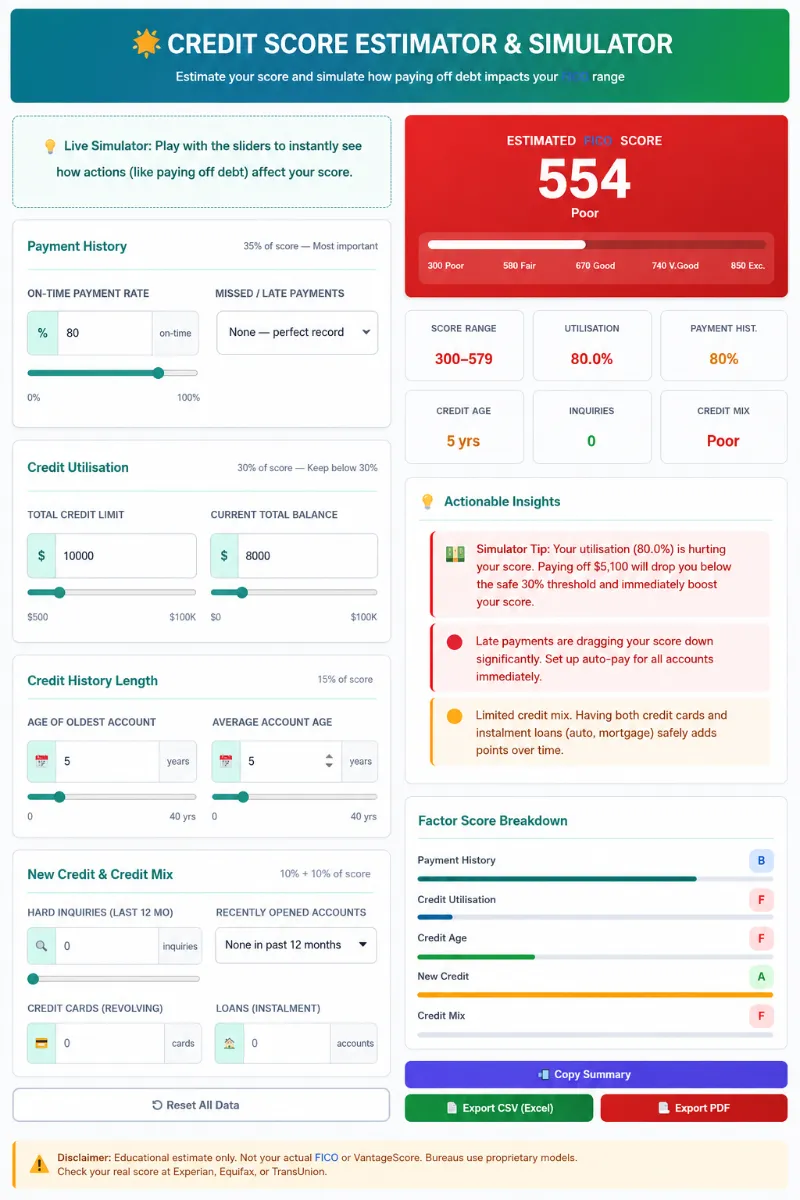
Estimate your score from the two most important factors.
Score Ranges and What Approval Data Actually Shows
The research brief doesn’t establish a universal minimum score for rewards credit cards. What it provides is the range framework and the approval-rate data that shows score alone isn’t the full picture.
| Score Range | Label (Source) | Card Access Generally | Bankrate Approval Rate (Good Range) |
|---|---|---|---|
| 580–669 | Fair (LendingTree) | Limited; often secured cards or cards for building credit | N/A — below good range |
| 670–739 | Good (Bankrate) | Many cards; some premium rewards cards accessible | 38% of applicants approved through Bankrate |
| 740–799 | Very Good | Most credit cards; more competitive rewards tiers | Not separately broken out in cited data |
| 800+ | Exceptional | Essentially all cards; best rates and terms | Not separately broken out in cited data |
Source: LendingTree fair credit data · Bankrate good-credit card data
The 38% approval rate in the good range is the most practically useful number in this table. It tells a consumer with a score of 695 that applying for a top-tier rewards card isn’t automatically going to work — and that income, existing debt obligations, and application frequency will factor into whether they’re in the 38% or the 62%.
📊 Estimate Your Score Range: SaveXpert Credit Score Estimator
I ran the research scenarios through the Credit Score Estimator — entering the fair and good score ranges and the corresponding utilization and payment history inputs. The output puts those abstract FICO percentages into a working estimate of where a consumer’s profile currently sits and what changes would move it. It’s most useful as a planning tool: the research gives ranges rather than guaranteed approval scores, and the calculator converts those ranges into the specific input changes most likely to shift the estimate.
Educational note: Estimates are approximate and for informational purposes only. Actual scores depend on specific bureau data and the scoring model used by the lender. Source: FICO Credit Education
What the Research Shows Works (and What Doesn’t)
What the FICO, CFPB, and FTC data consistently supports
Reducing revolving balances below 30% of credit limits — ideally below 10%.
Utilization is the fastest-moving factor, updating within one billing cycle. The CFPB’s 30% threshold is the commonly cited ceiling; the research also cites data showing slightly higher scores around 1%–3% utilization for cards where you’re not willing to carry any balance.
Building and maintaining a clean payment history over time.
Payment history at 35% is the largest FICO factor. The research doesn’t identify a shortcut to improve a damaged payment history quickly — the path is consistent on-time payments in the months and years ahead. Older missed payments diminish in weight over time; recent positive history accumulates simultaneously.
Reviewing credit reports for errors before applying.
Soft inquiries from personal checks don’t affect scores. Under the FCRA, bureaus have 30 days to investigate disputes. Finding and disputing an inaccurate late-payment entry several weeks before applying gives the investigation process time to run.
Stopping new credit applications 3–6 months before the target date.
Each hard inquiry costs fewer than 5 FICO points individually. The research concern is the pattern — multiple inquiries in a short window signal risk to scoring models and to lenders reading the report.
What the data says doesn’t work
Carrying a balance to improve credit.
FICO data is clear: a 0% statement balance doesn’t damage your score. Carrying balances produces interest charges at 20%+ market rates with no corresponding scoring benefit.
Paying a credit repair company to remove accurate negative information.
The FTC and CFPB research consistently documents this as a scam. Accurate items remain for their full reporting period regardless of whether a company charges to attempt removal. The only legitimate removal mechanism for accurate information is the passage of time.
Counting on approval from a score alone.
The 38% Bankrate approval rate for applicants with good credit makes this concrete. Credit score is one factor. The full application decision also weighs income, debt-to-income ratio, account relationship history, and recent application frequency.

Bottom Line: 5 Steps Before Applying for a Holiday Credit Card
1. Pull your free credit report from AnnualCreditReport.com now — before the application — and dispute any inaccurate negative items:
Personal checks are soft inquiries; they don’t affect your score. Under the FCRA, bureaus have 30 days to investigate disputes. If you find errors, starting the dispute 6–8 weeks before your target application date gives the investigation time to complete and the correction time to appear. Inaccurate items suppressing your score can be legitimately removed — accurate ones cannot, regardless of what anyone charges you to try.
2. Pay down revolving balances to get utilization below 30% — and ideally below 10% — at least 6 weeks before your target application date:
On a $5,000 credit limit card, 30% is $1,500 and 10% is $500. Utilization changes appear within 30–45 days after the creditor reports the new balance. Plan the paydown 6–8 weeks before applying to ensure the updated balance appears in scoring data before the lender checks. If you carry balances across multiple cards, prioritise the card closest to its limit — per-card utilization affects the score alongside the aggregate total.
3. Confirm your payment history shows at least 12 months of on-time payments before applying:
Payment history at 35% is the largest FICO factor — and the hardest to repair quickly. Missed payments stay for seven years. But recent positive history accumulates alongside older negative marks, and the negative weight of older items diminishes over time. A 12-month clean window before a major application strengthens the payment-history signal more than almost any other action you can take.
4. Stop opening new credit in the 3–6 months before your target holiday card application:
Each hard inquiry from a new credit application typically costs fewer than 5 FICO points and affects scoring for 12 months. The research concern isn’t one inquiry — it’s the pattern. FICO data shows a correlation between 6 or more inquiries and significantly higher credit risk signals. A clean application window signals to the lender reviewing your profile that you’re not in a pattern of rapid credit-seeking. This doesn’t mean avoid everything — it means make the holiday card application the intentional choice, not one of several applications in a short period.
5. Use the Credit Score Estimator to model where your score sits before applying — then target card applications at realistic approval tiers:
Bankrate’s data found 38% approval for “good” credit applicants. That figure should recalibrate any assumption that a score of 700 automatically qualifies you for any card with a rewards programme. The Credit Score Estimator converts the FICO factor percentages into a score range estimate, giving you a realistic baseline before approaching an application. Target the card most likely to approve at your current score range rather than the highest-tier card you’d eventually qualify for.
“When I went through the FICO weighting data and the CFPB credit-score guidance, the finding that most changed my reading of the advice was the Bankrate approval rate: only 38% of applicants with ‘good’ credit received approval in their data. A score in the 670–739 range doesn’t guarantee the card. Credit score is one input — not the outcome. Income, debt-to-income ratio, and recent inquiry activity all factor into the lender’s decision. That changes what ‘improving your score’ actually achieves.”
— Kevin Brown, Lead Researcher at SaveXpert.com
Frequently Asked Questions
Ans: The fastest-moving factor in FICO scoring is credit utilization, which carries 30% of the score. Reducing revolving balances below 30% of your credit limits — and ideally below 10% — can show up in your score within 30–45 days after the creditor reports the updated balance to the bureaus. Checking your credit report for errors and disputing inaccurate negative items is another relatively quick step, with FCRA giving bureaus 30 days to investigate qualifying disputes. Payment history (35% of the score) has the largest weight but takes longer to repair — missed payments remain for seven years, and positive history builds over months and years of consistent on-time payments.
Ans: According to FICO data, credit utilization accounts for 30% of the overall FICO Score — making it the second most important factor behind payment history. Keeping revolving balances low relative to credit limits produces a stronger positive scoring signal. The CFPB commonly references 30% as the upper threshold to avoid; the research also cites data showing slightly higher scores at 1%–3% utilization. Utilization is calculated both per card and across all revolving accounts.
Ans: The research doesn’t provide one universal timeline because different factors update on different schedules. A balance reduction appears in scoring data within 30–45 days after the creditor reports the new balance. A credit report error dispute takes up to 30 days for bureau investigation under the FCRA. Hard inquiries affect FICO Scores for 12 months and remain visible on reports for 24 months. Missed payments remain on reports for seven years, and Chapter 7 bankruptcy stays for ten. Building positive payment history is a months-to-years process; reducing utilization is the most actionable short-term change.
Ans: Not instantly. Experian data cited in the research shows that paying off a balance improves your score only after the card issuer reports the new balance to the major credit bureaus — which typically happens at the end of the next billing cycle, around 30–45 days after payment. A consumer who pays a large balance two days before submitting a card application may not see that lower utilization reflected in the score the lender checks. Plan paydowns 6–8 weeks before the target application date to ensure the updated balance appears in scoring data first.
Ans: The research doesn’t establish one universal minimum for rewards cards. General ranges from cited data place “fair” credit at 580–669 (LendingTree) and “good” credit at 670–739 (Bankrate). Bankrate’s own approval data is the most practically useful finding: only 38% of applicants with “good” credit who applied through its platform received approval. Credit score is one factor — lenders also weigh income, debt-to-income ratio, and recent application frequency. A score in the good range improves your odds; it doesn’t determine the outcome.
Ans: No. This is one of the most persistent credit misconceptions, and FICO data cited in the research directly addresses it. A 0% statement balance does not damage your score. Carrying a balance produces interest charges at the applicable APR — the Federal Reserve reports averages above 20% for 2026 — without providing any scoring benefit. The confusion likely stems from mixing up “using credit regularly” (which benefits your score by building payment history) with “carrying a balance” (which generates interest with no corresponding credit benefit). Pay in full each month to avoid interest while still demonstrating active credit use.