
ⓘ Educational Disclosure:
This article is for educational and informational purposes only. It does not constitute financial, legal, tax, lending, or investment advice. SaveXpert and its authors are not licensed financial advisors, CPAs, attorneys, or tax advisors. All data comes from publicly available government and institutional sources. Always consult a qualified professional before making investment decisions.
What credit score do you need for a personal loan in 2026? There is no single federal requirement. Experian’s May 2026 research shows that borrowers generally need a minimum score of around 580 to qualify with many lenders, though some lenders accept lower. Scores in the 700s consistently produce much more favorable interest rates — and the difference between a fair-credit APR and a very-good-credit APR can reach nearly $10,000 in total interest over five years on a $10,000 loan, according to Bankrate’s research.
Key Takeaways
- Problem: Many Americans don’t know what credit score they need to qualify for a personal loan — or how dramatically that score shifts the interest rate they’ll actually pay.
- Solution: There’s no federal minimum, but Experian data shows 580 is the practical benchmark for approval. Scores in the 700s are needed for meaningfully better rates — and the gap between tiers can reach $9,798 on a single $10,000 loan.
- Result: Borrowers who pre-qualify with multiple lenders using soft inquiries and understand their credit tier before applying tend to get better rates — without extra hard inquiry hits on their score.
- Source: Federal Reserve G.19 Consumer Credit (Aug 2026), CFPB Consumer Credit Trends
- Time To Read: 8 Minutes
Table of Contents
1. There’s No Single Credit Score Minimum for a Personal Loan
2. Can You Get a Personal Loan With a 580 Credit Score?
3. How Your Credit Score Changes the Interest Rate
4. What Is the Average Personal Loan Rate in 2026?
5. Running the Numbers: The $9,798 Loan Cost Difference
6. Does Applying for a Personal Loan Hurt Your Credit Score?
7. What the Research Shows Works (and What Doesn’t)
8. Realistic Expectations for a Personal Loan in 2026
No federal law tells a lender what credit score to require for a personal loan. That means two borrowers with identical incomes and loan amounts can get very different answers — and very different prices. The research shows the gap between the best and worst credit tiers can add up to $9,798 in extra interest on a single $10,000 loan. That number is what makes understanding your credit position before you apply so important.

There’s No Single Credit Score Minimum for a Personal Loan
I spent time going through the CFPB, Federal Reserve G.19, Experian, Bankrate, and NerdWallet data for this article. The clearest finding came first: no federal law sets a minimum FICO score for personal loan approval.
Each lender creates its own eligibility rules within the boundaries of federal lending law. That explains why the same borrower can get a very different answer from two different lenders on the same day.
What the lender data actually shows
Bankrate’s April 2026 research gives a useful snapshot of how much lender minimums vary. Some of the numbers might surprise you.
| Lender | Reported Minimum Credit Score | Notes |
|---|---|---|
| Avant | ~550 | Specializes in near-prime borrowers |
| Upgrade | 600 | Considers income and other factors |
| Discover | 660 | Prime lender; checks full credit profile |
| LightStream | 660 | Targets good-to-excellent credit only |
| SoFi | No stated minimum | Uses income, employment, and free cash flow |
| Upstart | No stated minimum | Uses AI model including education and work history |
Source: Bankrate April 2026 lender research · CFPB Consumer Credit Trends
Experian’s May 2026 guidance settles on 580 as the general practical benchmark — the score at which some lenders will approve a borrower, though not on the most favorable terms. Think of 580 as the floor of eligibility for many mainstream personal loan products, not the target for good pricing.
💡 Research note: Lenders set their own minimums, and those thresholds can change. A score that qualifies with one lender this month may not qualify with a different lender next month. The research consistently supports comparing multiple lenders rather than targeting one based on a single minimum score number.
Can You Get a Personal Loan With a 580 Credit Score?
The research says yes — with conditions. Both Experian and Bankrate identify 580 as a level where some lender approvals are possible. But this is where the research gets more nuanced than a simple yes or no.
The two-borrower comparison
Consider two borrowers with the same income and the same $10,000 loan request. One has a 580 score. The other has a 740 score. The research shows both can potentially get approved — but at very different prices. The 580-score borrower may face an APR several times higher than the 740-score borrower on the same loan amount
That’s not just a difference in numbers. It’s a difference in total dollars paid back. The research section on interest rates shows exactly how large that gap gets.
Below 580: what the research found
For borrowers below the 580 threshold, the research identifies specialized fintech lenders and credit unions as potential options. Those products can carry APRs of 25% to 36% — significantly higher than prime-tier borrowing costs. Some lenders with no stated minimum, like Upstart, use alternative data models that look beyond the score itself.
⚠️ Payday and title loan warning: The research explicitly flags payday and auto title loans as a separate category. Those products can carry APRs of 400% or more — compared with personal loan APRs that typically cap at 36% in the research data. They’re not the same product, and the research doesn’t treat them as comparable alternatives.
How Your Credit Score Changes the Interest Rate
This is the part most people miss when they focus only on whether they’ll get approved. Your credit score doesn’t just affect the yes-or-no decision. It largely determines the price tag attached to that yes.
NerdWallet’s September 2026 aggregate data breaks down average APRs by credit score tier. The spread is striking.
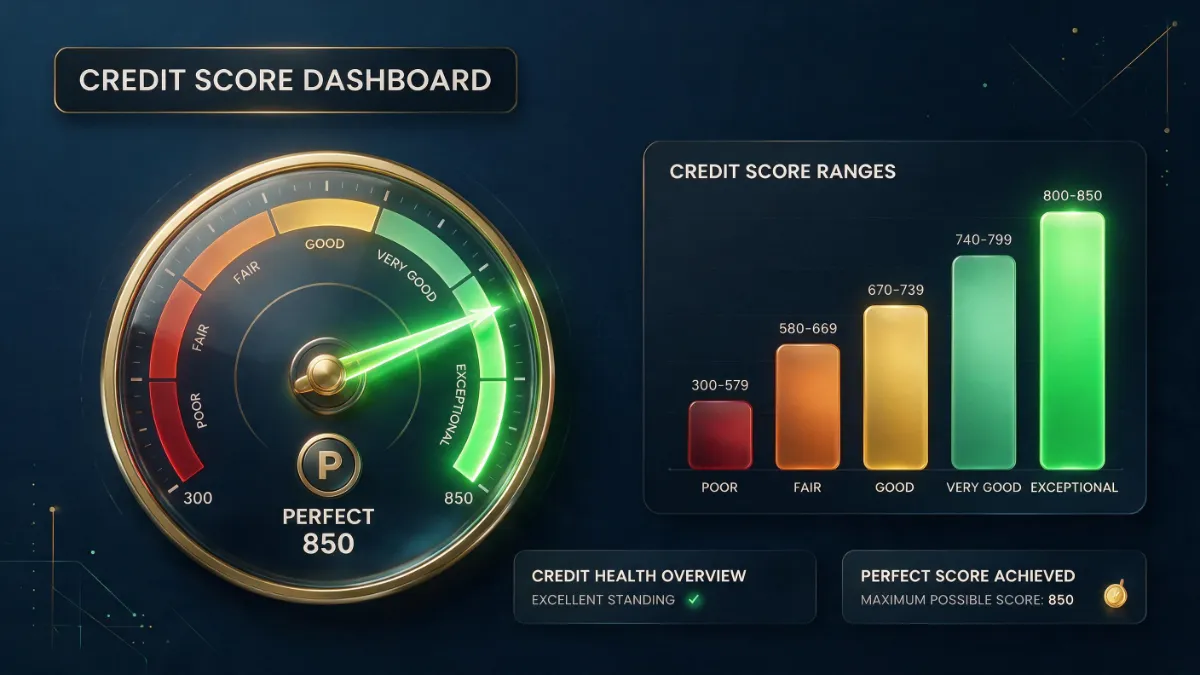
| Credit Score Range | Credit Tier | Average APR (NerdWallet Sept 2026) |
|---|---|---|
| 720–850 | Excellent / Very Good | 14.90% |
| 690–719 | Good | 19.62% |
| 630–689 | Fair | 23.85% |
| 300–629 | Poor / Bad | 27.31% |
Source: NerdWallet September 2026 aggregate personal loan data · Federal Reserve G.19 Consumer Credit
That’s a 12.41 percentage point spread between excellent and poor credit on average APRs — and those are averages. Individual lender quotes can be higher or lower within each tier.
The Bankrate example pushes the comparison even further. On a $10,000 loan over five years, the research compares a 6.99% APR for very good credit with 35.99% for poor credit. That gap drives a $9,798 difference in total interest paid — on an identical loan, to an identical lender, for an identical term. The only variable is the credit score.
💡 Research note: The question that matters most often isn’t “can I get approved?” It’s “what will this loan cost me if I get approved?” The research shows those two questions can have very different answers at a 580 score versus a 740 score — even when both get a yes from the lender.
Compare two loans side-by-side to find the cheaper option.

What Is the Average Personal Loan Rate in 2026?
The answer depends heavily on the dataset and borrower population being measured. The research covers several sources, and they point in different directions for a reason.
The Federal Reserve’s August 2026 G.19 release puts the average personal loan rate at commercial banks at 11.86% for 24-month terms during Q2 2026. That’s up from 11.36% in Q1 2026 — a 0.50 percentage point increase in a single quarter.
Bankrate’s September 2026 monitor gives a slightly different figure: 12.21% for a borrower with a 700 FICO score on a $5,000 loan over three years. That’s a different population and a different loan structure — which is exactly why these figures look different.
NerdWallet’s aggregate data adds the credit-tier dimension. When you break borrowers into score bands, the “average” rate becomes much less useful. A borrower with a 750 score and a borrower with a 600 score are both in any national average figure — but they’re borrowing at fundamentally different prices.
What else lenders look at beyond the score
Credit score isn’t the only factor determining a loan offer. The research shows lenders closely review debt-to-income ratio, income level, and employment history alongside the score. A borrower with a 750 credit score and a very high DTI ratio may not qualify for a lender’s lowest advertised APR.
The research specifically flags a DTI threshold: lenders typically reject applications with debt-to-income ratios above 50% — excluding mortgage payments — regardless of credit score. That’s a hard filter the score alone can’t overcome.
⚠️ An important gap in the data: The Federal Reserve’s 2026 household report found 32 million U.S. adults without credit scores — 7 million credit invisible and 25 million with thin files. Credit score discussions don’t reach every American borrower. Lenders that use alternative data models (like Upstart) serve some of this population, but mainstream personal loan products largely require at least some credit history.
Running the Numbers: The $9,798 Loan Cost Difference
The Bankrate example in the research brief makes the credit score pricing gap concrete. It compares two borrowers taking out the exact same loan.
| Borrower Profile | APR | Loan | Term | Estimated Total Interest |
|---|---|---|---|---|
| Very good credit | 6.99% | $10,000 | 5 years | ~$1,847 |
| Poor credit | 35.99% | $10,000 | 5 years | ~$11,645 |
| Difference | 29 percentage points | Same | Same | ~$9,798 |
Source: Bankrate personal loan rate research · Federal Reserve G.19 Consumer Credit
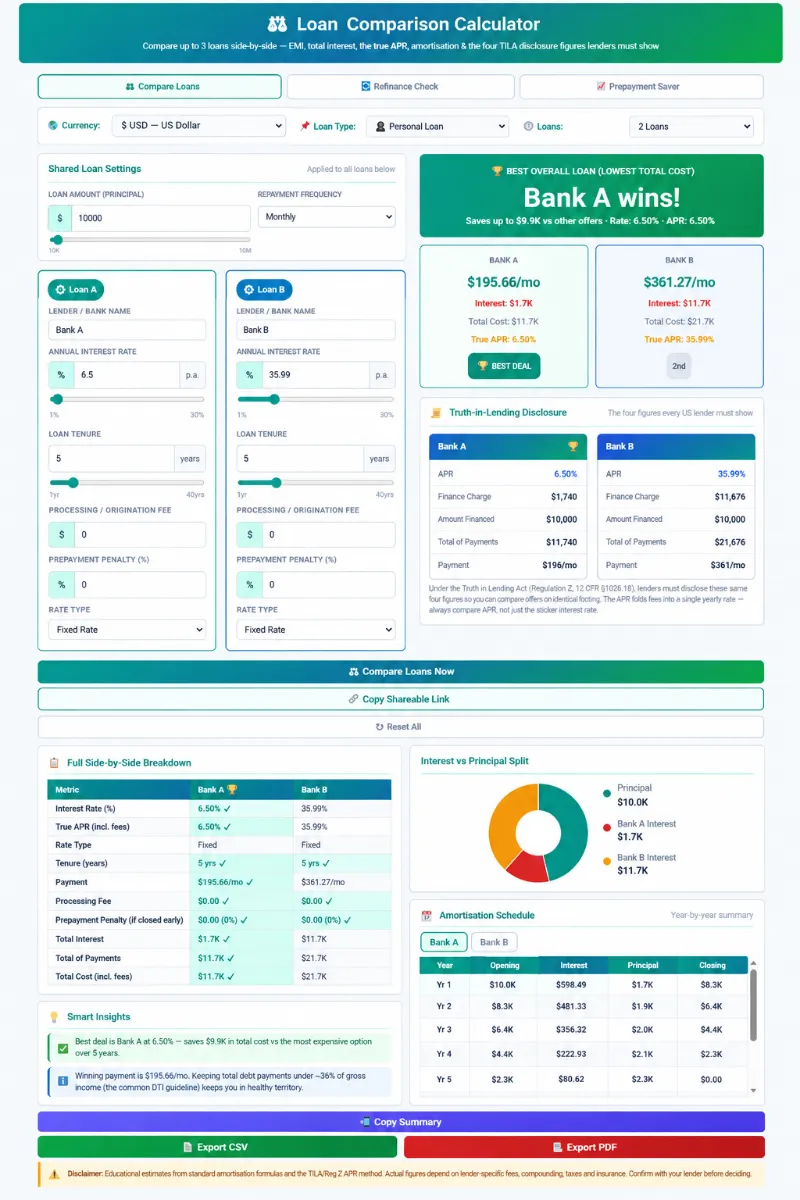
The monthly payment difference runs roughly $164 per month — about $197 at 6.99% versus $361 at 35.99%. Same lender. Same loan amount. Same five-year term. The only variable is the credit score behind each application.
That makes the first question before any personal loan application less “will I get approved?” and more “which tier am I in, and what does that cost me?”
💰 Try the SaveXpert Loan Comparison Calculator
I ran the 6.99% versus 35.99% scenario through the logic behind SaveXpert’s Loan Comparison Calculator — and the total interest gap at $9,798 is exactly what the research shows. Put your own two offers in and see the real cost difference side by side, not just the monthly payment. Most people focus on the monthly number and miss the total cost entirely.
Educational note: This calculator models loan cost scenarios for informational purposes only and does not provide personalized financial advice. Source: CFPB Consumer Credit Trends
Does Applying for a Personal Loan Hurt Your Credit Score?
The answer depends entirely on how you apply. The research draws a clear line between two types of credit checks — and mixing them up is one of the most common mistakes borrowers make.
Soft inquiries: pre-qualification
Many lenders offer a pre-qualification process that uses a soft inquiry. Soft inquiries don’t affect your credit score. They give the lender enough information to estimate what rates and terms you might qualify for — without recording a formal application on your credit file.
The research identifies pre-qualifying with three or more lenders as an approach that lets borrowers compare preliminary rate offers without creating hard inquiry hits. This is the comparison step the data consistently supports taking before submitting any formal application.
Hard inquiries: formal applications
A formal loan application typically triggers a hard inquiry. Hard inquiries do affect credit scores. The research puts the impact at 5 to 10 points per inquiry. Submitting multiple formal applications at once can stack those hits — potentially moving a borrower from one credit tier to a lower one at exactly the moment they need a good rate.
💡 Research note: The research separates rate shopping from repeated formal applications. Pre-qualifying with multiple lenders is rate shopping — and uses soft inquiries. Submitting full applications to multiple lenders simultaneously is a different action with a different credit impact. The research supports the first approach and warns against the second.
What the Research Shows Works (and What Doesn’t)
What the data supports
Pre-qualifying with three or more lenders before applying.
The research specifically flags that borrowers who don’t compare offers can pay 3 to 5 percentage points more in APR than borrowers who compare three or more lenders. At those margins, on a $10,000 loan, that’s real money left on the table.
Reducing credit card utilization before applying.
Payment history and utilization rank among the largest factors in FICO score calculations. A borrower who can move their utilization from 60% to under 30% before applying may find themselves in a meaningfully different credit tier — which the interest rate data shows has significant pricing consequences.
Check your DTI before you start.
If your debt-to-income ratio is above 50%, that’s typically a disqualifying threshold regardless of your credit score. Knowing this before applying avoids a hard inquiry hit on an application likely to be declined.
Understanding which bureau each lender pulls from.
Not all lenders check the same bureau. Your score can differ by 20 to 40 points between Equifax, Experian, and TransUnion depending on what each bureau has on file.
What the data says doesn’t work
Submitting multiple formal applications at once.
Each hard inquiry can cut 5 to 10 points. Stacking several formal applications means stacking those hits — and the research shows this can move a borrower from a better tier into a worse one before any loan is even approved.
Focusing only on monthly payment, not total cost.
The $9,798 gap in the Bankrate example shows exactly what happens when borrowers focus on “can I afford $361 a month?” without also asking “how much does the full loan actually cost?” A lower monthly payment with a higher APR often costs significantly more in total.
Payday and title loans as a fallback.
The research explicitly flags these as a separate category with APRs of 400% or more — not comparable to personal loan APRs that cap around 36% in the data. Fintech lenders and credit unions offer higher-APR personal loans to fair-credit borrowers that are still fundamentally different products from short-term payday lending.
Realistic Expectations for a Personal Loan in 2026
The research gives a clear overall picture, but it also has honest limits worth naming.
The New York Fed’s Q1 2026 Household Debt and Credit report recorded a 5.16% serious delinquency rate for “Other” consumer loans — a category that includes personal loans. That figure sits in a broader credit environment where the Federal Reserve’s Q2 2026 G.19 data shows average commercial bank rates rising from 11.36% to 11.86% in a single quarter.
That rate movement matters for anyone timing a loan application. Rates aren’t static, and the trend in the 2026 data points upward. A borrower who pre-qualifies now and compares offers gets current market pricing — not last quarter’s estimate.
The research doesn’t establish one reliable national approval timeline, so I won’t put a specific number on it. Timelines vary widely by lender type: online-only fintech lenders tend to move faster than traditional banks, but the research doesn’t give a reliable universal figure. The pre-qualification process is faster — often instant or same-day — because it’s not a final credit decision.
💡 Research note: Your credit score is one input into a lender’s decision — not the only one. Income, employment history, existing debt, and debt-to-income ratio all interact with the score. Two borrowers at 650 can receive very different offers based on the rest of their financial picture.

Bottom Line: 5 Steps Before You Apply for a Personal Loan in 2026
1. Check your score and identify your credit tier:
The NerdWallet data shows APRs differ by 12+ percentage points between excellent and poor credit — knowing which band you’re in before you apply sets realistic expectations and tells you whether it’s worth building your score first.
2. Pre-qualify with three or more lenders using soft inquiries:
The research says borrowers who don’t compare offers can pay 3 to 5 percentage points more in APR. Soft inquiries don’t touch your score — use them to shop before you commit to any single lender’s hard pull.
3. Calculate the total loan cost — not just the monthly payment:
Use the SaveXpert Loan Comparison Calculator to run the total interest figure on each offer. The $9,798 difference in the Bankrate example came from two offers that look like the same type of loan but cost fundamentally different amounts over five years.
4. Check your debt-to-income ratio before applying:
The research shows lenders typically reject applications with DTI above 50% — excluding mortgage — regardless of credit score. Calculate your DTI first, so you’re not spending a hard inquiry on an application likely to be declined on that basis alone.
5. If your score is below 580, consider improving it first:
The research shows credit card utilization reductions can move scores more quickly than most other strategies. A borrower who moves from 580 to 650 may not just get approved — they may step into a meaningfully cheaper interest rate tier that saves money for the full loan term.
“When I went through the Federal Reserve G.19 data alongside the Experian and Bankrate research, the thing that stood out wasn’t the minimum score question. It was the cost gap. The research shows a 29-percentage-point APR spread between credit tiers on otherwise identical loans. The question isn’t just whether you can qualify — it’s what qualifying actually costs you.”
— Kevin Brown, Lead Researcher at SaveXpert.com
Frequently Asked Questions
Ans: There’s no universal federal minimum. Experian’s May 2026 research shows that borrowers generally need a score of 580 or higher to qualify with many mainstream lenders, though some lenders — including Avant and fintech lenders like Upstart — accept lower scores or use no stated minimum. The 580 figure is a practical benchmark from the research, not a legal floor. Individual lenders set their own thresholds and can change them.
Ans: Yes — some lenders do approve borrowers at 580. Both Experian and Bankrate identify 580 as a level where approval is possible with some lenders. The catch: approval at 580 typically comes with significantly higher interest rates than approval at 700 or above. The research shows borrowers at fair-credit levels averaged 23.85% APR in NerdWallet’s September 2026 aggregate data, versus 14.90% for excellent-credit borrowers — a gap that adds up to thousands of dollars over a multi-year loan term.
Ans: Significantly. NerdWallet’s September 2026 aggregate data shows average APRs of 14.90% for scores between 720 and 850, rising to 19.62% for 690–719, 23.85% for 630–689, and 27.31% for scores below 630. That’s a 12-plus percentage point spread between excellent and poor credit. Bankrate’s published example puts the total interest difference at $9,798 on a $10,000 five-year loan between a 6.99% APR for very good credit and 35.99% for poor credit.
Ans: The Federal Reserve’s August 2026 G.19 data puts the average at commercial banks at 11.86% for 24-month term loans in Q2 2026 — up from 11.36% in Q1 2026. Bankrate’s September 2026 monitor shows 12.21% for a 700 FICO borrower with a $5,000 three-year loan. These figures measure different populations and loan structures, which is why they differ. NerdWallet’s credit-tier breakdown shows the “average” masks a wide spread depending on the borrower’s score.
Ans: It depends on the type of inquiry. A soft inquiry pre-qualification — which many lenders offer — doesn’t affect your credit score. A formal loan application can trigger a hard inquiry, which the research shows can lower your score by 5 to 10 points per inquiry. The research supports pre-qualifying with multiple lenders using soft inquiries to compare rates before committing to any single formal application.
Ans: The research shows lenders closely review DTI alongside credit score. Lenders typically reject applications with DTI ratios above 50% — excluding mortgage payments — regardless of the applicant’s credit score. Even borrowers with scores above 800 may not qualify for a lender’s lowest advertised APR if their total existing debt obligations are too high relative to income. Calculating your DTI before applying helps avoid a hard inquiry hit on an application likely to be declined on income-ratio grounds alone.