

ⓘ Educational Disclosure:
This article is for educational and informational purposes only. It does not constitute financial, legal, tax, lending or investment advice. SaveXpert and its authors are not licensed financial or tax advisors. All investments involve risk. Investors can lose some or all of their money. Always consult a qualified professional before making investment decisions.
Many Americans have money to invest but worry about choosing the wrong day to enter the market. A market drop shortly after investing can make that decision feel especially painful. Dollar-cost averaging addresses that specific concern — but the research shows it does something more limited than most people expect.
Key Takeaways
- Problem: Many Americans have money to invest but worry about choosing the wrong day to enter the market — especially during periods of volatility
- Solution: Dollar-cost averaging spreads equal-dollar purchases across regular intervals. The SEC confirms this method reduces the risk of investing all available money at an unfavorable time by spreading purchases across multiple dates.
- Result: Research indicates DCA manages timing risk and can lower short-term volatility exposure — but long-term peer-reviewed data and industry analysis of historical periods both show lump-sum investing often produces slightly higher returns. DCA solves a specific problem; it doesn’t guarantee better performance.
- Source: SEC Investor.gov — Investing Basics · Federal Reserve — Survey of Consumer Finances · IRS
- Time To Read: 8 Minutes
Table of Contents
1. The Surprising Answer to Whether DCA Beats Lump-Sum Investing
2. What Is Dollar-Cost Averaging and Does It Work?
3. Does Dollar-Cost Averaging Actually Reduce Investment Risk?
4. How Often Should You Invest With Dollar-Cost Averaging?
5. What Are the Disadvantages of Dollar-Cost Averaging?
6. Is Dollar-Cost Averaging Better Than Lump-Sum Investing?
8. Realistic Expectations from Dollar-Cost Averaging
What is dollar-cost averaging and does it work? It means investing equal amounts at regular intervals regardless of market movements. The SEC confirms this approach reduces timing risk by buying more shares when prices fall, though it doesn’t eliminate all investment risk or guarantee higher returns than a lump-sum approach.
I went through the SEC’s Investor.gov materials, the IRS contribution rules, the Federal Reserve’s household-finance data, and the published peer-reviewed research on DCA. Here’s what the evidence actually shows.
The Surprising Answer to Whether DCA Beats Lump-Sum Investing
Industry analysis reviewing more than 1,000 overlapping historical seven-year periods found that lump-sum investing generated slightly higher annualized returns than a dollar-cost averaging strategy in more than 56% of cases. That finding matters because DCA often sounds like the obviously safer choice when investing in the stock market. The research shows a more complicated picture.
DCA can reduce the risk of investing everything at one unfavorable time, while lump-sum investing can gain more from staying invested longer. This trade-off — between timing risk and time in the market — runs through all the research on this topic and doesn’t resolve cleanly in DCA’s favour.
That doesn’t make DCA a bad strategy. It makes it a specific tool for a specific problem. Understanding which problem you’re actually trying to solve is the more useful starting point.
What Is Dollar-Cost Averaging and Does It Work?
The SEC defines dollar-cost averaging as investing equal portions of money at regular intervals, regardless of market ups and downs. The contribution amount stays consistent while the investment price changes. That mechanical regularity is what gives DCA its effect.
The mechanics work like this. When prices fall, the same dollar amount buys more shares. When prices rise, that same amount buys fewer shares. The SEC says this can help manage the risk of investing all available money at an unfavorable time.
A simple example makes the structure clear. An investor puts $200 into an investment every month. The first month, shares cost $20 — the investor buys 10 shares. The following month, shares cost $10 — the same $200 buys 20 shares. The investor doesn’t need to predict market direction. The contribution stays fixed; the number of shares changes based on price.
💡 Research note: The SEC does not describe DCA as a way to guarantee profits. Investor.gov states that all investments involve risk, and investors can lose some or all of their money. So the answer to “what is dollar-cost averaging and does it work?” is: the mechanical effect is real. It spreads purchase timing. It does not guarantee a positive return or a lower final investment cost.

Estimate your lump-sum investment growth over time.
Does Dollar-Cost Averaging Actually Reduce Investment Risk?
The SEC’s explanation focuses on timing risk rather than total investment risk. DCA reduces dependence on one purchase date because the investor buys across several dates instead. That’s a meaningful difference from what most people mean when they say “reduces risk.”
Spreading purchases across time doesn’t protect an investment from falling in value after each purchase. The SEC is clear: investors can lose some or all of their money. DCA doesn’t change that fundamental fact.
DCA also doesn’t replace diversification. The SEC describes diversification as spreading money among different investments or asset classes. DCA spreads purchases across time instead. An investor can use DCA to buy shares of one company every month — the purchases spread across time, but the portfolio still faces concentration risk because nothing about the approach diversifies the underlying investment.
⚠️ Two different things: DCA (spreading purchases across time) and diversification (spreading money across different assets) are independent strategies. Using DCA to regularly buy one stock does not diversify your portfolio. The SEC says diversification can reduce risk but cannot guarantee protection when markets decline — and DCA carries the same limitation.
Peer-reviewed research adds an important nuance. A 1999 study published in the Journal of Financial Planning, using S&P 500 data and simulations from 1926 through 1993, found lower volatility with DCA during the periods studied — but also found that long-term investors could achieve higher returns through lump-sum investing. A 2015 follow-up in the same area found that DCA can lower risk in a mean-variance framework, while prior research generally favoured lump-sum investing on performance. These findings answer what DCA actually does: it can change the timing risk attached to investing. It doesn’t remove market risk.
How Often Should You Invest With Dollar-Cost Averaging?
There’s no official U.S. government source that sets one universally correct DCA schedule. The SEC defines DCA around regular intervals but doesn’t require weekly, biweekly, monthly, or quarterly recurring contributions. The IRS rules work differently — they set annual contribution limits for retirement accounts rather than telling investors how frequently to contribute within the year.
For 2026, the IRS set the IRA contribution limit at $7,500, with a $1,100 standard catch-up amount for eligible individuals. The 2026 employee elective-deferral limit for most 401(k), 403(b), governmental 457 plans, and the Thrift Savings Plan stands at $24,500, with a standard catch-up limit of $8,000. The IRS also sets a $72,000 annual-additions limit for defined-contribution plans, subject to compensation and applicable catch-up rules.
These rules create an important boundary. The IRS determines how much money can enter certain retirement accounts each year — it doesn’t determine whether an investor contributes weekly or monthly within that annual limit.
The SEC promotes automatic investing and consistent fixed-dollar contributions as a way to maintain regular investment discipline. That supports regular investing as a process, not as a schedule that guarantees better performance.
See how your money grows with the power of compounding.
What Are the Disadvantages of Dollar-Cost Averaging?
The clearest disadvantage appears when an investor already holds a fully available lump sum. Keeping some of that money in cash while investing gradually reduces exposure to the investment’s expected return during the waiting period. Research in this area consistently finds that scenario disadvantages DCA compared with investing the full amount immediately.
Historical data generally shows higher long-term returns from putting all money in at once. That advantage comes with greater short-term timing risk — the entire amount enters the market at one moment. Industry analysis of a $120,000 lump sum divided into $10,000 monthly installments over 12 months found that lump-sum investing in an aggressive portfolio produced roughly 0.42 percentage points higher return than the 12-month DCA approach, using the historical periods studied.
Fees create another disadvantage for frequent small purchases. The SEC says fees and expenses reduce investment returns. A flat trading fee takes up a larger percentage of a smaller purchase. The SEC’s July 2025 bulletin on mutual fund and ETF fees covers expense ratios, shareholder fees, sales loads, redemption fees, exchange fees, account fees, and transaction costs — and states that higher-cost funds need better performance to produce the same investor return as lower-cost funds.
Consumer finance publications add useful behavioral context. DCA can reduce emotion-based decisions and attempts to time the market — that’s a real behavioral benefit. But the same publications identify regular investing and missed extreme market upswings as disadvantages. DCA in a strong bull market can consistently buy at higher prices than the starting point.
Is Dollar-Cost Averaging Better Than Lump-Sum Investing?
The research doesn’t support one universal winner. It shows a trade-off between timing risk and time invested in the market.
DCA spreads purchases across time. Lump-sum investing puts available money to work immediately. When markets rise steadily, later DCA installments remain uninvested while prices increase. When markets decline after the first investment date, DCA limits the amount invested before that decline. The SEC describes this as managing the risk of investing all available money at an unfavorable time — but that doesn’t mean DCA protects money already invested.
The bigger question often involves where the money comes from. A worker receiving a regular paycheck can naturally invest each pay period as money becomes available — that’s DCA by default. A person holding a large cash balance faces a different decision, because the full amount already exists and the DCA vs lump-sum comparison is a genuine choice between strategies rather than a timing question.
💡 Federal Reserve context: The Federal Reserve’s 2022 Survey of Consumer Finances found that 58% of U.S. families owned stock directly or indirectly, up from 53% in 2019. Twenty-one percent directly owned stock in 2022, compared with 15% in 2019. The conditional median value of directly held stock reached $15,000 in 2022. These figures describe ownership — they don’t establish a DCA success rate. No official national DCA success rate, average return, or win rate against lump-sum investing exists in the reviewed official sources.
💰 Compare Your Scenarios with the SaveXpert Investment Return Calculator
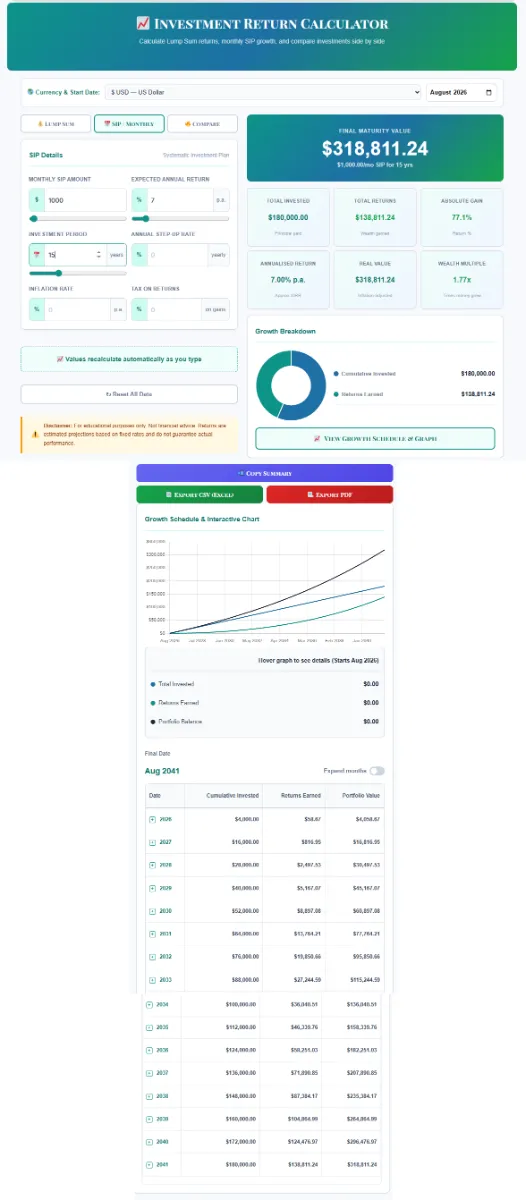
I ran a recurring-contribution scenario through SaveXpert’s Investment Return Calculator to see how the DCA and lump-sum comparison works with hypothetical numbers. The calculator lets you compare regular contributions and a one-time investment across the same period, while keeping return assumptions clearly hypothetical. The important step is entering your actual contribution amount and timeline — not assuming any particular outcome based on historical averages.
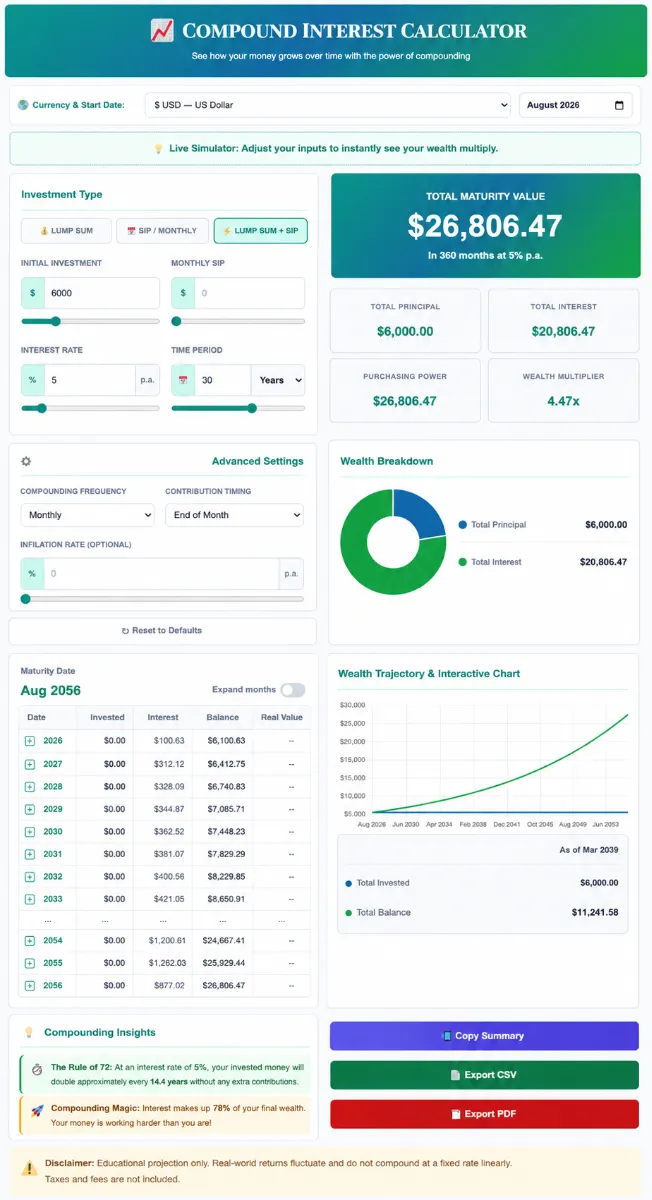
The Compound Interest Calculator can also help illustrate how repeated contributions and investment growth may accumulate over time — consistent with the SEC’s own compound-interest illustration tool at Investor.gov.
Use The Free Compound Interest Calculator→Educational note: This calculator models budget scenarios for educational purposes. For official eligibility determinations, visit HealthCare.gov. For Premium Tax Credit rules, see IRS FS-2025-10.

What the Data Shows Works
Based on what I found in the SEC, IRS, Federal Reserve, and peer-reviewed research, the approach that consistently shows useful results has several clear features.
1. DCA creates regular, equal-dollar purchases.
The SEC confirms that the same amount buys more shares at lower prices and fewer shares at higher prices. That mechanical effect is real and well-documented.
2. Regular contributions can reduce dependence on one purchase date.
The SEC supports automatic and consistent investing as a way to maintain regular contributions. That’s a process benefit — not a return guarantee.
3. Diversification remains separate from DCA.
Spreading purchases across time doesn’t diversify the underlying investment. The SEC says diversification can reduce risk but cannot eliminate market losses. These are two different tools addressing two different problems.
4. Costs matter.
Frequent small transactions can multiply fees when they carry fixed per-transaction costs. SEC research confirms that fees reduce investor returns. Index funds and ETFs with no trading commissions reduce this problem significantly.
5. The research doesn’t support the claim that DCA always beats lump-sum investing.
Historical studies generally found higher long-term returns from lump-sum investing, while DCA produced lower volatility in some periods. The right choice depends on what problem you’re actually solving.
Realistic Expectations from Dollar-Cost Averaging
The research suggests that DCA works mainly as a timing framework, not a return guarantee. Peer-reviewed studies covering historical periods from 1926 through 1993, along with industry analysis of more than 1,000 seven-year periods, show different risk and return trade-offs rather than one guaranteed outcome.
For investors using retirement accounts, the IRS limits the annual amount that can enter those accounts regardless of investment strategy. The 2026 limits — $7,500 for IRAs and $24,500 for most 401(k), 403(b), and governmental 457 plan employee deferrals — shape how much can be invested annually, not how frequently it should move in.
The Federal Reserve’s most recent FOMC statement maintained the federal-funds target range at 3.50% to 3.75%. That rate affects the broader comparison between holding cash and investing — cash earns more when rates are higher — but it doesn’t change DCA’s definition or required schedule.
Dollar-cost averaging solves a specific problem: spreading purchase timing across multiple dates to reduce dependence on one entry point. If that’s the problem you’re facing, DCA is a well-supported tool. If you’re trying to maximise long-term returns above a lump-sum approach, the research doesn’t support DCA as the better choice.
The Bottom Line: 5-Step DCA Starter Plan
What should you actually do if you want to use dollar-cost averaging? Here’s what the SEC, IRS, and research evidence supports as a practical starting sequence:
1. Be clear about the problem you’re solving:
DCA addresses timing risk — the danger of putting everything in at exactly the wrong moment. It doesn’t remove market risk, doesn’t guarantee better returns than lump-sum investing, and doesn’t diversify your portfolio. Knowing which problem you’re solving determines whether DCA is the right tool at all.
2. Check the annual IRS contribution limits first:
Those caps shape how much can enter tax-advantaged accounts each year regardless of strategy — $7,500 for IRAs and $24,500 for most 401(k)s in 2026. Your DCA schedule needs to fit within those annual limits.
3. Keep transaction costs in mind:
Fixed per-trade fees multiply quickly with frequent small purchases. Low-cost index funds and commission-free ETF platforms eliminate most of this friction. The SEC confirms that fees reduce returns — don’t let a DCA schedule create costs that offset the strategy’s timing benefit.
4. Use DCA alongside diversification — not instead of it:
Regularly buying shares of one company or one fund doesn’t diversify your portfolio. The SEC says diversification reduces risk but cannot eliminate market losses. DCA and diversification address different problems — both matter independently.
5. Run your own numbers before committing to either strategy:
Use SaveXpert’s Investment Return Calculator to compare regular contributions against a single lump-sum over the same period and return assumption. The result won’t tell you what markets will do — but it will show what the timing difference means in dollars under your specific scenario.
After reviewing the SEC, IRS, Federal Reserve, and peer-reviewed evidence, the most accurate answer to what is dollar-cost averaging and does it work is this: it solves a real timing problem with a real mechanical effect. It doesn’t remove investment risk or guarantee better returns. The most useful next step is testing realistic assumptions with your own contribution amount in the Investment Return Calculator.
“When I went through the SEC’s Investor.gov materials, the IRS contribution rules, and the peer-reviewed research on DCA, the most useful finding wasn’t about which strategy wins more often. It was about what DCA actually solves. The SEC describes it as reducing timing risk — the danger of putting everything in at exactly the wrong moment. The research is clear: DCA doesn’t remove market risk, doesn’t replace diversification, and historically hasn’t beaten lump-sum investing on long-term returns. Knowing exactly what DCA does and doesn’t do is what makes it useful.”
— Kevin Brown, Lead Researcher at SaveXpert.com
Frequently Asked Questions
Ans: According to the SEC, dollar-cost averaging involves investing equal portions of money at regular intervals, regardless of market highs and lows. It works mechanically by reducing timing risk — allowing investors to purchase more shares when prices fall and fewer when prices rise. It never guarantees profits or removes the risk of losing money. The SEC makes clear that all investments involve risk.
Ans: The SEC data shows that this approach can reduce timing risk — the danger of investing everything right before a sudden market drop. It doesn’t eliminate overall investment risk, nor does it replace portfolio diversification. Investor.gov notes that all investments carry risk and that investors can lose some or all of their money, regardless of contribution strategy.
Ans: According to SEC guidelines, there is no single universally required schedule. Investors can choose weekly, biweekly, or monthly intervals depending on their income flow and account rules — provided they maintain consistent, equal-dollar contributions over time. The IRS sets annual limits on how much can enter tax-advantaged accounts, but not how frequently contributions should occur within the year.
Ans: One major disadvantage is that holding cash to invest gradually can reduce exposure to expected market growth during the waiting period. Historical peer-reviewed research and industry analysis have generally found higher long-term returns from lump-sum investing when the full amount is available upfront. Additionally, frequent small purchases can increase transaction fees, and missing significant market upswings can lower long-term returns. The SEC confirms that fees reduce investment returns.
Ans: The research doesn’t support one universal answer. Industry analysis of more than 1,000 historical seven-year periods found lump-sum investing generated slightly higher returns in over 56% of cases. While lump-sum investing maximises time in the market, DCA can reduce the behavioral and emotional risk of investing a large amount at exactly the wrong moment. The right choice depends on whether you’re trying to manage timing risk or maximise expected return.
Ans: The SEC’s data shows that DCA can limit the amount invested before a market decline, because it spreads purchases across time. When prices fall, the same dollar amount buys more shares under a DCA plan — that’s the core mechanical advantage. However, money that’s already been invested through earlier DCA contributions isn’t protected from the decline. The SEC makes clear that all investments can lose value, and diversification cannot guarantee protection when markets fall. DCA manages entry timing — it doesn’t protect the portfolio value of money already invested.