
ⓘ Educational Disclosure:
This article is for educational and informational purposes only. It does not constitute financial, legal, tax, insurance, lending, or advice. SaveXpert and its authors are not licensed financial, insurance, tax, lending, or benefits advisors. Always consult a qualified professional before making financial decisions.
What is the I Bond interest rate for November 2026? The official November 2026 I Bond rate is not yet finalized. TreasuryDirect will publish the new composite rate on November 1, 2026, after the Bureau of Labor Statistics releases September 2026 CPI-U data (~October 14, 2026). The current rate for bonds issued through October 31, 2026, is 4.26% — a 0.90% fixed rate plus a 3.34% annualized inflation component.
Key Takeaways
- Problem: Unverified rate predictions are everywhere online, and everyday savers need to know what the November 2026 I Bond rate actually is — and what it isn’t — before making savings decisions.
- Solution: The November 2026 rate can’t be confirmed until September 2026 CPI-U data arrives (~October 14) and Treasury makes its official announcement on November 1, 2026.
- Result: Waiting for official Treasury data prevents flawed savings assumptions and keeps interest modeling grounded in verified figures, not guesses.
- Source: TreasuryDirect I Bond Rates, BLS CPI-U
- Time To Read: 6 Minutes
Table of Contents
1. Why the November 2026 Rate Isn’t Known Yet
2. How Treasury Calculates the November 2026 Rate
3. A Calculator Example Using the Current Rate
4. How to Buy I Bonds and the Annual Limit
5. I Bond Taxes and the High-Yield Savings Comparison
7. What Americans Can Realistically Expect
As of August 2026, the I Bond interest rate sits at 4.26%. That combines a 0.90% fixed rate with a 3.34% annualized inflation component — and it applies to every bond issued from May 1 through October 31, 2026. (TreasuryDirect: May 1, 2026 Rate Announcement)
The November 2026 rate? That number doesn’t exist yet. It can’t. Two things have to happen first: the Bureau of Labor Statistics has to release the September 2026 CPI-U data, and then TreasuryDirect has to run the official calculation and publish it on November 1. Any site claiming to already know the November figure is giving you an estimate, not a Treasury rate.
Why the November 2026 Rate Isn’t Known Yet
I went through TreasuryDirect’s I Bond information and the BLS release schedule carefully. The conclusion is simple: the official November 2026 rate requires data that hasn’t been published yet.
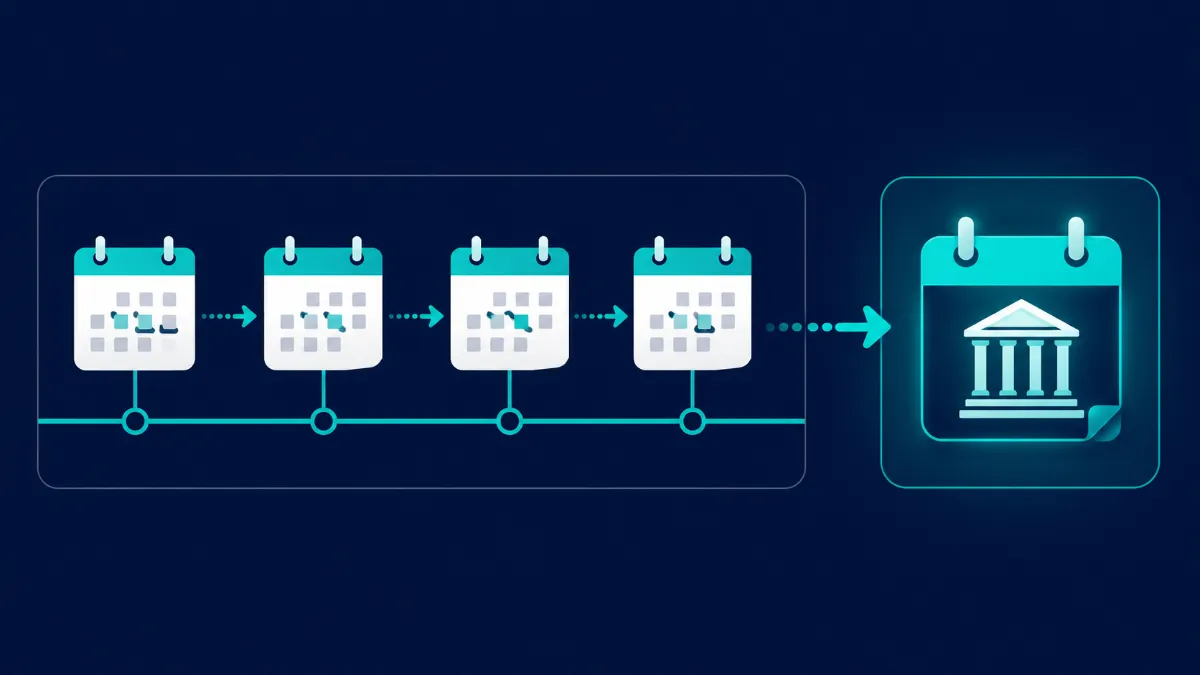
TreasuryDirect announces new I Bond rates on May 1 and November 1 each year. The November 1, 2026 announcement covers bonds issued from November 1, 2026, through April 30, 2027. The fixed-rate component set in that announcement locks in for the full 30-year life of those bonds.
Here’s the timing, step by step. Treasury builds the inflation component from the six-month percentage change in non-seasonally adjusted CPI-U. For the November announcement, it needs September 2026 CPI-U data — and that’s scheduled for release by the BLS around October 14, 2026, at 8:30 a.m. Eastern. The August 2026 CPI release (September 11, 2026) gives useful context on the inflation trend, but it’s the September figure that feeds the November formula. (BLS CPI News Release)
💡 Research note: The July 2026 CPI-U came in at 333.918, up 3.4% over the past 12 months. That’s useful background — but the six-month window Treasury uses for the November rate runs from March 2026 CPI-U to September 2026 CPI-U. September data is still ahead. (BLS CPI Release, July 2026)
There’s also a misconception worth clearing up. The Federal Reserve’s federal funds rate doesn’t directly set the I Bond composite rate. Treasury uses the fixed-rate component and CPI-U data — its own formula, not the Fed’s benchmark. Readers sometimes connect every savings rate to the Fed. I Bonds follow different rules.
⚠️ Note on government shutdowns: The October 2025 CPI release was not published due to a lapse in federal funding. The BLS schedule around October 14, 2026 is planned, but external disruptions can shift publication dates. Confirm the date on BLS.gov as it approaches.

How Treasury Calculates the November 2026 Rate
The I Bond composite rate comes from two parts: a fixed rate and an inflation rate. I found both in TreasuryDirect’s published materials.
The current May 2026 issue carries a 0.90% fixed rate and a 1.67% semiannual inflation rate (3.34% annualized), producing the 4.26% composite. Treasury announced those numbers on May 1, 2026. (TreasuryDirect May 2026 Rate Announcement)
Here is the official Treasury composite rate formula:
📐 TreasuryDirect Composite Rate Formula
Composite rate = Fixed rate + (2 × Semiannual inflation rate)
+ (Fixed rate × Semiannual inflation rate)
Current example (May–Oct 2026):
= 0.0090 + (2 × 0.0167) + (0.0090 × 0.0167)
= 0.0090 + 0.0334 + 0.000150
= 0.042550 → rounded to 4.26%
Source: TreasuryDirect I Bond Interest Rates
The fixed component stays with the bond for its full 30-year life. The inflation component adjusts every six months — but not on a universal schedule. Each bond’s six-month clock runs from its own issue date, so a bond bought in January resets in January and July; one bought in May resets in May and November.
Here’s where the research gets interesting. The current 4.26% doesn’t mean every dollar earns 4.26% indefinitely. When the inflation portion resets — based on whatever CPI-U change Treasury calculates — the composite rate moves up or down. The fixed rate never changes. The inflation rate always does.
The historical pattern puts this in plain terms:
| I Bond Rate Period | Fixed Rate | Semiannual Inflation Rate | Composite Rate |
|---|---|---|---|
| May–Oct 2025 | 0.90% | 1.54% | 3.98% |
| Nov 2025–Apr 2026 | 0.90% | 1.56% | 4.03% |
| May–Oct 2026 | 0.90% | 1.67% | 4.26% |
| Nov 2026–Apr 2027 | TBD | TBD (needs Sep 2026 CPI-U) | TBD — announced Nov 1, 2026 |
Source: TreasuryDirect I Bond Interest Rates, Treasury Fiscal Data — I Bond Rate History
💡 Research note: The composite rate can never go below 0% — Treasury floors it there. An I Bond can’t lose principal due to deflation. That floor is part of the official product design. (TreasuryDirect: I Bonds)
See how your money grows with the power of compounding.
A Calculator Example Using the Current Rate
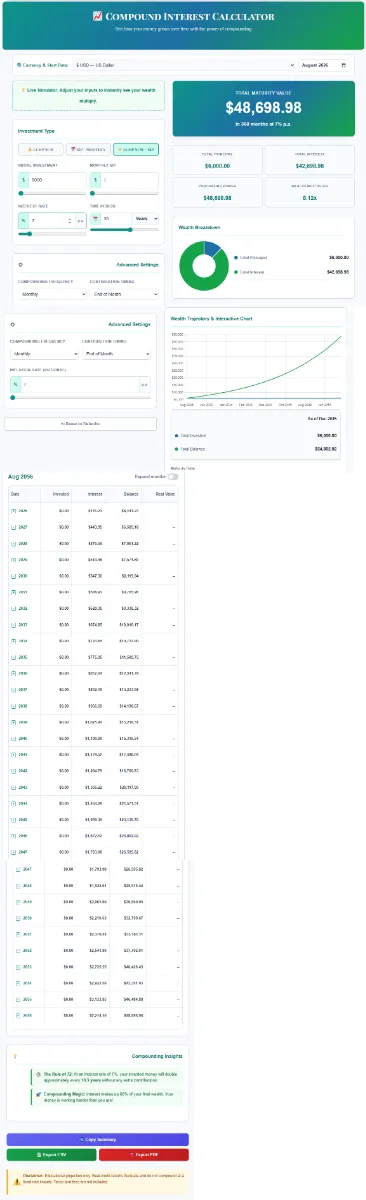
I ran a $10,000 balance at 4.26% through SaveXpert’s Compound Interest Calculator as a simplified illustration, under a constant-rate assumption, that produces roughly $426 in interest over one year.
That’s not a forecast for your specific I Bond. The inflation component resets every six months, so a flat 4.26% assumption doesn’t reproduce what TreasuryDirect will actually calculate. But it shows the order of magnitude — and how different the picture looks if the November rate shifts meaningfully.
🧮 Try the SaveXpert Compound Interest Calculator
Plug in $10,000 at different assumed rates — 3.5%, 4.26%, 5% — and see how the six-month reset structure changes the long-run picture. It won’t reproduce TreasuryDirect’s exact calculation, but it makes the moving parts visible.
Educational note: This calculator models constant-rate compound interest scenarios and does not replicate TreasuryDirect’s semiannual reset calculation. Treat outputs as illustrations, not predictions. Source: TreasuryDirect I Bond Rates
The research also points to SaveXpert’s Retirement Savings Calculator as a useful companion. It can model periodic I Bond contributions under an assumed rate — just mark the November 2026 figure as unconfirmed until Treasury publishes it.
📈 Try the SaveXpert Retirement Savings Calculator
Model how regular I Bond purchases fit into a longer-term savings plan. Use the current 4.26% as your baseline, then revisit after November 1 with the official rate.
Educational note: This calculator illustrates savings scenarios using a user-specified rate and does not provide personalized financial advice. Source: IRS: Individual Retirement Arrangements
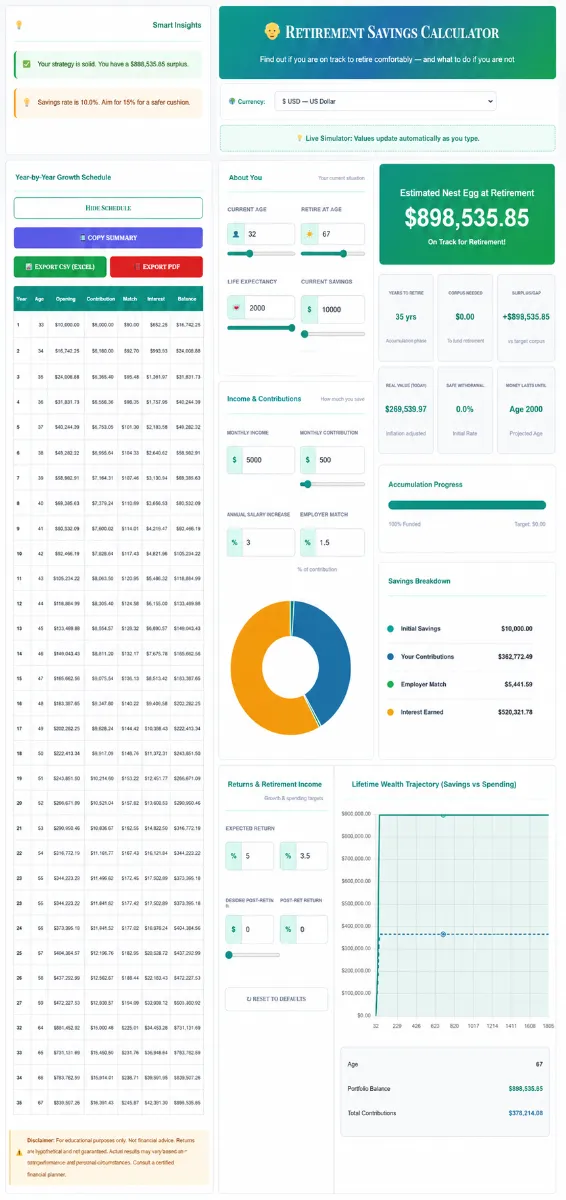
Estimate your future nest egg from your current savings.
How to Buy I Bonds and the Annual Limit
The research confirms that electronic Series I Bonds carry a $10,000 annual purchase limit per Social Security number or EIN. That limit resets each calendar year. The minimum electronic purchase is $25. (TreasuryDirect: I Bonds)
For the buying process, the official source is TreasuryDirect itself — not a bank or brokerage. You open an account at TreasuryDirect.gov, link a U.S. bank account, and purchase electronically. That’s what the official guidance says. I won’t invent click-by-click instructions that go beyond what the published materials document.
⚠️ Paper bonds are gone: TreasuryDirect states that taxpayers could no longer purchase paper Series I Bonds through federal tax refunds starting January 1, 2025. The $10,000 electronic annual limit is now the only path for individual purchases. The old “tax refund trick” no longer applies.
There are also two liquidity rules that matter before you buy. First: I Bonds generally can’t be redeemed until they’ve been held for 12 months. Second: if you redeem before five years, you lose the most recent three months of interest. (TreasuryDirect: Redeeming I Bonds)
That makes an I Bond different from a savings account you can access any time. The research flags both rules specifically — and the data doesn’t support treating the two products as identical just because both earn interest.
The $10,000 cap also puts I Bonds in perspective for retirement planning. They’re not a substitute for a 401(k) or IRA contribution. Treasury rules cap annual electronic purchases regardless of income or account size.

I Bond Taxes and the High-Yield Savings Comparison
The tax treatment is one of the cleaner findings. I Bond interest is subject to federal income tax but generally not subject to state or local income tax. (TreasuryDirect: Tax Information for EE and I Bonds)
Federal tax can be handled two ways: report it annually as it accrues, or defer it until you cash the bond or it matures at 30 years. Most holders defer, which keeps the math cleaner year to year.
The education interest exclusion
The IRS allows a potential education-related exclusion for qualifying taxpayers who use I Bond proceeds for qualified higher-education expenses. The full exclusion phases out above certain modified adjusted gross income (MAGI) thresholds. For 2025 tax-year figures, the research brief lists:
| Filing Status | Phaseout Begins | Exclusion Eliminated At |
|---|---|---|
| Single / Head of Household / Qualifying Widow(er) | $99,500 | $114,500 |
| Married Filing Jointly | $149,250 | $179,250 |
| Married Filing Separately | Not eligible — exclusion not available | |
Source: IRS Publication 970 (2025 figures; verify 2026 thresholds when IRS publishes updated guidance)
⚠️ 2026 thresholds not yet confirmed: These MAGI figures are from 2025 IRS data. The 2026 figures will be in updated IRS Publication 970. Check IRS.gov/publications/p970 before filing.
What about high-yield savings accounts?
This is where the research runs out of road — and I won’t pretend otherwise. The official government sources I reviewed don’t provide current high-yield savings rates, and they don’t set up a controlled comparison between I Bonds and savings accounts. So I can’t give a clean side-by-side from verified data alone.
The comparison also needs more than one number. I Bonds come with a 12-month redemption lock and a three-month interest penalty before five years. Savings accounts don’t. Those access rules change the real-world math in ways a raw rate comparison misses. (TreasuryDirect: Comparing EE and I Bonds)
What the Data Shows Works
Based on what I found across TreasuryDirect, BLS, and IRS materials, the approach the data keeps supporting is careful verification before treating any rate as final. Here’s what the research establishes:
TreasuryDirect announces I Bond rates on May 1 and November 1.
Those are the only two dates each year that produce official rates. (TreasuryDirect I Bond Rates)
The November 2026 rate can’t be confirmed before October 14.
That’s when September CPI-U data is scheduled to arrive — the last input Treasury needs. Any number published before that date is an estimate.
The current 4.26% composite isn’t permanent.
Its inflation component resets every six months from each bond’s own issue date. The fixed rate (0.90% for May–Oct 2026 bonds) never changes.
Electronic purchases are capped at $10,000 per year per SSN/EIN.
There’s no income exception, no workaround. Paper bonds through tax refunds ended January 1, 2025.
Holding rules are firm.
No redemption before 12 months. Redeem before five years, you lose the last three months of interest.
Federal tax applies. State and local tax generally doesn’t.
The education exclusion exists but has income limits that need annual verification against IRS guidance.
💡 Research note: The official data does not establish that I Bonds will outperform stocks, CDs, money markets, or other investments over any specified period. That comparison requires data the government sources don’t provide.
What Americans Can Realistically Expect
Right now — late August 2026 — you can verify the 4.26% composite rate on TreasuryDirect and buy a bond earning it until October 31. That’s a confirmed, official number. (TreasuryDirect I Bond Rates)
The November 2026 rate is a different story. Two calendar events define the path to it:
| Date | Event | What It Unlocks |
|---|---|---|
| September 11, 2026 | BLS releases August 2026 CPI-U | Trend data — useful context, not the final input |
| ~October 14, 2026 | BLS releases September 2026 CPI-U | The six-month change Treasury needs to set the inflation component |
| November 1, 2026 | TreasuryDirect announces official November rate | The only date a “November 2026 I Bond rate” becomes real |
Source: BLS CPI Release Schedule, TreasuryDirect I Bond Rates
The practical upside of understanding this timeline: if you’re weighing whether to buy before or after October 31, you now know exactly what information you’re missing and exactly when it arrives. That’s more useful than any estimate.
Your 5-Step I Bond Action Plan
1. Verify the current rate first:
Confirm the 4.26% composite at TreasuryDirect’s rate page — not a third-party summary — before making any purchase decision.
2. Mark October 14 and November 1:
Set a calendar reminder for the September CPI release (~Oct 14) and the Treasury announcement (Nov 1). Those are the two dates that matter.
3. Run the numbers before buying:
Use the Compound Interest or Retirement Savings Calculator above with the current confirmed rate — not a speculated November figure.
4. Respect the liquidity rules:
Don’t put money you might need inside 12 months into an I Bond — the lock-up is real, and the three-month interest penalty before five years is real.
5. Check November 1 and update:
When TreasuryDirect posts the official rate, revisit your savings plan with the confirmed figure. SaveXpert’s calculators will still be there.
“When I traced this through TreasuryDirect’s published formula and the BLS release calendar, the finding was straightforward: any November 2026 percentage published before October 14 is an estimate, not an official rate. The data supports waiting.”
— Kevin Brown, Lead Researcher at SaveXpert.com
Frequently Asked Questions
Ans: According to U.S. Treasury and BLS data, the official November 2026 I Bond rate is not yet finalized. TreasuryDirect announces the new rate on November 1, 2026, after calculating the six-month CPI-U change through September 2026. The current rate for bonds issued through October 31, 2026, is 4.26% — a 0.90% fixed rate plus a 3.34% annualized inflation component.
Ans: The TreasuryDirect schedule shows new Series I Savings Bond rates are announced on May 1 and November 1 each year. The November 1, 2026 rate applies to bonds issued from November 1, 2026, through April 30, 2027. The fixed rate set on that date locks in for the 30-year life of those bonds, while the inflation component resets every six months.
Ans: According to TreasuryDirect guidelines, electronic Series I Bonds are purchased at TreasuryDirect.gov by opening an account linked to a U.S. bank account and Social Security number or EIN. The minimum purchase is $25. Treasury eliminated the option to buy paper I Bonds through federal tax refunds starting January 1, 2025, so TreasuryDirect is the only channel for individual purchases.
Ans: TreasuryDirect data confirms the annual electronic purchase limit is $10,000 per Social Security number or EIN per calendar year. Trusts and businesses each have their own separate $10,000 limit. Since the paper-bond-via-tax-refund option ended in 2025, $10,000 electronically per person is the current ceiling for individuals.
Ans: According to IRS Publication 970 and TreasuryDirect tax guidance, I Bond interest is subject to federal income tax but generally exempt from state and local income taxes. Federal tax can be reported annually or deferred until the bond is redeemed or matures. Qualifying taxpayers may exclude interest used for eligible higher-education expenses, subject to MAGI limits that need annual verification with updated IRS guidance.
Ans: TreasuryDirect data shows each bond follows its own six-month rate clock from its issue month. If you bought a bond in May 2026, your rate resets every May and November — so the November 2026 announcement will apply to your bond at its next November reset. If you bought in July, your rate clock resets in January and July instead, so the November announcement sets your rate the following May. The fixed rate from your original purchase never changes; only the inflation component updates.