

ⓘ Educational Disclosure:
This article is for educational and informational purposes only. It does not constitute financial, legal, tax, lending, or investment advice. SaveXpert and its authors are not licensed financial or tax advisors. Always consult a qualified professional before making investment decisions.
How does tax-loss harvesting work under the 2026 IRS rules? Under the tax-loss harvesting rules for 2026, investors realize investment losses to offset capital gains in taxable accounts. When losses exceed gains, the IRS generally allows individuals to deduct up to $3,000 of the excess against ordinary income, or $1,500 for married taxpayers filing separately. Any remaining net capital losses carry forward into future tax years. A 30-day wash-sale window before and after any loss sale applies. (IRS Publication 550)
Key Takeaways
- Problem: American investors often believe a $10,000 investment loss creates a $10,000 tax refund in the same year — but the IRS rules work very differently.
- Solution: The tax loss harvesting rules for 2026 let you offset capital gains first, then deduct up to $3,000 of excess losses against ordinary income, with any remaining losses carrying forward to future years — per IRS Publication 550.
- Result: The data indicates these rules can provide measured tax value over time, though results depend heavily on transaction costs, wash-sale avoidance, and your specific income bracket.
- Source: IRS Publication 550, IRS Topic No. 409
- Time To Read: 8 Minutes
Table of Contents
1. The $10,000 Loss That Isn’t a $10,000 Deduction
2. How Tax-Loss Harvesting Works Under the IRS Rules
3. What Is the IRS Wash-Sale Rule for 2026?
4. The 2026 Capital-Gain Rate Thresholds
5. When Is the 2026 Tax-Loss Harvesting Deadline?
6. How Much Can You Deduct Through Tax-Loss Harvesting?
7. Does Tax-Loss Harvesting Work in IRAs?
8. Is Tax-Loss Harvesting Worth It for Small Portfolios?
9. Model Your 2026 Capital-Gain Scenarios
A $10,000 investment loss doesn’t automatically create a $10,000 tax deduction. That surprised me when I worked through the IRS rules — but it’s one of the most common misconceptions about tax-loss harvesting. The tax code applies capital losses against capital gains first. Only what’s left over can reach ordinary income, and even then the annual limit is $3,000.
I went through IRS Publication 550, IRS Topic No. 409, the 2026 capital-gain thresholds from IRS Rev. Proc. 2025-32, and the wash-sale rules under 26 U.S.C. §1091. Here’s what the research actually shows.

The $10,000 Loss That Isn’t a $10,000 Deduction
The IRS framework runs in a specific order, and that order matters a great deal. Capital losses first offset capital gains. Only the remaining net loss — after all gains have been absorbed — moves toward ordinary income. And even then, most individuals can only apply $3,000 per year against ordinary income. Married taxpayers filing separately face a $1,500 limit. (IRS Topic No. 409)
Here’s a plain example. An investor realizes $8,000 in capital gains and $12,000 in capital losses during 2026. The losses first offset the gains, leaving a $4,000 net capital loss. The IRS then generally allows $3,000 of that excess against ordinary income. The remaining $1,000 becomes a capital loss carryover to 2027 — not lost, just deferred.
The research also flags one more important point about character. Capital losses first offset capital gains of the same character — short-term losses against short-term gains, long-term losses against long-term gains. Then net losses of each character can offset gains of the other character. This sequence affects the tax value of a loss because short-term gains are taxed at ordinary income rates while long-term gains receive preferential rates.
💡 Research note: Tax-loss harvesting is a tax-timing strategy, not a tax-elimination strategy. The IRS generally requires you to reduce the cost basis of a replacement security by the disallowed wash-sale loss — meaning that loss eventually resurfaces when the replacement is sold. (IRS Publication 550)
How Tax-Loss Harvesting Works Under the IRS Rules
The basic mechanics are straightforward from IRS Publication 550. An investor sells an investment that has declined in value, realizing the capital loss. The IRS then applies that loss under the offset framework above. Any disallowed wash-sale loss enters the cost basis of the replacement security rather than disappearing entirely.
The reporting process matters as much as the strategy. Taxpayers generally report capital-asset sales on Form 8949 and summarize them on Schedule D. The IRS identifies a nondeductible wash-sale loss with code “W” on Form 8949 — the disallowed amount enters the adjustment column as a positive number. (IRS Form 8949 Instructions)
💡 Research note — short-term vs. long-term character matters: Short-term capital gains (assets held one year or less) are taxed as ordinary income at your marginal rate. Long-term gains (held more than one year) receive preferential rates of 0%, 15%, or 20%. When harvesting losses, the character of the loss you realize affects which gains it offsets first — and therefore how valuable that loss is to your specific tax situation.
What Is the IRS Wash-Sale Rule for 2026?
The wash-sale rule is the biggest trap in tax-loss harvesting — and it catches investors both before and after the sale.
According to IRS Publication 550, the IRS examines a 30-day window before and after the loss sale. If the taxpayer buys or acquires substantially identical stock or securities during that 61-day testing window, the IRS disallows the current loss. The statutory basis is 26 U.S.C. §1091.
⚠️ The 30-day window runs before the sale too: Many investors treat the wash-sale rule as a post-sale concern. The IRS applies it on both sides — 30 days before the loss sale and 30 days after. A purchase made before the loss sale can disallow the loss just as effectively as one made afterward. Plan both sides of the trade.
The “31 days” figure and the actual statutory rule
Investors commonly repeat “31 days” as a rule-of-thumb for how long to wait before repurchasing. But the IRS states the rule as a 30-day window. The 31-day figure is a practical implication — if you want to repurchase on day 31, you need to sell on day one and wait 30 days to have any gap at all — but it is not the statutory number. The statute says 30 days. The IRS does not present “31 days” as a separate legal standard. (26 U.S.C. §1091)
IRA purchases and the wash-sale rule
Here’s where the rule extends beyond what many investors expect. The wash-sale rule can apply when substantially identical securities are purchased inside an IRA or Roth IRA within the applicable window around a taxable-account loss sale. IRS Publication 550 expressly identifies those IRA transactions as potentially triggering wash-sale consequences.
The practical implication: if you sell a stock at a loss in your taxable brokerage account and buy the same stock in your Roth IRA within 30 days, the IRS can disallow the loss. The rule isn’t limited to purchases in the same account — it covers the same investor’s IRA purchases as well. (Investor.gov: Tax Resources for Investors)
The research found no new 2025–2026 legislative change to the individual 30-day wash-sale window. The reviewed materials continue to point to §1091 as the governing rule.
The 2026 Capital-Gain Rate Thresholds
I reviewed IRS Revenue Procedure 2025-32 for the 2026 capital-gain thresholds. The rate structure (0%, 15%, 20%) remains unchanged; only the dollar thresholds moved up for inflation.
| Filing Status | 0% Rate (up to) | 15% Rate (up to) | 20% Rate (above) |
|---|---|---|---|
| Married Filing Jointly / Surviving Spouse | $98,900 | $613,700 | $613,700 |
| Head of Household | $66,200 | $579,600 | $579,600 |
| Single / All Other Individuals | $49,450 | $545,500 | $545,500 |
| Married Filing Separately | $49,450 | $306,850 | $306,850 |
Source: IRS Revenue Procedure 2025-32; thresholds apply to taxable income, not gross income
These thresholds matter because the value of realizing a gain or loss depends partly on where your taxable income lands. A long-term capital gain taxed at 0% produces no federal tax cost — meaning harvesting a loss to offset it generates no immediate benefit in that scenario. The same loss harvested against a 15% or 20% gain has more direct value.
The Net Investment Income Tax adds another layer
The IRS also imposes a 3.8% Net Investment Income Tax (NIIT) that can apply on top of regular capital-gains rates when modified adjusted gross income (MAGI) exceeds statutory thresholds. Unlike the capital-gain rate brackets, these NIIT thresholds are not inflation-adjusted — they’ve remained unchanged since 2013:
| Filing Status | MAGI Threshold for 3.8% NIIT | Effective Top Rate on LTCG |
|---|---|---|
| Single / Head of Household | $200,000 | 23.8% (20% + 3.8%) |
| Married Filing Jointly / Qualifying Widow(er) | $250,000 | 23.8% (20% + 3.8%) |
| Married Filing Separately | $125,000 | 23.8% (20% + 3.8%) |
Source: IRS: Net Investment Income Tax Q&A; 26 U.S.C. §1411
💡 Research note: For investors above the NIIT thresholds, harvesting a $10,000 capital loss is worth up to $2,380 in combined federal tax savings (23.8% × $10,000) if offsetting a gain that would have been taxed at the combined 20% + 3.8% rate — before factoring in transaction costs and state taxes.
When Is the 2026 Tax-Loss Harvesting Deadline?
There is no separate IRS deadline labeled “tax-loss harvesting deadline.” What the research identifies is a practical December 31 cutoff driven by two rules: losses must be realized — sales must settle — within the 2026 calendar year to offset 2026 capital gains. And the wash-sale window then extends 30 days into January 2027 for any year-end sale. (IRS Publication 550)
This creates a practical end-of-year constraint. An investor who sells at a loss on December 20 cannot repurchase the same security — or a substantially identical one — before January 20, 2027, without triggering the wash-sale disallowance. Many investors sell in mid-December to give themselves enough trading days to confirm settlement before year-end and still have the full 30-day window pass before January repurchase.
⚠️ The deadline is the settlement date, not the trade date: Stock trades in U.S. markets typically settle in one business day (T+1). If December 31 falls on a Wednesday, a trade made Monday, December 29, settles Tuesday, December 30 — inside the tax year. A trade on December 31 likely settles January 2, 2027, in the next tax year. Check settlement dates with your broker before treating a late-December trade as a 2026 loss.
Find your marginal bracket, income tax, and take-home.
How Much Can You Deduct Through Tax-Loss Harvesting?
The number most investors need to remember is $3,000. After capital losses offset capital gains, an individual can generally deduct up to $3,000 of remaining net capital losses against ordinary income per year. The limit drops to $1,500 for married taxpayers filing separately. (IRS Topic No. 409, IRS Schedule D Instructions)
Any net capital loss above those amounts doesn’t disappear — it carries forward to the following tax year as a capital loss carryover. There is no expiration date on capital loss carryforwards. A $20,000 net capital loss could reduce ordinary income by $3,000 per year for several years while also offsetting future capital gains. But it won’t create a $20,000 ordinary income deduction in a single year.
💡 Research note — the carryover is indefinite: The IRS does not impose a time limit on how long you can carry a capital loss forward. A loss from 2026 that exceeds the $3,000 annual limit rolls into 2027, then 2028, and so on until it’s fully used against gains or the $3,000/year ordinary income offset. (IRS Topic No. 409)

Does Tax-Loss Harvesting Work in IRAs?
No — and the IRS reasons are distinct from what most investors assume. Inside a traditional IRA or Roth IRA, gains and losses don’t create current-year taxable events — so there’s no realized capital loss to harvest. The tax-deferred or tax-free structure means the concept simply doesn’t apply to trades within those accounts.
But here’s the important distinction: even though you can’t harvest losses inside an IRA, what you do inside your IRA can affect a loss you’re trying to harvest in your taxable account. IRS Publication 550 expressly identifies IRA purchases as potential triggers for the wash-sale rule when they occur within the 30-day window around a taxable-account loss sale.
If you sell a stock at a loss in your taxable brokerage account and buy the same stock in a Roth IRA within 30 days — either direction — the IRS can disallow the taxable loss. The rule doesn’t care that the purchase happened in a tax-advantaged account. The investor is the same person, and the securities are substantially identical. (IRS Publication 550)
Estimate your lump-sum investment growth over time.
Is Tax-Loss Harvesting Worth It for Small Portfolios?
The academic research gives a more nuanced answer than a simple yes or no. A Financial Analysts Journal study examined large-cap U.S. securities from 1926 through 2018 and reported a historical before-transaction-cost tax alpha of 1.08% per year. After applying the wash-sale constraint, the figure fell to 0.82%. The CFA Institute summary reported a 13-basis-point reduction from transaction costs. These are historical academic findings, not 2026 household results.
A separate individual-investor study found that investor profiles explained roughly 60% of the variation in tax-loss-harvesting outcomes. Portfolio size, tax bracket, trading frequency, and transaction costs all shape the result differently for different investors.
💡 Research note: The academic evidence covers historical periods and specific assumptions — it doesn’t establish a universal 2026 household outcome. For small portfolios, trading commissions and bid-ask spreads can consume a meaningful portion of the tax benefit. The research doesn’t set a universal dollar threshold where harvesting becomes worthwhile. Investor circumstances matter more than a single portfolio-size cutoff.
⚠️ Don’t harvest a loss in the 0% capital-gains bracket: If your 2026 taxable income is below $49,450 (single) or $98,900 (MFJ), long-term capital gains already face a 0% federal rate. Harvesting a long-term loss against a 0%-rate gain produces no immediate federal tax benefit — but creates a wash-sale window that can complicate future purchases. Check your bracket before selling.
Model Your 2026 Capital-Gain Scenarios
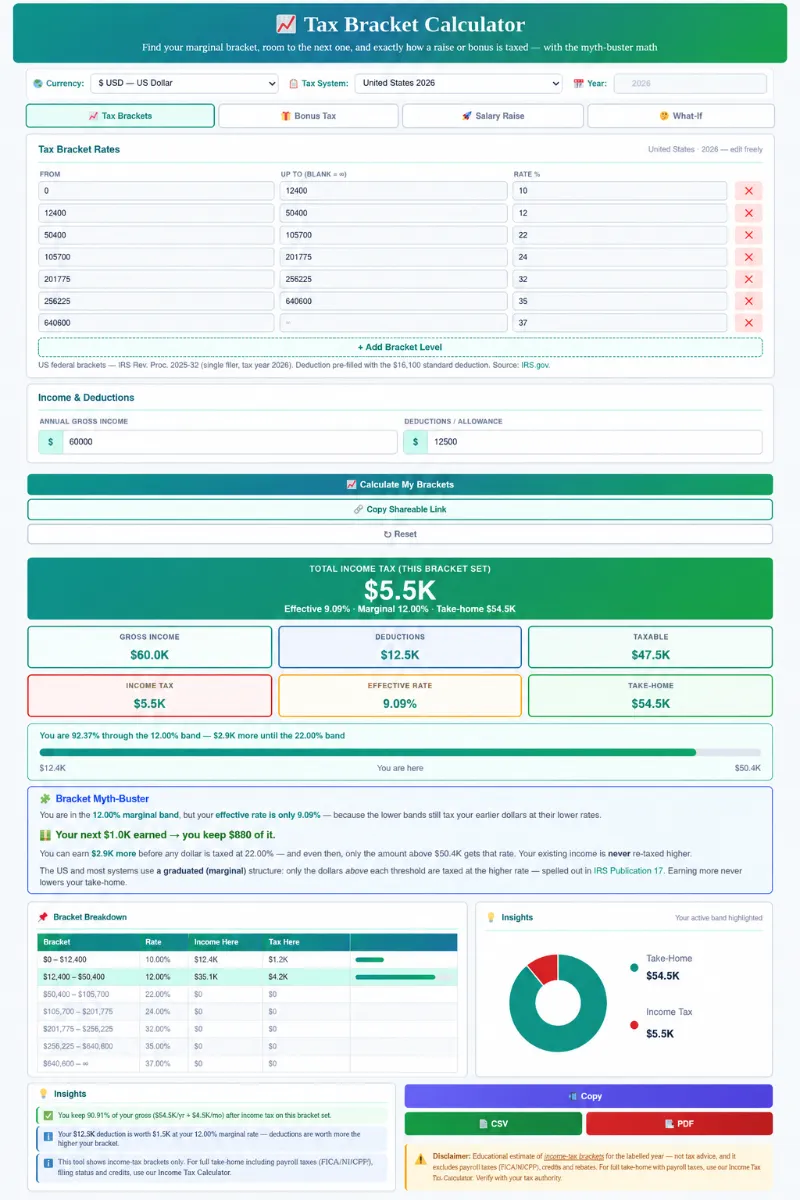
I ran a sample scenario using the 2026 capital-gain thresholds from IRS Rev. Proc. 2025-32 through SaveXpert’s Tax Bracket Calculator. The key finding: filing status and taxable income can shift which capital-gain threshold applies, while realized losses offset realized gains before the remaining loss reaches the ordinary-income deduction limit. Try your own 2026 numbers here:
💰 Check Which 2026 Bracket You’re In — Tax Bracket Calculator
Use the 2026 capital-gain thresholds ($98,900 for MFJ, $49,450 for single, $66,200 for HOH at the 0%/15% boundary) to see where a realized gain — or a loss that becomes ordinary income — actually lands in your tax picture. The calculator is an educational tool; it illustrates the interaction between income and bracket thresholds.
Educational note: This calculator illustrates bracket scenarios using user-supplied inputs and does not calculate exact tax liability. Source: IRS Rev. Proc. 2025-32
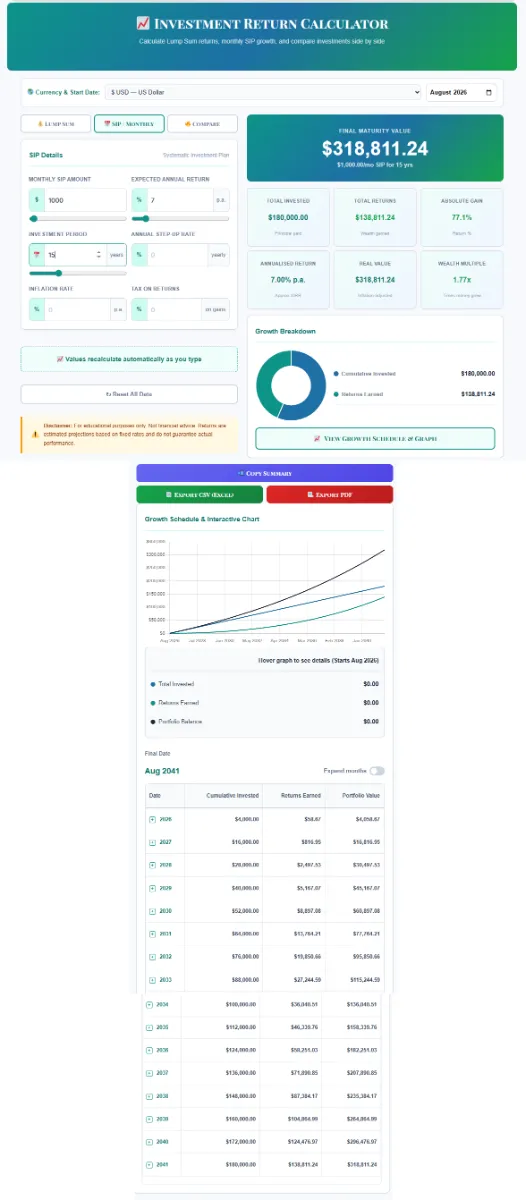
Before working through the tax impact, it also helps to quantify the portfolio return and unrealized loss amount. The Investment Return Calculator is a useful first step for seeing the numbers before applying the capital-gain treatment.
📈 Quantify the Loss — Investment Return Calculator
Enter your original cost basis and current market value to see the percentage return and dollar gain or loss before you model the tax treatment. I used this alongside the Tax Bracket Calculator to build the example scenario above — cost basis first, then bracket impact.
Educational note: This calculator illustrates portfolio return scenarios and does not calculate exact tax liability or provide personalized investment advice. Source: Investor.gov: Tax Resources
What the Data Shows Works
Based on what I found across IRS Publication 550, Topic No. 409, Rev. Proc. 2025-32, and the academic literature, the approach that consistently shows in the research has five identifiable features.
First: the IRS offset order is fixed.
Losses first offset gains, then excess losses face the $3,000 or $1,500 ordinary-income limit, then the rest carries forward. The $3,000 deduction against ordinary income is the ceiling for any single year’s excess loss. (IRS Topic No. 409)
Second: the wash-sale rule applies before and after.
The IRS tests 30 days before and after the loss sale. An IRA purchase triggers the rule the same way a taxable-account purchase does. (IRS Publication 550)
Third: transaction costs reduce the economic value.
The academic research quantified a 13-basis-point reduction from transaction costs in the historical study period. That real-world friction matters more for smaller portfolios relative to the tax benefit.
Fourth: investor circumstances determine the outcome.
The individual-investor study found roughly 60% of variation in tax-loss-harvesting outcomes explained by investor profiles — bracket, portfolio size, trading frequency, and cost structure all interact.
Fifth: historical studies don’t guarantee 2026 results.
The academic findings cover earlier market periods and specific assumptions. They describe what happened historically, not what your portfolio will experience this year.
What the research doesn’t establish:
a universal dollar threshold where tax-loss harvesting always becomes worthwhile, or a guaranteed tax saving from any single strategy. The IRS rules set the framework; the economic result depends on the specific investor’s situation.

Your 5-Step Tax-Loss Harvesting Checklist for 2026
1. Identify your realized gains first:
Know whether your 2026 realized gains are short-term or long-term before harvesting any losses. Losses of each character offset gains of the same character first — the character match affects the tax value of the harvest.
2. Check your 2026 capital-gain bracket:
If your taxable income is below $49,450 (single) or $98,900 (MFJ), long-term gains may already be taxed at 0%. Harvesting a long-term loss against a 0%-rate gain produces no immediate federal tax benefit.
3. Plan the wash-sale window on both sides:
Map 30 days before and 30 days after the planned loss sale. Check your taxable accounts and your IRAs — any purchase of substantially identical securities in either type of account during that window can disallow the loss.
4. Confirm settlement before December 31:
The loss must settle inside the 2026 tax year to offset 2026 gains. Check T+1 settlement timing with your broker. Don’t rely on a December 31 trade date alone — verify that the settlement date also falls before year-end.
5. Report correctly on Form 8949 and Schedule D:
Wash-sale losses get code “W” on Form 8949 with the disallowed amount as a positive adjustment. Capital loss carryovers follow from Schedule D year to year. Accurate basis tracking is the foundation the whole strategy rests on.
“When I ran through IRS Publication 550, the key finding was clear: tax-loss harvesting generally changes when gains and losses affect taxes — not whether they’re taxed at all. It doesn’t erase the tax permanently. And the wash-sale window applies before the sale as well as after, which is the part investors most often miss.”
— Kevin Brown, Lead Researcher at SaveXpert.com
Frequently Asked Questions
Ans: According to IRS Publication 550, tax-loss harvesting involves selling an investment at a loss to offset realized capital gains in your taxable account. Capital losses first offset capital gains. If your losses exceed your gains, the remaining net capital loss can reduce ordinary income by up to $3,000 per year ($1,500 if married filing separately). Any excess carries forward to offset gains or income in future years. The strategy changes when taxes are owed, not whether the tax is ever owed.
Ans: According to IRS Publication 550 and 26 U.S.C. §1091, the wash-sale rule prevents you from claiming a loss deduction if you buy substantially identical securities within 30 days before or after the loss sale. The disallowed loss isn’t eliminated — the IRS adds it to the cost basis of the replacement security. The rule applies to purchases in taxable accounts and in IRAs and Roth IRAs alike. No new 2025–2026 legislation changed the individual 30-day window.
Ans: According to IRS rules, there is no specific statutory “tax-loss harvesting deadline.” To offset 2026 capital gains, the loss sale must settle inside the 2026 calendar year — practically, before December 31. The 30-day wash-sale window then extends into January 2027 for year-end sales. U.S. stock trades now settle in one business day (T+1), so the trade date and settlement date can fall in different calendar years near year-end.
Ans: According to IRS Topic No. 409 and Schedule D instructions, you can deduct up to $3,000 of excess net capital losses against ordinary income per year ($1,500 if married filing separately). Any remaining net capital loss carries forward indefinitely to future tax years — there is no expiration date. A $20,000 net capital loss would generally produce a $3,000 ordinary income deduction in year one, with the $17,000 balance rolling into subsequent years.
Ans: According to IRS Publication 550, you cannot harvest losses inside a traditional IRA or Roth IRA because gains and losses inside those accounts don’t create current-year taxable events. However, buying substantially identical securities inside an IRA within 30 days of selling them at a loss in a taxable account will trigger the wash-sale rule and disallow the taxable deduction. The IRA location doesn’t protect against the wash-sale test — the rule follows the investor, not the account type.
Ans: According to IRS Schedule D instructions, yes — character matters. Short-term losses first offset short-term gains, and long-term losses first offset long-term gains. Net short-term and long-term results are then combined. This sequencing affects the tax value of a harvest because short-term gains are taxed at ordinary income rates while long-term gains receive preferential 0%, 15%, or 20% rates. Harvesting a long-term loss to offset a long-term gain in the 0% bracket produces no immediate federal benefit; the same loss harvested against a short-term gain taxed at 22% may be worth substantially more.