
ⓘ Educational Disclosure:
This article is for educational and informational purposes only. It does not constitute financial, legal, tax, lending, student-loan, or insurance advice. SaveXpert and its authors are not licensed financial aid professionals. Federal student aid rules, loan limits, and repayment options can change. Always verify current requirements directly at StudentAid.gov before making enrollment or borrowing decisions.
Millions of families are searching “is FAFSA going away in 2026” right now – and the anxiety is understandable given how much federal student aid has changed. The answer from the official data is clear. But the follow-up question matters just as much: what exactly did change, and what does it mean for your borrowing options?
Key Takeaways
- Problem: Many American families worry that FAFSA is being eliminated, threatening their ability to apply for federal financial aid.
- Solution: Federal Student Aid’s own data confirms FAFSA is not going away. The 2026-27 application is fully active, with 14,883,709 submissions already recorded as of July 20, 2026. What changed are the aid rules built around the application.
- Result: Students continue using FAFSA to apply for federal aid, but loan limits, Pell Grant eligibility rules, and repayment structures have changed significantly under Public Law 119-21 (the One Big Beautiful Bill Act, signed July 4, 2025).
- Source: Federal Student Aid – FAFSA Central Submission Statistics · StudentAid.gov – FAFSA Application
- Time To Read: 7 Minutes
Table of Contents
1. The Surprising Number: 14.8 Million FAFSA Applications Already Submitted
2. Is FAFSA Going Away in 2026? The Official Answer Is No
3. What Major FAFSA Changes Are Coming in 2026?
4. What Does the Big Beautiful Bill Change About FAFSA and Student Loans?
5. When Does FAFSA Open for the 2026-27 Academic Year?
6. Is Trump Eliminating Student Loan Forgiveness in 2026?
7. What Happens If You Miss the FAFSA Deadline?
9. What Can Americans Realistically Expect in 2026 and 2027?
Is FAFSA going away in 2026? No. According to Federal Student Aid, the 2026-27 FAFSA application remains fully active for students and contributors. The federal submission deadline is June 30, 2027. The One Big Beautiful Bill Act (Public Law 119-21) changed aid eligibility rules, Pell Grant formulas, and federal student-loan limits – but it did not repeal the FAFSA form or eliminate access to the application itself.
The Surprising Number: 14.8 Million FAFSA Applications Already Submitted
Federal Student Aid’s FAFSA Central data as of July 20, 2026 shows a system that isn’t going away – it’s processing at scale.
| FAFSA Central Metric | Count (as of July 20, 2026) |
|---|---|
| Applications started | 16,419,752 |
| Applications submitted | 14,883,709 |
| Applications processed without rejection | 14,704,246 |
| ISIRs sent to colleges | 58,278,522 |
| Records sent to states | 26,802,960 |
| Unique institutions receiving FAFSA data | 5,988 |
Source: Federal Student Aid – FAFSA Central Submission Statistics. Data as of July 20, 2026.
For families searching “is FAFSA going away in 2026,” those numbers give a clear answer. FAFSA still exists, is still processing applications, and is still transmitting aid information to institutions across the country. What changed are several of the rules underneath the application that determine how much aid a student receives.
Is FAFSA Going Away in 2026? The Official Answer Is No
I spent time going through Federal Student Aid’s current FAFSA information and the 2026-27 Federal Student Aid Handbook. The official records show that FAFSA remains the application used for federal financial-aid consideration.
Federal Student Aid says the 2026-27 FAFSA is available for all students and contributors, with the official federal deadline set at June 30, 2027, at 11:59 p.m. Central Time. The full online FAFSA was scheduled to be available by October 1, 2025 – a schedule Federal Student Aid published in its 2026-27 application handbook.
Federal Student Aid also reported strong user experience data alongside the application statistics. Its survey showed 95% of surveyed users were satisfied with the FAFSA form. Another 90% said the form took a reasonable amount of time to complete. Federal Student Aid says people typically finish their section of the form in 12 minutes or less.
That doesn’t mean every part of federal financial aid stayed the same. The administrative data shows the application is active – what changed are the aid formulas and programs built around it.

What Major FAFSA Changes Are Coming in 2026?
The biggest changes came from Public Law 119-21, the One Big Beautiful Bill Act, which Congress approved on July 4, 2025. The law changed federal student-aid rules without eliminating the FAFSA application. Its education provisions cover loan limits, repayment plans, PSLF, Pell Grant eligibility, and Workforce Pell.
Pell Grant eligibility tightened.
Federal Student Aid announced that applicants with a Student Aid Index equal to or greater than twice the maximum Pell Grant award are now ineligible for Pell. With the maximum scheduled Federal Pell Grant award for 2026-27 set at $7,395, the new ineligibility threshold sits at a Student Aid Index of $14,790 or higher.
Workforce Pell created.
The law established Workforce Pell rules for eligible short-term programs. Qualifying programs can run from 150 to fewer than 600 clock hours and last from eight to fewer than 15 weeks – expanding Pell eligibility to certain workforce-training programs that previously didn’t qualify.
Foreign earned income treatment changed.
Federal Student Aid updated its handbook on August 17, 2026. Foreign earned income exclusion reported on FAFSA now gets added back to adjusted gross income for Pell eligibility calculations beginning with the 2026-27 award year.
💡 Research note: These changes explain why some headlines make FAFSA sound like it’s disappearing. The application remains – but the formulas and aid programs around it changed enough to affect eligibility for many families in ways that can feel like elimination when their aid package shrinks.
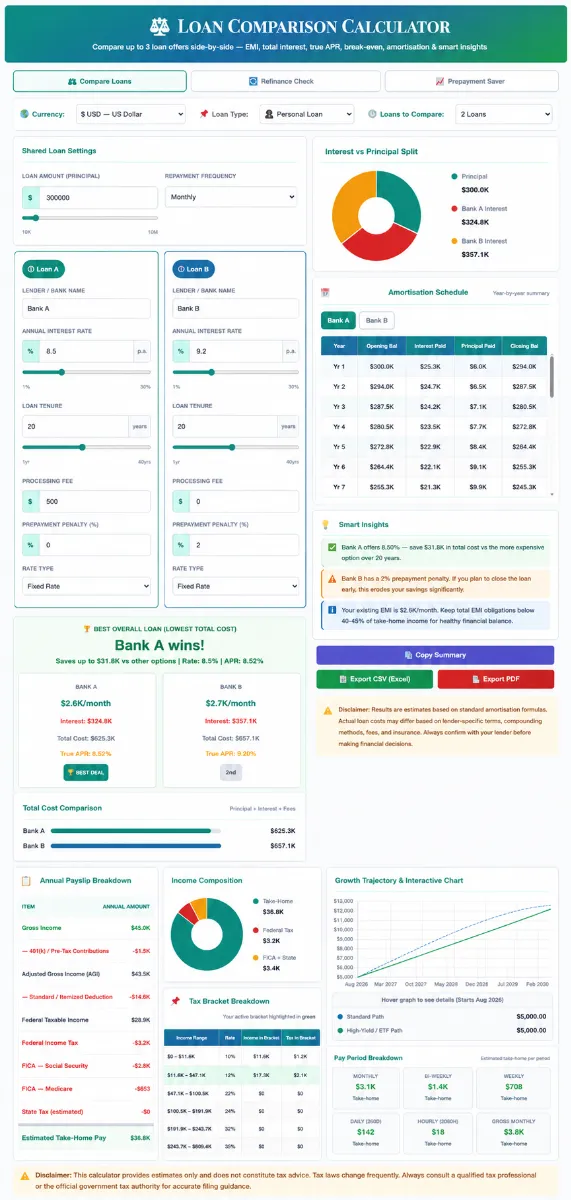
Compare two loans side-by-side to find the cheaper option.
What Does the Big Beautiful Bill Change About FAFSA and Student Loans?
The most consequential changes for borrowers affect federal loan limits for new graduate, professional, and parent borrowers starting July 1, 2026.
| Borrower Type | Annual Limit | Aggregate Limit | Notes |
|---|---|---|---|
| Graduate students (new borrowers) | $20,500 | $100,000 | Grad PLUS loans ended for affected new borrowers |
| Professional students (new borrowers) | $50,000 | $200,000 | Grad PLUS loans ended for affected new borrowers |
| Parent PLUS | $20,000/year | $65,000/dependent | New limits effective July 1, 2026 |
| Transitional exception borrowers | Legacy rates | $138,500 (incl. undergrad) | Enrolled by June 30, 2026 with prior Direct Loan; up to 3 academic years |
| Lifetime aggregate (loans from July 1, 2026) | – | $257,500 | Applies across all federal loan types |
Source: Federal Student Aid – Loan-Limit FAQ · U.S. Department of Education Higher Education Fact Sheet
Some borrowers qualify under the transitional exception. Federal Student Aid describes this as available to borrowers who were enrolled by June 30, 2026, and had already received a Direct Loan before July 1, 2026. That exception can last for up to three academic years, allowing qualifying borrowers to retain the legacy $138,500 aggregate graduate and professional loan limit including undergraduate borrowing.
The Department of Education also announced new repayment structures beginning July 1, 2026: the Repayment Assistance Plan and the Tiered Standard repayment plan. Federal Student Aid issued FAFSA processing updates in March 2026 and updated those in April as it implemented provisions from Public Law 119-21.
The key distinction for 2026: a student can still complete FAFSA. That student’s federal aid options may look substantially different from what was available before July 1, 2026.
💰 Try the SaveXpert Loan Comparison Calculator
I ran a hypothetical graduate-student borrowing scenario through SaveXpert’s Loan Comparison Calculator. A student needing $30,000 in federal borrowing would compare that figure against the new $20,500 annual graduate limit – a $9,500 gap that federal loans alone can no longer fill. The calculator makes that difference visible before comparing other funding sources such as institutional aid, state grants, or private loans.
Educational note: This calculator models hypothetical borrowing scenarios. For official loan-limit information, visit StudentAid.gov.
When Does FAFSA Open for the 2026-27 Academic Year?
The 2026-27 FAFSA is already available for all students and contributors, having been available since October 1, 2025. The federal deadline for the 2026-27 FAFSA is June 30, 2027, at 11:59 p.m. Central Time.
The research shows another deadline issue that matters far sooner. State and college priority deadlines can occur months before the federal deadline. The official 2026-27 FAFSA materials list deadlines ranging from October 2025 through 2027, depending on the state or institution.
⚠️ Critical distinction: Missing a state or institutional deadline does not automatically remove federal student-aid eligibility – but it can eliminate eligibility for state grants and school-specific scholarships. A student could still submit FAFSA before June 30, 2027, yet miss a college’s earlier priority deadline and lose institutional aid. Check your state and school deadlines at StudentAid.gov – these often close first and control the most limited funding.
Is Trump Eliminating Student Loan Forgiveness in 2026?
The research doesn’t support the claim that all student-loan forgiveness ended in 2026. What changed are specific programs and qualifying rules – not the existence of forgiveness itself.
The CFPB describes Public Service Loan Forgiveness as forgiveness after 120 qualifying payments, approximately 10 years for borrowers making consistent qualifying payments. Income-driven repayment forgiveness periods run 20 or 25 years depending on the plan and loan type.
The Department of Education announced a PSLF final rule on October 30, 2025. That rule changed the definition of a qualifying employer prospectively beginning July 1, 2026. The Department of Education’s data confirms that the rule change did not abolish PSLF altogether. Public Law 119-21 also allows qualifying payments under the new Repayment Assistance Plan to count toward PSLF.
The SAVE Plan is a different story. The Department of Education announced on March 27, 2026, that the SAVE Plan had ended following a court-approved settlement. Borrowers in SAVE moved into legal repayment plans, while the Repayment Assistance Plan launched July 1, 2026, as the primary new income-driven repayment option.
💡 Research summary: Student-loan forgiveness rules changed significantly in 2026. The SAVE Plan ended. The PSLF qualifying-employer definition changed. But PSLF itself still exists, income-driven repayment forgiveness still exists, and the research found no source establishing that all forgiveness programs ended.

What Happens If You Miss the FAFSA Deadline?
Federal Student Aid separates the federal deadline from state and institutional deadlines. For the 2026-27 award year, the federal FAFSA deadline is June 30, 2027. Missing a state FAFSA deadline does not automatically eliminate federal aid eligibility – but it can affect eligibility for state grants and school-specific scholarships.
The official FAFSA form also explains that incomplete or inaccurate information can delay or prevent aid calculations. The processed application feeds the Student Aid Index and other aid decisions. Reviewing the FAFSA Submission Summary and correcting any errors is a required part of the official process.
“Late” can mean three different things with very different consequences:
Missed federal deadline (June 30, 2027):
Removes eligibility for federal grants, work-study, and loans for the entire 2026-27 award year.
Missed state deadline:
Can eliminate state grant eligibility without affecting federal aid.
Missed college priority deadline:
Can reduce or eliminate institutional aid while federal and state aid may still be available.

What the Data Shows Works
Based on what I found in Federal Student Aid’s published data, the approach that consistently shows results is careful, timely use of the existing FAFSA process.
1. FAFSA remains the gateway.
Federal Student Aid confirms FAFSA is used to determine eligibility for federal grants, work-study, loans, and many state and institutional aid programs. Submitting it – even with changed loan limits – is the required first step.
2. Meeting the right deadlines matters more than meeting the federal deadline.
State and college priority deadlines often close months earlier. Missing them can eliminate specific aid categories even if the federal application stays open.
3. Reviewing the FAFSA Submission Summary matters.
The processed application information affects the Student Aid Index and aid package. Errors or incomplete data can reduce aid or delay processing.
4. Federal borrowing became more limited for certain new borrowers after July 1, 2026.
Graduate students face a new $20,500 annual limit. Professional students face $50,000. Parent PLUS borrowing has new annual and aggregate caps. The transitional exception covers some enrolled borrowers for up to three academic years.
What the data doesn’t support: that FAFSA itself disappeared, or that every student-loan forgiveness program ended in 2026. The findings here focus on official rules, administrative data, and published government statements.
What Can Americans Realistically Expect in 2026 and 2027?
FAFSA remains available through the 2026-27 award year, with the federal submission deadline set for June 30, 2027. Students can also expect several aid-rule changes already taking effect from July 1, 2026 – and these changes matter most for graduate and professional borrowers entering school under the new limits.
Those changes include new federal loan limits, the end of Grad PLUS loans for affected new borrowers, Parent PLUS caps, updated Pell Grant eligibility formulas incorporating foreign earned income, new repayment structures (Repayment Assistance Plan and Tiered Standard), and PSLF qualifying-employer rule changes effective July 1, 2026.
The application remains available while the rules determining aid keep changing around it – and the pace of change means verifying current rules at StudentAid.gov before each award year matters more than in previous cycles.
The Bottom Line: 5-Step FAFSA Action Plan
What should you actually do right now if you are working through FAFSA decisions in 2026? Here is what the Federal Student Aid data and updated legislation support as a practical sequence:
1. Submit your FAFSA before your state and college priority deadlines – not just the federal one:
The federal deadline (June 30, 2027) is the last possible date, not the target. State and school deadlines at StudentAid.gov often close months earlier and control access to the most limited grant funding.
2. Check your Pell Grant eligibility under the new Student Aid Index rules:
If your SAI is at or above $14,790 (twice the $7,395 maximum Pell award), you no longer qualify for Pell under the new formula. Foreign earned income exclusion is now added back to adjusted gross income for Pell calculations in 2026-27. See Federal Student Aid’s updated guidance.
3. If entering graduate or professional school after July 1, 2026, model your borrowing against the new limits before you commit:
Graduate students face a $20,500 annual federal limit ($100,000 aggregate). Professional students face $50,000 annually ($200,000 aggregate). Use SaveXpert’s Loan Comparison Calculator to see the gap between program cost and what federal aid now covers.
4. If you were enrolled by June 30, 2026 with a prior Direct Loan, check whether the transitional exception applies:
Qualifying borrowers can retain the legacy $138,500 aggregate limit for up to three academic years. Verify eligibility at StudentAid.gov’s loan-limit FAQ – this exception has specific criteria that vary by enrollment and borrowing history.
5. If you are in income-driven repayment, verify your current plan status immediately:
The SAVE Plan ended March 27, 2026. The Repayment Assistance Plan launched July 1, 2026. Contact your loan servicer or visit StudentAid.gov’s repayment section to confirm which plan your loans are on and whether you need to take action.
After going through the official Federal Student Aid records, Public Law 119-21, Congress.gov, GovInfo, and CFPB materials: FAFSA is active, heavily used, and not going away. What changed is the financial-aid framework around it – and those changes matter enough that anyone entering or continuing in higher education in 2026-27 needs to verify their specific situation against the new rules.
“When I went through Federal Student Aid’s submission statistics, Public Law 119-21, and the 2026-27 FSA Handbook, the most important thing I found wasn’t in the legislation at all. It was in the numbers: 14,883,709 FAFSA applications already submitted as of July 20, 2026. The form isn’t going away. What changed is the financial-aid framework built around it – and that’s a very different thing to track.”
— Kevin Brown, Lead Researcher at SaveXpert.com
Frequently Asked Questions
Ans: Yes. According to Federal Student Aid, the FAFSA form remains fully available in 2026. As of July 20, 2026, 14,883,709 applications had already been submitted for the 2026-27 award year, with over 14.7 million processed without rejection. Students and contributors continue using this system to determine eligibility for federal grants, work-study, and student loans.
Ans: The application itself remains unchanged – what changed are the rules it feeds into. Under Public Law 119-21, major changes include: updated Pell Grant calculations that now incorporate foreign earned income exclusion into adjusted gross income, new federal student-loan limits for graduate and professional borrowers, the elimination of Grad PLUS loans for affected new borrowers starting July 1, 2026, and new Workforce Pell eligibility for qualifying short-term programs. Federal Student Aid’s OBBBA updates page has current details.
Ans: The 2026-27 FAFSA has been available since October 1, 2025. The federal submission deadline is June 30, 2027, at 11:59 p.m. Central Time. Individual states and colleges maintain their own earlier priority deadlines that can close months before the federal date.
Ans: No. The One Big Beautiful Bill Act (Public Law 119-21, signed July 4, 2025) restructures federal student aid but does not authorize elimination of the FAFSA application. The legislation changes federal borrowing limits, introduces Workforce Pell rules, and establishes new repayment plans – but the FAFSA process itself continues operating as the required gateway for federal financial aid.
Ans: According to Federal Student Aid guidance, the consequences depend on which deadline you miss. Missing state or institutional priority deadlines can mean losing limited state grants or school-specific scholarships without eliminating federal aid eligibility, provided you submit before the federal deadline of June 30, 2027. Missing the federal deadline removes eligibility for federal grants, work-study, and loans for the entire 2026-27 award year.
Ans: The SAVE (Saving on a Valuable Education) Plan ended on March 27, 2026, following a court-approved settlement. The Department of Education moved affected borrowers into legal repayment plans. The Repayment Assistance Plan launched July 1, 2026 as the primary new income-driven repayment option under Public Law 119-21. Visit StudentAid.gov’s repayment section to confirm your current plan status, as individual situations vary by loan type and servicer.