
ⓘ Educational Disclosure:
This article is for educational and informational purposes only. It does not constitute financial, legal, tax, lending, or investment advice. SaveXpert and its authors are not licensed financial or tax advisors. Always consult a qualified professional before making investment decisions.
What is the RMD deadline for 2026? For most retirement account owners already taking required minimum distributions, the RMD deadline for 2026 is December 31, 2026. One exception applies: if you turn 73 during 2026, the IRS permits delaying your very first RMD until April 1, 2027. However, that same person must still take their 2027 RMD by December 31, 2027 — potentially creating two taxable distributions in the same calendar year. (IRS Publication 590-B)
Key Takeaways
- Problem: The RMD deadline for 2026 has two different answers depending on whether you’re taking your first-ever distribution or a continuing one — and confusing the two can cost 25% of the shortfall.
- Solution: Most account owners face a December 31, 2026 deadline. The exception: if you turn 73 during 2026, your first RMD can wait until April 1, 2027 — but a second RMD is then due December 31, 2027.
- Result: Understanding which deadline applies — and using the correct December 31, 2025 account balance in the calculation — prevents both a missed RMD and an avoidable tax penalty.
- Source: IRS Publication 590-B, IRS Retirement Topics: RMDs
- Time To Read: 8 Minutes
Table of Contents
1. The Two RMD Deadlines in 2026 — and Why They Confuse People
2. What Is the RMD Deadline for 2026?
3. Can You Take Your 2026 RMD Before December 31?
4. How Is a 2026 RMD Calculated?
5. What Retirement Accounts Require RMDs in 2026?
6. Are RMD Rules Changing in 2026?
7. What Happens If You Miss the RMD Deadline?
9. What Can You Realistically Expect?
Two dates drive the RMD deadline 2026 conversation: December 31, 2026 and April 1, 2027. Most retirement account owners deal with one. A smaller group — those turning 73 during 2026 — gets to choose between them. Getting the wrong one is a 25% excise tax on whatever shortfall you create.
The Two RMD Deadlines in 2026 — and Why They Confuse People
The confusion almost always comes from the same place: people see April 1 on IRS materials and assume it gives everyone extra time each year. It doesn’t. The April 1 deadline applies only to your first-ever required minimum distribution — specifically the one triggered when you reach the applicable starting age.
Under current IRS rules, the applicable starting age is 73. The research found no change to that age for 2026. Someone who reached age 73 in 2025 already had their first RMD due by April 1, 2026. They now face the standard December 31, 2026 deadline for their continuing 2026 distribution. (IRS RMD FAQs)
Someone who turns 73 during 2026 is in the first-RMD window. That person’s first distribution can wait until April 1, 2027. But here’s the part that catches people: delaying the first RMD to April 1, 2027 doesn’t avoid a 2027 RMD. The 2027 RMD still comes due December 31, 2027. Both distributions become taxable in 2027. Two RMDs landing in the same calendar year means two taxable distributions added to 2027 income.
⚠️ The double-RMD year problem: If someone turning 73 in 2026 delays their first RMD to April 1, 2027, both that distribution and the regular 2027 RMD become taxable in 2027. Both get reported on the 2027 tax return. That can push taxable income significantly higher in a single year — and into a higher bracket. The IRS explicitly allows taking the first RMD during the year you turn 73 rather than waiting for April 1, which spreads the tax load across two years instead of one. (IRS Publication 590-B)

What Is the RMD Deadline for 2026?
| Situation | 2026 RMD Deadline | Next Deadline |
|---|---|---|
| Already taking RMDs (turned 73 before 2026) | December 31, 2026 | December 31, 2027 |
| Turning 73 during 2026 — first-ever RMD | Option A: Take during 2026 Option B: Delay to April 1, 2027 | December 31, 2027 (either way) |
| Under age 73 in 2026 | No RMD required | Year you turn 73 |
| Still employed, not a 5% owner (workplace plan) | Plan may allow delay until retirement | Varies by plan |
The still-employed exception is worth flagging separately. If you’re still working for the employer who sponsors your retirement plan, you’re not a 5% owner of the business, and the plan permits it, you may be able to delay RMDs from that specific workplace plan until you retire. This exception doesn’t apply to IRAs or to plans with former employers. (IRS RMD FAQs)
💡 Research note — the IRS comparison chart: The IRS publishes a side-by-side chart comparing RMD rules for IRAs versus defined-contribution plans. It separates what applies to IRA owners, designated beneficiaries, employer-plan participants, and Roth account holders. It’s the clearest single-page summary of how the rules differ across account types. (IRS: RMD Comparison Chart)
Can You Take Your 2026 RMD Before December 31?
Yes — and the IRS doesn’t require waiting until December. A retirement account owner with a 2026 RMD obligation can take that distribution at any point during the year, either as a single payment or as multiple payments spread across the year. The requirement is that the total required amount is distributed by the deadline. (IRS Retirement Topics: RMDs)
The research brief makes an important distinction here. The official IRS sources establish the annual required amount and the deadline. They don’t establish that monthly, quarterly, or December-only withdrawals produce better investment or retirement outcomes. That’s a separate financial planning question — not an IRS rule.
Someone who prefers to take the full 2026 RMD in January can do so. Someone who prefers twelve equal monthly transfers can do that too. The IRS focuses on whether the total required amount has been distributed by December 31, not on how the distribution is scheduled throughout the year.
How Is a 2026 RMD Calculated?
The IRS calculation follows a consistent method. For a 2026 RMD, the starting point is the retirement account balance as of December 31, 2025 — not the current balance. The IRS then divides that prior year-end balance by the applicable life-expectancy factor from the relevant IRS table. (IRS Publication 590-B)
📐 The RMD Formula
December 31, 2025 account balance
÷ Applicable IRS life-expectancy factor
= 2026 Required Minimum Distribution
Source: IRS Publication 590-B
⚠️ Don’t use today’s account balance: The research brief specifically identifies “the RMD is based on the current account balance” as one of the most common misconceptions. Using today’s balance — rather than the December 31, 2025 balance — can produce a different number from the one the IRS requires. This matters especially when market movements have changed the account value significantly since year-end.
The three IRS life-expectancy tables
The correct factor depends on which IRS table applies to your situation. The IRS identifies three, each for different circumstances:
| IRS Table | Use This When |
|---|---|
| Table III — Uniform Lifetime | Your spouse is not your sole beneficiary, OR your spouse is not more than 10 years younger. This is the table most account owners use. |
| Table II — Joint Life and Last Survivor | Your spouse is your sole beneficiary AND your spouse is more than 10 years younger than you. |
| Table I — Single Life Expectancy | You are a beneficiary of an inherited IRA (not the original owner). |
Source: IRS Publication 590-B, IRS RMD FAQs
Estimate your future nest egg from your current savings.
A real IRS example from Publication 590-B
IRS Publication 590-B includes a worked example that shows exactly how the 2026 calculation flows. Here’s what the IRS presents:
📊 IRS Publication 590-B: Justin’s 2026 RMD
- Background: Justin turned 73 on December 15, 2025. He uses Table III (Uniform Lifetime).
- December 31, 2025 IRA balance: $34,800
- Applicable factor (age 73, Table III): 26.5
- 2026 RMD: $34,800 ÷ 26.5 = $1,313
Source: IRS Publication 590-B (2025 edition, covering 2026 distributions)
This matters because it shows that excess distributions in prior years don’t carry forward. Justin had taken $3,600 in 2025 distributions — $2,150 more than required. The IRS is explicit: that excess can’t reduce the 2026 RMD obligation. Each year’s requirement stands on its own, calculated from that year’s prior December 31 balance.
How multiple IRAs work
If you own more than one traditional, SEP, or SIMPLE IRA, the IRS calculates each account’s RMD separately. However, you can then add those amounts together and withdraw the total from any one IRA or any combination of IRAs — you don’t need to pull each account’s RMD from that specific account. (IRS RMD FAQs)
Employer retirement plans work differently. The IRS requires each employer plan’s RMD to be satisfied separately from that plan — you can’t pull an employer-plan RMD from an IRA instead. Certain 403(b) arrangements have a specific aggregation exception, but the general rule for 401(k) and similar plans is separate satisfaction from each plan. (IRS Retirement Topics: RMDs)
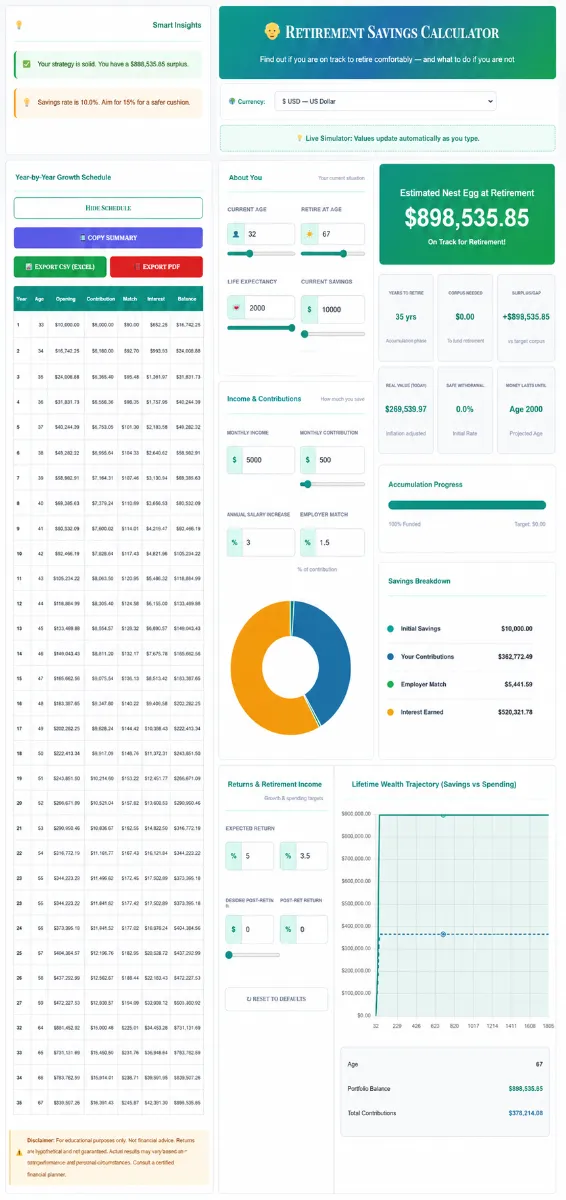
📈 Model Your Retirement Account Scenarios — Retirement Savings Calculator
I ran a basic RMD timing scenario through SaveXpert’s Retirement Savings Calculator to see how changing the account balance changes the estimated withdrawal amount. The IRS formula determines the actual RMD — the calculator is an educational planning tool that shows the order of magnitude, not an IRS calculation or tax-filing result.
Educational note: This calculator illustrates scenarios using user-supplied inputs and does not replicate the IRS life-expectancy table calculation or constitute tax advice. Always use your actual December 31, 2025 account balance with the correct IRS table factor. Source: IRS Publication 590-B

What Retirement Accounts Require RMDs in 2026?
The IRS RMD rules cover a specific set of accounts. Here’s what the research shows:
| Account Type | RMD Required in 2026? | Notes |
|---|---|---|
| Traditional IRA | Yes | Starting at age 73; each IRA calculated separately |
| SEP IRA | Yes | Same age-73 rules as traditional IRA |
| SIMPLE IRA | Yes | Same age-73 rules as traditional IRA |
| 401(k), 403(b), 457(b) plans | Yes | Satisfied separately per plan; still-employed exception may apply |
| Roth IRA (original owner) | No | No lifetime RMD requirement for original owner |
| Designated Roth account (401k/403b) | No | No lifetime RMD starting 2024 per SECURE 2.0 |
| Inherited IRA / Roth IRA (beneficiary) | Yes | Different rules; see IRS beneficiary guidance |
Source: IRS RMD FAQs, IRS Retirement Topics: RMDs
💡 Research note — Roth IRA vs designated Roth accounts: The original Roth IRA owner has no lifetime RMD requirement. Designated Roth accounts inside 401(k) or 403(b) plans received the same no-lifetime-RMD treatment starting in 2024 under SECURE 2.0. This means someone who has a traditional IRA and a Roth IRA shouldn’t assume both accounts require withdrawals after age 73 — they don’t. (IRS: Traditional and Roth IRAs)
Are RMD Rules Changing in 2026?
The research found no new 2026 RMD law that changes the standard December 31 deadline or the age-73 starting point. The IRS final RMD regulations became effective September 17, 2024, and generally apply to RMD determinations for calendar years beginning on or after January 1, 2025. Those regulations are the controlling framework for 2026. (IRS Retirement Topics: RMDs)
The current age-73 requirement stays in place for 2026. The future SECURE 2.0 increase to age 75 doesn’t apply yet. That later increase is scheduled for individuals born after December 31, 1959 — meaning those who would reach age 73 after December 31, 2032. For everyone turning 73 in 2026, the starting age is 73, period.
| Year Born | RMD Starting Age | First RMD Year |
|---|---|---|
| 1950 or earlier | 70½ (old rule) or 72 | Already past first RMD |
| 1951–1959 | 73 | 2024 through 2032 |
| 1953 (turning 73 in 2026) | 73 | 2026 — applies to you now |
| 1960 or later | 75 (future SECURE 2.0) | 2035 or later |
Source: IRS Retirement Topics: RMDs, SECURE 2.0 Act §107
What Happens If You Miss the RMD Deadline?
The IRS imposes a 25% excise tax on the shortfall — the amount that should have been distributed but wasn’t. This comes from Internal Revenue Code §4974. To report and potentially address the excise tax, taxpayers use IRS Form 5329. (IRS Retirement Topics: RMDs)
What Happens If You Miss the RMD Deadline?
The research brief specifically flags this misconception. The 25% excise tax has two important qualifications:
Reduction to 10%:
If you correct the missed RMD within the applicable two-year correction window, the 25% rate drops to 10%. That window starts from the date the tax is imposed, not from when the RMD was originally due. (IRS Retirement Topics: RMDs)
Waiver for reasonable error:
The IRS may waive part or all of the excise tax when the shortfall resulted from reasonable error and the taxpayer takes reasonable steps to fix it. The taxpayer uses Form 5329 to request the waiver and provides a written explanation. The waiver isn’t automatic — it requires the IRS to agree — but it’s a real mechanism, not just a theoretical one. (IRS: Form 5329)
⚠️ If you miss the deadline — act quickly and document everything: The correction path requires taking the missed distribution as soon as the error is discovered, filing Form 5329, and attaching a written explanation. The faster the correction, the stronger the case for the reduced 10% rate or a waiver. A qualified tax professional should handle the Form 5329 process — the stakes are real and the procedural steps matter.
What the Data Shows Works
Based on what I found across IRS Publication 590-B, the RMD FAQs, and the IRS Retirement Topics materials, the approach the official data consistently supports comes down to five research findings.
First: the April 1 exception applies only once.
After the first-ever RMD, December 31 is the annual deadline for every subsequent distribution. Treating April 1 as a recurring annual option is the source of most RMD confusion. (IRS Publication 590-B)
Second: use December 31 of the prior year — not today’s balance.
The IRS formula for a 2026 RMD starts with the December 31, 2025 account balance. Using a current balance produces the wrong number.
Third: Roth IRAs and designated Roth accounts don’t require lifetime RMDs.
A Roth IRA owner is not subject to RMD rules during their lifetime. Designated Roth accounts in employer plans joined that treatment starting in 2024. Someone with both a traditional IRA and a Roth IRA only has an RMD obligation from the traditional IRA. (IRS: Traditional and Roth IRAs)
Fourth: multiple traditional IRAs can be aggregated for withdrawal, but employer plans cannot.
You can satisfy the combined IRA RMD obligation from any one IRA or combination of IRAs. Employer-plan RMDs must be taken separately from each plan. (IRS RMD FAQs)
Fifth: a missed RMD has a correction path.
The 25% excise tax drops to 10% with timely correction, and the IRS has a waiver process for reasonable error. “Permanent 25% penalty” overstates the outcome for most missed-RMD situations — but the correction requires deliberate action, not passive waiting. (IRS Form 5329)

What Can You Realistically Expect?
A realistic picture for 2026 is straightforward. The rules tell you when the distribution needs to happen and how the annual amount gets determined. They don’t establish one universally superior withdrawal schedule — monthly, quarterly, or one December lump sum can each satisfy the requirement, as long as the total clears the deadline.
The calculation will produce different amounts for different account owners because it depends on two inputs that are personal: the December 31, 2025 balance and the applicable life-expectancy factor. The IRS publication gives both the tables and a worked example — that’s more specific than a general-purpose calculator can be.
What the research doesn’t promise: a specific investment or retirement outcome from taking distributions earlier or later in the year. The IRS focuses on whether the minimum amount was distributed by the deadline. The broader question of when in the year to take an RMD, and what to do with the funds, is a financial planning decision outside the IRS rules.
Your 5-Step RMD Deadline Checklist for 2026
1. Confirm which deadline applies to you:
Already taking RMDs? December 31, 2026 is your deadline. Turning 73 in 2026? You have the option to take the first RMD this year or delay to April 1, 2027 — but think through the double-RMD year tax impact before choosing the delay.
2. Pull your December 31, 2025 account balance:
This is the number the IRS formula requires — not your current balance. Your custodian reports this on Form 5498, Box 5. Don’t use a mid-year statement.
3. Use the correct IRS table:
Most account owners use Table III (Uniform Lifetime) from IRS Publication 590-B. If your spouse is your sole beneficiary and is more than 10 years younger, you use Table II instead. The wrong table produces the wrong RMD amount.
4. Check whether each account type needs a separate withdrawal:
IRA RMDs can be aggregated and pulled from any IRA. Employer plan RMDs must be satisfied separately per plan. Roth IRAs need no distribution during your lifetime.
5. If you miss the deadline — correct it immediately:
Take the missed distribution as soon as you discover the shortfall, file Form 5329, and attach a written explanation. The 25% excise tax drops to 10% with timely correction, and the IRS has a waiver process for genuine reasonable error. Don’t wait — the correction window matters.
“When I went through the IRS material, the pattern that kept showing up was this: April 1 is the exception, not the rule. It applies to exactly one RMD — the first one ever. Every subsequent distribution follows the December 31 deadline. Once you hold that distinction clearly, the rest of the rules fall into place.”
— Kevin Brown, Lead Researcher at SaveXpert.com
Frequently Asked Questions
Ans: According to IRS Publication 590-B and the IRS Retirement Topics page, the standard RMD deadline for 2026 is December 31, 2026, for individuals already taking required minimum distributions. The one exception: someone turning 73 during 2026 can delay their very first RMD until April 1, 2027. That same person must still take their 2027 RMD by December 31, 2027 — meaning two taxable distributions could land in the same calendar year if they use the April 1 delay.
Ans: According to IRS rules under IRC §4974, the general excise tax on an RMD shortfall is 25% of the amount that wasn’t distributed. That rate can drop to 10% if the missed RMD is corrected within the applicable two-year correction period. The IRS may also waive part or all of the excise tax when the shortfall resulted from reasonable error and the taxpayer takes reasonable steps to fix it — using Form 5329 with a written explanation. A permanent 25% penalty is not automatic under the rules.
Ans: According to IRS rules, yes — there is no requirement to wait until December. You can take the distribution at any point during 2026, either as a single payment or as multiple smaller withdrawals throughout the year. The IRS requirement is that the full annual amount be distributed by the RMD deadline, not that it be taken in December. Monthly, quarterly, or a January lump sum can each satisfy the annual obligation.
Ans: According to IRS materials, there is no new 2026 law changing the standard December 31 deadline or the age-73 starting requirement. The IRS final RMD regulations, effective September 17, 2024, apply to 2026 and confirm the current rules. The SECURE 2.0 increase to age 75 is scheduled for individuals born after December 31, 1959 — those who would reach age 73 after December 31, 2032. For anyone turning 73 in 2026, the starting age is 73.
Ans: According to IRS Publication 590-B, traditional IRAs, SEP IRAs, SIMPLE IRAs, and most employer-sponsored plans — 401(k), 403(b), and 457(b) — require RMDs starting at age 73. The original owner of a Roth IRA has no lifetime RMD requirement. Designated Roth accounts in employer plans also have no lifetime RMD requirement starting in 2024 under SECURE 2.0. Inherited IRAs and inherited Roth IRAs are subject to separate beneficiary RMD rules.
Ans: According to IRS RMD FAQs, if you are still employed by the sponsor of your workplace retirement plan, you are not a 5% owner of the business, and the plan document permits it, you may be able to delay RMDs from that specific plan until you retire. This still-employed exception applies only to the plan from your current employer — it does not apply to IRAs or to plans from previous employers. Traditional IRA RMDs must begin at age 73 regardless of employment status.