
ⓘ Educational Disclosure:
This article is for educational and informational purposes only. It does not constitute financial, legal, tax, lending, or investment advice. SaveXpert and its authors are not licensed financial or tax advisors. Always consult a qualified professional before making investment decisions.
What is the Roth conversion deadline for 2026? The Roth conversion deadline for 2026 is December 31, 2026. Unlike regular IRA contributions — which allow time until April 15, 2027 — a Roth conversion is tied to the calendar year in which the transaction actually completes. A conversion executed in January 2027 belongs to tax year 2027. There is no retroactive prior-year election for conversions. (IRS Publication 590-B)
Key Takeaways
- Problem: Many retirement savers believe April 15, 2027 gives them extra time to complete a 2026 Roth conversion — but that date applies to contributions, not conversions.
- Solution: A Roth conversion must be completed by December 31, 2026, to count for the 2026 tax year. A January 2027 conversion belongs to 2027 — there is no retroactive election.
- Result: Missing the December cutoff means the conversion is reported in the following tax year, changing the year your taxable income increases.
- Source: IRS Publication 590-B, IRS Form 8606
- Time To Read: 6 Minutes
Table of Contents
1. What Is the Roth Conversion Deadline for 2026?
2. How Much Can You Convert to a Roth IRA in 2026?
3. Do You Pay Taxes on a Roth Conversion?
4. What Is the Five-Year Rule for Roth Conversions?
5. Can You Undo a Roth Conversion After It Happens?
7. What Can You Realistically Expect?
April 15, 2027, is on every retirement saver’s radar right now. But that date is the IRA contribution deadline for 2026 — not the conversion deadline. The Roth conversion deadline for 2026 is December 31, 2026. Full stop. I went through IRS Publication 590-B, Form 8606, and the related IRS retirement guidance to confirm exactly where that line is — and where people most often cross it by accident.

What Is the Roth Conversion Deadline for 2026?
The research points to December 31, 2026, as the hard cutoff for a Roth conversion to count in tax year 2026. IRS Form 8606 covers conversions from traditional, SEP, and SIMPLE IRAs to a Roth IRA. Publication 590-B explains the tax treatment. Both tie a conversion to the year in which it actually occurs.
Here’s the plain example. A conversion completed on December 30, 2026 falls inside the 2026 calendar year. A conversion completed on January 2, 2027 belongs to 2027 instead. The IRS doesn’t provide a mechanism to call a 2027 transaction a 2026 conversion after the fact.
| Transaction Type | 2026 Deadline | Extended to April 2027? |
|---|---|---|
| Roth IRA conversion | December 31, 2026 | No — calendar year only |
| Traditional / Roth IRA contribution | April 15, 2027 | Yes — prior-year contributions allowed |
| Filing extension | Extends filing date only | Does not extend the conversion window |
| 60-day rollover period | 60 days from distribution | Does not create a prior-year conversion election |
⚠️ Watch your custodian’s processing cutoff — not just the calendar: Most financial institutions stop processing year-end Roth conversions by 4:00 PM ET on the last business day of December. If December 31 falls on a weekend, the last business day may be December 29 or 30. Submitting a conversion request on December 31 doesn’t guarantee it posts in 2026. Check your custodian’s specific deadline in November — not December.
⚠️ Age 73+ — RMD must come first: If you’re subject to required minimum distributions, you must take your full 2026 RMD before converting any remaining funds. Converting before taking the RMD means you could owe a 25% excise tax on the amount that should have been distributed. The IRS does not allow the RMD amount itself to be converted to a Roth. (IRS Publication 590-B)

How Much Can You Convert to a Roth IRA in 2026?
This is where another common misconception sits. The IRS does not set a separate dollar ceiling for Roth conversions the way it caps annual contributions. The $7,500 and $8,600 figures that appear in IRA discussions are contribution limits — not conversion limits.
The IRS lists the 2026 combined traditional and Roth IRA contribution limit at $7,500 for people under age 50. For people age 50 or older, that rises to $8,600, including the $1,100 IRA catch-up. That limit applies collectively across traditional and Roth IRAs — not $7,500 per account. But it has nothing to do with how much you can convert. (IRS: IRA Contribution Limits)
💡 Research note: The research brief doesn’t identify a general dollar ceiling for a Roth conversion. The IRS treats the contribution limit and conversion rules as entirely separate systems. Someone converting a $500,000 traditional IRA isn’t capped at $7,500 — they’re converting a balance, not making a fresh contribution.
Roth IRA direct contribution phase-out ranges for 2026
These income limits apply to direct Roth IRA contributions, not to conversions. High earners above these thresholds who can’t contribute directly to a Roth can still execute a conversion — which is the basis of the backdoor Roth strategy. (IRS Publication 590-A)
| Filing Status | Phase-Out Begins | No Direct Contribution Above |
|---|---|---|
| Single / Head of Household / MFS (didn’t live with spouse) | $153,000 | $168,000 |
| Married Filing Jointly / Qualifying Widow(er) | $242,000 | $252,000 |
| Married Filing Separately (lived with spouse) | $0 | $10,000 |
The pro rata rule — the part most people miss
When you convert, the IRS doesn’t let you pick which dollars move over. The taxable portion of a conversion is calculated proportionally across all your non-Roth IRAs combined — traditional, SEP, and SIMPLE IRAs — as of December 31 of the conversion year. (IRS Publication 590-B)
Here’s why that matters. If you have $50,000 in a traditional IRA made up of $40,000 pre-tax dollars and $10,000 after-tax (basis), and you convert $10,000 to a Roth, you might expect to pay zero tax — after all, you’re moving your after-tax money over. But the IRS pro rata rule says 80% of the conversion ($8,000) is taxable and 20% ($2,000) is not, regardless of which account you thought you were converting from. The math runs across your entire non-Roth IRA picture, reported on Form 8606.
⚠️ Pro rata surprise for backdoor Roth users: If you plan a backdoor Roth conversion and also hold a large pre-tax traditional IRA elsewhere, the pro rata rule applies to the combined balance — making most of your conversion taxable. Rolling the pre-tax IRA balance into a current employer’s 401(k) before December 31 is one approach some taxpayers use to clean up the IRA picture before converting. Talk to a tax professional before executing this.
Find your marginal bracket, income tax, and take-home.
Do You Pay Taxes on a Roth Conversion?
What I found in Publication 590-B is straightforward: a Roth conversion is generally included in gross income to the extent the converted amount is taxable. The IRS uses Form 8606 to report conversions and calculate the taxable and nontaxable portions.
For example, someone who moves pre-tax money from a traditional IRA into a Roth IRA during 2026 generally adds the taxable conversion amount to 2026 gross income. That increases taxable income for the year — which is why timing relative to tax brackets matters.
The tax on the conversion is due by your 2026 filing deadline (April 15, 2027, or later with an extension). But the extension only extends the filing — not the conversion itself. The conversion had to happen by December 31, 2026. (IRS Publication 590-B, Form 8606 Instructions)
💡 Research note: The IRS’s 2026 inflation-adjusted tax brackets affect the potential cost of a conversion, but they don’t change the December 31 deadline. The interaction between conversion amount and bracket is where the Tax Bracket Calculator becomes useful — not for predicting an exact liability, but for seeing which bracket the conversion amount pushes into. (IRS 2026 Inflation Adjustments)
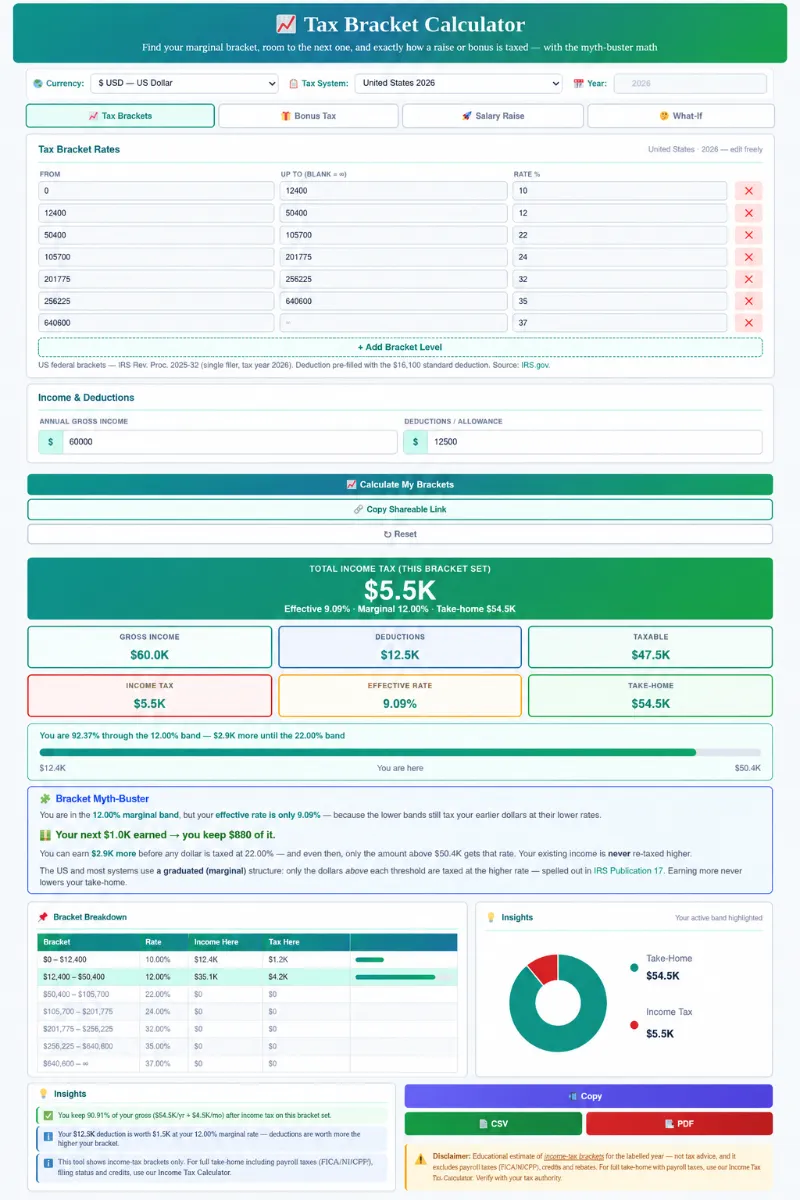
📈 See Which Bracket Your Conversion Hits — Tax Bracket Calculator
I ran a hypothetical conversion scenario through this tool to see how the taxable conversion amount interacts with 2026 income brackets. The key question isn’t just “will I owe tax?” — it’s “how much of the conversion falls inside a higher bracket?” Run your own numbers here.
Educational note: This calculator illustrates bracket interactions and does not calculate exact tax liability. Always confirm with a tax professional. Source: IRS 2026 Tax Inflation Adjustments
What Is the Five-Year Rule for Roth Conversions?
The five-year rule is an area where the details matter — and where the conversion five-year clock differs from the contribution five-year clock. They aren’t the same rule.
IRS Publication 590-B says a separate five-year period applies to amounts converted to a Roth IRA when determining whether a later distribution of those converted amounts faces the 10% additional tax. The IRS identifies a possible 10% additional tax on certain early distributions, subject to exceptions and applicable rules. The five-year clock on each conversion begins January 1 of the year the conversion occurs.
A 2026 conversion clears its five-year window on January 1, 2031. A 2027 conversion clears January 1, 2032. For early retirees building a Roth conversion ladder to fund living expenses before age 59½, this per-conversion clock is the entire strategy — and it starts on December 31 of the conversion year.
💡 Research note — two different five-year rules: (1) For qualified distributions of earnings — the five-year holding period runs from the first year a Roth IRA contribution (of any kind) was made. This clock typically starts once and doesn’t reset. (2) For converted amounts — each conversion carries its own five-year period before withdrawing those dollars avoids the 10% additional tax (if under age 59½). Each annual conversion creates a new rung on the ladder. These are two separate IRS tests.
Trustee-to-trustee transfers vs. 60-day rollovers
There are two ways to mechanically execute a Roth conversion. With a direct trustee-to-trustee transfer, the assets move straight from the traditional IRA trustee to the Roth IRA trustee without passing through the account owner’s hands. With a 60-day rollover, the account owner receives the distribution and redeposits it into the Roth IRA within 60 days. (IRS: Rollovers of Retirement Plan and IRA Distributions)
The IRS confirms the one-rollover-per-year limitation doesn’t apply to traditional-to-Roth conversions or trustee-to-trustee transfers. But the 60-day window doesn’t automatically let you elect the prior tax year for the conversion. The date the distribution enters the Roth IRA determines the year — not the date the distribution left the traditional IRA.
⚠️ Missing the 60-day rollover window: If you take a distribution intending to convert it and miss the 60-day window, the distribution becomes taxable and may carry a 10% additional tax unless a waiver or exception applies. The IRS provides separate guidance on waivers of the 60-day requirement — but waivers aren’t guaranteed. (IRS Rollover Guidance)
Can You Undo a Roth Conversion After It Happens?
This was one of the clearest findings in the research. IRS Publication 590-B states directly: a Roth conversion made in tax years beginning after December 31, 2017, cannot be recharacterized back to a traditional IRA. The Form 8606 instructions repeat this explicitly.
That makes the “I’ll convert now and undo it later if the timing doesn’t work out” approach inconsistent with the rules the IRS currently publishes. Modern conversions are a one-way door. The research brief identifies the belief that a Roth conversion can simply be reversed through recharacterization as one of the most common misconceptions in this space — and it’s a misconception with real tax consequences for anyone who acts on it.
⚠️ This changed permanently in 2018 — no exceptions: Before the Tax Cuts and Jobs Act, taxpayers could recharacterize a Roth conversion — reverse it — before the following October 15. That option ended for conversions made after December 31, 2017. The IRS hasn’t restored it. A 2026 conversion is permanent once processed. Model the tax impact before converting, not after.
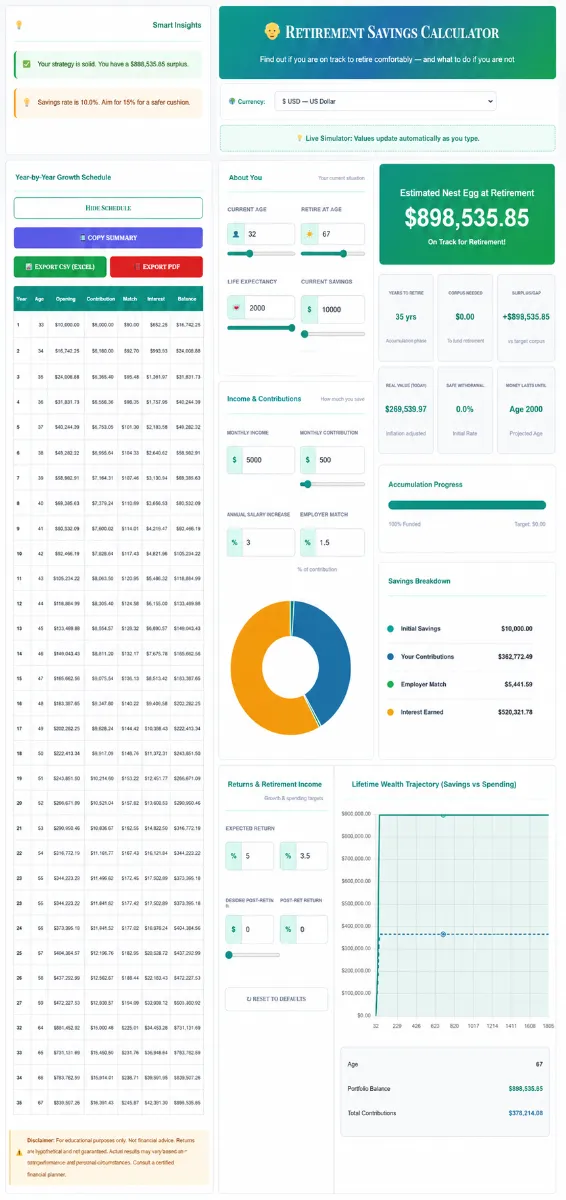
📈 Model the Long-Run Picture — Retirement Savings Calculator
I used the Retirement Savings Calculator to compare scenarios — keeping funds in a traditional IRA versus converting and paying the tax now. Since the conversion is permanent, getting the long-run projection in front of you before December 31 is the only sensible sequence.
Educational note: This calculator illustrates retirement projections using assumed rates and does not calculate exact tax liability or predict investment returns. Source: IRS: Roth IRAs
What the Data Shows Works
Based on what I found across IRS publications, forms, and retirement guidance, the approach that consistently holds up is careful separation of deadlines, transaction types, and reporting requirements.
Separate the conversion deadline from the contribution deadline.
The December 31 conversion cutoff and the April 15 contribution window are two different rules from two different sections of the IRC. Conflating them is the most common year-end Roth planning error. (IRS Publication 590-B, Publication 590-A)
Use Form 8606 every year you convert.
This form is how the IRS tracks your taxable and nontaxable IRA amounts and calculates the pro rata allocation. Keeping a complete filing history prevents double taxation on after-tax dollars. Losing or discarding prior-year Form 8606s can create costly basis problems later. (IRS Form 8606)
Understand the pro rata rule before converting.
If you have mixed pre-tax and after-tax dollars across multiple traditional IRAs, the taxable portion of a conversion isn’t determined by which account you convert from — it’s a proportional calculation across all non-Roth IRAs. Model this before executing.
Distinguish a trustee-to-trustee transfer from a 60-day rollover.
Both are valid conversion mechanics, but they carry different operational risks. The 60-day rollover clock starts the day of distribution — not the day you decide to convert. (IRS: Rollovers)
Don’t assume a filing extension or 60-day rollover extends the conversion year.
The published rules treat these as entirely separate mechanisms. Neither one moves the December 31
What the research doesn’t support:
Claiming a Roth conversion “always saves taxes” without taxpayer-specific modeling. The taxable conversion amount interacts with brackets, IRMAA thresholds, and Social Security taxation in ways that are genuinely person-specific. The IRS data establishes the rules; it doesn’t establish a universal answer to “is this worth it for me?”

What Can You Realistically Expect?
The research points to a calendar-year deadline rather than an April tax-filing deadline. For a transaction intended to count in 2026, December 31, 2026 is the practical cutoff. A January 2027 conversion belongs to 2027.
The tax reporting follows the year of conversion. Form 8606 provides the IRS reporting framework. The tax itself is due at your 2026 filing deadline — but the conversion had to happen inside the calendar year. A later distribution can also bring the five-year conversion rule and possible 10% additional-tax analysis into play.
The research doesn’t support promising a specific tax saving from any given conversion without taxpayer-specific modeling. The 2026 IRA contribution limit ($7,500 / $8,600) doesn’t establish a matching conversion ceiling — those are separate systems entirely.
Your 5-Step Roth Conversion Checklist for 2026
1. Confirm your custodian’s actual processing deadline:
Most institutions cut off year-end conversions by 4:00 PM ET on the last business day of December. If December 31 falls on a weekend, that cutoff may be December 29 or 30. Call your custodian now — not in late December.
2. Run the pro rata calculation first:
If you hold pre-tax balances in any traditional, SEP, or SIMPLE IRA alongside after-tax dollars, calculate the taxable portion of the conversion before moving anything. Form 8606 will do this math — but you want to see it before December, not after.
3. Take your RMD first if you’re 73 or older:
The RMD must come out before any conversion funds move. The converted amount cannot include RMD dollars — doing so creates a 25% excise tax exposure on the RMD amount that wasn’t properly distributed.
4. Model the bracket impact before converting:
The taxable conversion amount adds to 2026 gross income. Use the Tax Bracket Calculator above to see where the converted amount lands relative to current brackets, IRMAA thresholds, and any other 2026 income.
5. File Form 8606 and keep it permanently:
This form tracks your IRA basis and documents each conversion’s taxable and nontaxable split. Losing or discarding it means future distributions may be taxed on dollars you’ve already paid tax on. Store it with your permanent tax records.
“The biggest surprise in the IRS material is how clearly it separates conversions from contributions. Most retirement savers see April 15 on their calendar and assume it covers conversions too. It doesn’t. The IRS reporting framework ties a conversion to the calendar year the transaction occurs — and that calendar closes on December 31.”
— Kevin Brown, Lead Researcher at SaveXpert.com
Frequently Asked Questions
Ans: According to IRS Publication 590-B, the Roth conversion deadline for 2026 is December 31, 2026. Unlike regular IRA contributions — which give taxpayers until the April 15, 2027 filing deadline — conversions are tied strictly to the calendar year the transaction actually completes. A conversion executed on January 2, 2027 counts for tax year 2027, not 2026. There is no retroactive prior-year election for conversions.
Ans: IRS data shows no maximum dollar limit on Roth conversions. While the 2026 IRA contribution limit is $7,500 ($8,600 for those 50 or older), those caps apply to new annual contributions — not to conversions. A conversion is a balance transfer, not a fresh contribution. Someone can convert $50,000, $200,000, or their entire traditional IRA balance — subject to the tax consequences of including that amount in gross income for the year.
Ans: According to IRS Form 8606 and Publication 590-B, the taxable portion of a Roth conversion is generally added to gross income for the year the conversion is completed. Pre-tax dollars and earnings converted to a Roth are taxable; after-tax dollars (basis) may not be, depending on the pro rata calculation across all non-Roth IRA balances. The tax is due with the 2026 return (April 2027), but the conversion itself had to happen by December 31, 2026.
Ans: The data indicates a 2026 conversion may make sense if your current tax bracket is lower than what you expect to face in retirement. But the taxable conversion amount adds to 2026 gross income — potentially pushing income into a higher bracket, triggering IRMAA Medicare surcharges, or affecting other income-based calculations. The research doesn’t support a universal “always convert” rule. Whether it makes sense depends on the individual taxpayer’s full income picture, and the Tax Bracket Calculator is a useful first step — not a final answer.
Ans: According to IRS Publication 590-B and Form 8606 instructions, a Roth conversion completed after December 31, 2017 cannot be recharacterized back to a traditional IRA. The Tax Cuts and Jobs Act eliminated this option permanently. Under current rules, a 2026 conversion is permanent once the transaction processes. Modeling the tax impact before converting — not after — is the only way to manage this.
Ans: The pro rata rule is an IRS requirement found in Publication 590-B: when converting IRA funds, the taxable portion is calculated proportionally across all your non-Roth IRAs combined — traditional, SEP, and SIMPLE IRA balances — as of December 31 of the conversion year. You cannot elect to convert only your after-tax (basis) dollars. If your total non-Roth IRA balance is 80% pre-tax and 20% after-tax, then 80% of any conversion you make is taxable, regardless of which account you convert from. This catches many backdoor Roth users off guard when they hold large pre-tax IRA balances alongside their after-tax contribution.