
ⓘ Educational Disclosure:
This article is for educational and informational purposes only. It does not constitute financial, legal, tax, lending, or investment advice. SaveXpert and its authors are not licensed financial or tax advisors. Always consult a qualified professional before making investment decisions.
What is the 401(k) contribution deadline for 2026? For regular employee salary deferrals, the 401k contribution deadline for 2026 is tied to your employer’s final eligible payroll period of the year — not a universal December 31 cutoff. According to the IRS, deferrals must come from compensation actually paid through payroll. The 2026 employee elective-deferral limit is $24,500, with a standard $8,000 catch-up for eligible participants age 50 or older, and a higher $11,250 catch-up for eligible participants ages 60–63 under SECURE 2.0.
Key Takeaways
- Problem: American workers often miss the exact cutoff to max out their retirement accounts because employer and employee deadlines frequently differ — and December 31 isn’t the deadline most people think it is.
- Solution: The 401(k) contribution deadline for 2026 for salary deferrals depends on your employer’s final payroll cutoff, not the calendar year-end. The IRS does not allow personal retroactive deposits after wages have already been paid.
- Result: Data shows that coordinating with HR on final December paycheck timing prevents missed deferral opportunities and avoids the excess-contribution correction process.
- Source: IRS Topic No. 424, IRS §402(g) Limits
- Time To Read: 8 Minutes
Table of Contents
1. The Deadline Isn’t Simply December 31
2. What Counts as a 2026 Employee Contribution
3. The 2026 Contribution Limits, All Three Tiers
4. Does Employer Match Count Toward Your $24,500?
5. What Happens If You Over-Contribute
6. Can You Still Contribute After Leaving a Job?
7. What the Data Shows Works — and What Doesn’t
8. Realistic Expectations for the 2026 Deadline
Most articles about the 401(k) contribution deadline 2026 give you “December 31” and move on. The research doesn’t support that. I went through IRS publications, §402(g) rules, and the guidance on employer-contribution timing — and the picture is more specific than a calendar date. For most employees, the real deadline is the date of the final eligible December paycheck, not December 31.
The Deadline Isn’t Simply December 31
The most important finding from my research is also the least obvious one: there is no universal federal December 31 deadline for every employee’s 2026 401(k) salary deferral.
According to IRS Retirement Topics: Contributions, regular employee elective deferrals come directly from compensation through payroll. The practical deadline therefore depends on the employer’s payroll schedule, the processing cutoff, and the plan’s own rules. That makes it a payroll question for most employees — not a December 31 question.
Readers often treat a 401(k) like an IRA in this regard. The research doesn’t support that comparison. With an IRA, you have until Tax Day of the following year to make contributions for the prior year. That rule does not apply to regular employee elective deferrals under a 401(k). (IRS Topic No. 424)
💡 Research note: Employee salary deferrals and employer contributions follow different rules and different deadlines. That distinction drives almost every confusing question about the 2026 deadline.

What Counts as a 2026 Employee Contribution
IRS guidance ties elective deferrals to compensation actually paid through payroll. The rules state that an employee generally cannot make a personal retroactive deposit after the relevant wages have already been paid. (IRS: Retirement Topics — Contributions)
Here’s the practical example. An employee wants to add another $2,000 to their 401(k) after the final 2026 paycheck has already cleared. The data shows that the employee generally cannot send $2,000 directly to the plan and label it a 2026 salary deferral. The contribution window tied to that compensation is closed.
The underlying rule is Internal Revenue Code §402(g), which limits employee elective deferrals. For 2026, that basic limit increased from $23,500 to $24,500. (IRS — 401(k) Limit Increases to $24,500 for 2026)
⚠️ The window closes with the paycheck: If your employer’s last payroll run of 2026 processes before December 31, that’s your true deadline — even if December 31 is still days away. Talk to HR in November, not December.
Estimate your future nest egg from your current savings.
The 2026 Contribution Limits, All Three Tiers
The IRS sets three separate employee-contribution tiers for 2026. Each one applies to a different group of participants. Getting these straight matters because mixing them up leads to either leaving money on the table or triggering a correction.
| Participant Group | Employee Deferral Limit | Total with Limit Applied |
|---|---|---|
| Under age 50 | $24,500 (§402(g)) | $24,500 |
| Age 50–59 and age 64+ (standard catch-up) | $24,500 + $8,000 catch-up | $32,500 |
| Ages 60, 61, 62, or 63 (SECURE 2.0 enhanced catch-up) | $24,500 + $11,250 catch-up | $35,750 |
Source: IRS — 401(k) and Profit-Sharing Plan Contribution Limits, IRS — Retirement Topics: Catch-Up Contributions
The $11,250 figure comes from the SECURE 2.0 Act Section 109, which created a higher catch-up for workers who turn 60, 61, 62, or 63 during the calendar year. It does not apply to everyone age 50 or older — only to those four specific birth-year groups. (IRS COLA Increases for 2026)
The two limits most people confuse
Two different IRC sections produce two very different numbers, and conflating them is one of the most common errors in 401(k) planning.
| Limit | IRC Section | 2026 Amount | What It Covers |
|---|---|---|---|
| Employee elective-deferral limit | §402(g) | $24,500 | Employee salary deferrals only |
| Annual additions limit | §415(c) | Lesser of $72,000 or 100% of compensation | Employee + employer contributions combined |
| Compensation cap | §401(a)(17) | $360,000 | Max pay used in contribution calculations |
Source: IRS — 401(k) Contribution Limits, IRS Internal Revenue Bulletin 2025-49
💡 Research note: The $72,000 §415(c) figure causes a lot of confusion. It does not mean every employee can personally contribute $72,000 through salary deferrals. It’s the ceiling for everything going into the account — employee money plus employer money combined. Your personal deferral room is still $24,500 (or $32,500 / $35,750 with catch-up).
The new Roth catch-up rule for high earners — effective 2026
⚠️ New in 2026 — affects high earners making catch-up contributions: Beginning January 1, 2026, participants age 50 or older whose prior-year FICA wages from the same employer exceeded $150,000 must make all catch-up contributions on a Roth (after-tax) basis. This is a SECURE 2.0 Act §603 requirement. If your plan does not offer Roth contributions, you may be blocked from making any catch-up contributions until your employer adds the Roth feature. Check your plan document and talk to HR before making 2026 catch-up elections. (IRS: Catch-Up Contributions)
There is also a separate SIMPLE 401(k) limit. The IRS sets the 2026 employee elective-deferral limit for SIMPLE 401(k) plans at $17,000 — a different cap that applies to those plan types, not standard 401(k)s. (IRS — 401(k) Contribution Limits)
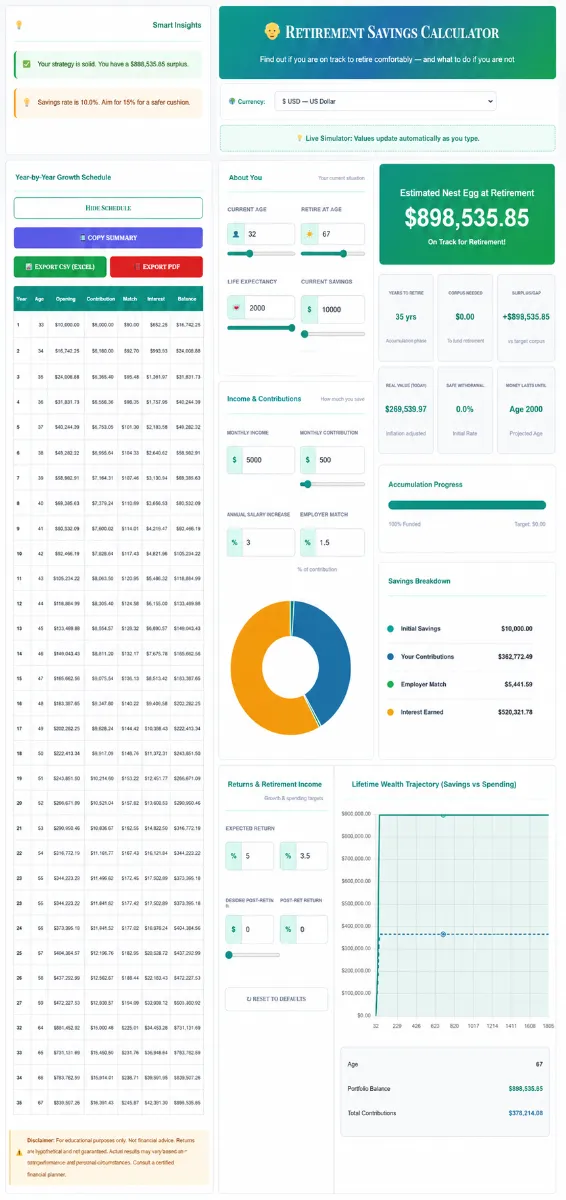
📈 Model Your 2026 Contributions — Retirement Savings Calculator
I ran a realistic 2026 salary scenario through this calculator, including catch-up amounts and an employer match. It makes the difference between the employee-only limit and the broader §415(c) combined ceiling much easier to see than a table alone.
Educational note: This calculator models contribution scenarios based on user inputs and does not provide personalized financial advice. For growth projections, see the Compound Interest Calculator. Source: IRS 401(k) Contribution Limits
Does Employer Match Count Toward Your $24,500?
The research on this is clear: employer matching contributions do not reduce your separate $24,500 elective-deferral limit. They fall into the broader §415(c) combined annual-additions rules. Both employee and employer contributions can count toward the $72,000 combined ceiling, but they don’t compete for the same space. (IRS — 401(k) Contribution Limits)
Investor.gov gives a concrete example: a plan offering a 50-cent employer contribution for every dollar saved, up to 5% of pay. In that structure, the employer contribution represents an immediate 50% addition to whatever the employee puts in. That’s the case for maximizing your match.
But there’s an important timing distinction. Employer matching and profit-sharing contributions can arrive after year-end when the plan rules permit it. Certain employer contributions can qualify for the prior tax year when made by the employer’s tax-return deadline, including extensions. (IRS Publication 560)
💡 Research note: For the maximum 401(k) match, hitting your final eligible paycheck on schedule is the key. Missing the last payroll deferral opportunity doesn’t just cost you the employee contribution — it may reduce the employer match too, depending on how your plan’s match formula works across the year.

What Happens If You Over-Contribute
The IRS treats excess elective deferrals as a correction issue — not something that self-resolves. The data shows that excess employee deferrals, along with any allocable earnings, generally must be distributed by April 15 of the following year. For a 2026 over-contribution, that points to April 15, 2027. Missing that window creates additional tax consequences. (IRS 401(k) Plan Fix-It Guide)
The underlying rule is IRC §401(a)(30), which requires qualified cash-or-deferred arrangements to stay within applicable elective-deferral limits. The research doesn’t support assuming an over-contribution will sort itself out.
A plain example of how excess deferrals happen
Say an employee hits $24,500 by mid-December, but payroll keeps deducting another $1,000 because the deferral election wasn’t updated. That $1,000 is now an excess deferral. It — plus whatever earnings it accumulated — needs to come back out by April 15, 2027, and will be taxable in the year it comes back out.
The lesson from the IRS material: payroll monitoring matters year-round, not just in December. The contribution limit and the correction deadline work together.
⚠️ If you work for two employers: Your combined employee deferrals across all plans still can’t exceed $24,500 (one §402(g) limit applies across all plans). The §415(c) combined limit, by contrast, resets separately for each unrelated employer. Monitor your totals across employers yourself — no single plan administrator sees the full picture.
See how your money grows with the power of compounding.
Can You Still Contribute After Leaving a Job?
The answer depends entirely on which type of contribution you’re asking about.
For regular employee elective deferrals, the research is clear: they come from compensation through payroll. An employee generally cannot make a personal retroactive deposit into an employer 401(k) once the relevant wages have already been paid. Leaving a job eliminates future payroll under that employer’s plan, which closes the door to new employee deferrals. (IRS: Retirement Topics — Contributions)
Employer matching or profit-sharing contributions can operate on a different timeline. When plan rules and employer tax-return deadlines allow it, certain employer contributions can still qualify for the prior tax year even after the year closes. (IRS Publication 560)
For one-participant (solo) 401(k) plans, the rules differ again. SECURE 2.0 allows certain plan owners to make a first-year elective-deferral election by the individual income-tax return due date, without extensions. These rules apply specifically to solo plan arrangements and deserve a separate check against current IRS guidance. (IRS: One-Participant 401(k) Plans)
💡 Research note: The answer to “can I still contribute after leaving?” comes in three versions — one for employee deferrals, one for employer contributions, and one for solo plan owners. The research doesn’t support one blanket answer.
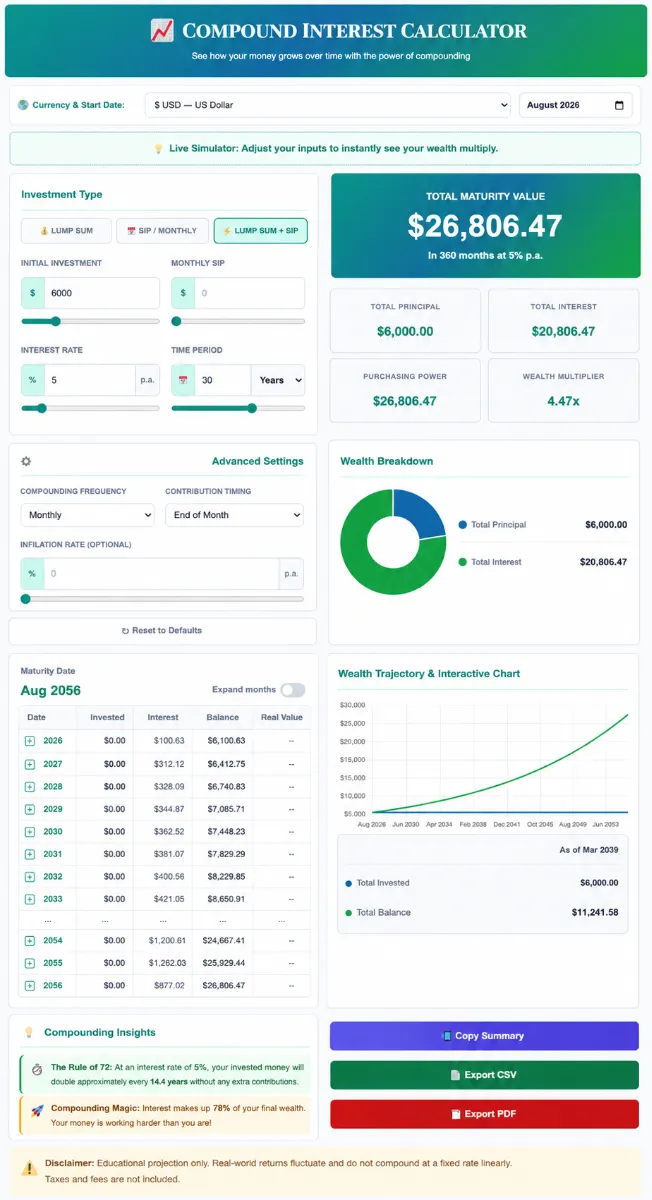
💰 Project Long-Run Growth — Compound Interest Calculator
I used this alongside the Retirement Savings Calculator to show how 2026 contributions might compound at different assumed return rates over 10, 20, or 30 years. Keep the output as a projection, not a guarantee — but the order-of-magnitude picture is useful.
Educational note: This calculator illustrates compound growth using a constant assumed rate and does not predict actual investment returns. Source: Investor.gov: Compound Interest
What the Data Shows Works — and What Doesn’t
Based on what I found across IRS and Investor.gov materials, here is what the research consistently supports:
1. Keep employee deferrals tied to payroll — not a tax-return deadline.
The IRS rules are structured around compensation paid through payroll. There’s no mechanism for a retroactive personal deposit equivalent to an IRA contribution for the prior year. (IRS: Retirement Topics — Contributions)
2. Treat the three contribution categories separately.
Employee elective deferrals, employer contributions, and excess deferrals each carry different limits, mechanics, and deadlines. Lumping them together produces wrong answers.
3. Track the $24,500 employee limit — not the $72,000 combined figure.
The §415(c) annual-additions limit is not your personal contribution room. It’s the combined ceiling for every dollar flowing into the account from all sources.
4. Confirm your catch-up tier before December.
The $11,250 SECURE 2.0 catch-up applies only to workers who turn 60, 61, 62, or 63 during 2026. Age 50–59 and 64+ use the $8,000 standard catch-up. Those under 50 get no catch-up at all.
5. If your prior-year FICA wages exceeded $150,000, check the new Roth requirement.
From 2026 onward, SECURE 2.0 mandates that those catch-up contributions go in as Roth. If your plan doesn’t offer Roth yet, that may block catch-ups entirely. (IRS: Catch-Up Contributions)
What doesn’t fit the research: treating every 401(k) contribution as though it follows the same deadline. Investor.gov confirms that 401(k) plans can receive contributions from employees, employers, or both — and each category follows its own rules.

Realistic Expectations for the 2026 Deadline
For an ordinary employee, the research points to the final eligible 2026 payroll period as the practical salary-deferral deadline. The exact date depends on when your compensation gets paid, how your employer’s payroll runs, and what your plan documents require. Some employers run their last payroll of the year on December 19. Others run it on December 30. That difference is your deadline difference.
Here’s how the major 2026 deadline categories stack up:
| Contribution Type | Who It Applies To | Deadline |
|---|---|---|
| Employee salary deferrals (§402(g)) | Most employees | Final eligible payroll period of 2026 |
| Employer matching / profit-sharing | Employers | Employer’s tax-return due date (including extensions) when plan rules allow |
| Excess deferral correction | Anyone who over-contributed | April 15, 2027 |
| First-year deferral election — solo 401(k) | One-participant plan owners | Individual tax-return due date (no extensions) under SECURE 2.0 |
Source: IRS: Retirement Topics — Contributions, IRS Publication 560, IRS: One-Participant 401(k) Plans
One more piece of context: the federal no-individual-mandate-penalty era (since 2019) affects health insurance decisions, not 401(k) ones. There’s no IRS tax penalty for simply not maxing out a 401(k). But there is a correction cost if you go over the limit — and the data supports treating the April 15, 2027 excess-deferral correction deadline as a real date to plan around. (IRS 401(k) Fix-It Guide)
Your 5-Step 401(k) Deadline Action Plan for 2026
1. Find your actual payroll deadline:
Ask HR for the last 2026 payroll processing date and the cutoff to change your deferral election. Don’t assume December 31.
2. Confirm your catch-up tier:
Are you under 50, 50–59 / 64+, or ages 60–63? The right tier determines whether you’re working with $24,500, $32,500, or $35,750 this year.
3. Check the new Roth catch-up rule:
If your 2025 FICA wages from your current employer exceeded $150,000 and you’re making catch-up contributions, those must go in as Roth in 2026. Confirm your plan document with HR.
4. Track your year-to-date total:
If you worked for more than one employer in 2026, the $24,500 §402(g) limit applies across all plans combined. No single plan administrator sees your full picture.
5. Flag over-contributions by April 15, 2027:
If payroll ran past your limit, contact your plan administrator immediately. The excess plus earnings needs to be back in your hands by April 15, 2027.
“What I kept finding across IRS materials is that the 401(k) deadline isn’t a fixed date — it’s a payroll event. The moment your last eligible 2026 paycheck gets processed, the window for employee salary deferrals is closed. That distinction changes how you plan the final months of the year.”
— Kevin Brown, Lead Researcher at SaveXpert.com
Frequently Asked Questions
Ans: According to the IRS, the regular employee elective-deferral limit for 2026 is $24,500 — up from $23,500 in 2025. For participants age 50 or older, the standard catch-up adds $8,000 for a total of $32,500. Workers who turn 60, 61, 62, or 63 during 2026 have a higher SECURE 2.0 catch-up of $11,250, bringing their total to $35,750. The combined annual-additions limit for all employee and employer contributions under §415(c) is the lesser of $72,000 or 100% of compensation.
Ans: The IRS data shows that for regular employee salary deferrals, the 401(k) contribution deadline for 2026 is tied to your final eligible paycheck of the calendar year. Unlike an IRA, you generally cannot make retroactive personal deposits for the prior year once your final December wages have been fully processed and paid. Employer contributions can follow a later timeline tied to the employer’s tax-return due date when plan rules allow it.
Ans: According to SECURE 2.0 and IRS guidelines, the standard 2026 catch-up limit for participants age 50 and older is $8,000. Workers who turn exactly 60, 61, 62, or 63 during 2026 qualify for a higher SECURE 2.0 catch-up of $11,250 instead. That higher amount does not apply to participants who are 64 or older — they use the $8,000 standard catch-up. The age range is specific: the year you turn 60 through the year you turn 63.
Ans: According to the IRS 401(k) Plan Fix-It Guide, excess elective deferrals must be corrected to avoid tax penalties. The excess amount, along with any allocable earnings, generally must be distributed to the employee by April 15 of the following year — April 15, 2027 for 2026 over-contributions. Missing that correction deadline creates additional tax consequences. The right step is to contact the plan administrator as soon as you discover the over-contribution.
Ans: IRS data shows that employer matching contributions do not count toward the personal $24,500 elective-deferral limit. Instead, employer matches count toward the broader combined annual-additions limit under §415(c), which is the lesser of $72,000 or 100% of compensation for 2026. Those are two separate limits operating under two separate IRC sections, and the employee’s deferral room is not reduced by what the employer contributes.
Ans: Starting January 1, 2026, participants age 50 or older who earned more than $150,000 in prior-year FICA wages from the employer sponsoring their plan must make all catch-up contributions on a Roth basis. This is a mandatory SECURE 2.0 Act §603 provision confirmed on IRS.gov. If the plan doesn’t currently offer Roth contributions, affected participants may be blocked from making any catch-up contributions until the employer adds the Roth feature. Workers below the $150,000 FICA threshold can still make pre-tax catch-up contributions as before.