
ⓘ Educational Disclosure:
This article is for educational and informational purposes only. It does not constitute financial, legal, tax, lending or insurance advice. SaveXpert and its authors are not licensed financial, tax or benefits advisors. Social Security rules have specific exceptions and individual circumstances vary. Always consult the SSA directly at ssa.gov or speak with a qualified professional before making Social Security claiming decisions.
Yes, you can claim Social Security at 62 and keep working in 2026. The more important question is how your earnings affect current payments — and what the SSA does with any withheld benefits once you reach full retirement age.
Key Takeaways
- Problem: Many older Americans want to claim Social Security at 62 while continuing to work but worry about permanently losing benefits if their earnings are too high.
- Solution: You can work while receiving early Social Security benefits, but earnings above the 2026 thresholds ($24,480 for those under full retirement age all year; $65,160 for those reaching FRA during 2026) will trigger temporary benefit withholding.
- Result: The data confirms that excess-earnings withholding is temporary — the SSA recalculates and credits withheld months once you reach full retirement age. But a permanent 30% benefit reduction applies for claiming at 62 versus waiting until FRA of 67.
- Source: SSA — Receiving Benefits While Working · SSA Publication 05-10069
- Time To Read: 8 Minutes
Table of Contents
1. How Much Can I Make While Drawing Social Security at 62 in 2026?
2. What Is the Social Security Earnings Test Limit for 2026?
3. What Are the Disadvantages of Claiming Social Security at 62?
4. Can You Draw Social Security at 62 and Still Work Part Time?
5. At What Age Can You Earn Unlimited Income While on Social Security?
6. The 2026 Numbers: How the Limits Changed from 2025
8. What You Can Realistically Expect
How much can I make while drawing Social Security at 62? For someone below full retirement age throughout 2026, the SSA sets the earnings limit at $24,480. According to the SSA, the agency withholds $1 in benefits for every $2 earned above that amount. The $24,480 figure isn’t a limit on all income — the SSA counts wages and net self-employment earnings but not pensions, annuities, interest, or investment income.
I went through the Social Security Administration’s 2026 rules, regulations, and retirement publications for this article, along with the IRS rules covering the possible taxation of Social Security benefits. The real question isn’t whether you can work. You can. The question is how your countable earnings affect current Social Security payments — and whether any withheld amounts come back to you later.
How Much Can I Make While Drawing Social Security at 62 in 2026?
For someone below full retirement age throughout 2026, the SSA sets the earnings test limit at $24,480. The agency withholds $1 in benefits for every $2 earned above that amount.
Here’s a concrete example. Suppose someone claims benefits at 62 and earns $30,000 from wages during 2026. The amount above $24,480 is $5,520. Under the SSA formula, $2,760 would be withheld from benefits — not every dollar disappears, just the calculated excess.
The SSA materials also identify a special monthly rule. SSA Publication 05-10069 lists $2,040 per month for someone below full retirement age during all of 2026. This special rule can matter during the first year of retirement and isn’t a general monthly earnings cap — it’s a separate provision for people who start benefits mid-year.
The SSA counts wages, bonuses, commissions, and vacation pay under the earnings test. It also counts net profit from self-employment. The rules don’t count pensions, annuities, investment income, interest, veterans’ benefits, or other government or military retirement benefits.
So when searching for how much you can make while drawing Social Security at 62, the first step is identifying your income type. The $24,480 threshold applies only to countable earnings under the earnings test.
What Is the Social Security Earnings Test Limit for 2026?
The 2026 earnings test has two different limits, and the one that applies depends on whether someone reaches full retirement age during the year.
| Situation in 2026 | Annual Earnings Limit | Withholding Formula | Monthly Equivalent |
|---|---|---|---|
| Below full retirement age for the entire year | $24,480 | $1 withheld for every $2 over the limit | $2,040 |
| Reaching full retirement age during 2026 | $65,160 | $1 withheld for every $3 over the limit (pre-FRA months only) | $5,430 |
| At or past full retirement age for the full year | No limit | No earnings test applies | — |
Source: SSA — Receiving Benefits While Working · SSA Publication 05-10069
Once someone reaches the month of full retirement age, the earnings limit ends completely. Beginning with that month, there is no earnings cap — not a higher one, but no limit at all.
For people born in 1960 or later, the SSA sets full retirement age at 67. Age 62 remains the earliest age for claiming retirement benefits. That five-year gap is where the earnings test applies in full.
Here’s a comparison scenario. A worker who claims at 62 and stays below full retirement age during all of 2026 faces the $24,480 test. A different worker who reaches full retirement age in August 2026 and earns $70,000 before that month falls under the $65,160 test only for those pre-FRA earnings — and only the $1-for-$3 formula applies.
The Social Security earnings test comes from Section 203 of the Social Security Act (42 U.S.C. § 403), which establishes the legal authority for the withholding mechanism.
What Are the Disadvantages of Claiming Social Security at 62?
The main issue isn’t simply working while collecting — it’s the lower benefit that comes with claiming early. Early retirement requires careful long-term planning because the monthly amount can stay lower for the rest of your life.
The SSA’s table for people born in 1960 or later shows a worker benefit of 70% of the full-retirement-age amount when benefits begin at 62. At full retirement age, the table shows 100%. That 30% reduction versus the FRA amount is permanent — it doesn’t reverse when the earnings test ends at full retirement age.
The federal regulations set the early-claiming reduction formula: 5/9 of 1% for each of the first 36 months before full retirement age, and 5/12 of 1% for each additional month (20 C.F.R. § 404.410). For someone with a full retirement age of 67 who claims at exactly 62, that’s 60 months early — producing the full 30% reduction.
⚠️ Two separate effects: The 30% early-claiming reduction and the earnings-test withholding are independent calculations. Claiming at 62 and earning above $24,480 triggers both simultaneously. The withholding adjusts at FRA — the claiming reduction doesn’t. These are not the same thing, and treating them as one is the most common misunderstanding in this topic.
There’s another side to the data. Delaying retirement benefits can increase the monthly amount. The SSA says delayed-retirement increases stop accumulating after age 70 (20 C.F.R. § 404.313).
Continued work can also affect a future benefit. The SSA uses a worker’s highest 35 years of earnings. A new year of higher earnings can replace a lower year in that calculation — meaning continued work during early retirement isn’t necessarily a loss if those earnings improve the 35-year average.

Can You Draw Social Security at 62 and Still Work Part Time?
Yes. The SSA allows people to work while receiving retirement benefits. The earnings test measures countable earnings — not whether a job carries a part-time label. Part-time work can produce very different results depending on the actual wage amount.
A worker with modest part-time wages may stay well below $24,480. Another worker in a higher-paying part-time role can cross the threshold even while working fewer hours. The test looks at total annual countable earnings, not the job classification.
For example, a worker who claims Social Security at 62 and takes a part-time job earning $22,000 in wages during 2026 stays under the $24,480 limit. No earnings-test withholding applies. But a part-time consultant earning $38,000 from net self-employment profit crosses the threshold, and the $1-for-$2 formula applies to the $13,520 excess.
The most important distinction — one the SSA data confirms clearly — is that crossing the earnings limit doesn’t permanently forfeit benefits.
💡 Research note: When someone reaches full retirement age, the SSA recalculates the benefit and gives credit for months when benefits were reduced or withheld because of excess earnings. This recalculation can produce a higher monthly payment going forward. Earnings-test withholding is temporary. The 30% early-claiming reduction is permanent. Those are genuinely different things.
Estimate your future nest egg from your current savings.
At What Age Can You Earn Unlimited Income While on Social Security?
The earnings limit ends beginning with the month you reach full retirement age. According to the SSA, for people born in 1960 or later, full retirement age is 67. From the month of FRA onward, the earnings test no longer applies — there’s no limit on earned income.
This is different from saying every financial consequence ends at 67. Other tax rules can still affect how much of the Social Security benefit gets included in taxable income.
The IRS uses provisional-income rules when determining whether Social Security benefits may become taxable. IRS Publication 915 lists a $25,000 base amount for single, head-of-household, or qualifying-surviving-spouse filers, and $32,000 for married taxpayers filing jointly. (Certain married taxpayers filing separately face a $0 base amount.)
Below those base amounts, Social Security benefits generally aren’t taxable. Between the base and higher thresholds, up to 50% of benefits may enter taxable income. Above the higher thresholds — $34,000 for single filers and $44,000 for married filing jointly — up to 85% of benefits may be taxable.
💡 Research note: The end of the Social Security earnings test at full retirement age doesn’t end every tax consequence. Wages earned after FRA count as provisional income — they can push Social Security benefits into the taxable range even when the earnings test no longer applies. The two rules are independent. See IRS Publication 915 for current thresholds.
The 2026 Numbers: How the Limits Changed from 2025
The 2026 earnings thresholds increased from 2025, so checking the current year’s figures matters.
Below FRA all year: $23,400 → $24,480 (+$1,080)
Reaching FRA during the year: $62,160 → $65,160 (+$3,000)
The SSA announced a 2.8% cost-of-living adjustment for 2026, with an estimated average increase of approximately $56 per month for Social Security retirement benefits beginning January 2026.
The SSA’s updated materials also note the Social Security Fairness Act, signed January 5, 2025. That law ended the Windfall Elimination Provision and Government Pension Offset for affected public-sector workers, generally applying to benefits payable for January 2024 and later. The SSA started adjusting affected payments on February 25, 2025.
That law matters for certain government-pension cases. It did not remove the regular retirement earnings test for someone claiming at 62 while working — the $1-for-$2 formula and the $24,480 threshold remain in place for 2026.
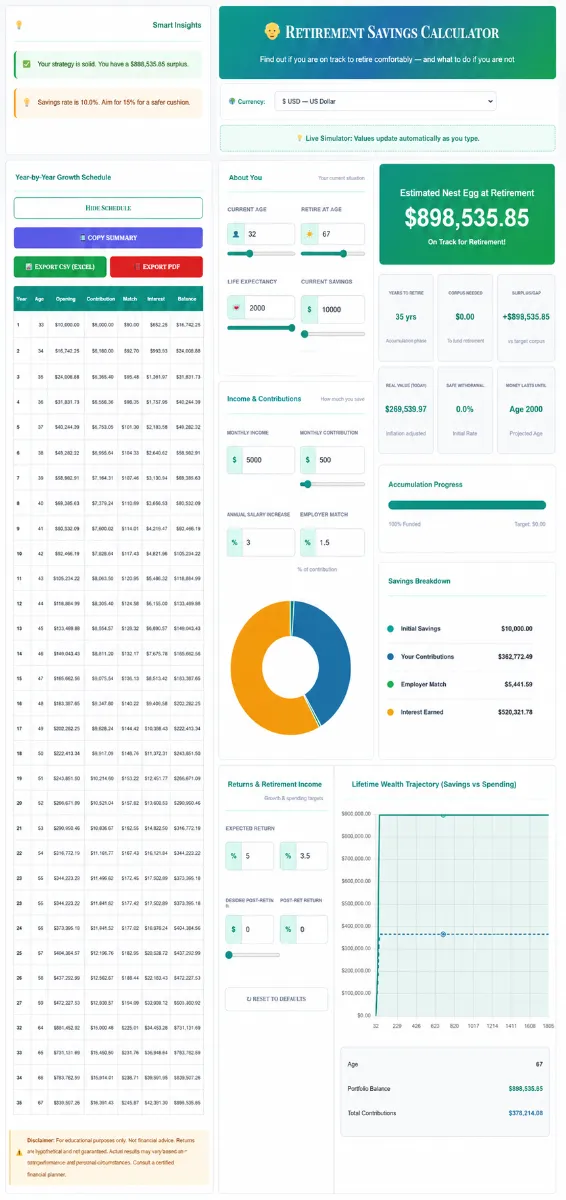
💰 Run Your Scenario with the SaveXpert Retirement Savings Calculator
I ran a scenario involving someone claiming Social Security at 67 while continuing to earn wages. The important variables aren’t just age or job title — annual countable earnings, claiming age, and eventual full retirement age all affect the picture. Claiming at 67 can provide income earlier, but the monthly retirement benefit may be lower than the amount available at full retirement age. Continued work can also change the earnings record used for future benefits when new earnings replace lower years in the highest-35-years calculation. Enter your own numbers to see how those variables interact.
Wages and other income can also affect whether part of Social Security becomes taxable under IRS provisional-income rules — see SaveXpert’s Income Tax Calculator and IRS Publication 915 for those figures.
Educational note: This calculator models hypothetical scenarios. It doesn’t predict official Social Security benefit amounts. For official estimates, use the SSA’s retirement planner tools at ssa.gov.
Estimate your tax, effective rate, and take-home pay.

What the Data Shows Works
Based on what I found in the official SSA and IRS data, the approach that consistently shows clear results is understanding each rule separately — because several separate rules interact here.
The data shows that delaying benefits increases the monthly benefit amount.
The SSA says benefits that start before full retirement age are smaller, while benefits starting at FRA or later are larger. Delayed-retirement increases stop after age 70.
The data shows that continued work can improve a future benefit.
The SSA can recalculate benefits when a new earnings year becomes one of the worker’s highest 35. This is a separate mechanism from the earnings-test withholding.
The data shows that part-time work gets measured by earnings, not hours.
The Social Security rules don’t create a separate earnings-test category for part-time workers. Total annual countable earnings are what the SSA measures (20 C.F.R. § 404.429).
The data shows that excess-earnings withholding is not equivalent to permanently losing benefits.
The SSA recalculates benefits at full retirement age for months affected by the earnings test. A higher monthly payment going forward accounts for the withheld period.
The data shows that early claiming reduces the worker benefit permanently.
For people born in 1960 or later, SSA’s table shows 70% at age 62 versus 100% at age 67. That 30% reduction doesn’t reverse when the earnings test ends at FRA.
Finally, the SSA research doesn’t identify one universally correct claiming age. The SSA says there’s no best age for everyone — the right answer depends on continued work plans, life expectancy, health insurance, other income, and family eligibility.
What You Can Realistically Expect
Someone claiming at 62 can work — including part time — while staying subject to the applicable earnings test before full retirement age. For 2026, that means $24,480 for someone below full retirement age all year, with $1 withheld for every $2 above the limit. In the year FRA arrives, the limit rises to $65,160 for earnings before that month, with $1 withheld for every $3 above it. From the month of FRA onward, no earnings limit applies.
The longer-term picture also depends on claiming age and earnings history. Additional high-earning years can replace lower years in the highest-35-years calculation. Delayed-retirement increases stop accumulating after age 70. And any high-income years after FRA can push Social Security benefits into the taxable range under IRS provisional-income rules — even though the earnings test no longer applies.
💡 Research note: The SSA says there is no best age for everyone when it comes to claiming Social Security. The decision involves earnings history, life expectancy, health insurance coverage, other income sources, and potential spousal or family benefits. The $24,480 earnings limit is just one data point in a larger picture.
The Bottom Line: 5-Step Action Plan
What should you do if you’re considering claiming Social Security at 62 while continuing to work? Here’s what the SSA and IRS data actually supports:
1. Identify your full retirement age:
For anyone born in 1960 or later, FRA is 67. That’s the anchor for both the earnings-test limits (which disappear at FRA) and the early-claiming reduction (which is permanent). If your FRA differs, check the SSA’s retirement planner for your birth year.
2. Count only what the SSA counts:
Wages, bonuses, commissions, and net self-employment profit count. Pensions, annuities, interest, and investment income don’t. Before estimating your withholding, identify which of your income sources are countable under the earnings test — the distinction can significantly change the calculation.
3. Separate earnings-test withholding from the early-claiming reduction:
The $1-for-$2 withholding is temporary and gets credited at FRA. The 30% permanent reduction from claiming at 62 versus 67 doesn’t reverse. These are two different calculations that apply simultaneously — don’t confuse them.
4. Check whether continued work improves your 35-year earnings average:
The SSA recalculates benefits when a new high-earnings year replaces a lower year in the highest-35-years record. If current wages are among your highest earnings years, staying in the workforce may increase future benefits even while early claiming reduces the current monthly amount.
5. Model the trade-off with your real numbers before claiming:
Use SaveXpert’s Retirement Saving Calculator to compare scenarios — early claiming with continued work versus delayed claiming. Then check IRS Publication 915 to see whether any combination of wages and Social Security income pushes benefits into the taxable range for your filing status.
The research through the official SSA and IRS materials found a straightforward answer: you can claim Social Security at 62 and continue working, but the earnings test matters before full retirement age. If your main concern is how much you can make while drawing Social Security at 62, the 2026 threshold is $24,480 for someone below full retirement age all year. The bigger decision involves more than that limit alone.
“When I went through the SSA’s 2026 materials on the earnings test and Publication 05-10069, the finding most people miss was about the withheld benefits themselves. The SSA recalculates your benefit at full retirement age and gives you credit for the months when excess earnings caused a withholding. That’s a meaningful difference from permanently losing those dollars — and it changes how the early-claiming decision should actually be framed.”
— Kevin Brown, Lead Researcher at SaveXpert.com
Frequently Asked Questions
Ans: According to the SSA, if you remain below full retirement age for the entire year of 2026, the earnings limit is $24,480. For every $2 you earn above this amount in countable wages or net self-employment income, $1 is temporarily withheld from your benefits. The limit doesn’t apply to pensions, annuities, interest, or investment income.
Ans: The SSA sets two limits for 2026. If you’re under full retirement age all year, the limit is $24,480 ($1 withheld per $2 over). If you reach full retirement age during 2026, the limit for your pre-FRA months increases to $65,160, and withholding drops to $1 for every $3 earned above that threshold. Beginning the month you reach full retirement age, the earnings test ends entirely and no limit applies.
Ans: According to official SSA tables, claiming at 62 results in a permanent 30% reduction in monthly benefits for those born in 1960 or later, compared with waiting until full retirement age of 67. This reduction doesn’t reverse when the earnings test ends at FRA. Early claiming is a long-term financial trade-off — a smaller monthly benefit for more years versus a full benefit starting later.
Ans: Yes. The SSA allows people to work while receiving retirement benefits. The earnings test evaluates total countable annual income — not job hours or whether a role carries a part-time label. If part-time wages stay below the $24,480 threshold in 2026, no earnings-test withholding applies. If they exceed it, the $1-for-$2 formula applies to the excess. Any withheld amounts are credited back at full retirement age through a benefit recalculation.
Ans: According to SSA guidelines, the earnings test ends entirely starting the month you reach full retirement age. For anyone born in 1960 or later, that’s age 67. From that month onward, you can earn unlimited income without any benefits being withheld under the earnings test. Note that wages after FRA can still affect how much of Social Security becomes taxable income under IRS Publication 915 provisional-income rules.
Ans: No. The SSA recalculates benefits at full retirement age and gives credit for months when payments were reduced or withheld because of excess earnings. This recalculation can produce a higher monthly benefit going forward to compensate for the withheld period. Earnings-test withholding is temporary. The 30% permanent benefit reduction from claiming at 62 instead of 67 is a separate, permanent calculation — not recoverable through the FRA recalculation.