

ⓘ Educational Disclosure:
This article is for educational and informational purposes only. It does not constitute financial, legal, tax, or benefits advice. SaveXpert and its authors are not licensed financial advisors. The 2027 Social Security COLA has not been officially determined as of this writing. Always verify current benefit information directly with the Social Security Administration at SSA.gov.
As of August 26, 2026, the Social Security Administration has not finalised the 2027 COLA. Three separate numbers are circulating — and they tell very different stories depending on which one you’re looking at. The research shows that treating any of them as the final answer creates the wrong budget expectation.
Key Takeaways
- Problem: American retirees can’t plan their 2027 budgets without knowing how inflation will affect their fixed income — and conflicting estimates from different sources make the answer hard to pin down.
- Solution: The preliminary Social Security COLA 2027 estimate sits at about 3.1% based on July 2026 CPI-W data, while the SSA Trustees Report intermediate projection is 2.7%. Outside advocacy group forecasts reach 3.5%–3.6%. None of these is the final number.
- Result: The final adjustment stays unconfirmed until August and September CPI-W data is released.
- Source: SSA 2026 Trustees Report · Bureau of Labor Statistics — CPI-W
- Time To Read: 6 Minutes
Table of Contents
1. The 2027 COLA Estimate Is Already Above One Official Projection
2. How the Social Security COLA 2027 Estimate Gets Calculated
3. When Will SSA Officially Announce the 2027 COLA?
4. Was the 2026 Social Security COLA 2.5% or 2.8%?
5. Could the 2027 COLA Be Higher Than 2026?
7. What Americans Can Realistically Expect
What is the Social Security COLA 2027 estimate? The preliminary Social Security COLA 2027 estimate is approximately 3.1% based on July 2026 CPI-W data from the Bureau of Labor Statistics. However, the SSA’s own 2026 Trustees Report intermediate-assumption projection stands at 2.7%. The final official increase will be announced in October 2026, once the required third-quarter CPI-W average — covering July, August, and September — is complete.
So readers searching for a Social Security COLA 2027 estimate should separate three distinct figures: the SSA actuarial projection, the preliminary calculation from available CPI-W data, and the final COLA that SSA will announce. Right now, those numbers are 2.7%, approximately 3.1%, and still undetermined.

The 2027 COLA Estimate Is Already Above One Official Projection
The number that caught my attention was 3.1%. That figure comes from the actual July 2026 CPI-W reading from the Bureau of Labor Statistics — not from a finalised SSA announcement. The SSA’s current intermediate-assumption projection sits at 2.7% for the COLA effective December 2026 and payable in January 2027.
That difference matters because neither number represents the final 2027 COLA. The July-only figure uses one month of the required three-month calculation. The 2.7% figure comes from an actuarial projection in the 2026 Trustees Report — an estimate, not an announcement.
I spent time going through the SSA and BLS data behind this. The research shows that the official formula still depends on the third-quarter CPI-W average. That means August and September data can still move the final percentage in either direction.
For comparison, the official 2026 COLA was 2.8%. SSA announced that increase on October 24, 2025.
The Three Numbers You Need to Keep Separate
| Source | 2027 COLA Figure | What It Is |
|---|---|---|
| SSA Trustees Report (2026) — intermediate projection | 2.7% | Official actuarial estimate — not the final announced COLA |
| Preliminary CPI-W calculation (July 2026 data only) | ~3.1% | Based on one month of the required three-month average; subject to change |
| Outside advocacy group and media forecasts | 3.5%–3.6% | Non-SSA estimates; do not replace the official statutory calculation |
| Final official 2027 COLA | TBD | To be announced by SSA in October 2026 after complete Q3 CPI-W data |
Source: SSA 2026 Trustees Report · BLS CPI-W releases · Outside estimates from senior advocacy organisations (not official SSA data).
How the Social Security COLA 2027 Estimate Gets Calculated
According to SSA’s COLA calculation guidance and Social Security Act §215, the annual COLA uses the Consumer Price Index for Urban Wage Earners and Clerical Workers (CPI-W), published by the Bureau of Labor Statistics. The law ties the annual adjustment to changes in that specific measure — not CPI-U, core CPI, gasoline inflation, medical inflation, or any individual household budget.
SSA doesn’t simply take July’s inflation number and apply it. The agency compares the average CPI-W for July, August, and September with the average for the third quarter of the last year when a COLA became effective. For the January 2027 COLA, the comparison base is the third-quarter 2025 average.
That 2025 comparison average was 317.265. The July 2026 CPI-W index came in at 327.104 — a 3.4% increase from July 2025. Using those two figures alone gives a preliminary July-only calculation of about 3.1%. But the research brief labels this preliminary because two required months remain unavailable.
SSA then rounds a qualifying increase to the nearest one-tenth of one percent. If the increase doesn’t reach a qualifying amount after rounding, the rules provide for no COLA.
💡 Real-world effect: Imagine someone receives exactly $2,000 per month in Social Security benefits. A 2.7% increase would add about $54 more per month. A 3.1% increase would add about $62 more per month. These figures illustrate the math — they’re not an official benefit award. The actual net deposit can differ because deductions and other adjustments affect what reaches a bank account.

When Will SSA Officially Announce the 2027 COLA?
SSA’s COLA summary page identifies October as the announcement month. The exact October 2026 announcement date remains unconfirmed in the current research — but the timing follows the CPI-W data release schedule from BLS
BLS scheduled its August 2026 CPI release for September 11, 2026. BLS scheduled its September 2026 CPI release for October 14, 2026. That September CPI release supplies the final monthly data point needed to complete the third-quarter average. SSA can only finalise the calculation once that figure is available.
This timing explains why current forecasts can change quickly. Any estimate published before October cannot use the complete third-quarter data set. The final percentage requires all three months.
⚠️ Private forecast ≠ official SSA date: For 2026, a financial media outlet reported a projected 2.7% increase and expected an October 15 announcement — but SSA announced the actual 2026 COLA on October 24, 2025. An expected date from a private publication isn’t the same as an official SSA announcement date. Watch ssa.gov/cola directly for the official announcement.
Estimate your future nest egg from your current savings.
Was the 2026 Social Security COLA 2.5% or 2.8%?
The official 2026 COLA was 2.8%. SSA announced the increase on October 24, 2025, and the adjustment applied to Social Security and SSI payments beginning in January 2026.
The 2.5% figure belongs to the COLA for benefits payable in January 2025 — not 2026. That distinction creates confusion when older articles continue appearing in search results alongside newer ones about the 2026 adjustment.
According to the SSA 2026 COLA Fact Sheet, average monthly retirement benefits for all retired workers rose from about $2,015 to $2,071 with the 2.8% increase — an average gain of approximately $56 per month across all retired workers.
💡 Research note: A percentage increase doesn’t produce the same dollar increase for everyone. A person with a higher benefit receives a larger dollar increase; someone with a smaller benefit receives a smaller one. The $56 average figure represents all retired workers combined — individual results vary based on each person’s actual monthly benefit calculation.
The research also shows why the COLA shouldn’t be confused with any individual’s personal inflation rate. SSA uses CPI-W under the statutory formula. It doesn’t substitute CPI-U, core CPI, gasoline inflation, medical inflation, or an individual’s household budget — even though those measures may feel more relevant to a specific retiree’s actual expenses.
Could the 2027 COLA Be Higher Than 2026?
The current evidence leaves that question open — and the range of estimates is wide.
The official 2026 COLA was 2.8%. The SSA’s intermediate-assumption projection for the COLA payable in January 2027 is 2.7% — slightly below the actual 2026 increase. At the same time, the available July CPI-W data from BLS produces a preliminary 3.1% calculation. That figure sits above both the 2.7% projection and the 2.8% 2026 COLA — but it still lacks August and September CPI-W data.
Outside forecasts from senior advocacy groups and financial media have reached as high as 3.5% and 3.6% for 2027. These figures come from organisations using their own methodologies and available CPI data at different points in the year. They should not replace the official SSA and BLS calculation — but they do show why the final number could land anywhere in the 2.7%–3.6%+ range depending on how August and September inflation unfolds.
💡 Easy-to-miss SSA figure: The SSA Trustees data also projects 2.4% for the COLA effective December 2027 and payable in January 2028. That is not the 2027 COLA — it’s the following year’s intermediate projection. Don’t mix up the two when reading Trustees Report tables.
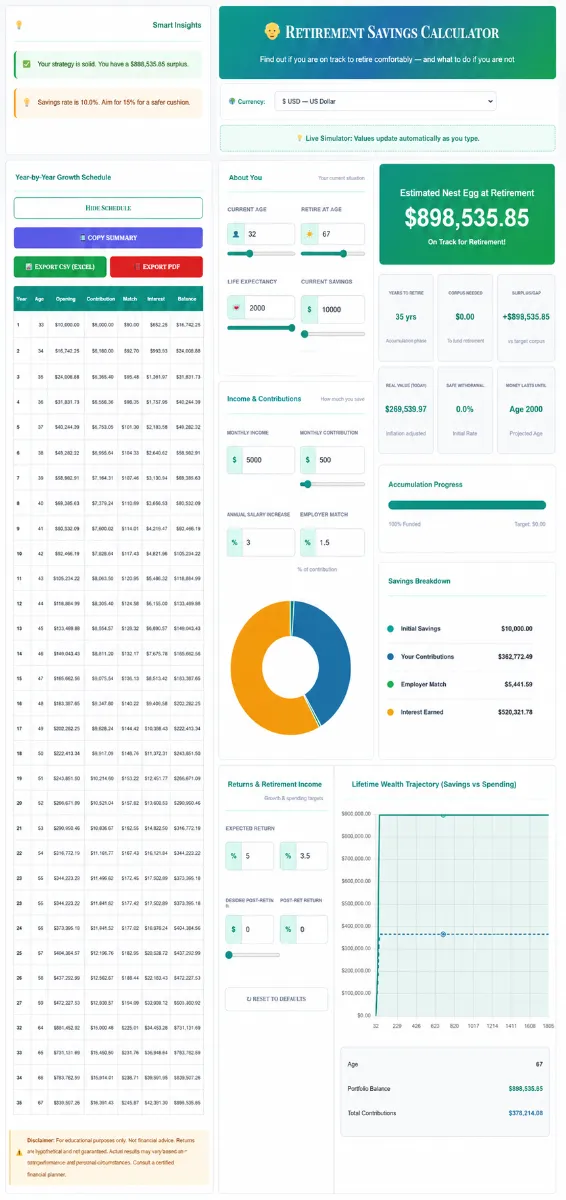
💰 Model Your COLA Scenarios with the SaveXpert Retirement Savings Calculator
I ran a simple $2,000 monthly Social Security scenario through SaveXpert’s Retirement Saving Calculator. A 2.7% increase adds about $54 monthly. A 3.1% increase adds about $62 monthly. Even a few tenths of a percentage point produces a different real-world dollar amount — and that difference compounds over a full year. Enter your own monthly benefit amount and apply different COLA percentages to see what each scenario means in practice before October’s official announcement.
Educational note: This calculator models hypothetical scenarios and does not predict or guarantee any official COLA percentage. For confirmed benefit information, visit ssa.gov/cola.
What the Data Shows Works
Based on what I found in the SSA and BLS data, the approach that consistently holds up is separating the official SSA inflation-adjustment calculation from early estimates and keeping three categories clear.
First:
The official process uses the three-month third-quarter CPI-W average — not one month’s reading. That reduces the risk of treating a single monthly figure as the complete answer.
Second:
The research supports using 317.265 as the third-quarter 2025 comparison average for the COLA payable in January 2027. That figure provides the calculation base for anyone wanting to track the estimate as August and September CPI-W data arrives.
Third:
The data supports keeping the SSA actuarial projection (2.7%), the preliminary CPI-W calculation (~3.1%), and the final SSA determination clearly separate. Right now, only the first two exist. The third arrives in October 2026.
Fourth:
SSA describes the purpose of COLAs as protecting Social Security and SSI benefits from losing purchasing power due to inflation. That purpose doesn’t mean every household’s expenses rise at the same rate as CPI-W — only that benefits adjust based on that statutory measure.
What Americans Can Realistically Expect
Based on the available data, the final 2027 COLA remains unknown until the complete third-quarter CPI-W figures arrive. BLS scheduled the August CPI release for September 11, 2026, and the September CPI release for October 14, 2026. SSA identifies October 2026 as the announcement month.
The current evidence supports watching the official releases rather than treating any early forecast as a fixed payment increase. The range between the SSA intermediate projection (2.7%) and outside advocacy group estimates (3.6%) is almost a full percentage point — a meaningful spread when applied to millions of monthly benefits.
One other 2026 change deserves separate attention. The Social Security Fairness Act, signed January 5, 2025, repealed the Windfall Elimination Provision and Government Pension Offset. SSA began adjusting affected payments in February 2025. That’s a benefit-calculation change for specific affected workers — it’s not a replacement for the annual CPI-W COLA formula and doesn’t affect the 2027 COLA calculation.
The official sources reviewed also found no confirmed 2025–2026 court decision changing the CPI-W COLA formula. SSA continues to describe the annual adjustment under Social Security Act §215(i).
The Bottom Line: 5-Step Action Plan
What should retirees and near-retirees do right now? Here’s the research-based 5-step sequence for handling the 2027 COLA uncertainty while managing a real household budget:
1. Know the three separate numbers:
2.7% (SSA Trustees projection), ~3.1% (preliminary July CPI-W calculation), and 3.5%–3.6% (outside advocacy group estimates). None is the final COLA. Don’t build a 2027 budget around any of them until SSA announces officially.
2. Mark October 14, 2026, and watch SSA directly:
BLS releases the final September CPI data on October 14, 2026. SSA’s official announcement follows shortly after. Bookmark ssa.gov/cola and check it directly — don’t rely on media projections for the official date or percentage.
3. Model your own dollar scenarios now:
Use SaveXpert’s Retirement Saving Calculator to apply both the 2.7% and 3.1% estimates to your actual monthly benefit. Knowing the dollar difference between scenarios helps you plan a conservative budget without waiting for
4. Don’t confuse the Fairness Act with the COLA:
The Social Security Fairness Act changes (WEP/GPO repeal, effective February 2025) affect specific workers’ benefit calculations — separately from the annual CPI-W adjustment. If you were affected by WEP or GPO, verify your benefit with SSA directly rather than assuming the Fairness Act change is baked into your COLA projection.
5. Budget conservatively using the lower estimate:
Budget conservatively using the lower estimate: Until the official number arrives, the research supports planning around the more conservative SSA projection (2.7%) rather than outside forecasts. A budget built on the lower figure can only improve in October — one built on a higher forecast risks a shortfall.
I research these numbers so readers don’t have to sort through multiple government releases and competing forecasts alone. The next meaningful checkpoint comes when BLS releases the remaining CPI-W data in September and October, followed by SSA’s official October announcement. Until then, the calculator can help translate the current percentage range into monthly dollars without treating any Social Security COLA 2027 estimate as confirmed.
“When I went through the SSA Trustees Report and the Bureau of Labor Statistics CPI-W release schedule, the most important finding was how many separate numbers are circulating right now. The SSA’s own projection (2.7%), the preliminary July CPI-W calculation (3.1%), and outside advocacy group forecasts (3.5%–3.6%) are all real figures — but none of them is the final 2027 COLA. The law still requires the complete third-quarter average before SSA can make it official.”
— Kevin Brown, Lead Researcher at SaveXpert.com
Frequently Asked Questions
Ans: According to the SSA 2026 Trustees Report, the official intermediate projection for the 2027 Social Security COLA is 2.7%. However, early calculations using July 2026 CPI-W data from the Bureau of Labor Statistics show a preliminary estimate of about 3.1%. Outside estimates from senior advocacy organisations reach as high as 3.5%–3.6%. The final number depends on August and September CPI-W data and won’t be official until SSA announces in October 2026.
Ans: The SSA COLA page identifies October as the announcement month. The timeline follows the BLS schedule: August CPI data releases September 11, 2026, and September CPI data releases October 14, 2026. That September data provides the final monthly figure needed to complete the third-quarter average. The 2026 COLA was officially announced on October 24, 2025.
Ans: According to Social Security Act §215 and SSA’s COLA calculation guidance, the annual adjustment compares the average CPI-W for July, August, and September with the third-quarter average of the most recent year in which a COLA became effective. For 2027, the base is the third-quarter 2025 CPI-W average of 317.265. SSA rounds any qualifying increase to the nearest one-tenth of one percent.
Ans: The official 2026 COLA was 2.8%, announced by SSA on October 24, 2025. According to the SSA 2026 COLA Fact Sheet, this applied to Social Security and SSI payments starting in January 2026 and raised average monthly retirement benefits from about $2,015 to $2,071 — an average increase of approximately $56 per month across all retired workers.
Ans: The exact dollar amount depends on your current benefit. Using the two current estimates as illustrations: a 2.7% increase would add about $54 monthly to a $2,000 benefit, while a 3.1% increase would add approximately $62 monthly. The final increase depends entirely on the complete third-quarter CPI-W data — the official COLA will be announced in October 2026.
Ans: No — these are two separate changes. The Social Security Fairness Act, signed January 5, 2025, repealed the Windfall Elimination Provision (WEP) and Government Pension Offset (GPO), with SSA adjusting affected payments beginning in February 2025. It changes the benefit calculation formula for specific affected workers. The annual COLA, by contrast, is a percentage adjustment calculated annually using the CPI-W formula under Social Security Act §215(i) and applies to all beneficiaries. The Fairness Act changes do not alter how the COLA is calculated.