

ⓘ Educational Disclosure:
This article is for educational and informational purposes only. It does not constitute financial, legal, tax, lending, or investment advice. SaveXpert and its authors are not licensed financial or tax advisors. Always consult a qualified professional before making investment decisions.
Can you take all your RMD from one account? Yes, for traditional, SEP, and SIMPLE IRAs. IRS Publication 590-B confirms that an owner of multiple traditional IRAs must calculate the required distribution separately for each IRA, but may then aggregate those amounts and withdraw the full total from a single IRA. This aggregation rule does not apply to 401(k) plans — each plan must satisfy its own RMD separately. (IRS Senior Taxpayers FAQ)
Key Takeaways
- Problem: Millions of retirees with multiple traditional IRAs wonder whether they must process separate withdrawals from every account or can pull all required distributions from one.
- Solution: According to IRS Publication 590-B, you can take all your RMD from one account when you hold multiple traditional, SEP, or SIMPLE IRAs — provided you calculate each account’s required amount separately first.
- Result: Research shows calculating each IRA separately before aggregating eligible distributions satisfies IRS compliance requirements without triggering excise penalties.
- Source: IRS Publication 590-B, IRS Senior Taxpayers FAQ
- Time To Read: 6 Minutes
Table of Contents
1. The Short Answer: Yes, With One Condition
2. You Still Calculate Each IRA Separately
3. Does It Matter Which IRA Provides the RMD?
4. IRA Aggregation vs. 401(k): The Rules Are Not the Same
5. What Age and Deadlines Apply to IRA RMDs?
6. What Happens If You Don’t Take the Full RMD?
7. Can You Spread Your RMD Across the Year?
8. A Practical RMD Example Using Multiple IRAs
9. What the Data Shows Works — and What It Doesn’t
Yes — and the IRS says so directly. If you hold multiple traditional IRAs, you can take your entire required minimum distribution from a single account. You do the calculation separately for each IRA first, add those amounts together, then pull the combined total from whichever IRA you choose. The IRS doesn’t require a separate withdrawal from every account.
That’s the short answer. The longer answer has three parts: the aggregation rule that makes it work, the account-type limits that apply, and the one step people most often skip.

The Short Answer: Yes, With One Condition
The IRS confirms the aggregation rule in its Senior Taxpayers FAQ page. The exact language: “If you have more than one IRA, you can total the required distributions for all the IRA accounts and then satisfy the requirement by taking distributions from any one (or more) of the IRA accounts.” (IRS Senior Taxpayers FAQ)
That one condition: you must calculate the RMD for each IRA individually before combining. The IRS doesn’t allow you to skip directly to a single combined balance and run one calculation on that number. Each account gets its own calculation — then the results aggregate.
💡 Research note: IRS Publication 590-B was published January 21, 2026. The research brief identifies it as the current controlling source for this IRA aggregation question. The rules covered here apply to traditional, SEP, and SIMPLE IRAs — not to every retirement account type.
You Still Calculate Each IRA Separately
This is the step most people want to skip — and the one the IRS is firm about. IRS Publication 590-B says an owner with more than one IRA must determine the RMD separately for each IRA. Each calculation uses the account’s own December 31 balance from the prior year, divided by the applicable IRS distribution period.
For a 2026 RMD, that means the December 31, 2025 balance for each account. If you have three IRAs with different year-end balances, each one runs its own calculation. The results are then added together. (IRS RMD FAQs: Distributions)
⚠️ Don’t combine balances before calculating: Adding all your IRA balances first and running one calculation produces a different number than the IRS method requires — because each account’s factor and balance interact individually. The published IRS framework requires one calculation per IRA, then aggregation. Doing it in the wrong order doesn’t satisfy the requirement.
The general RMD formula
📐 RMD Calculation — Per Account
Each IRA’s December 31, 2025 balance
÷ Applicable IRS life-expectancy factor
= That IRA’s 2026 RMD amount
Add all IRA RMD amounts together
→ Withdraw total from one IRA (or any combination)
Source: IRS Publication 590-B
Here’s a simple example. Three traditional IRAs generate individual RMDs of $4,500, $3,500, and $2,000. The combined 2026 RMD equals $10,000. Under the IRS aggregation rule, that $10,000 can come entirely from the first IRA. Or split across two. Or one-third from each. The IRS doesn’t require proportional withdrawals — only that the full $10,000 clears by December 31, 2026.
Does It Matter Which IRA Provides the RMD?
No — the IRS doesn’t require the distribution to come from any particular eligible IRA. Once the individual calculations are complete and aggregated, you can pull the total from whichever account or combination of accounts makes sense for your situation. (IRS RMD FAQs)
The research brief makes an honest point worth including here. No peer-reviewed study or federal statistical dataset in the reviewed materials compares one-account RMD withdrawals against proportional withdrawals in terms of investment or tax outcomes. The IRS tells you what satisfies the compliance requirement. It doesn’t establish that pulling from one IRA produces better personal financial results than pulling from several.
That said, there are practical reasons someone might prefer one account over another — account fees, investment allocations, custodian processing convenience, or wanting to preserve a particular IRA for estate planning. Those are financial planning considerations outside the IRS rules, not IRS requirements.
IRA Aggregation vs. 401(k): The Rules Are Not the Same
This is the most common point of confusion — and the one with the biggest consequences if you get it wrong.
The IRA aggregation rule applies to traditional, SEP, and SIMPLE IRAs. It does not apply to separate 401(k) plans. Each employer-sponsored defined-contribution plan must satisfy its own RMD separately. You can’t pull a 401(k) plan’s RMD from an IRA. And you can’t combine IRA distributions with employer-plan distributions to meet either obligation. (IRS: RMD Comparison Chart — IRAs vs. Defined Contribution Plans)
There’s a partial exception for 403(b) accounts. The IRS Form 5329 Instructions confirm: “If you have more than one 403(b) tax-sheltered annuity account, you can total the required minimum distributions and then take them from any one (or more) of the tax-sheltered annuities.” So 403(b) accounts can be aggregated among themselves — but not with IRAs or with 401(k) plans. Each type stays in its own lane. (IRS Form 5329 Instructions)
| Account Type | Can Aggregate RMDs? | How It Works |
|---|---|---|
| Multiple traditional IRAs | Yes | Calculate each separately; withdraw total from any IRA(s) |
| Multiple SEP IRAs | Yes | Same rule as traditional IRAs |
| Multiple SIMPLE IRAs | Yes | Same rule as traditional IRAs |
| Multiple 403(b) accounts | Yes — among themselves | Calculate each separately; withdraw total from any 403(b)(s) — not from IRAs |
| Multiple 401(k) plans | No | Each plan satisfies its own RMD separately |
| IRA + 401(k) combined | No | Cannot cross-aggregate; each type follows its own rules |
| Roth IRA (original owner) | N/A | No lifetime RMD requirement |
Source: IRS: RMD Comparison Chart, IRS Publication 590-B, IRS Form 5329 Instructions
⚠️ 401(k) owners with multiple plans: If you have old 401(k) accounts at former employers alongside a current employer’s plan, each needs its own separate RMD. You can’t satisfy one plan’s obligation from another. The IRS treats each defined-contribution plan as a standalone requirement. (IRS RMD Comparison Chart)
Find your marginal bracket, income tax, and take-home.
What Age and Deadlines Apply to IRA RMDs?
Traditional IRA owners generally begin required minimum distributions for the year they reach age 73. (IRS Retirement Topics: RMDs)
The first RMD has a special deadline: April 1 of the year after you turn 73. Every RMD after the first is due December 31 of the year it covers. But here’s the catch the IRS specifically warns about: delaying the first RMD to April 1 doesn’t eliminate the second annual requirement. Both can land in the same calendar year — and both are taxable income for that year. Two RMDs in one year means two taxable distributions added to 2027 income, which can push someone into a higher bracket.
For 2026 specifically: someone who turned 73 during 2026 can take their first RMD during 2026 or delay it to April 1, 2027. Their 2027 RMD then comes due December 31, 2027 regardless. The calculation for the 2026 RMD uses the December 31, 2025 balance. The 2027 RMD uses the December 31, 2026 balance — a separate calculation on a different number.

What Happens If You Don’t Take the Full RMD?
The IRS imposes a 25% excise tax on the shortfall — the portion of the required amount that wasn’t distributed by the deadline. That rate drops to 10% if the missed distribution is corrected within the applicable two-year correction period. (IRS Retirement Topics: RMDs)
The IRS may also waive the excise tax when the shortfall resulted from reasonable error and the taxpayer takes steps to correct it — using Form 5329 with a written explanation. That waiver isn’t automatic, but it’s a real mechanism. (IRS Form 5329)
One important nuance specific to this article’s topic: if you plan to take all your IRA RMDs from one account, and that account runs low or gets tied up in processing near year-end, you still owe the full combined amount by December 31. Concentrating the withdrawal in a single account adds a custodian-processing risk that spreading across accounts avoids. Plan the withdrawal timing with your custodian well before December.
Estimate your future nest egg from your current savings.
Can You Spread Your RMD Across the Year?
Yes — the IRS requires the full annual amount to be distributed by the deadline, not as a single December transaction. You can take distributions throughout the year, in any amounts that add up to the required total. Monthly transfers, a single January lump sum, or quarterly withdrawals all satisfy the requirement as long as the full amount clears by December 31. (IRS Publication 590-B)
The research brief doesn’t identify a special tax or investment advantage from any particular withdrawal schedule. The IRS rule concerns the annual amount and the deadline — not how you distribute that amount across the calendar.
A Practical RMD Example Using Multiple IRAs
Here’s how the two-step process works with real numbers. Suppose someone holds three traditional IRAs with 2026 RMDs of $4,500, $3,500, and $2,000, respectively. Each was calculated from its own December 31, 2025 balance using the applicable IRS Table III factor.
Step 1: Add the three amounts. $4,500 + $3,500 + $2,000 = $10,000 combined 2026 IRA RMD.
Step 2: Choose the source. Under the IRS aggregation rule, that $10,000 can come entirely from the first IRA, split between two IRAs, or pulled from all three. The IRS doesn’t prescribe the source — only that the total gets distributed by December 31, 2026.
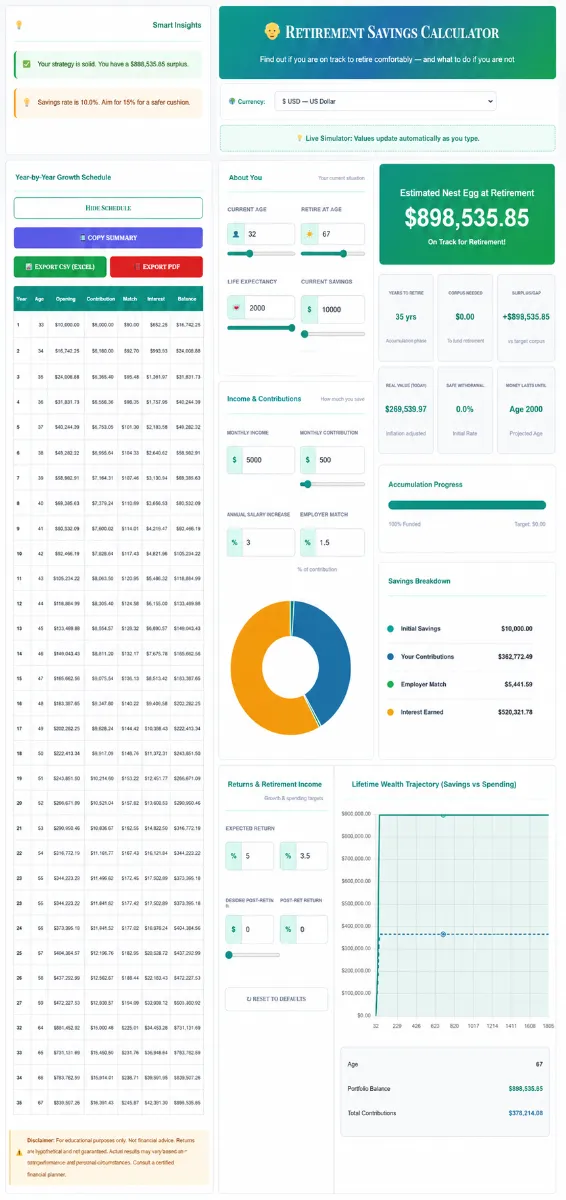
📈 Model Your Account Balances — Retirement Savings Calculator
I ran a multiple-IRA scenario through SaveXpert’s Retirement Savings Calculator to see how taking all distributions from one account affects the remaining balance over time. The calculator is an educational planning tool — the actual RMD figure requires the IRS life-expectancy table and your custodian-reported December 31 balance.
Educational note: This calculator illustrates scenarios using assumed inputs and does not replicate the IRS life-expectancy table calculation. Always confirm with your custodian and a tax professional. Source: IRS Publication 590-B
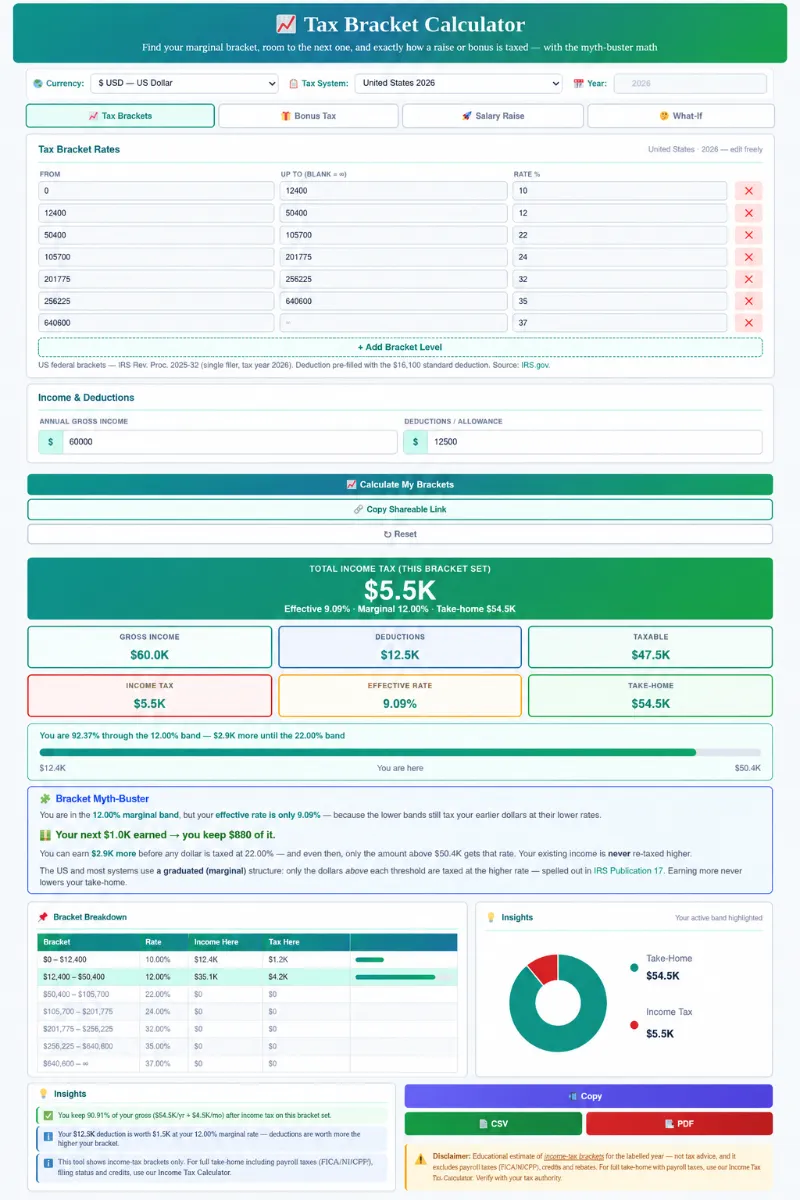
When RMD distributions are taxable, they add to gross income for the year. A larger single-account withdrawal can push income into a higher bracket or affect other income-dependent calculations — IRMAA Medicare surcharges, for instance. The Tax Bracket Calculator is a useful first check before deciding which account and how much to distribute in a given year.
💰 Check Bracket Impact — Tax Bracket Calculator
Taxable IRA distributions add to gross income for the year. I used this calculator to see how a $60,000 combined RMD sits against 2026 bracket thresholds — especially useful for anyone weighing whether to take the full amount from one IRA early in the year or spread it to manage the bracket exposure.
Educational note: This calculator illustrates bracket interactions and does not calculate exact tax liability. Consult a tax professional before making distribution decisions. Source: IRS 2026 Tax Inflation Adjustments
What the Data Shows Works — and What It Doesn’t
1. Calculate each account separately
IRS Publication 590-B specifically requires one calculation per IRA using that account’s own December 31 balance and the applicable life-expectancy factor. There’s no shortcut to a single combined calculation. (IRS Publication 590-B)
2. Aggregate and choose the source account
After calculating each IRA separately, add the amounts together. The IRS permits the combined total to come from one IRA or multiple IRAs. The choice of which account writes the check is yours — the IRS doesn’t prescribe it. (IRS Senior Taxpayers FAQ)
3. Keep employer plans separate
Don’t apply the IRA aggregation rule to 401(k) plans or mix IRA and 401(k) withdrawals toward a shared obligation. Each 401(k) satisfies its RMD on its own. 403(b) accounts can be aggregated among themselves, but not with IRAs or 401(k)s. (IRS RMD Comparison Chart)
4. Use the prior year-end balance
The formula requires December 31 of the preceding year — not the current balance. Your custodian reports this on Form 5498, Box 5. Using a mid-year statement produces the wrong number. (IRS RMD FAQs: Distributions)
5. Meet the applicable deadline
The full combined IRA RMD amount must clear by December 31, 2026 for ongoing distributions (or April 1, 2027 for a first-ever RMD). The 25% excise tax applies to any shortfall; the 10% reduced rate applies with timely correction. (IRS Retirement Topics: RMDs)
💡 What the research doesn’t establish: No peer-reviewed study or federal statistical dataset in the reviewed IRS materials compares one-account withdrawals against proportional withdrawals in terms of investment or tax outcomes. The IRS rules establish compliance requirements — not a guarantee of one approach being financially superior.

Your 5-Step RMD Aggregation Checklist
1. Gather every December 31, 2025 IRA balance:
Pull the year-end balance for each traditional, SEP, or SIMPLE IRA you own. This is the number each calculation starts with — not the current balance, not a mid-year statement. Your custodian reports it on Form 5498.
2. Run the RMD calculation for each IRA individually:
Unlike employer plans, IRA contributions can generally be made until Tax Day 2027. Still, tracking your 2026 progress now avoids a scramble in April.
3. Add the individual amounts together:
The sum is your total 2026 IRA RMD obligation. This is the number that needs to clear by December 31, 2026 — from one IRA or any combination of your eligible IRAs.
4. Handle 401(k) and 403(b) accounts separately:
Any 401(k) RMDs must be satisfied from each plan on its own — they don’t roll into the IRA total. 403(b) accounts can be aggregated among themselves but not with your IRAs.
5. Confirm the withdrawal with your custodian before December:
Custodians can have processing cutoffs in mid-to-late December. If you’re taking the full combined RMD from one account, confirm that account can clear the full amount in time — don’t wait until December 30.
“What I found in the IRS material surprised me with its clarity. The agency cleanly separates the calculation step from the withdrawal step. You calculate for every IRA — no shortcuts there. But once those numbers are in hand, the IRS gives you full flexibility about which account writes the check.”
— Kevin Brown, Lead Researcher at SaveXpert.com
Frequently Asked Questions
Ans: According to IRS Publication 590-B and the IRS Senior Taxpayers FAQ, yes. If you hold multiple traditional, SEP, or SIMPLE IRAs, you must calculate the required distribution separately for each IRA first, then add those amounts together. You can then withdraw the entire combined total from a single IRA, or split it across any combination of your eligible IRAs. The IRS does not require a proportional withdrawal from every account.
Ans: According to IRS guidelines, no — the rules don’t require the distribution to come from any particular eligible IRA. Once the per-account calculations are complete and combined, you choose which IRA or combination of IRAs provides the withdrawal. The compliance requirement focuses on whether the total required amount is distributed by the annual deadline, not on which account generates it.
Ans: According to IRS Publication 590-B, an owner of multiple IRAs must first calculate the RMD for each account separately, using that account’s December 31 balance from the prior year divided by the applicable IRS life-expectancy factor. After running those individual calculations, the owner adds the results together. That combined total can then be withdrawn from any single IRA or distributed across several eligible IRAs.
Ans: The IRS RMD Comparison Chart shows that multiple traditional IRAs can have their RMDs combined into a single withdrawal after individual calculations. Separate 401(k) plans don’t get the same treatment — each plan must calculate and satisfy its own RMD independently. You can’t pull a 401(k) RMD from an IRA, and you can’t apply IRA distributions toward a 401(k) obligation. The two account types follow separate sets of rules.
Ans: According to IRS guidance, failing to take the full required amount by the deadline may trigger a 25% excise tax on the shortfall. That rate drops to 10% if the missed distribution is corrected within the applicable two-year correction period. The IRS may also waive the tax when the shortfall resulted from reasonable error and the taxpayer takes steps to fix it, using Form 5329 with a written explanation.
Ans: According to IRS Form 5329 Instructions, yes — with an important boundary. If you own multiple 403(b) tax-sheltered annuity accounts, the IRS allows you to total the required minimum distributions and then take them from any one or more of those accounts. This is the same calculate-separately-then-aggregate approach used for IRAs. However, the aggregation stays within the account type: 403(b) RMDs can only be aggregated with other 403(b) accounts — not with traditional IRAs or 401(k) plans.