
ⓘ Educational Disclosure:
This article is for educational and informational purposes only. It does not constitute financial, legal, tax, lending, or investment advice. SaveXpert and its authors are not licensed financial advisors, CPAs, attorneys, or tax advisors. All data comes from publicly available government and institutional sources. Always consult a qualified professional before making investment decisions.
How do you freeze your credit for free? Federal law guarantees every U.S. consumer the right to a free credit freeze. You must contact Equifax, Experian, and TransUnion individually — online, by phone, or by mail. Each freeze blocks new creditors from accessing your credit file, which stops most new-account identity theft. The freeze doesn’t lower your credit score, costs nothing to place or lift, and can be temporarily removed in as little as one hour when you need to apply for credit.
Key Takeaways
- Problem: Identity theft complaints surpassed 1.35 million in 2025 — up 19.6% from 2024 — leaving Americans highly exposed to new-account fraud ahead of Black Friday shopping season.
- Solution: Place a federal security freeze at Equifax, Experian, and TransUnion separately — this blocks new creditors from accessing your file and is free under federal law.
- Result: A federal freeze creates an FCRA-backed barrier against new-account identity theft without lowering your credit score or costing anything to place or lift.
- Source: FTC Consumer Guidance, CFPB Security Freeze Guide
- Time To Read: 8 Minutes
Table of Contents
1. Why a Credit Freeze Matters Before Black Friday
2. How to Freeze Your Credit Free at All Three Bureaus
3. Credit Freeze vs. Credit Lock: What’s the Difference?
4. Does Freezing Your Credit Hurt Your Credit Score?
5. What a Credit Freeze Doesn’t Block
6. How to Temporarily Lift a Credit Freeze
7. What the Research Shows Works (and What Doesn’t)
8. What You Can Realistically Expect
9. Bottom Line: 5 Steps to Freeze Your Credit Before Black Friday
Identity theft complaints topped 1.35 million in 2025 — a 19.6% jump from 2024. Of those, 597,770 FTC complaints involved hijacked or newly opened bogus credit card accounts. That’s up 33% from the prior year. Black Friday is exactly when this pressure peaks. And the solution is free, takes about 10 minutes per bureau, and doesn’t touch your credit score.
Why a Credit Freeze Matters Before Black Friday
Black Friday creates a concentrated window of credit applications, new store card sign-ups, and rushed online transactions. That same window is attractive to identity thieves.
I went through the FTC’s consumer complaint data, and the numbers are striking. In 2025, FTC data recorded 597,770 complaints involving hijacked or newly opened bogus credit card accounts — a 33% increase year over year. Credit card fraud specifically saw 503,450 cases in Q1–Q3 2025 alone, up 54% from the same period in 2024.
For someone planning holiday purchases, the concern is direct. A stolen Social Security number is all a thief needs to open a new credit card in your name. A federal security freeze blocks new creditors from pulling your file before approving those applications. The thief can’t get approved for what the lender can’t see.
💡 Research note: The Identity Theft Resource Center found that 11% of respondents had never frozen their credit because they expected a fee or a credit score hit. Both assumptions are wrong. The FTC’s own consumer guidance confirms freezes are free and don’t affect your score.
The Identity Theft Resource Center data also estimates a 33% lifetime chance of identity theft for U.S. adults. A freeze isn’t just for people who’ve already been targeted. It’s a pre-emptive step anyone can take — and the data shows most people who qualify simply haven’t done it yet.

How to Freeze Your Credit Free at All Three Bureaus
I spent time reading the CFPB’s guidance and the FCRA statute directly. The legal foundation is specific. The Economic Growth, Regulatory Relief, and Consumer Protection Act amended the Fair Credit Reporting Act on September 21, 2018. That amendment made credit freezes free for all U.S. consumers — and required free unfreezes too.
The relevant statute is 15 U.S.C. § 1681c-1. It’s worth knowing that reference — it’s the legal text behind every right discussed in this article.
Three bureaus, three separate requests
This is the part most people miss. Freezing one bureau doesn’t freeze the others. Creditors may check any of the three — Equifax, Experian, or TransUnion — depending on which they use. A freeze at only one or two bureaus leaves gaps a creditor (or a thief) can walk through.
| Bureau | Freeze Request Link | Also Available By |
|---|---|---|
| Equifax | equifax.com — Credit Freeze | Phone · Mail |
| Experian | experian.com — Security Freeze | Phone · Mail |
| TransUnion | transunion.com — Credit Freeze | Phone · Mail |
Source: CFPB — What is a Credit Freeze?
Federal processing deadlines
The FCRA sets specific timeframes — these aren’t estimates. The bureaus are legally required to meet them.
| Action | Online or Phone | By Mail |
|---|---|---|
| Place a freeze | Within 1 business day | Within 3 business days |
| Temporary lift | Within 1 hour | Within 3 business days |
| Permanent removal | Within 1 business day | Within 3 business days |
| Written confirmation sent | Within 5 business days | Within 5 business days |
Source: 15 U.S.C. § 1681c-1 — FCRA Security Freeze Provisions
The FTC held a consumer webinar on June 9, 2026 — titled “How to Place and Lift a Credit Freeze Online” — specifically to walk through the three-bureau process. That event signals the FTC still treats the freeze as a primary consumer protection tool, not an edge-case measure. You can find the event record at ftc.gov.
💡 Research note: A freeze isn’t only for people who’ve already experienced identity theft. The federal right applies to every U.S. consumer. The FTC’s guidance and the CFPB’s consumer resources both treat it as a standard protective step, not a reactive one.

Credit Freeze vs. Credit Lock: What’s the Difference?
This distinction matters more than most people realize — and the research makes the legal gap between the two very clear.
A credit freeze is a federal right under the FCRA. It carries strict legal protections, enforcement rights, and free access guaranteed by statute. A credit lock is a private product sold by a credit bureau under its own service agreement. It has no FCRA enforcement backing. If the bureau changes its terms or discontinues the product, the contractual protections can change with it.
That’s not hypothetical. TransUnion discontinued its credit lock product in 2025, leaving the federal security freeze as the only free, federally protected option at that bureau.
| Feature | Credit Freeze | Credit Lock |
|---|---|---|
| Legal basis | Federal law (FCRA, 15 U.S.C. § 1681c-1) | Private service agreement |
| Cost | Free by federal law — always | Varies; often a monthly fee |
| Consumer protections | Full FCRA enforcement rights | Contract terms only — can change |
| Place / remove speed (online) | 1 business day to place; 1 hour to lift | Varies by provider |
| TransUnion option? | Yes — available | Discontinued 2025 |
| Recommended by FTC / CFPB? | Yes | Not specifically |
Source: FTC Consumer Guidance · CFPB Security Freeze
The research from Bankrate and NerdWallet both support the same conclusion: the federal freeze provides stronger, more durable protection than a contractual credit lock. The freeze is the option the data consistently supports.
Does Freezing Your Credit Hurt Your Credit Score?
The research gave me a clear answer on this — and it’s one of the most persistent myths in consumer finance.
A credit freeze doesn’t lower your credit score. The CFPB, FTC, and all three major bureaus confirm this. Experian’s published guidance says the freeze doesn’t hurt your score or prevent scoring models from calculating it. The freeze restricts access to your file for new applications — it doesn’t erase your credit history or stop ordinary account reporting.
Your score can still change while a freeze is active. Current creditors can still see your report in permitted situations. Payment history, utilization, and other factors keep affecting your score normally. The freeze just means a new lender can’t pull your file to approve a brand-new account — in your name or a thief’s.
⚠️ Why the myth persists: The Identity Theft Resource Center’s 2024 research found that 11% of respondents avoided credit freezes because they wrongly believed it would cost money or hurt their score. That’s a significant share of consumers who left themselves unprotected based on a factually incorrect assumption. The FTC’s guidance directly addresses both misconceptions.
What a Credit Freeze Doesn’t Block
This is the part the research made me take seriously. A freeze is strong protection — but it’s not complete protection. Knowing its limits is as important as knowing what it does.
What the freeze blocks
A freeze primarily stops new creditors from accessing your credit file for new-account applications. That covers the most common form of identity theft: someone using your information to open a new credit card, personal loan, or line of credit.
What the freeze doesn’t stop
Existing creditors can still access your report in permitted circumstances. Debt collectors and government agencies retain access where the law allows. Companies you’ve already authorized — for employment checks or rental screening — can still pull your report.
A stolen physical card is a completely different problem. A thief with your card number can make charges to an existing account without touching your frozen credit file. Account takeovers — where someone hijacks your online banking or credit card login — aren’t blocked by a freeze either. Neither are tax refund scams or synthetic identity fraud, which uses a mix of real and fabricated information to build a new identity rather than taking over an existing one.
⚠️ Important limit: The research treats a credit freeze as one layer of protection — not a complete solution. Monitoring existing accounts for suspicious activity remains important even when a freeze is in place. A freeze and active account monitoring work better together than either does alone.
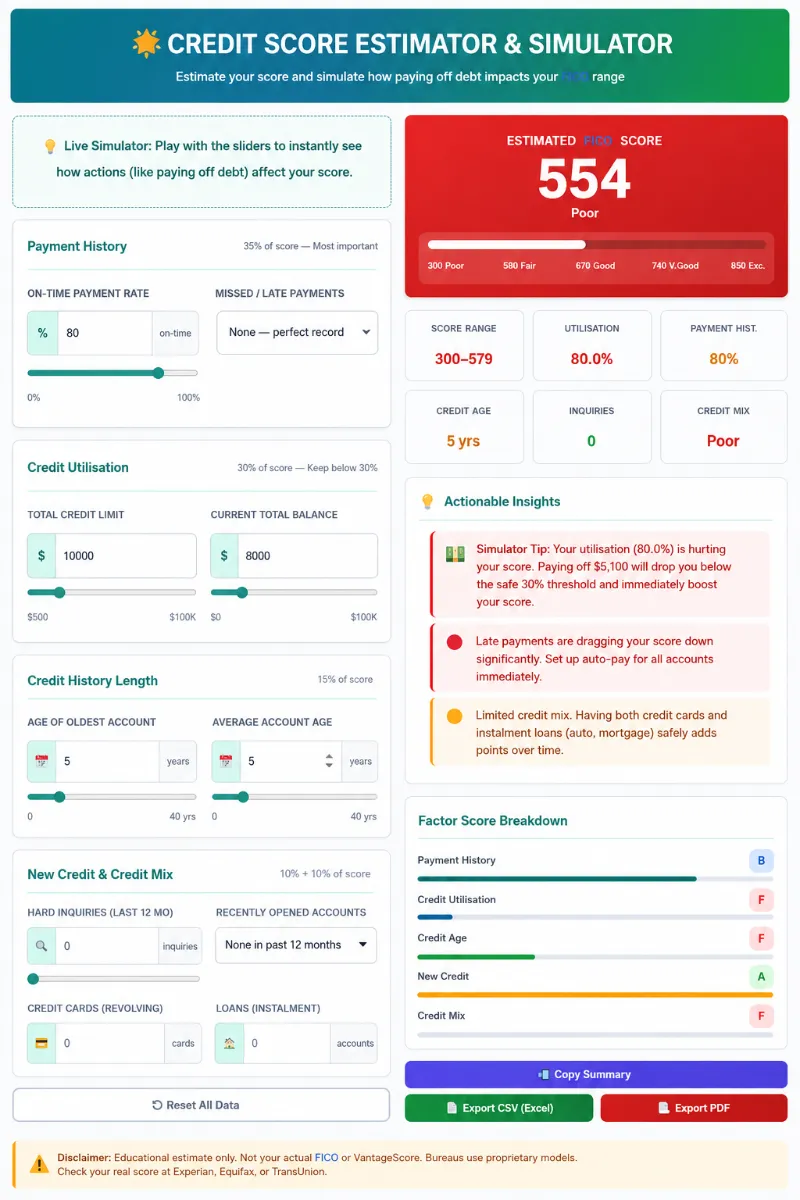
Estimate your score from the two most important factors.
How to Temporarily Lift a Credit Freeze
This surprised me when I read the federal rules. A temporary lift is faster than most people expect.
Online or phone requests for a temporary lift must be processed within one hour under federal law. Mail requests can take up to three business days. Either way, the bureau cannot charge for the lift — that protection is also in the FCRA.
The law also permits a lift for a specified time window rather than a permanent removal. So a consumer planning a Black Friday financing application can schedule a freeze lift for a specific date — say, November 28th — and restore the freeze immediately after. The thaw doesn’t have to be open-ended.
Planning the timing
The key question is which bureau the lender will pull. Not all lenders use the same bureau. If you don’t know, contacting the lender in advance to ask which bureau they check can save time — you only need to lift the freeze at that specific bureau rather than all three.
Experian provides detailed instructions for how to temporarily unfreeze your credit report. TransUnion’s freeze instructions cover both placement and the thaw process.
💡 Research note: Save the PIN or confirmation number each bureau sends when you place the freeze. You’ll need it to lift or permanently remove the freeze. Losing the PIN doesn’t lock you out permanently — but recovering access requires verifying your identity through the bureau’s process, which takes additional time.
💳 Check Your Baseline With the SaveXpert Credit Score Estimator
A credit freeze doesn’t change your underlying credit picture — it just blocks new access to it. I looked at how the Credit Score Estimator fits here: it lets you model your current standing without opening a new account or triggering a hard inquiry. A good step before the Black Friday season is knowing where your score sits before any new spending or applications hit.
Educational note: This calculator models credit scenarios for informational purposes only and does not provide personalized financial or legal advice. Source: CFPB Security Freeze Guide
What the Research Shows Works (and What Doesn’t)
What the data consistently supports
Freeze all three bureaus — not just one.
Creditors can check any of the three. A freeze at only Experian still leaves Equifax and TransUnion open. Thieves and lenders alike can use whichever bureau isn’t frozen.
Use the federal security freeze rather than relying only on fraud alerts or monitoring services.
Monitoring can notify you after suspicious activity has already appeared. A freeze prevents the new-account application from going through in the first place. Both have a role — but the freeze works before the damage, not after.
Keep monitoring existing accounts even with a freeze active.
The freeze doesn’t stop account takeovers, stolen card fraud, or synthetic identity scams. Reviewing existing account activity regularly remains a separate, necessary step.
What the data doesn’t support
Avoiding a freeze because of score concerns.
CFPB and FTC guidance is unambiguous: a freeze doesn’t affect your credit score. Skipping the protection based on that fear means leaving a real gap open for a myth.
Assuming children are automatically protected.
Parents must separately place a “protected consumer freeze” at each bureau for children under 16. Children’s Social Security numbers can be misused for years before anyone notices — because there’s no credit activity to trigger an alert until the child applies for credit as an adult. The FTC’s consumer guidance on children’s freezes covers this gap directly.

What You Can Realistically Expect
The research gives specific federal timeframes — not approximations. That’s worth noting because the legal deadlines are tighter than most consumers expect.
Online or phone freeze requests must be processed within one business day. A temporary lift happens within one hour of an online or phone request. Written confirmation arrives within five business days. None of these services cost anything under the 2018 federal law.
The Federal Reserve’s 2026 report on the economic well-being of U.S. households provides the broader household financial context behind why these protections matter. Credit access and financial stress both affect how identity theft ripples through a family’s finances.
The research found no major new CFPB or FTC rule changes specifically targeting credit freezes during 2025–2026. The core framework still comes from the 2018 federal law. What has changed is the threat environment — the 19.6% jump in identity theft complaints and the 54% rise in credit card fraud cases show the risks the 2018 law was designed to address are growing, not shrinking.
💡 Research note: A freeze is one layer of a multi-layered approach. The research supports combining it with active account monitoring, strong unique passwords, and careful sharing of Social Security numbers during holiday transactions. No single measure covers every fraud vector.
Bottom Line: 5 Steps to Freeze Your Credit Before Black Friday
1. Request the freeze at all three bureaus separately:
Equifax, Experian, and TransUnion don’t share freeze status. Do all three online — the process takes about 10 minutes per bureau. Online requests are processed within one business day under federal law.
2. Choose the federal security freeze — not a credit lock:
The freeze is free, FCRA-backed, and carries federal enforcement rights. A credit lock is a private product with contract-level protections that can change. TransUnion discontinued its lock product in 2025 — the freeze is the only free federally protected option at all three bureaus.
3. Save the PIN or confirmation number from each bureau:
You’ll need it to temporarily lift or permanently remove the freeze. Store it somewhere secure — not on the same device you use for financial accounts.
4. Schedule a temporary lift if you’re planning a credit application:
Ask the lender which bureau they pull from. Lift only that bureau’s freeze — online, it takes as little as one hour. You can set the thaw for a specific date window so the freeze automatically reinstates.
5. Keep monitoring existing accounts — a freeze doesn’t stop everything:
Stolen card numbers, account takeovers, and tax refund scams bypass a credit freeze entirely. Review existing account statements regularly through the holiday season, and set up account alerts where your bank and card issuers offer them.
“What stood out to me in the FTC and CFPB research is the awareness gap. Eleven percent of consumers have never frozen their credit because they thought it would cost money or hurt their score. Neither of those things is true. Federal law made it free in 2018 — and the bureaus confirmed the score impact is zero.”
— Kevin Brown, Lead Researcher at SaveXpert.com
Frequently Asked Questions
Ans: Federal law makes it free for every U.S. consumer. Contact Equifax, Experian, and TransUnion individually — online, by phone, or by mail — to place a security freeze at each bureau. The Fair Credit Reporting Act (15 U.S.C. § 1681c-1) prohibits bureaus from charging for placing or lifting the freeze. It doesn’t cost anything now or in the future.
Ans: A credit freeze is a federal right governed by the FCRA, with free access guaranteed by statute and federal enforcement rights if violated. A credit lock is a private service under a bureau’s own contract, often carrying a monthly fee, with protections that depend on the service agreement — which can change. The research supports using the federal freeze: it’s stronger, permanent until you choose to remove it, and costs nothing. TransUnion discontinued its credit lock product in 2025, making the federal freeze the only free federally protected option at all three bureaus.
Ans: No — and this is one of the most common misconceptions in consumer credit. The CFPB, FTC, and all three major bureaus confirm that a credit freeze doesn’t lower your credit score. The freeze restricts new creditors from accessing your file for new applications. Your existing accounts keep reporting payment history, balances, and all normal activity. Your score continues to reflect your financial behavior — it just can’t be pulled by a new lender (or a thief) trying to open a new account.
Ans: Contact the specific bureau the lender plans to pull from — ask the lender in advance if you’re not sure which one. Request a temporary lift online or by phone. Federal law requires the bureau to process it within one hour. You can specify a date window for the thaw, after which the freeze automatically reinstates. Mail requests take up to three business days. Neither the lift nor the reinstatement costs anything under federal law.
Ans: A federal security freeze lasts indefinitely — it stays in place until you explicitly request to lift or remove it. There’s no expiration date. The CFPB’s guidance confirms the freeze remains active until you contact the bureau to change it. You verify your identity with your PIN or confirmation number to authorize any change.
Ans: Not automatically. Parents must separately request a “protected consumer freeze” at each of the three bureaus for children under 16. Children’s Social Security numbers can be misused for years before anyone notices — because there’s no credit file to generate alerts until the child applies for credit as an adult. The FTC’s consumer guidance specifically addresses children’s credit freezes and treats them as a separate, necessary step for parents.