ⓘ Educational Disclosure:
This article is for educational and informational purposes only. It does not constitute financial, legal, tax, lending, or investment advice. SaveXpert and its authors are not licensed financial or tax advisors, CPAs, or attorneys. All data comes from publicly available government and institutional sources. Always consult a qualified professional before making investment decisions.
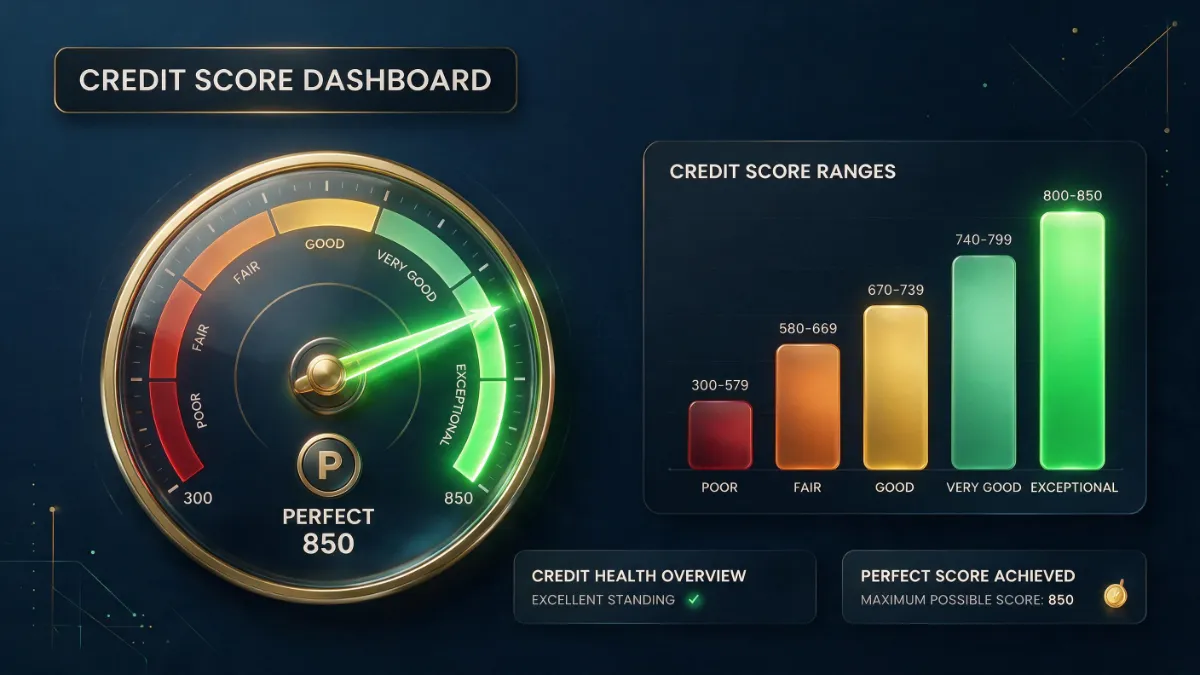
Does holiday shopping hurt your credit score? Holiday shopping can temporarily lower your credit score — but not because of the spending itself. It’s because higher card balances raise your credit utilization ratio. According to FICO and the CFPB’s 2025 Consumer Credit Card Market Report, when reported balances push utilization above the 30% threshold, a temporary score drop of 20 to 60 points is common. That drop typically reverses within 1–3 billing cycles once the balances are paid down — provided no late payments occur.
Key Takeaways
- Problem: Holiday spending pushes credit card balances higher, raising your credit utilization ratio and temporarily lowering your credit score by 20 to 60 points.
- Solution: Pay down balances before your statement closing date to reduce reported utilization, and keep total utilization below 30% — ideally under 10%.
- Result: Research shows most holiday-related score declines reverse within 1–3 billing cycles, provided no late payments occur.
- Source: CFPB 2025 Consumer Credit Card Market Report, FICO Score Education
- Time To Read: 10 Minutes
Table of Contents
1. The Core Question: Does Holiday Shopping Hurt Your Credit Score?
2. The Data Behind Holiday Credit Balances
3. How Credit Utilization Actually Works
4. Does Paying Before the Statement Close Date Help?
5. What Happens When You Open Store Cards?
6. What the Research Shows Works (and What Doesn’t)
7. Beyond Credit Cards: BNPL and the Bigger Picture
8. Realistic Expectations: How Long Does the Dip Last?
9. Bottom Line: 5 Steps to Protect Your Credit Score This Holiday Season
Revolving credit outstanding hit $1.324 trillion at the end of 2024. That’s the backdrop to every holiday shopping season in America right now. And Federal Reserve G.19 data shows it climbed another 3.1% in 2025 — reaching $1.351 trillion by June 2026. That’s a lot of credit card swiping. And a lot of people wondering what the December receipts will do to their score.
The Core Question: Does Holiday Shopping Hurt Your Credit Score?
The surprising part isn’t that Americans spend more during the holidays. It’s how that spending can quietly affect their credit files — even when they don’t miss a single payment.
A consumer can pay every bill on time and still see a December score dip. Credit scoring models don’t distinguish between holiday spending and any other reason balances are high. The reported balance is the reported balance. FICO’s published breakdown assigns 30% of your score to amounts owed and utilization — making it the second most important factor after payment history (35%).
So when the research shows holiday credit score drops can reach 20–60 points, the size depends on where utilization starts and how far new spending pushes it. That makes “does holiday shopping hurt your credit score” a more complicated question than a simple yes or no.
💡 Research note: FICO scoring models are proprietary. The 30% utilization threshold is guidance from FICO’s published education materials — not a hard rule where every consumer loses the same number of points. Individual outcomes depend on the full credit profile.
The Data Behind Holiday Credit Balances
I went through the CFPB’s 2025 Consumer Credit Card Market Report, the Federal Reserve G.19 release, and several 2025–2026 consumer surveys. The picture they paint together is consistent.
Credit card use during the holidays is climbing
TransUnion reported that 42% of consumers planned to use credit cards for Thanksgiving through Cyber Monday shopping in 2025 — up from 38% in 2024. And 58% of Americans expected to spend more than $250 that holiday season.
Online sales hit a record $257.8 billion during the 2025 holiday period, according to Experian’s 2026 research. Meanwhile, YouGov data found that 21% of U.S. adults borrowed money for Christmas in 2025 — and 66% of those people used credit cards to do it. Of those holiday borrowers, 68% took on less than $1,000 in Christmas-related debt.
| Metric | Data Point | Source |
|---|---|---|
| Revolving credit outstanding (end 2024) | $1.324 trillion | CFPB 2025 Report |
| Revolving credit (June 2026) | $1.351 trillion | Federal Reserve G.19 |
| Annual revolving credit growth (2025) | +3.1% | Federal Reserve G.19 |
| Consumers planning credit cards for holidays (2025) | 42% (up from 38%) | TransUnion |
| Americans planning to spend $250+ during 2025 holidays | 58% | TransUnion |
| U.S. adults who borrowed for Christmas 2025 | 21% | YouGov |
| Record online holiday sales (2025 season) | $257.8 billion | Experian 2026 |
Source: CFPB 2025 Consumer Credit Card Market Report · Federal Reserve G.19 · TransUnion
How Credit Utilization Actually Works
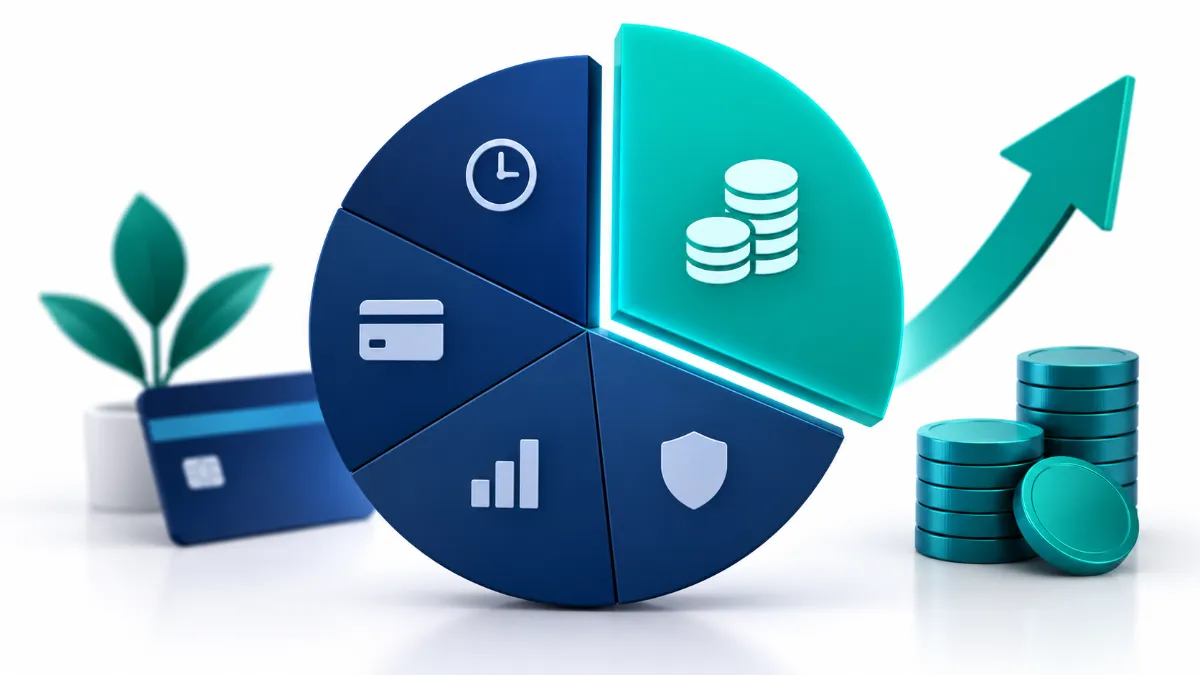
Here’s where it gets interesting. FICO breaks your score into five factors. Utilization sits inside the second-biggest one — and most people don’t realize how fast holiday spending can move that number.
| FICO Score Factor | Weight | Holiday Impact |
|---|---|---|
| Payment History | 35% | Indirect — late payments during high-spend months hurt most |
| Amounts Owed (Utilization) | 30% | Direct — higher holiday balances push utilization up immediately |
| Length of Credit History | 15% | Opening new store cards lowers your average account age |
| New Credit | 10% | Hard inquiries from store card applications register here |
| Credit Mix | 10% | Generally unaffected by holiday shopping |
Source: FICO — What’s In Your Score
Estimate your score from the two most important factors.
The math on a single card
Take a card with a $5,000 limit and a $1,000 existing balance. That’s 20% utilization — under the 30% level FICO’s education data flags as an area of concern.
Add $1,500 in holiday purchases. The balance is now $2,500. Utilization jumps to 50%. That’s the same payment behaviour, same card, same consumer — just a different reported number on statement day.
Total utilization across all accounts matters too, not just individual card balances. A consumer who spreads holiday spending across three cards can still push their aggregate ratio above 30% without maxing any single card.
⚠️ Credit limit matters more than the dollar amount: A $2,000 holiday charge means very different things on a $20,000 limit versus a $4,000 limit. Scoring models look at the percentage — not the raw spend.
What VantageScore’s data shows across all consumers
VantageScore’s November 2025 CreditGauge reported that average credit balances grew year over year during the holiday period — yet the average VantageScore 4.0 stayed stable at 701, with average utilization sitting at 50.80%. That tells you aggregate national data doesn’t translate into one fixed score result for every individual. Your starting utilization and full credit profile drive your personal outcome.
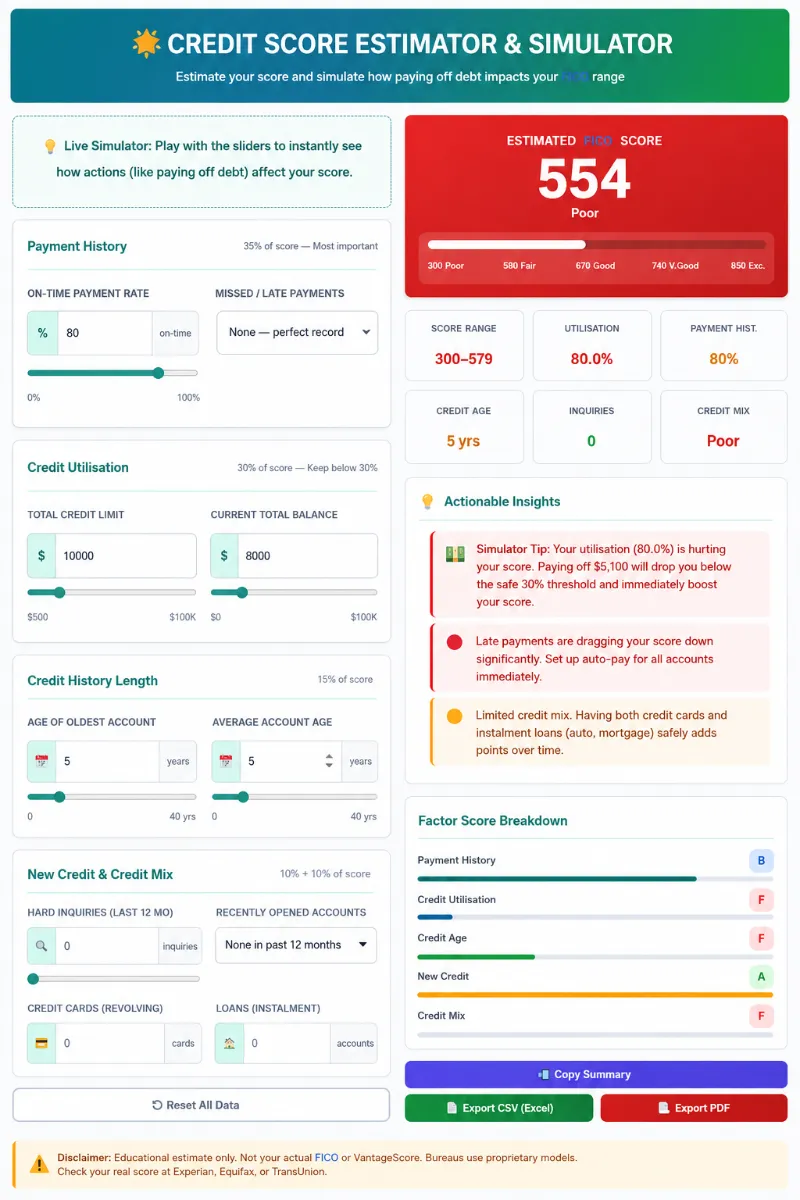
💳 Try the SaveXpert Credit Score Estimator
I ran a hypothetical holiday scenario through SaveXpert’s Credit Score Estimator — a shopper with a $10,000 total credit limit and an $8,000 Current balance. Add an 80% on-time payment rate. And a credit history of 5 years, which gives a poor score immediately. Put your own numbers in and see where your December balance lands.
Educational note: This calculator models credit utilization scenarios for informational purposes and does not provide personalized financial advice. Source: FICO Score Education
Does Paying Before the Statement Close Date Help?
This is one of the clearest findings in the research — and one of the most misunderstood distinctions in personal finance.
There are two dates on your credit card that matter very differently:
The statement closing date:
When your issuer locks your balance and reports it to the credit bureaus.
The payment due date:
When you have to pay to avoid a late fee and interest charges.
Most people focus on the due date. But the balance the bureaus see is the one on your closing date — not the one you owe after you pay. So if you charge $2,000 in December gifts and pay the full balance on January 15th (the due date), the bureaus still record the $2,000 balance from the December closing date.
Paying down that balance before the statement closes reduces what gets reported. That reduces reported utilization. And that’s the number that moves your score.
💡 Research note: The statement closing date and the payment due date are not the same day — and they do different things for your score. Paying before the close date reduces the balance bureaus see. Paying by the due date avoids interest — but doesn’t change what was already reported.
What Happens When You Open Store Cards?
The holiday season is when retailers push sign-up bonuses hardest. It’s also the worst possible time for your credit score to absorb a new account.
When you apply for a store card, a hard inquiry gets recorded. That hits the “New Credit” factor — 10% of your FICO score. Then the new account lowers your average account age, hitting “Length of Credit History” — another 15%.
A shopper who opens three retail cards for discounts during November and December can face three hard inquiries, a lower average account age, and higher utilization from holiday spending — all at the same time.
⚠️ Thin credit files take this harder: The research specifically flags that compounding effects from new inquiries, lower average account age, and higher utilization hit consumers with fewer accounts most sharply. The 15% off one purchase rarely justifies a December score hit — especially when the recovery window runs into the next mortgage application or car loan review.
What the Research Shows Works (and What Doesn’t)
What the data supports
Based on what I found across the CFPB, Federal Reserve, and FICO research, three approaches show consistent support.
Pay down balances before your statement closes.
The research directly connects this timing with reducing reported utilization. It’s the most actionable single step available to any cardholder — no new accounts, no credit repair, just timing a payment differently.
Keep utilization below 30% — ideally below 10%.
FICO education data identifies these thresholds as most associated with better scoring outcomes. The VantageScore aggregate data adds context: even at 50.80% average utilization nationally, average scores held at 701. Individual results vary significantly based on the full credit picture.
Avoid opening multiple new accounts in November and December.
The research assigns 10% to new credit and 15% to credit history length. Stacking those effects during the period when utilization is already rising amplifies the potential score impact.
What the data says doesn’t help
Maxing out credit cards pushes utilization well past the levels the research identifies as problematic. The 20–60 point drop range is associated with crossing those thresholds significantly, not just nudging past 30%.
Relying on BNPL without understanding how it reports can also create unexpected credit effects. Nearly half of consumers didn’t realize BNPL can affect their credit score — that awareness gap has real consequences now that FICO is integrating BNPL data.
Panic-closing accounts after a December dip is also something the data doesn’t support. Closing accounts reduces total available credit, which raises utilization further. It also potentially lowers average account age. Both effects work against recovery.
Beyond Credit Cards: BNPL and the Bigger Picture
Buy now, pay later has become a standard part of the holiday payment mix — and its credit score implications are still catching many shoppers off guard.
Adobe Analytics data estimated holiday BNPL spending exceeded $20 billion during the 2025 season — an 11% jump from 2024. The research also found that 84% of Americans planned to use credit cards for holiday spending, while 30% planned to use BNPL alongside or instead.
Here’s the number that stood out to me: survey data found that 46% of consumers didn’t realize BNPL could affect their credit score. That awareness gap has gotten more consequential. FICO announced plans to integrate BNPL data into credit scoring beginning in fall 2025. Late BNPL payments can now negatively affect scores the same way a late credit card payment does.
💡 Research note: BNPL is not automatically invisible to credit bureaus. If the provider reports to Equifax, Experian, or TransUnion — and more of them do every year — late payments land on your report just like any other credit account. FCRA obligations apply to BNPL products that pull from or report to the bureaus.
Realistic Expectations: How Long Does the Dip Last?
The research gives a relatively clear answer here. Holiday-related score declines typically recover within 1–3 billing cycles after balances fall — provided no late payments occur.
Langley Federal Credit Union’s January 2026 research gives the same 1–3 month window. That makes a temporary December utilization dip very different from a late payment — which can stay on your credit report for up to seven years.
The timing can still vary. Credit reporting depends on when issuers transmit data to the bureaus, and that cadence isn’t the same for every card. So 1–3 billing cycles is the evidence-supported range, not a guaranteed calendar date for everyone.
One broader data point from VantageScore’s November 2025 CreditGauge is worth noting: late-stage delinquencies of 90–119 days past due rose to 0.24% — up 30% year over year. That’s a reminder that the bigger long-term risk isn’t the temporary utilization dip. It’s carrying balances that don’t come back down by February.

Bottom Line: 5 Steps to Protect Your Credit Score This Holiday Season
1. Check your utilization before you swipe:
Know your current balance-to-limit ratio on every card before the holiday spending season starts. If you’re already at 25%, even a modest shopping trip can push you past 30%.
2. Pay before your statement closing date — not just the due date:
This is the single clearest finding in the research. The balance reported to bureaus is the one on your closing date. A payment before that date reduces reported utilization — which is what moves your score.
3. Skip the store card sign-up bonuses:
Hard inquiries plus lower average account age on top of higher holiday balances stack three scoring effects at once. The 15% off one purchase rarely justifies the December hit — especially before a major loan application.
4. Read the BNPL terms before you tap:
If the lender reports to the credit bureaus, late payments land on your report. FICO is now integrating BNPL data into scoring. A missed BNPL installment is no different from a missed credit card payment — and 46% of consumers still don’t know that.
5. Don’t panic over a December dip:
The research supports a 1–3 billing cycle recovery for utilization-driven score drops. Pay the balances down in January and February. Don’t close accounts in frustration — that raises utilization and lowers account age. The score tends to recover on its own when the balances do.
“What I found going through the CFPB’s 2025 Credit Card Market Report is that holiday score drops aren’t really about spending. They’re about what that spending does to your reported balance on statement day. That’s the number scoring models look at — and it’s the one most people don’t think about until January.”
— Kevin Brown, Lead Researcher at SaveXpert.com
Frequently Asked Questions
Ans: Holiday shopping doesn’t directly hurt your credit score — but the higher balances it creates can. When reported balances push your credit utilization ratio above 30%, FICO and CFPB data show a temporary score drop of 20 to 60 points is common. The key word is temporary: research shows most declines reverse within 1–3 billing cycles once those balances are paid down, provided no late payments occur.
Ans: FICO education data identifies keeping utilization below 30% as the threshold most associated with better scoring outcomes. For optimal results, FICO recommends staying below 10%. If your total credit limit across all cards is $10,000, keeping reported balances under $1,000 puts you in the best range. These are guidance thresholds — not guarantees — because scoring models are proprietary and individual results vary based on the full credit picture.
Ans: Holiday spending typically appears on your credit report at the end of the billing cycle in which it was charged — usually on your statement closing date. Card issuers generally report balances to the bureaus monthly. December spending often shows up in January credit reports. The good news: utilization-related score drops typically reverse within 1–3 billing cycles after balances fall. Late payments are different — those can stay on your report for up to seven years.
Ans: Before, according to FICO scoring research. The balance your issuer reports to the credit bureaus is the one on your statement closing date — not the one you owe after you pay by the due date. Paying down balances before the statement closes means a lower balance gets reported, which keeps utilization lower and limits any holiday-related score dip.
Ans: Consumer credit data shows high holiday spending can trigger a temporary score drop of 20 to 60 points. The actual drop depends on how far spending pushes utilization above 30% — and on the overall credit profile. A consumer with a strong, established credit history will typically see a smaller proportional dip than someone with a thin file or already-high balances going into the season.
Ans: It can — and nearly half of consumers still don’t know it. Survey data shows 46% of Americans weren’t aware BNPL could affect their credit score. FICO announced plans to integrate BNPL data into credit scoring beginning in fall 2025, and late BNPL payments can negatively affect scores the same way a late credit card payment does. If the BNPL provider reports to Equifax, Experian, or TransUnion, full FCRA rules around adverse action and credit reporting apply.